
Upper Deck’s Heroes Autograph Cards Defined the Chase
In this story:
Before one-of-ones and logomans defined the hobby, there was a simpler dream: pull a real autograph from a wax (or foil) pack.
In the early ’90s, Upper Deck turned that idea into a reality. Through its Heroes sets, the company introduced pack-pulled autographs—not redemptions—of Hall of Fame players—seeded into mass-produced products.
It wasn’t just a gimmick. It changed how collectors ripped packs, despite the challenging odds of roughly 1 in 150 boxes—or about $12,000 in 2026 dollars
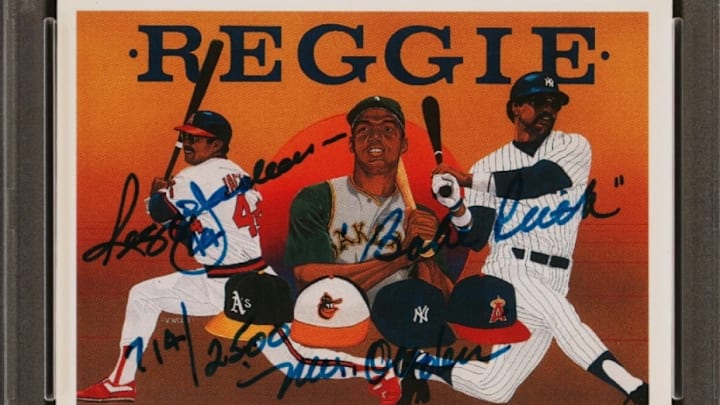
Reggie Jackson and the Birth of the Chase
It started in 1990 with Reggie Jackson. Upper Deck’s Baseball Heroes insert set featured nine cards celebrating “Mr. October,” but the real prize was hidden in high-series packs: a hand-signed, hand-numbered autograph limited to 2,500 copies.
“Find the Reggie” became the hobby’s first true chase.

The estimated odds were brutal, but that didn’t matter. For the first time, collectors had a reason to rip beyond set-building. A single card could justify the price of an entire case.
Even now, sealed 1990 Upper Deck High Series still carries that energy. And nostalgic collectors are still searching for Reggie and the other Heroes, which command big bucks on the secondary market.
Aaron, Ryan, and Williams Build on the Formula
Upper Deck didn’t hesitate to build on the success of “Find the Reggie.”
In 1991, Hank Aaron and Nolan Ryan followed with their own Heroes sets, each anchored by a hand-signed, hand-numbered autograph limited to 2,500 copies and seeded into packs. A year later, Ted Williams carried the concept into 1992, with his own /2,500 autograph and the addition of a dual-signed Johnny Bench/Joe Morgan card.

By this point, collectors understood the formula—but that didn’t make the chase any less compelling. Each new name reinforced the idea that Upper Deck wasn’t just inserting autographs—it was redefining what could be pulled from a pack.

Brett Hull Takes the Card Hunt to Hockey
Upper Deck quickly proved the concept wasn’t limited to baseball. In 1991–92 hockey, Brett Hull became the face of the Hockey Heroes set—and the centerpiece of its own chase.
Like its baseball counterparts, Hull’s autograph was hand-numbered to 2,500 and inserted into low-series packs. It also featured a distinct hologram on the back, an early attempt at authentication that helped separate it from standard inserts.

For hockey collectors, “the Hull auto” became the equivalent of “the Reggie”—a card everyone knew, but very few actually pulled.

Joe Montana Takes the Concept to the Gridiron
Upper Deck brought the “find the auto” concept to football in 1991 with Joe Montana.
The Football Heroes insert set celebrated Montana’s career, but the real prize was a hand-signed, hand-numbered checklist card limited to 2,500 copies and quietly seeded into packs. Like its baseball counterparts, it was a true chase—something most collectors heard about more than they actually pulled.

Authentic versions can be identified by a diamond-shaped Upper Deck hologram on the back, distinct from the unsigned cards. More importantly, the Montana auto carried the same weight for football that Reggie Jackson did for baseball, giving collectors their first real taste of a pack-pulled NFL autograph.

Why These Cards Still Matter
Taken together, that 1990–92 run created a tight, iconic checklist: Jackson, Aaron, Ryan, Williams (plus Bench/Morgan), Hull, and Montana.
By today’s standards, /2,500 might not sound rare. But in the middle of the junk wax era, these cards stood apart. They introduced the idea that true scarcity—and real excitement—could exist inside mass-produced products.
More importantly, they changed collector behavior. Collectors weren’t just buying boxes to complete sets anymore. They were chasing a moment.
And that’s the legacy. Every modern chase—whether it’s a one-of-one patch auto or a high-end insert—can trace its DNA back to these early Upper Deck Heroes releases. Before the hobby became what it is today, there was a simple idea:
 Add us as a preferred source on Google
Lucas Mast is a writer based in California’s Bay Area, where he’s a season ticket holder for St. Mary’s basketball and a die-hard Stanford athletics fan. A lifelong collector of sneakers, sports cards, and pop culture, he also advises companies shaping the future of the hobby and sports. He’s driven by a curiosity about why people collect—and what those items reveal about the moments and memories that matter most.
Follow sneakrz