
Arizona State Takes College Football to London: Inside the First Union Jack Classic
In this story:
More than 5,000 miles of travel, countless tiny cups of espresso and a handful of Arizona State articles written from a London flat: My trip to the inaugural Union Jack Classic was a marathon of a weekend to remember.
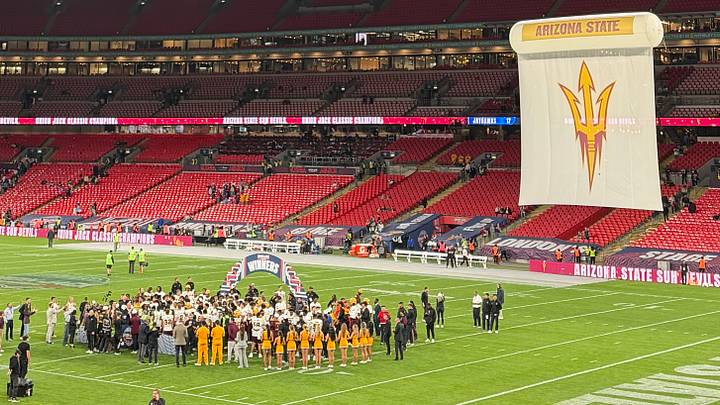
Arizona State capped it with a 24-17 victory victory over Kansas at Wembley Stadium before the Sun Devils, Jayhawks and thousands of fans who made the trip began their journeys back to the United States.
But the game was only part of the experience.
London is hardly unfamiliar with American football after years of hosting NFL games. What felt new was introducing English fans to everything surrounding the college version — marching bands, fight songs, rivalries, mascots, student traditions and fan bases willing to cross an ocean to follow their schools.
Here are my biggest takeaways from college football's week in the London spotlight.
The 'Beautiful (College) Game'
My first stop in London included a historic pub tour around Piccadilly Circus.
As our group made its way through some of the city's oldest establishments, my tour guide, Luke, became curious about why I had traveled to England.
When I mentioned Arizona State vs. Kansas, I was met with an "Ah, yes."
Luke and the locals clearly weren't fazed by American football the way they might have been years ago, thanks in large part to the NFL's regular trips to England.
College football was another matter.
The tour group ahead of us happened to include 16 ASU fans, one small example of how visible Sun Devils and Jayhawks supporters had become around London during the week.
Soon, the pub tour temporarily became a college football Q&A, except I was suddenly the guide.
"What is the championship called? Something similar to the Super Bowl?"
"Why is it one foot in college and two feet in the NFL?"
Some questions had easy answers. Others were good enough that I didn't have one.
By the end of the afternoon, I knew more about some of London's finest watering holes, and Luke knew considerably more about America's version of the "beautiful game."
Cheers to you, Luke.
College Football Pageantry Meets Wembley
Saturday morning was all about the scene surrounding Wembley, and it quickly became another learning experience for the English fans taking it in.
FOX's "Big Noon Kickoff" set outside the stadium attracted a large crowd. Fans from both schools were joined by marching bands, cheerleaders, mascots and everything else that accompanies a major college football Saturday.
Standing near the set, I overheard a conversation between a couple of British men trying to decipher one of the signs in the crowd.
Why, they wondered, did a sign say something derogatory about the University of Arizona when these fans were from Arizona?
It required a quick introduction to one of college sports' most important concepts: rivalries.
The distinction between Arizona and Arizona State began to make more sense when compared with something much more familiar to an English sports fan — Manchester City and Manchester United.
One British street vendor apparently hadn't received the lesson. He was selling unofficial merchandise that said "Arizona" instead of "Arizona State."
Business did not appear to be booming.
When "Big Noon Kickoff" went live, the crowd became even louder, with Arizona State and Kansas chants breaking out around the set.
"Hey, they know all the chants. That's brilliant!"
For people raised around English soccer, chants are nothing unusual. But now the locals were getting a look at the traditions surrounding American college football — something that doesn't quite translate from the NFL.
Then came another observation as the marching band got moving:
"Look at those tuba players dance. They're going to be knackered!"
Long before kickoff, the point had become clear: This wasn't simply another American football game at Wembley.
Could College Football Find a Home in England?
After leaving the "Big Noon Kickoff" set, I headed down the street to see what was happening inside the pubs surrounding Wembley.
You could spot the crowds before reaching the doors. Seas of blue and gold filled the windows, with lines stretching outside.
I squeezed my way into one of the pubs and spoke with a bartender who was staring at a much busier afternoon than expected.
"My boss sent away all the help today. He thought we weren't going to be busy," she told me as a crowd of college football fans waited behind us for drinks.
Anyone in Europe who doubts the ability of college football fans to fill a pub should probably spend a game day in Tempe or Lawrence.
At Wembley, much was made of the empty seats in the upper bowl. But the fans who were there produced an atmosphere that felt distinctly different from an NFL game.
Arizona State supporters raised their pitchforks and chanted "A-S-U." Kansas fans "waved the wheat" after Jayhawks scores.
Those traditions offered perhaps the best demonstration of what separates college football from the professional game.
And as the weekend progressed, I noticed the questions changing.
Early on, British fans wanted to understand the rules. Later, they wanted to know about the schools, their traditions and their histories.
That curiosity extended to the local media.
One London reporter told Arizona State coach Kenny Dillingham that one of the things he appreciated about college football was the opportunity for the sport to develop young men as people as well as players.
Dillingham's response captured why the trip meant more to Arizona State than simply playing a football game overseas.
"That's why we're here," Dillingham said. "They just got to do something they've never done and maybe would have never done in their entire life. My mom has never been out here until this trip. So, think about that. We just gave 18- to 22-year-olds an experience."
Dillingham continued by pointing to the value of exposing his players to another part of the world.
"Just seeing another part of the world and how people operate, it's how you build people," Dillingham said. "And I think it's an unbelievable experience for those guys to just really see the world and be college athletes."
Now that the inaugural Union Jack Classic is complete, attention turns to 2027 and another Big 12 matchup in London.
Whether college football can establish the kind of foothold in England that the NFL has built will take years to determine. But during one weekend around Wembley, there were signs of what might make the college game appealing here.
The British already understand passionate crowds, songs, chants, rivalries and traditions passed from one generation of supporters to another.
Maybe college football isn't quite as foreign as it first appears.
As for me, one thing is certain: This won't be my last sporting event in the great city of London.
Cheerio, Wembley.
 Add us as a preferred source on Google
Dan Allison is a graduate of the Walter Cronkite School of Journalism and Mass Communication at Arizona State University, graduating Cum Laude in Sports Journalism. He currently works for the Rio Rancho Observer and the Albuquerque Journal in New Mexico and has covering high school sports in both New Mexico and Arizona and he is a contributor to High School On SI. He began contributing to Arizona State Sun Devils On SI in 2026.