
Kenny Dillingham Already Saved Arizona State Football. What Comes Next Is Much Harder
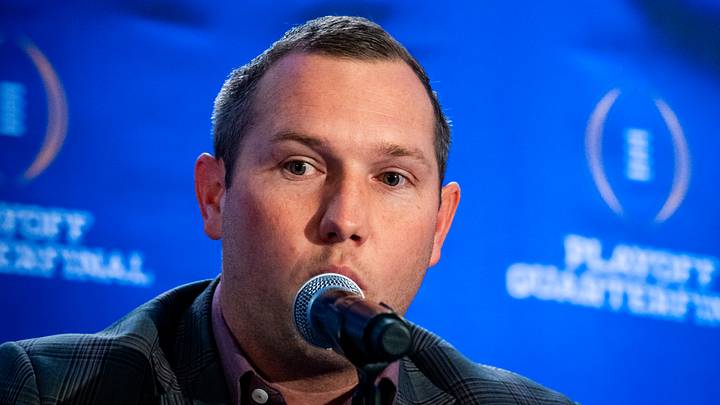
Kenny Dillingham has already accomplished something at Arizona State that seemed improbable when he took over the program.
Now comes the harder part.
Dillingham inherited a program coming off consecutive 3-9 seasons and dealing with the aftermath of an NCAA investigation. By his second season, Arizona State was the Big 12 champion and playing in the College Football Playoff.
The Sun Devils went 11-3 in 2024, beating Iowa State 45-19 in the Big 12 championship game before taking Texas to double overtime in the Peach Bowl.
That season established that Dillingham could build a championship team. What Arizona State is attempting now could determine whether he has built a championship program.
The difference is significant.
Building a roster capable of making a dramatic climb is one challenge. Maintaining that level while players graduate, enter the NFL Draft or transfer elsewhere is something else entirely.
And in the current era of college football, roster turnover can happen faster than ever. Dillingham has understood that reality for some time.
"Recruiting is dead, retention is alive," Dillingham said while discussing roster construction at the start of Arizona State's 2025 fall camp. "Retaining the guys you recruit and not losing two of your top guys in the first two years is a real value in that process."
His larger point wasn't that traditional recruiting no longer matters. Dillingham was explaining that acquiring talented players is only one part of roster construction now.
Keeping them matters just as much.
Arizona State's 2026 roster demonstrates exactly why.
Arizona State Had to Rebuild Its Offense
The Sun Devils entered this season with an almost entirely reconstructed offense.
Arizona State needed a new starting quarterback, had to replace its entire original 2025 offensive line and lost several significant skill-position players.
Dillingham and his staff turned aggressively to the transfer portal.
Kentucky transfer Cutter Boley won the starting quarterback job. Colorado transfer Omarion Miller and Boston College transfer Reed Harris became major additions at receiver. Washington transfer Raiden Vines-Bright joined them, while Delaware State transfer Marquis Gillis added another option in the backfield.
In all, Arizona State entered the season with more than 40 newcomers.
Dillingham wasn't interested in simply replacing departing players one-for-one.
"We're trying to win at the highest level, and you can't do that by building teams like everybody else," Dillingham said, according to Cronkite News. "You're not going to be able to try to win a margin or try to bridge a gap that you may have. So what we're trying to do is do it a little bit differently in our own way."
That statement gets to the heart of where Arizona State is as a program. Three years ago, the Sun Devils needed to become relevant again. Now they're trying to remain relevant despite substantial annual roster turnover.
Those are two very different assignments.
The Portal Can Build a Team — And Disrupt One
Dillingham has never hidden his willingness to use the transfer portal.
It was an important tool in Arizona State's rapid turnaround, and it remains an important part of the Sun Devils' roster-building strategy.
But the portal works both ways.
Programs can add an experienced quarterback instead of waiting several seasons for a high school recruit to develop. They can rebuild a receiving corps in one offseason. They can fill an unexpected hole on the offensive line.
They can also lose established players who might once have remained in the program for three or four seasons.
That changes the definition of recruiting.
Coaches aren't simply recruiting high school prospects and transfers anymore. They're effectively recruiting their own rosters every year.
That's why Dillingham's declaration that "retention is alive" matters so much. The objective isn't simply to win the transfer portal.
It's to develop a program strong enough that the portal becomes one component of roster construction rather than something required to rebuild the roster every offseason.
Arizona State Is Testing That Model Now
The first three games of 2026 have demonstrated both the potential and the difficulty of Arizona State's approach.
The Sun Devils overwhelmed Morgan State 70-7 in the opener. Boley threw six touchdown passes, while Harris had 137 receiving yards and two touchdowns and Miller added 102 yards and a score.
A week later, Arizona State encountered a very different environment at No. 10 Texas A&M. The Sun Devils stayed within four points through three quarters before turnovers helped turn the game into a 48-20 loss.
Then came London.
Arizona State defeated Kansas 24-17 at Wembley Stadium despite being outgained 414-228. The Sun Devils forced three turnovers without committing one, got a 100-yard kickoff return from Jaren Hamilton and turned Hyrum Vaeono's 77-yard fumble return into another touchdown.
It wasn't necessarily evidence that Arizona State's rebuilt offense had arrived. It was evidence that the Sun Devils could find another way to win.
Arizona State enters the heart of its Big 12 schedule at 2-1 overall and 1-0 in conference play.
The Standard at Arizona State Has Changed
There was a time when simply getting Arizona State back to bowl eligibility would have represented meaningful progress.
Dillingham changed that calculation remarkably quickly.
The 2024 season introduced an entirely different set of expectations. Once a program wins the Big 12 and reaches the College Football Playoff, merely being competitive isn't viewed the same way.
That doesn't mean Arizona State should be expected to reach the playoff every season. It means the standard for what constitutes a successful program has changed and Dillingham has acknowledged this.
"The floor is when people think you underachieve and (you) win eight games, when you took over a program (where) you won back-to-back three," Dillingham said in an August interview with Inferno Intel. "When people expect more than what they've expected in the past, I think that's what the floor is."
Can Arizona State absorb significant personnel losses, develop another quarterback, integrate another transfer class, maintain its recruiting base and continue competing near the top of the Big 12?
College football has always been cyclical. Even elite programs lose exceptional players and occasionally take a step backward. The difference now is the speed at which rosters change.
Dillingham used that new reality to help accelerate Arizona State's rise. Now he has to navigate the other side of it.
The 2024 season proved Arizona State could reach the top.
The next stage of Dillingham's tenure will show whether the Sun Devils can make staying there part of the program's new standard.
 Add us as a preferred source on Google