%22%3E%0A%3Cpath%20d%3D%22M0%206.81873H6.2878V13.4548H12.0391V6.81873H18.3269V25.6162H12.0391V18.8766H6.2878V25.6162H0V6.81873Z%22%20fill%3D%22white%22%2F%3E%0A%3Cpath%20d%3D%22M20.5762%206.81873H31.0998C33.7071%206.81873%2035.345%207.41174%2036.4463%208.51304C37.1146%209.18136%2037.6041%2010.1509%2037.6041%2011.4404V11.4969C37.6041%2013.7278%2036.258%2015.0926%2034.2437%2015.7986C36.6628%2016.4952%2038.2159%2017.7847%2038.2159%2020.3638V20.4203C38.2159%2023.4324%2035.7497%2025.635%2030.9962%2025.635H20.5762V6.81873ZM31.4292%2012.8524C31.4292%2012.024%2030.7609%2011.5628%2029.4149%2011.5628H26.7039V14.1984H29.4431C30.7891%2014.1984%2031.4292%2013.7372%2031.4292%2012.9089V12.8524ZM29.8667%2018.0671H26.6945V20.8627H29.8384C31.2033%2020.8627%2031.9093%2020.298%2031.9093%2019.4979V19.4414C31.9093%2018.6319%2031.241%2018.0671%2029.8667%2018.0671Z%22%20fill%3D%22white%22%2F%3E%0A%3Cpath%20d%3D%22M39.2705%2016.2693V16.2129C39.2705%2010.6028%2043.6475%206.41406%2049.2576%206.41406C53.3898%206.41406%2056.1854%208.42842%2057.7668%2011.2993L52.5803%2014.3303C51.8838%2012.9842%2050.886%2012.043%2049.1728%2012.043C47.0549%2012.043%2045.6524%2013.8973%2045.6524%2016.1564V16.2129C45.6524%2018.6602%2047.102%2020.3733%2049.1728%2020.3733C50.9425%2020.3733%2051.9402%2019.4038%2052.7215%2018.0107L57.908%2020.9381C56.3266%2023.7337%2053.691%2026.0117%2049.0222%2026.0117C43.8169%2026.0117%2039.2705%2022.0865%2039.2705%2016.2599V16.2693Z%22%20fill%3D%22white%22%2F%3E%0A%3Cpath%20d%3D%22M59.0664%2017.1823V6.81873H65.4577V17.107C65.4577%2019.4414%2066.6626%2020.4391%2068.3569%2020.4391C70.0512%2020.4391%2071.2561%2019.5261%2071.2561%2017.2388V6.81873H77.6474V17.0505C77.6474%2023.4701%2073.9105%2025.9927%2068.3004%2025.9927C62.6904%2025.9927%2059.0664%2023.4136%2059.0664%2017.1823Z%22%20fill%3D%22white%22%2F%3E%0A%3Cpath%20d%3D%22M86.6738%206.81873H92.9616V20.2509H101.8V25.6256H86.6832V6.81873H86.6738Z%22%20fill%3D%22white%22%2F%3E%0A%3Cpath%20d%3D%22M102.394%2018.359V18.3025C102.394%2013.9255%20105.537%2010.5934%20109.943%2010.5934C115.157%2010.5934%20117.567%2014.2173%20117.567%2018.679C117.567%2018.9991%20117.567%2019.3756%20117.539%2019.705H108.117C108.55%2020.9946%20109.566%2021.6629%20110.884%2021.6629C111.985%2021.6629%20112.898%2021.1546%20113.868%2020.1569L117.144%2022.7642C115.694%2024.6468%20113.623%2025.9646%20110.46%2025.9646C105.65%2025.9646%20102.403%2022.9337%20102.403%2018.3684L102.394%2018.359ZM112.004%2017.0224C111.872%2015.6293%20111.035%2014.8198%20109.961%2014.8198C108.888%2014.8198%20108.22%2015.6763%20108.032%2017.0224H112.004Z%22%20fill%3D%22white%22%2F%3E%0A%3Cpath%20d%3D%22M118.696%2028.139L120.579%2024.4585C122.217%2025.3151%20123.855%2025.8516%20125.869%2025.8516C128.156%2025.8516%20129.361%2024.6656%20129.361%2022.6324V22.1994C128.533%2023.1407%20127.158%2024.2138%20125.116%2024.2138C121.332%2024.2138%20118.593%2021.5311%20118.593%2017.4742V17.4177C118.593%2013.3043%20121.388%2010.5934%20124.768%2010.5934C126.914%2010.5934%20128.175%2011.4029%20129.248%2012.5042V10.9417H135.348V21.8982C135.348%2024.6091%20134.783%2026.4635%20133.437%2027.8095C132.119%2029.1273%20130.105%2029.9557%20126.829%2029.9557C123.553%2029.9557%20121.059%2029.3062%20118.696%2028.1296V28.139ZM129.38%2017.446V17.3895C129.38%2016.1281%20128.41%2015.1021%20126.933%2015.1021C125.455%2015.1021%20124.485%2016.147%20124.485%2017.4365V17.493C124.485%2018.7543%20125.455%2019.7521%20126.933%2019.7521C128.41%2019.7521%20129.38%2018.7261%20129.38%2017.446Z%22%20fill%3D%22white%22%2F%3E%0A%3Cpath%20d%3D%22M136.825%2018.359V18.3025C136.825%2013.9255%20139.969%2010.5934%20144.374%2010.5934C149.589%2010.5934%20151.999%2014.2173%20151.999%2018.679C151.999%2018.9991%20151.999%2019.3756%20151.97%2019.705H142.548C142.981%2020.9946%20143.998%2021.6629%20145.316%2021.6629C146.417%2021.6629%20147.33%2021.1546%20148.299%2020.1569L151.575%2022.7642C150.126%2024.6468%20148.055%2025.9646%20144.892%2025.9646C140.082%2025.9646%20136.835%2022.9337%20136.835%2018.3684L136.825%2018.359ZM146.436%2017.0224C146.304%2015.6293%20145.466%2014.8198%20144.393%2014.8198C143.32%2014.8198%20142.652%2015.6763%20142.463%2017.0224H146.436Z%22%20fill%3D%22white%22%2F%3E%0A%3Cpath%20d%3D%22M153.448%2010.9511H159.548V12.9937C160.489%2011.7888%20161.967%2010.6028%20164.038%2010.6028C167.125%2010.6028%20169.064%2012.6454%20169.064%2015.9493V25.6163H162.965V17.9072C162.965%2016.6458%20162.212%2015.9211%20161.299%2015.9211C160.386%2015.9211%20159.557%2016.6458%20159.557%2017.9072V25.6163H153.458V10.9511H153.448Z%22%20fill%3D%22white%22%2F%3E%0A%3Cpath%20d%3D%22M170.448%2018.3872V18.3307C170.448%2013.6808%20173.244%2010.5934%20176.708%2010.5934C178.939%2010.5934%20180.172%2011.5629%20181.113%2012.6077V5.99988H187.213V25.6069H181.113V23.809C180.115%2024.8821%20178.995%2025.9552%20176.764%2025.9552C173.216%2025.9552%20170.448%2022.8677%20170.448%2018.3778V18.3872ZM181.245%2018.3119V18.2554C181.245%2016.8058%20180.2%2015.6198%20178.797%2015.6198C177.395%2015.6198%20176.35%2016.7776%20176.35%2018.2554V18.3119C176.35%2019.7897%20177.395%2020.9475%20178.797%2020.9475C180.2%2020.9475%20181.245%2019.7897%20181.245%2018.3119Z%22%20fill%3D%22white%22%2F%3E%0A%3Cpath%20d%3D%22M188.098%2023.8373L190.168%2020.3734C191.938%2021.4747%20193.924%2022.0112%20195.59%2022.0112C196.183%2022.0112%20196.475%2021.8794%20196.475%2021.5311V21.4747C196.475%2021.1829%20196.202%2020.9946%20194.734%2020.6181C191.025%2019.705%20188.747%2018.7073%20188.747%2015.6763V15.6199C188.747%2012.4007%20191.326%2010.5934%20195.138%2010.5934C197.558%2010.5934%20199.948%2011.2146%20201.718%2012.2877L199.788%2015.9117C198.235%2015.0551%20196.353%2014.5374%20195.12%2014.5374C194.527%2014.5374%20194.263%2014.6974%20194.263%2014.9986V15.0551C194.263%2015.3469%20194.583%2015.5351%20196.061%2015.9117C199.77%2016.8247%20202%2017.8413%20202%2020.8534V20.9099C202%2024.1008%20199.61%2025.9646%20195.637%2025.9646C192.795%2025.9646%20190.216%2025.2398%20188.116%2023.8373H188.098Z%22%20fill%3D%22white%22%2F%3E%0A%3Cpath%20fill-rule%3D%22evenodd%22%20clip-rule%3D%22evenodd%22%20d%3D%22M211.368%204.36764C217.191%20-1.45588%20226.632%20-1.45588%20232.456%204.36764C238.279%2010.1912%20238.279%2019.6324%20232.456%2025.4559L221.912%2036L211.368%2025.4559C205.544%2019.6324%20205.544%2010.1912%20211.368%204.36764ZM214.009%207.55761C213.948%207.86849%20213.916%208.39718%20213.916%209.14566V10.4189C213.916%2011.1832%20213.948%2011.7198%20214.013%2012.0267C214.078%2012.3317%20214.278%2012.6168%20214.617%2012.8762C214.956%2013.1376%20215.403%2013.3316%20215.958%2013.4623C216.512%2013.593%20217.1%2013.6583%20217.837%2013.6583C218.573%2013.6583%20219.217%2013.591%20219.769%2013.4524C220.322%2013.3158%20220.761%2013.1178%20221.086%2012.8604C221.411%2012.6029%20221.605%2012.3178%20221.666%2012.0069C221.728%2011.6961%20221.759%2011.1674%20221.759%2010.4189V9.14566C221.759%208.38134%20221.728%207.84473%20221.662%207.53781C221.597%207.23287%20221.397%206.94972%20221.058%206.68834C220.72%206.42696%20220.272%206.23291%20219.718%206.10223C219.163%205.97154%20218.536%205.90619%20217.839%205.90619C217.102%205.90619%20216.459%205.97352%20215.906%206.11213C215.352%206.24875%20214.914%206.44677%20214.589%206.70418C214.265%206.9616%20214.071%207.24673%20214.009%207.55761ZM219.276%2024.8638C222.876%2024.8638%20224.557%2024.2064%20224.557%2021.862V21.858V21.3155C224.557%2019.6581%20223.516%2018.971%20220.252%2018.3136C219.278%2018.1136%20218.908%2017.9136%20218.908%2017.3136V16.9414C218.908%2016.6543%20219.177%2016.5117%20219.413%2016.5117C219.749%2016.5117%20219.918%2016.7137%20219.918%2016.9414V18.1136H224.391V17.3988C224.391%2015.4563%20223.347%2014.4266%20219.177%2014.4266C216.15%2014.4266%20213.896%2015.3414%20213.896%2017.3711V17.7433C213.896%2019.5155%20214.805%2020.3155%20218.201%2021.0303C218.28%2021.0472%20218.355%2021.063%20218.427%2021.0781C219.329%2021.2674%20219.647%2021.3341%20219.647%2021.9174V22.2897C219.647%2022.6619%20219.546%2022.8045%20219.142%2022.8045C218.67%2022.8045%20218.637%2022.5471%20218.637%2022.262V21.2897H213.894V21.7471C213.894%2024.149%20215.476%2024.8638%20219.276%2024.8638ZM225.424%2024.5569H229.925V14.7355H225.424V24.5569ZM226.955%2013.5019H229.925V6.06064H227.092V9.411L225.193%206.06064H222.359V13.5019H225.193V10.1199L226.955%2013.5019ZM218.269%2012.152C218.204%2012.2688%20218.055%2012.3262%20217.825%2012.3262L217.827%2012.3282C217.604%2012.3282%20217.459%2012.2767%20217.398%2012.1757C217.336%2012.0748%20217.305%2011.8074%20217.305%2011.3758V7.90068C217.305%207.51852%20217.352%207.28684%20217.445%207.20962C217.538%207.13239%20217.675%207.09279%20217.851%207.09279C218.059%207.09279%20218.198%207.14031%20218.265%207.23734C218.332%207.33239%20218.366%207.55416%20218.366%207.90068V11.3203C218.366%2011.7579%20218.334%2012.0352%20218.269%2012.152Z%22%20fill%3D%22white%22%2F%3E%0A%3C%2Fg%3E%0A%3Cdefs%3E%0A%3CclipPath%20id%3D%22clip0_15247_3459%22%3E%0A%3Crect%20width%3D%22237%22%20height%3D%2236%22%20fill%3D%22white%22%2F%3E%0A%3C%2FclipPath%3E%0A%3C%2Fdefs%3E%0A%3C%2Fsvg%3E%0A)
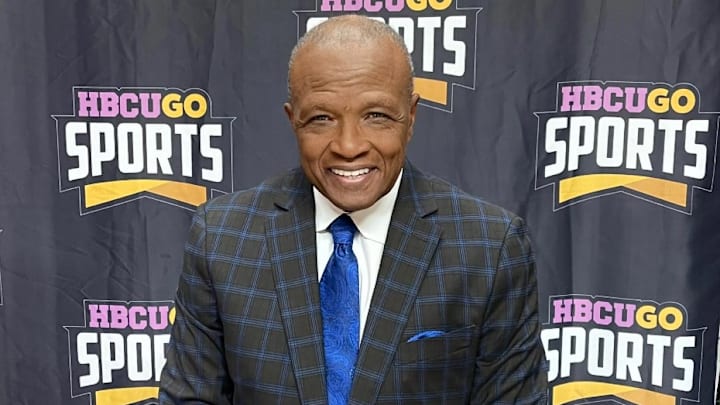
Charlie Neal: The Legendary Voice of Black College Sports Dies
In this story:
HOUSTON, Tx — Charlie Neal, the legendary architect of modern HBCU sports broadcasting and the lead play-by-play voice of HBCU GO, has died at the age of 80 following an illness that had sidelined him last season. Neal is survived by his wife and family. He was born on Oct. 28, 1945 and died on May 13, 2026.
For more than four decades, Neal sat at midcourt or in the press box and delivered what no one else in American sports media did at the scale he did it. He told the most compelling stories of historically Black colleges and universities, their coaches, players, administrators, stadiums, arenas, and campuses. He gave them all weight and historical relevance.
"Charlie was underrated for his impact on sports," Curtis Symonds said to HBCU Legends. "I consider him the 'John Madden' of Black College Sports. Who's been involved with Black college football for 50 years like Charlie? He was a historian. He was a proven product because he's lived it, and he would give you history and give you anything that no one else could give you. No other announcer could give it to you like Charlie Neal. Our BET broadcast were so real is because he told the real story. He wasn't fluffing the story. He told the real story of the game."
Neal called games for Black Entertainment Television (BET) from 1980 to 2004, then for ESPNU, MEAC Digital Network, and finally HBCU GO. He was the voice when Grambling State University's Eddie Robinson broke Bear Bryant’s all-time wins record in 1985. His body of work included Bayou Classics, Florida Classics, MEAC tournaments, and CIAA tournaments, and even hosted the NBA on TNT and covered the Goodwill Games in Moscow.
Howard University’s longtime sports information director, Ed Hill, once noted that Neal covered more Black college football and basketball games than anyone in history.
He was 80 at the time of his passing.

A Pioneer Who Built the Platform
Neal’s career did not begin with a microphone in Atlanta or Houston. It began in Philadelphia, where he worked as a radio disc jockey before breaking into television in Washington, D.C., in 1971 at WRC-TV (NBC). He worked in Philadelphia, Detroit, and New York City. In Detroit, he met Bob Johnson, who was building something called Black Entertainment Television.
Johnson signed him in 1980. That year changed Black college sports on television forever.
Neal told HBCU Legends in a 2023 interview that BET arrived at the same time as ESPN, but with a different mission.
“Bob Johnson came along in 1980 and created Black Entertainment Television. That was the platform in which I’ve been able to do the things that I’ve done for the last 43 years,” Neal said. “It gave me a platform to expose, tell the stories and bring to the forefront what’s happening around historically Black colleges and universities as far as athletics is concerned. Because if you remember prior to BET coming along, you may have seen one game a year, maybe Grambling and somebody on ABC. That was about all the exposure that HBCUs were getting at that particular time.”
He paired with former Detroit Lions Hall of Fame defensive back Lem Barney for 23 years, one of the longest broadcast partnerships in American television. They became, as ESPN play-by-play man James Verrett once said, the Al Michaels and Howard Cosell of Black college sports.
Neal called games of Jerry Rice at Mississippi Valley State and chronicled Walter Payton’s legacy at Jackson State. He also covered iconic black quarterbacks Doug Williams of Grambling State and Steve McNair at Alcorn State. Williams later joined him in the BET booth in 1990.
Neal was intimately knowledgeable of coaches who built the foundation for HBCU football, like Eddie Robinson, Marino Casem, W.C. Gorden, Willie Jeffries, Billy Joe, and Doug Porter. Before his passing, the HBCU GO broadcast team had games with coaches Chennis Berry, Eddie Robinson Jr., Willie Simmons, Deion Sanders, Trei Oliver, and T.C. Taylor.
In 2005, after BET stepped away from sports, Neal made the first football broadcast on ESPNU. The matchup was Morehouse versus Benedict. Of course, it was an HBCU game, and of course, it was Charlie Neal behind the microphone.
Neal’s career spanned over 50-plus campuses in the SWAC, MEAC, CIAA, and SIAC.

“I Was Just Given the Stage”
In November 2023, the National Football Foundation honored Neal with the Chris Schenkel Award for his distinguished career broadcasting college football. The 65th NFF Annual Awards Dinner at the ARIA Resort and Casino in Las Vegas placed him in a category of broadcasters that included Keith Jackson's successors and SEC voices who had spent lifetimes tied to single programs.
Days after the ceremony, sitting for an extended conversation with HBCU Legends, he gave the award away.
“I’m very humble to receive it, but also I give credit to the players that I was able to tell the stories about, the coaches that allowed me to tell those stories and the athletic administrators who led us onto their campuses to expose the culture and the very fine student athletes that they had,” Neal said. “That’s where the award belongs. I was just given the stage to go ahead and tell the stories. But they’re the ones that gave me the opportunity to do that.”
That answer was Charlie Neal. The plaque was his. The credit was always somebody else’s.

The Stories He Insisted On Telling
Neal made a point in every broadcast. He wove the program's history into the game's live action. He did this on purpose. He did it because he believed the current generation of HBCU athletes did not always know the names of the players who built the field they stood on.
“It’s important to tell those stories. They don’t know the Jerry Rice story. They may have heard of him as a member of the 49ers,” Neal said. “They don’t know Walter Payton, the running back at Jackson State. They probably heard his name because there’s something on the campus that probably reminds them of Walter Payton. But they don’t know Walter Payton. The people at Mississippi Valley, they don’t know Jerry Rice except that the stadium has his name, Totten Stadium. So when we do our games, we not only talk about the student athletes today, we talk about those student athletes who made the name for those schools back in the day.”
This was the Charlie Neal broadcast philosophy. The game was the canvas. The history was the paint.
That philosophy reached the next generation. At the same NFF dinner where he was honored, Neal sat with three HBCU finalists for the William V. Campbell Trophy: Davius Richard of North Carolina Central, Luper Dellis of Benedict College, and Kenny Gallop of Howard University. He spent time with his family. He kidded Dellis about being a small defensive end. He swapped psychology jokes with him. He met Gallop’s father, who told his son that Charlie Neal had called the father’s games at Norfolk State years earlier.
“I said, when you come and tell me that I did games when your kid starts playing and he comes up and says, ‘Oh, you did my dad and my granddad’s games,’ I said, you know, I’ve been around for a while,” Neal said.

The Honors Came Late and Came Often
Neal collected a body of recognition in the final stretch of his career that read like a roll call of every conference, association, and institution he had served.
Charlie Neal's Hall of Fame inductions and major awards:
• Mid-Eastern Athletic Conference Hall of Fame (2009)
• Central Intercollegiate Athletic Association Hall of Fame (2011)
• Black College Football Hall of Fame
• National Football Foundation Chris Schenkel Award (2023)
• Southwestern Athletic Conference Hall of Fame (2024)
• National Sports Media Association Hall of Fame finalist
• CIAA Jimmy Jenkins Legacy Award (2026)
The CIAA honor, announced this past January, recognized Neal for calling the first nationally televised CIAA basketball game and for spending more than two decades expanding national exposure for HBCU athletics. He had been scheduled to be formally recognized at the 2026 CIAA Hall of Fame Ceremony on Feb. 27 during the conference’s basketball tournament.
On the SWAC enshrinement, Neal had been characteristically thankful.
“It’s an honor that I treasure. It’s ironic when I started doing the HBCU games, it was with Black Entertainment Television back in 1980. And ironically enough, the SWAC was one of the first conferences that embraced what BET was doing,” Neal said. “Joe Johnson, who was the president of Grambling State University at the time, was a big fan of Black Entertainment Television and what they were trying to do. He pushed us to no end. I really owe a lot of that to him, the success of what BET was able to do. I’m very much indebted to them for allowing me over the years to continue to come into their area and broadcast the games from the Southwestern Athletic Conference.”
The Advice He Gave the Next Generation
Neal mentored. He answered emails. He took the calls. He gave young broadcasters and journalists his time without charging them.
In 2023, when asked for advice to young media professionals trying to get into the business, Neal did not romanticize the work.
“Take advantage of every opportunity that’s offered to you, no matter what it is. If they ask you to sweep the floors at the TV station, take the broom and sweep the floors,” Neal said. “Because what happens, you’re inside. And once you’re inside, people know who you are. You may be sweeping the floors, but you also have the attention of the people who make decisions. If you’re outside still knocking on the door, they may not open it and let you in.”
He warned against shortcuts. He warned against ex-athletes who thought play-by-play and color analysis meant walking into the booth and talking.
“A lot of people think you just walk into the stadium and sit down and start talking about the game. You don’t realize the research and the homework that you need to do, and the time you have to spend preparing for the game,” Neal said. “Yes, they know the game. But they don’t know the people playing the game. That’s the part that they have to get turned around in their head in order to be totally prepared to broadcast.”
Muhammad Ali, Deion Sanders, and the Quiet Room
Across 55 years of broadcasting, Neal interviewed the sports figures who defined their eras. Asked which subject left the deepest mark on him, he answered without hesitation. Muhammad Ali.
“A lot of people did not really get a real feel for the real Muhammad Ali, because what you saw on camera was not really Muhammad Ali. He was very boisterous and outgoing, you know, bodacious, and he was going to do this and float like a butterfly,” Neal said. “But if you got him away from all the cameras and just sat down, he was a very calm, serene, humble individual. That impressed the heck out of me. You had one image one way, but then when you get a chance to really know the person, the image changed. My perception of him changed. He got the utmost respect from me.”
He also remembered covering Deion Sanders during the 1992 World Series in Toronto, the day Sanders had his infamous confrontation with Tim McCarver.
“He would not do an interview with anybody but me, because I was the only Black journalist that was there to do an interview. They told everybody else to stay away, and he came over and did an interview with me,” Neal said.
HBCU GO and the Last Chapter
Curtis Symonds, a former senior vice president at BET and a close friend, founded HBCU GO after leaving the network. He brought Neal with him. The streaming service, acquired by the Allen Media Group in 2021, became Neal’s final home in the booth.
Neal expanded the schedule. Doubled-up Saturdays. Syndicated and cable crews. Female play-by-play assignments for analyst Lorenzia Moton. Studio shows. He pushed for HBCU baseball and tennis coverage in the spring.
He worked into his ninth decade because the work still mattered to him.
“I’m still enjoying it as long as I have my health and sound mind and body,” Neal said in 2023. “I don’t have a problem continuing on. Like I said, 40-some years of doing it and still feeling good. I don’t feel any worse today than I did 20, 30, 40 years ago.”
What He Built Stays
The architecture Neal poured concrete into is the architecture every HBCU broadcast still stands on. The conviction that the stories matter. The discipline of doing the homework. The cultural respect for the institution beneath the uniform. The decision to credit the players, the coaches, and the administrators who let him in the door.
Every HBCU game called on HBCU GO, ESPN, MEAC Digital, or any platform that comes next is calibrated to a standard Charlie Neal set, with a microphone, a baritone, and four decades of refusal to let the schools be invisible.
He gave them the stage. He told the stories. The stories will keep being told because he told them first.
Charlie Neal was 80.
 Add us as a preferred source on Google
I am Kyle T. Mosley, the Founder, Managing Editor, and Chief Reporter for the HBCU Legends. Former founder and publisher of the Saints News Network, and Pelicans Scoop on SI since October 2019. Morehouse Alum, McDonogh #35 Roneagles (NOLA), Drum Major of the Tenacious Four. My Father, Mother, Grandmother, Aunts and Uncles were HBCU graduates! Host of "Blow the Whistle" HBCU Legends, "The Quad" with Coach Steward, and "Bayou Blitz" Podcasts. Radio/Media Appearances: WWL AM/FM Radio in New Orleans (Mike Detillier/Bobby Hebert), KCOH AM 1230 in Houston (Ralph Cooper), WBOK AM in New Orleans (Reggie Flood/Ro Brown), and 103.7FM "The Game" (Jordy Hultberg/Clint Domingue), College Kickoff Unlimited (Emory Hunt), Jeff Lightsly Show, and Offscript TV on YouTube. Television Appearance: Fox26 in Houston on The Isiah Carey Factor, College Kickoff Unlimited (Emory Hunt). My Notable Interviews: Byron Allen (Media Mogul), Deion Sanders (Collegiate Head Coach), Drew Brees (Former NFL QB), Mark Ingram (NFL RB), Terron Armstead (NFL OL), Jameis Winston (NFL QB), Cam Newton (NFL QB), Cam Jordan (NFL), Demario Davis (NFL), Allan Houston (NBA All-Star), Deuce McAllister (Former NFL RB), Chennis Berry (Collegiate Head Coach), Johnny Jones (Collegiate Head Coach), Tomekia Reed (Women's Basketball Coach), Chennis Berry (South Carolina State - HBCU Champions), Tremaine Jackson (Collegiate Head Coach), Curtis Symonds (President - HBCU GO), Jay Walker (ESPN), Tiffany Greene (ESPN), Taylor Rooks (NBA Reporter), Swin Cash (Former VP of Basketball - New Orleans Pelicans), Demario and Tamala Davis (NFL Player), Jerry Rice (Hall of Famer), Doug Williams (HBCU & NFL Legend), Emmitt Smith (Hall of Famer), James "Shack" Harris (HBCU & NFL Legend), Cris Carter (Hall of Famer), Solomon Wilcots (SiriusXM NFL Host), Steve Wyche (NFL Network), Jim Trotter (NFL Network), Travis Williams (Founder of HBCU All-Stars, LLC), Malcolm Jenkins (NFL Player), Willie Roaf (NFL Hall of Fame), Jim Everett (Former NFL Player), Quinn Early (Former NFL Player), Dr. Reef (NFL Players' Trainer Specialist), Nataria Holloway (VP of the NFL). I am building a new team of journalists, podcasters, videographers, and interns. For media requests, interviews, or interest in joining HBCU Legends, please contact me at kmosley@hbcusi.com. Follow me:
Follow KyleTMosley