
LSU Gained 457 Yards Against Alabama and Still Couldn’t Solve Its Biggest Problem
In this story:
The LSU offense moved the football against Alabama, but when it came time to finish drives, the Tigers repeatedly came up short.
Despite outgaining Alabama 457-285, LSU suffered a 31-13 loss to the Crimson Tide on Saturday afternoon in Tiger Stadium. The Tigers finished with 27 first downs and 380 passing yards, but failed to turn their offensive production into points when it mattered most.
LSU head coach Lane Kiffin pointed to two major issues following the loss: red-zone execution and the inability to convert on fourth down. The Tigers went 0-for-4 on fourth-down attempts, while their four trips inside the red zone produced just 13 points.
“We didn’t make any. 0-for-4,” Kiffin said. “And we got in the red zone more than they did. And that’ll give you a problem on the scoreboard. You’ll get a lot of yards and not many points when that happens.”
For LSU, the problem wasn't necessarily moving the ball. It was what happened once the field became shorter and the margin for error became smaller.
LSU’s Red Zone Opportunities Went to Waste

The Tigers had an opportunity to establish control early, putting together a 14-play, 70-yard drive on their opening possession. However, LSU struggled to finish the drive, settling for a 23-yard field goal from Scott Starzyk after reaching the red zone.
LSU found itself in scoring position again early in the second quarter, but the offense failed to come away with points. After a missed 56-yard field goal attempt, the Tigers continued to have trouble turning promising possessions into points.
The biggest missed opportunity of the first half came with 3:31 remaining before halftime. LSU faced fourth-and-four at the Alabama 10-yard line, and Kiffin elected to keep the offense on the field.
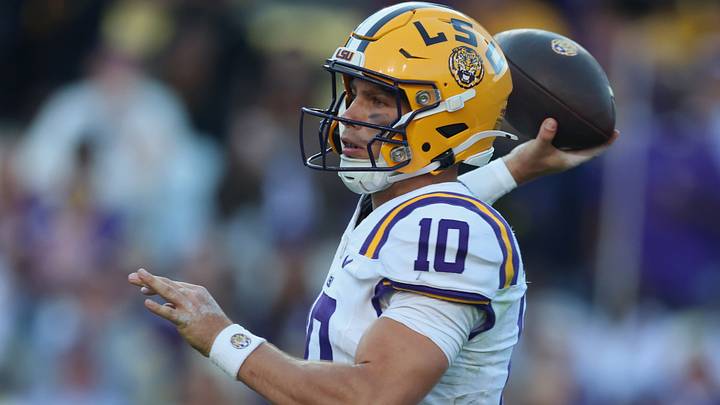
Quarterback Sam Leavitt attempted to find his receiver, but Alabama defensive lineman Chuck McDonald III got a hand on the pass, knocking it down and forcing a turnover on downs.
The decision to go for it was aggressive, but the execution never gave LSU a chance to capitalize. Rather than putting points on the board, the Tigers left another scoring opportunity empty.
LSU also had a chance to add points before halftime after getting into Alabama territory, but Leavitt threw an interception on the Alabama 24-yard line. Kiffin later identified the interception as a poor decision, saying Leavitt needed to take the underneath route against Alabama's zone coverage.
The Tigers entered halftime trailing 10-3 despite having multiple opportunities to make the game closer.
Fourth-Down Decisions Became a Bigger Problem

LSU's struggles on fourth down continued after halftime, even as the offense found some success moving the football.


The Tigers opened the second half with an 11-play, 53-yard drive, but were forced to settle for another Starzyk field goal after failing to convert on third-and-four from the Alabama 22-yard line.
After taking a 13-10 lead on a five-yard touchdown run from Dilin Jones, LSU had an opportunity to respond when Alabama regained the lead.
The Tigers faced fourth-and-three at the Alabama 36-yard line near the beginning of the fourth quarter. Leavitt attempted to find Jackson Harris, but the pass fell incomplete, giving Alabama possession.
Kiffin's decision to continue going for it on fourth down reflected his belief that field goals would not be enough to beat Alabama.
“I just felt like field goals weren’t going to win the game,” Kiffin said. “It was just a feeling that we were going to need some touchdowns.”
The final fourth-down failure came with approximately eight minutes remaining. LSU was trailing by 11 and faced fourth-and-10 at its own 25-yard line. Kiffin elected to keep the offense on the field, but Leavitt was sacked for a seven-yard loss, giving Alabama possession.
Kiffin defended the decision after the game, explaining that punting would have left LSU with little chance of coming back.
While the decision was understandable given the score and time remaining, the result put Alabama in excellent field position. The Crimson Tide scored a touchdown just three plays later to extend its lead to 31-13.
LSU's Offensive Production Wasn't Enough
The frustrating part of LSU's loss was how consistently the offense moved the football outside of scoring situations.
Leavitt completed 35 of 47 passes for 380 yards, while LSU finished with 457 total yards and 27 first downs. The Tigers also had more offensive production than Alabama in nearly every major yardage category.
However, the inability to finish drives ultimately overshadowed what was otherwise a productive offensive performance.
Alabama finished with 285 total yards, but the Crimson Tide made the most of its opportunities, scoring touchdowns on all three of its red-zone trips.
LSU, meanwhile, repeatedly gave Alabama opportunities to get off the field without allowing points.
The Tigers will have to find a way to correct those issues quickly, as they are set to host Texas next Saturday in another major SEC matchup.
For Kiffin and LSU, the loss to Alabama showed that moving the football is not necessarily the biggest concern. The Tigers have to find a way to turn those yards into points, especially when they get inside the red zone or face a fourth-down situation.
Sign up to our free newsletter and follow us on Facebook and X for the latest news.
 Add us as a preferred source on Google

Adrian is a writer for LSU Tigers on SI, covering LSU Athletics. A 2026 graduate of Texas State University with a B.S. in Journalism and a concentration in Sports Media, he developed extensive experience covering college athletics during his time with The University Star. As the publication’s Sports Editor, he led a staff of writers while overseeing coverage across digital, print and social media. He previously served as a sports analyst with Death Valley Insider in Baton Rouge, gaining experience covering LSU baseball and basketball. His reporting background also includes professional baseball, covering the Houston Astros for Last Word on Sports, as well as experience covering high school football in the Central Texas area. Adrian can be found on Twitter at @Adrian_Ram55
Follow Adrian_Ram55