
3 Biggest Concerns Michigan State Faces Entering Big Ten Play
In this story:
The conference schedule and the actual season for Michigan State are now up.
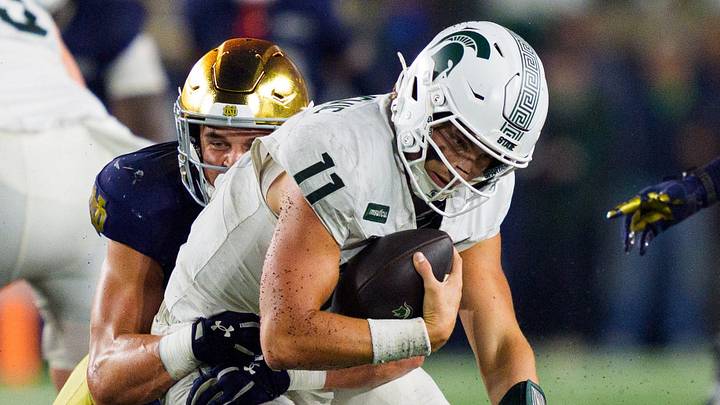
MSU did what it was supposed to do in its non-conference schedule: beat Toledo and Eastern Michigan, and then lose to No. 3 Notre Dame. That's a bit of an oversimplification, but the Spartans' standing hasn't really changed much, though Saturday's effort at Notre Dame gave some reasons for optimism. The Fighting Irish exposed some things, though, and Michigan State definitely has some concerns it's taking with it into the Big Ten schedule.
Explosive Plays Allowed

One big problem has been how often the top of MSU's defense has been taken off. The Spartans did fine keeping EMU's offense in check during Week 2, but Toledo and Notre Dame both had multiple pretty long plays. The Rockets had touchdowns of 71 and 60 yards during the season opener, and Notre Dame had pass plays of 61 and 39 yards, both of which were connections from quarterback CJ Carr to wide receiver Micah Gilbert.
Two of those plays directly involve corner Charles Brantley. The 60-yard touchdown allowed against Toledo was pretty much as simple as Brantley biting on a double move, which really should not have happened, given that he was guarding Toledo's big-play receiver, Adjatay Dabbs. Brantley also simply got beat on a go-ball against Notre Dame on the 39-yard gain.

Devin Vaught has made a few costly mistakes, too (though he makes enough good plays to help make up for it). Vaught was supposed to help Brantley on that previously mentioned 39-yard pass to Gilbert, though it looked like MSU was in Cover 1, and Vaught had to open up his hips in the opposite direction to go play center field.
Vaught was also partially at fault for the 61-yard gain the Spartans allowed on Saturday's opening play. Notre Dame went with play action, and Vaught completely bit on it. Some responsibility falls on Tre Bell for also getting beat, but the ball perhaps doesn't come out if Vaught wasn't sitting on a run play so much. Vaught was also in the same gap as rush end Kenny Soares Jr. on Toledo's long touchdown run during the fourth quarter of Week 1.
Wide Receiver Separation

The biggest knock on starting quarterback Alessio Milivojevic to this point in his career is probably that he takes a while to get the ball out sometimes. According to Pro Football Focus, Milivojevic's average 2.98-second time to throw is the second-longest in the Big Ten among starters. The only starter who takes longer is Aidan Chiles (3.24 seconds), funnily enough, but some of that added time could come from Chiles' scrambling ability.
I don't think Milivojevic has processing issues, necessarily. If he did, his interceptions would feel more, well, Aidan Chiles-esque. Milivojevic's first pick against Notre Dame wasn't great --- he should've looked off the safety and didn't. The second was more situational --- MSU was down and forced to pass, and Notre Dame teed off on that.

Sometimes, if the quarterback is standing in the pocket and not throwing, it's simply because there's nowhere to throw it. The passing game looked pretty crisp against Toledo, with a lot of easy stuff underneath and in the intermediate range, but the level of success dropped against Eastern Michigan and Notre Dame as the Spartans tried to push it downfield more. Michigan State's receivers simply aren't getting open on a consistent basis, which has led to coverage snaps and offensive limitations.
Milivojevic's average depth of target (ADOT) has increased from 8.6 vs. Toledo to 10.4 vs. EMU and then 13.0 against Notre Dame. His 10.1 ADOT for the season is the seventh-highest mark in the Big Ten (min. 30 dropbacks), but MSU's receivers haven't played well enough for that to be the norm. Some more short-and-easy stuff could be beneficial headed into conference play.
Run Blocking

Running the football was a central part of the identities of Pat Fitzgerald's Northwestern teams, and it seems to be a part of Michigan State's playstyle, too. The only problem is that MSU hasn't actually run the ball very well so far. Michigan State is averaging just 3.74 yards per rush through its first three games, which is 16th in the Big Ten. It's only ahead of Rutgers (3.56) and Purdue (3.39), probably the conference's two worst teams this year.
MSU only averaged 1.63 yards per carry against Notre Dame on Saturday, though that goes up to a more respectable 3.43 once sacks are filtered out. Still, not great, even against an elite defense. Michigan State probably won't see as good a defensive front the rest of the season, but the rushing numbers definitely need some improvement.
 Add us as a preferred source on Google
A 2025 graduate from Michigan State University, Cotsonika brings a wealth of experience covering the Spartans from Rivals and On3 to his role as Michigan State Spartans Beat Writer on SI. At Michigan State, he was also a member of the world-renowned Spartan marching band for two seasons.
Follow jacobcotsonika