%22%3E%0A%3Cpath%20d%3D%22M0%200.683105H4.9762L10.6354%207.70833V0.683105H15.9043V16.5874H11.1843L5.28112%209.2451V16.5874H0.0121963V0.683105H0Z%22%20fill%3D%22white%22%2F%3E%0A%3Cpath%20d%3D%22M17.2964%2010.4526V10.4038C17.2964%206.69607%2019.9552%203.87866%2023.6752%203.87866C28.0781%203.87866%2030.1272%206.94%2030.1272%2010.7209C30.1272%2010.9893%2030.1272%2011.3064%2030.1028%2011.5869H22.1262C22.4921%2012.6724%2023.3581%2013.2456%2024.468%2013.2456C25.3949%2013.2456%2026.1755%2012.8188%2026.9927%2011.9772L29.7613%2014.1848C28.5294%2015.7703%2026.7853%2016.8924%2024.1021%2016.8924C20.0406%2016.8924%2017.2842%2014.3189%2017.2842%2010.4648L17.2964%2010.4526ZM25.4315%209.31833C25.3217%208.13527%2024.6143%207.45226%2023.6996%207.45226C22.7848%207.45226%2022.2238%208.18405%2022.0652%209.31833H25.4315Z%22%20fill%3D%22white%22%2F%3E%0A%3Cpath%20d%3D%22M36.5166%2015.1847V16.5873H31.3574V0H36.5166V5.708C37.3581%204.79325%2038.3095%203.89071%2040.1999%203.89071C43.2003%203.89071%2045.542%206.50078%2045.542%2010.2939V10.3427C45.542%2014.27%2043.1759%2016.8923%2040.2487%2016.8923C38.3583%2016.8923%2037.3215%2016.0751%2036.5166%2015.1847ZM40.5414%2010.4037V10.3549C40.5414%209.11084%2039.6511%208.13512%2038.468%208.13512C37.285%208.13512%2036.3946%209.11084%2036.3946%2010.3549V10.4037C36.3946%2011.6355%2037.285%2012.6357%2038.468%2012.6357C39.6511%2012.6357%2040.5414%2011.6599%2040.5414%2010.4037Z%22%20fill%3D%22white%22%2F%3E%0A%3Cpath%20d%3D%22M46.8086%204.1835H51.9677V6.68379C52.6751%205.00067%2053.8094%203.91517%2055.8585%204.00055V9.47681H55.3096C53.1264%209.47681%2051.9677%2010.6843%2051.9677%2013.4285V16.5874H46.8086V4.1835Z%22%20fill%3D%22white%22%2F%3E%0A%3Cpath%20d%3D%22M55.789%2013.0623V13.0135C55.789%2010.5376%2057.6307%209.14717%2060.5091%209.14717C61.558%209.14717%2062.8996%209.3789%2063.4363%209.59844V9.3911C63.4363%208.25682%2062.7289%207.5982%2061.1433%207.5982C59.8749%207.5982%2058.8016%207.86653%2057.7161%208.3056L56.8014%204.87837C58.2284%204.32952%2059.8749%203.96362%2062.0215%203.96362C64.5462%203.96362%2066.1805%204.48808%2067.266%205.57357C68.193%206.50051%2068.5589%207.70797%2068.5589%209.50087V16.5627H63.3997V15.3064C62.5337%2016.2334%2061.3751%2016.8554%2059.8261%2016.8554C57.4356%2016.8554%2055.7646%2015.4894%2055.7646%2013.0379L55.789%2013.0623ZM63.4973%2012.0012V11.4767C63.2046%2011.3669%2062.7533%2011.2694%2062.3142%2011.2694C61.2897%2011.2694%2060.7287%2011.8792%2060.7287%2012.6598V12.7086C60.7287%2013.4404%2061.2531%2013.916%2061.9117%2013.916C62.8265%2013.916%2063.4973%2013.1842%2063.4973%2012.0134V12.0012Z%22%20fill%3D%22white%22%2F%3E%0A%3Cpath%20d%3D%22M69.2422%2015.0876L70.9863%2012.1604C72.4865%2013.0873%2074.1696%2013.5508%2075.5722%2013.5508C76.0723%2013.5508%2076.3162%2013.441%2076.3162%2013.1483V13.0995C76.3162%2012.8556%2076.0844%2012.697%2074.8404%2012.3677C71.7059%2011.5993%2069.7788%2010.7578%2069.7788%208.18431V8.13552C69.7788%205.40349%2071.962%203.89111%2075.1819%203.89111C77.2309%203.89111%2079.2434%204.41556%2080.7435%205.31811L79.1092%208.39165C77.792%207.65985%2076.2064%207.23297%2075.1575%207.23297C74.6574%207.23297%2074.4257%207.36714%2074.4257%207.62326V7.67205C74.4257%207.91598%2074.694%208.07454%2075.9503%208.40384C79.0848%209.17223%2080.9753%2010.0382%2080.9753%2012.5873V12.6361C80.9753%2015.3437%2078.9506%2016.9049%2075.5844%2016.9049C73.1817%2016.9049%2070.9985%2016.295%2069.2178%2015.112L69.2422%2015.0876Z%22%20fill%3D%22white%22%2F%3E%0A%3Cpath%20d%3D%22M82.144%200H87.3032V8.00095L89.962%204.18343H95.5725L91.6818%209.23281L95.6334%2016.5995H90.1084L88.3155%2013.1967L87.291%2014.5139V16.5995H82.1318V0.0121969L82.144%200Z%22%20fill%3D%22white%22%2F%3E%0A%3Cpath%20d%3D%22M95.4873%2013.0623V13.0135C95.4873%2010.5376%2097.329%209.14717%20100.207%209.14717C101.256%209.14717%20102.598%209.3789%20103.135%209.59844V9.3911C103.135%208.25682%20102.427%207.5982%20100.842%207.5982C99.5731%207.5982%2098.4998%207.86653%2097.4143%208.3056L96.4996%204.87837C97.9266%204.32952%2099.5731%203.96362%20101.72%203.96362C104.244%203.96362%20105.879%204.48808%20106.964%205.57357C107.891%206.50051%20108.257%207.70797%20108.257%209.50087V16.5627H103.098V15.3064C102.232%2016.2334%20101.073%2016.8554%2099.5244%2016.8554C97.1338%2016.8554%2095.4629%2015.4894%2095.4629%2013.0379L95.4873%2013.0623ZM103.196%2012.0012V11.4767C102.903%2011.3669%20102.452%2011.2694%20102.012%2011.2694C100.988%2011.2694%20100.427%2011.8792%20100.427%2012.6598V12.7086C100.427%2013.4404%20100.951%2013.916%20101.61%2013.916C102.525%2013.916%20103.196%2013.1842%20103.196%2012.0134V12.0012Z%22%20fill%3D%22white%22%2F%3E%0A%3Cpath%20d%3D%22M0.0121992%2027.7428V27.6941C0.0121992%2022.9496%203.71996%2019.4004%208.46443%2019.4004C11.9648%2019.4004%2014.331%2021.1079%2015.6726%2023.535L11.2818%2026.1085C10.6964%2024.9742%209.85483%2024.1814%208.39124%2024.1814C6.59834%2024.1814%205.41528%2025.7548%205.41528%2027.6575V27.7063C5.41528%2029.7797%206.64713%2031.2311%208.39124%2031.2311C9.89142%2031.2311%2010.733%2030.4139%2011.3916%2029.2308L15.7702%2031.7067C14.4285%2034.0729%2012.2088%2035.9999%208.24489%2035.9999C3.84192%2035.9999%200%2032.6825%200%2027.755L0.0121992%2027.7428Z%22%20fill%3D%22white%22%2F%3E%0A%3Cpath%20d%3D%22M16.1475%2029.4871V29.4383C16.1475%2025.9379%2019.0503%2022.9375%2023.1483%2022.9375C27.2464%2022.9375%2030.1003%2025.8891%2030.1003%2029.3895V29.4383C30.1003%2032.9387%2027.1976%2035.939%2023.0995%2035.939C19.0015%2035.939%2016.1475%2032.9875%2016.1475%2029.4871ZM25.1363%2029.4871V29.4383C25.1363%2028.2064%2024.2216%2027.2307%2023.0873%2027.2307C21.953%2027.2307%2021.0871%2028.2064%2021.0871%2029.3895V29.4383C21.0871%2030.6701%2021.9896%2031.6459%2023.1361%2031.6459C24.2826%2031.6459%2025.1363%2030.6701%2025.1363%2029.4871Z%22%20fill%3D%22white%22%2F%3E%0A%3Cpath%20d%3D%22M31.3447%2023.2421H36.5039V25.7424C37.2113%2024.0593%2038.3456%2022.9738%2040.3946%2023.0591V28.5354H39.8457C37.6626%2028.5354%2036.5039%2029.7429%2036.5039%2032.4871V35.646H31.3447V23.2421Z%22%20fill%3D%22white%22%2F%3E%0A%3Cpath%20d%3D%22M41.3584%2023.2424H46.5175V24.9743C47.3103%2023.9498%2048.5666%2022.9497%2050.3107%2022.9497C52.9207%2022.9497%2054.5551%2024.6816%2054.5551%2027.4746V35.6585H49.3959V29.1334C49.3959%2028.0723%2048.7617%2027.4502%2047.9933%2027.4502C47.225%2027.4502%2046.5175%2028.0601%2046.5175%2029.1334V35.6585H41.3584V23.2546V23.2424Z%22%20fill%3D%22white%22%2F%3E%0A%3Cpath%20d%3D%22M56.1177%2019.0586H61.2768V24.9008C62.0696%2023.8762%2063.3258%2022.9493%2065.07%2022.9493C67.68%2022.9493%2069.3144%2024.6812%2069.3144%2027.4742V35.6581H64.1552V29.133C64.1552%2028.0719%2063.521%2027.4498%2062.7404%2027.4498C61.9598%2027.4498%2061.2646%2028.0597%2061.2646%2029.133V35.6581H56.1055V19.0708L56.1177%2019.0586Z%22%20fill%3D%22white%22%2F%3E%0A%3Cpath%20d%3D%22M70.7656%2031.4256V23.2417H75.9248V29.7669C75.9248%2030.8402%2076.559%2031.45%2077.3396%2031.45C78.1202%2031.45%2078.8154%2030.8402%2078.8154%2029.7669V23.2417H83.9745V35.6456H78.8154V33.9869C78.0226%2035.0114%2076.7663%2035.9383%2075.0222%2035.9383C72.4122%2035.9383%2070.7778%2034.2064%2070.7778%2031.4134L70.7656%2031.4256Z%22%20fill%3D%22white%22%2F%3E%0A%3Cpath%20d%3D%22M84.7178%2034.1462L86.4619%2031.219C87.9621%2032.1459%2089.6452%2032.6094%2091.0478%2032.6094C91.5478%2032.6094%2091.804%2032.4996%2091.804%2032.2069V32.1581C91.804%2031.9142%2091.5722%2031.7556%2090.3282%2031.4263C87.1937%2030.6579%2085.2666%2029.8164%2085.2666%2027.2429V27.1941C85.2666%2024.4621%2087.4498%2022.9497%2090.6697%2022.9497C92.7187%2022.9497%2094.7311%2023.4742%2096.2313%2024.3767L94.597%2027.4502C93.2798%2026.7184%2091.6942%2026.2916%2090.6453%2026.2916C90.1453%2026.2916%2089.9135%2026.4257%2089.9135%2026.6819V26.7306C89.9135%2026.9746%2090.1818%2027.1331%2091.4381%2027.4624C94.5726%2028.2308%2096.4631%2029.0968%2096.4631%2031.6459V31.6947C96.4631%2034.4023%2094.4384%2035.9635%2091.0844%2035.9635C88.6816%2035.9635%2086.4985%2035.3536%2084.7178%2034.1706V34.1462Z%22%20fill%3D%22white%22%2F%3E%0A%3Cpath%20d%3D%22M97.6225%2019.0586H102.782V27.0595L105.441%2023.242H111.051L107.16%2028.2914L111.112%2035.6581H105.587L103.794%2032.2553L102.769%2033.5725V35.6581H97.6104V19.0708L97.6225%2019.0586Z%22%20fill%3D%22white%22%2F%3E%0A%3Cpath%20d%3D%22M110.493%2029.5115V29.4627C110.493%2025.7549%20113.152%2022.9375%20116.871%2022.9375C121.274%2022.9375%20123.323%2025.9988%20123.323%2029.7798C123.323%2030.0481%20123.323%2030.3652%20123.299%2030.6457H115.323C115.688%2031.7312%20116.554%2032.3045%20117.664%2032.3045C118.591%2032.3045%20119.372%2031.8776%20120.189%2031.036L122.958%2033.2436C121.726%2034.8292%20119.982%2035.9512%20117.298%2035.9512C113.237%2035.9512%20110.48%2033.3778%20110.48%2029.5236L110.493%2029.5115ZM118.628%2028.3772C118.518%2027.1941%20117.811%2026.5111%20116.896%2026.5111C116.03%2026.5111%20115.42%2027.2429%20115.262%2028.3772H118.628Z%22%20fill%3D%22white%22%2F%3E%0A%3Cpath%20d%3D%22M124.553%2023.2421H129.712V25.7424C130.419%2024.0593%20131.554%2022.9738%20133.603%2023.0591V28.5354H133.054C130.871%2028.5354%20129.712%2029.7429%20129.712%2032.4871V35.646H124.553V23.2421Z%22%20fill%3D%22white%22%2F%3E%0A%3Cpath%20d%3D%22M133.689%2034.1462L135.434%2031.219C136.934%2032.1459%20138.617%2032.6094%20140.019%2032.6094C140.52%2032.6094%20140.776%2032.4996%20140.776%2032.2069V32.1581C140.776%2031.9142%20140.544%2031.7556%20139.3%2031.4263C136.165%2030.6579%20134.238%2029.8164%20134.238%2027.2429V27.1941C134.238%2024.4621%20136.421%2022.9497%20139.641%2022.9497C141.69%2022.9497%20143.703%2023.4742%20145.203%2024.3767L143.569%2027.4502C142.251%2026.7184%20140.666%2026.2916%20139.617%2026.2916C139.117%2026.2916%20138.885%2026.4257%20138.885%2026.6819V26.7306C138.885%2026.9746%20139.154%2027.1331%20140.41%2027.4624C143.544%2028.2308%20145.435%2029.0968%20145.435%2031.6459V31.6947C145.435%2034.4023%20143.41%2035.9635%20140.056%2035.9635C137.653%2035.9635%20135.47%2035.3536%20133.689%2034.1706V34.1462Z%22%20fill%3D%22white%22%2F%3E%0A%3Cpath%20fill-rule%3D%22evenodd%22%20clip-rule%3D%22evenodd%22%20d%3D%22M155.368%204.36764C161.191%20-1.45588%20170.632%20-1.45588%20176.456%204.36764C182.279%2010.1912%20182.279%2019.6324%20176.456%2025.4559L165.912%2036L155.368%2025.4559C149.544%2019.6324%20149.544%2010.1912%20155.368%204.36764ZM158.009%207.55761C157.948%207.86849%20157.916%208.39718%20157.916%209.14566V10.4189C157.916%2011.1832%20157.948%2011.7198%20158.013%2012.0267C158.078%2012.3317%20158.278%2012.6168%20158.617%2012.8762C158.956%2013.1376%20159.403%2013.3316%20159.958%2013.4623C160.512%2013.593%20161.1%2013.6584%20161.837%2013.6584C162.573%2013.6584%20163.217%2013.591%20163.769%2013.4524C164.322%2013.3158%20164.761%2013.1178%20165.086%2012.8604C165.411%2012.6029%20165.605%2012.3178%20165.666%2012.0069C165.728%2011.6961%20165.759%2011.1674%20165.759%2010.4189V9.14566C165.759%208.38134%20165.728%207.84473%20165.662%207.53781C165.597%207.23287%20165.397%206.94971%20165.058%206.68834C164.72%206.42696%20164.272%206.23291%20163.718%206.10223C163.163%205.97154%20162.536%205.90619%20161.839%205.90619C161.102%205.90619%20160.459%205.97352%20159.906%206.11213C159.352%206.24875%20158.914%206.44677%20158.589%206.70418C158.265%206.9616%20158.071%207.24673%20158.009%207.55761ZM163.276%2024.8638C166.876%2024.8638%20168.557%2024.2064%20168.557%2021.862V21.858V21.3155C168.557%2019.6581%20167.516%2018.971%20164.252%2018.3136C163.278%2018.1136%20162.908%2017.9136%20162.908%2017.3136V16.9414C162.908%2016.6543%20163.177%2016.5117%20163.413%2016.5117C163.749%2016.5117%20163.918%2016.7137%20163.918%2016.9414V18.1136H168.391V17.3988C168.391%2015.4563%20167.347%2014.4266%20163.177%2014.4266C160.15%2014.4266%20157.896%2015.3414%20157.896%2017.3711V17.7433C157.896%2019.5155%20158.805%2020.3155%20162.201%2021.0303C162.28%2021.0472%20162.355%2021.063%20162.427%2021.0781C163.329%2021.2674%20163.647%2021.3341%20163.647%2021.9174V22.2897C163.647%2022.6619%20163.546%2022.8045%20163.142%2022.8045C162.67%2022.8045%20162.637%2022.5471%20162.637%2022.262V21.2897H157.894V21.7471C157.894%2024.149%20159.476%2024.8638%20163.276%2024.8638ZM169.424%2024.5569H173.925V14.7355H169.424V24.5569ZM170.955%2013.5019H173.925V6.06064H171.092V9.411L169.193%206.06064H166.359V13.5019H169.193V10.1199L170.955%2013.5019ZM162.269%2012.152C162.204%2012.2688%20162.055%2012.3262%20161.825%2012.3262L161.827%2012.3282C161.604%2012.3282%20161.459%2012.2767%20161.398%2012.1758C161.336%2012.0748%20161.305%2011.8074%20161.305%2011.3758V7.90068C161.305%207.51852%20161.352%207.28684%20161.445%207.20962C161.538%207.13239%20161.675%207.09279%20161.851%207.09279C162.059%207.09279%20162.198%207.14031%20162.265%207.23734C162.332%207.33239%20162.366%207.55416%20162.366%207.90068V11.3203C162.366%2011.7579%20162.334%2012.0352%20162.269%2012.152Z%22%20fill%3D%22white%22%2F%3E%0A%3C%2Fg%3E%0A%3Cdefs%3E%0A%3CclipPath%20id%3D%22clip0_15191_23649%22%3E%0A%3Crect%20width%3D%22181%22%20height%3D%2236%22%20fill%3D%22white%22%2F%3E%0A%3C%2FclipPath%3E%0A%3C%2Fdefs%3E%0A%3C%2Fsvg%3E%0A)
Commonly Asked Questions About Nebraska’s Memorial Stadium Renovation
In this story:
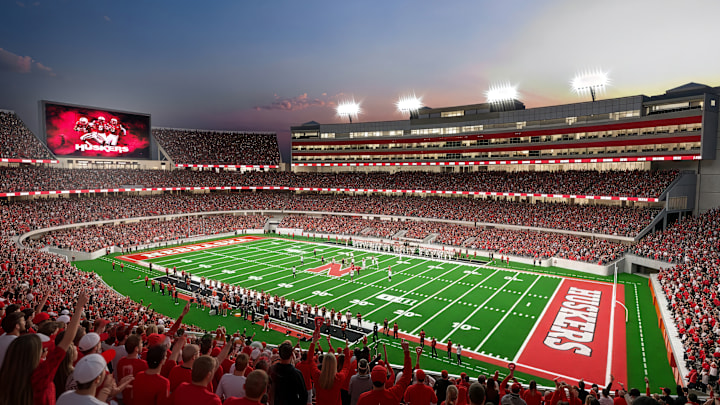
On Friday, Nebraska announced plans for a $600 million renovation of Memorial Stadium. If the plan is approved by the Board of Regents, work will begin after the home finale in late November.
The "Big Red Rebuild" will involve tearing down south stadium and replacing it with a new multi-leveled structure that will connect to the existing east and west stadiums. The bleachers in the west stadium will be torn out and replaced with seatbacks. Some seats in the east stadium will be replaced as well
It is an ambitious - and pricey - plan that will have a major impact on one of the best-known buildings in the state. Naturally, the plan is going to generate a lot of questions. Since Nebraska officials did not hold a public press conference to take questions,* I'm going to go over some of the most common questions I saw online and attempt to answer them.
It is an ambitious - and pricey - plan that will have a major impact on one of the best-known buildings in the state. Naturally, the plan is going to generate a lot of questions. Since Nebraska officials did not hold a public press conference to take questions,* I'm going to go over some of the most common questions I saw online and attempt to answer them.
*Members of the media met with athletic director Troy Dannen on Thursday to learn about the project.
Is this renovation really necessary?
Yes. Undoubtedly and absolutely yes.
Memorial Stadium - long considered one of the great cathedrals in the sport - is showing its 103-year age. The gameday experience for fans has declined. The "old grey lady" lacks many of amenities (and personal space) available at other stadiums.
I'm of the opinion that anybody who asks if a complete rebuild of south stadium is necessary has never watched a game in south. During the 2022 season, I had tickets in row 61 of section 16A. The views were excellent. We could see plays develop in real time and had a direct view of the big screen to watch replays. The people around us were great.
But getting to our seats meant hiking up a large (and crowded) ramp. Since all of the restrooms and concessions were on the ground level, my choices were missing a large chunk of a quarter or wait until halftime. I know people who sit higher up who don't bother to go down at halftime. Oh yeah, the "donation" for our two tickets costs about the same as a new 65" TV.
After one season in south, we moved to the north stadium. We were higher up (and had less personal space), but basic things like going to the restroom or getting a pop were much easier.
In addition, a notable chunk of the Big Red Rebuild project involves maintenance and upgrade projects that Nebraska has been putting off. Amie Just of the Journal-Star compared it to a colonoscopy. Nobody wants to do it, but it is best to address some things before they become a problem.
Fans can quibble about the price tag, scope, and timing of the project. But there should not be a debate on if renovations are needed.
Memorial Stadium is over 100 years old and will still have multiple areas needing improvement after this expensive project. Why don’t they just rebuild?
The biggest reason is cost.
Northwestern is in the homestretch of its project to completely rebuilt Ryan Stadium, at a cost of $862 million. There are two very notable asterisks with the price tag:
- New Ryan field will have a capacity of 35,000, which is 50,000 less than what Memorial Stadium currently holds. For Nebraska to build new AND have a capacity over 75,000 would likely cost well over $1.7 billion. That is billion with a b.
- The Ryan family donated $480 million, which is over half of the cost of Northwestern's new stadium. Nebraska does not have a benefactor like that. Nebraska alumnus Warren Buffett is not interested in spending his fortune on a football stadium (or paying for NIL).
Already facing budget cuts across campus, the university can't pay for a new stadium. The athletic department is very proud of not receiving taxpayer dollars, and is not going to ask the legislature (or voters) for money.
Even if NU had $2 billion in the bank, there would still be a host of other logistical questions. It wouldn't make sense to build a new stadium several miles away from the state-of-the-art football facility Nebraska just opened. If they rebuilt on the existing spot, the Huskers would need somewhere to play for 2-3 years. There aren't a lot of available places that can seat 20,000 fans without leaving the state.
For better or worse, the renovations likely mean that the discussion over rebuilding the stadium has been tabled for several decades.
How is this $600 million plan different from the $450 million plan Trev Alberts proposed in 2023?
The primary bullet points are very similar. Tear down and replace south stadium. Install chairbacks in west. Make it possible to walk completely around the stadium on the main level concourse. Put a big screen on top and create more club spaces for the big donors.
The interior and exterior renderings of the two plans are different, and it is unclear how much of the deferred-maintenance projects - if any - were included in Alberts's original estimate.
But the biggest difference is timing.
When Trev's plan was released, donors were still being asked to fund the new Osborne Legacy Complex as well as NIL and other capital projects outside of athletics. Alberts was not expecting the pushback he received from the public and NU leadership. I'd argue that resistance was a big factor in his decision to go to Texas A&M.
When Troy Dannen was hired, he put the project on hold, famously asking "Does it help us win?" The revenue sharing era - in which Nebraska now pays over $20 million a year to their student athletes - has changed the answer. Dannen now views Memorial Stadium as a revenue generator that can help offset annual rev share expenses.
That's why Memorial Stadium will be hosting more concerts and events like the Savannah Bananas. That's why the grandfathering on season ticket donations is going away. And that is why putting a large amount of money into the stadium will likely having a notable return on investment.
The flipside of the timing discussion is that everything is significantly more expensive than it was in 2023. That is the price Nebraska will pay for waiting.
Why don’t they put this money toward NIL / rev share for better players?
Let's be clear about one thing from the start: Nebraska is not going to spend $600 million on player acquisition, so the question – phrased like that – is in bad faith. The university is not going to take on debt or issue bonds to pay for a left tackle and running back. As discussed above, Nebraska views these renovations as an investment that will yield a return, and help pay for revenue sharing expenses.
But what if we rephrase the question to "donors only have so much money, so why should they give to build a section they'll never sit in when they could help bring in a star quarterback?" That is a different story, even though the ultimate answer is similar.
I don't have the type of wealth where I'm writing five-, six-, or seven-figure checks to the university. Those who do typically want to ensure their donations are going toward something with a level of permanence.
Inside buildings you'll often see a plaque of donors who contributed to its construction. I have yet to see a plaque of names of prominent NIL donors associated with funding a championship roster. Does anybody want to claim that their donation helped pay for the player who turned out to be a bust?
Husker fans often wish Warren Buffett would use his wealth to fund NU's NIL operation. But here's the thing: People like Buffett didn't amass their fortunes by massively overpaying for things that likely offer little ROI. Unfortunately, that describes the current state of the hyper-inflated transfer portal market.
Why is the capacity going down?
After renovations, Memorial Stadium's capacity will be around 80,000, a drop from the current 85,458.
There was a time - largely in the 20th century - where capacity was the big arms race in college athletics. Michigan, Penn State, Tennessee, Ohio State, Texas A&M, and others all expanded in an attempt to have the biggest venue. Back then, if you wanted to watch your team, you had to have a ticket.
Nebraska dipped its toe in the expansion waters as its major stadium projects (adding north and south stadiums, the skyboxes in west and north, and the major addition to east) all came with a capacity bump, peaking at 91,000 in 2014. Many fan bases still measure their… um… self-worth by the number of seats their stadium holds, regardless of how many of them are filled on a Saturday.
Things have changed in the 21st century. Every game is now televised. The home viewing experience offers multiple advantages over being in the stadium. In 2001, Nebraska played for its fourth national championship in eight years. Since then, the Huskers are 167-135. Put those in any order you choose, but the end result is the same: The scales have tipped to where ticket supply regularly outweighs fan demand.
Yes, Nebraska's vaunted sellout streak (410 games) marches on, asterisks and all. Today, the sellout streak is viewed a lot like Iowa's five national championships. The simple act of claiming them doesn't necessarily make them legitimate.
Memorial Stadium has had too many seats since the day the east stadium expansion opened in 2013. Call me sentimental, but I'd like to see the number get closer to 76,000 – the approximate capacity in the Osborne era when demand truly outweighed supply.
I have season tickets in the south stadium. Where will I sit during construction, and will I get my seats back when the project is done?
This is probably a good time to restate that these answers represent my informed opinions, and are not official NU plans or policy.
Let's take this question in reverse order. Before the renovation project is complete, Memorial Stadium is going to undergo a formal reseating process, similar to what happened in John Cook Arena for Nebraska volleyball. This has not been formally announced, but I guarantee it is coming.
That means that those who have had the same tickets in their family since the seats were originally installed will face a choice: Pay the donation for that section or move to a different location. Seats on the 50-yard line in west come with a $2,500-per-seat donation, except for those who were grandfathered in back when Bill Byrne was the AD.
Using the volleyball reseating as a test run, the same principles will be applied to Memorial Stadium, likely before the 2027 or 2028 season. Your ability to acquire (or retain) seats in desired sections will be based on your Husker Athletic Fund ranking. As a relatively penny-ante donor currently sitting in row 31 of north, I suspect I'm going to be asked to pay more or move, just like those of you who have been sitting in south for decades.
As for where the south-siders will sit during construction, I'm unsure how that will be handled. My guess is they'll have first dibs on available tickets in the other three stadiums (based on their HAF points, of course).
I will be very curious to see how Nebraska attempts to accommodate displaced south stadium fans. The consensus is that those folks are among the most loyal fans in the entire stadium, as their experience has long been the worst. Their patience and dedication deserve priority while construction is occurring.
The renovation plan will impact west, south, and east stadiums. Is there anything for those of us on the north side?
First and foremost, the days of turning around the see the big screen will be over. There will be a large, state-of-the-art screen on top of the newly remodeled south stadium. I'll be looking forward to that, figuratively and literally.
With the band and full student section moving to south, we'll get to hear them more than ever before. That should make the atmosphere more enjoyable.

Other than that, there's not much for the common fan in north. When the project is done, the north stadium will inherit the title of the worst seats / experience in the stadium. While I know that depends entirely on where your seats are, I'm hoping that the donation levels in the upcoming reseating process will reflect that lower perception.
Whenever the next wave or renovations occurs (in the 2030s or 2040s), north and east should be at the top of the list. So, we got that going for us, which is nice.
Why doesn’t Nebraska install seatbacks in the entire stadium?
For the majority of the stadium, it simply is not feasible. A seatback is worthless if it reduces an already limited amount of legroom.
Remember, the entire stadium is essentially a set of steps with bleachers mounted on top. Those stairs have a limited tread depth that is fixed in 60–100-year-old concrete which means adding leg room is not as simple as removing two rows and respacing the rest. That limitation is the main reason the west stadium portion of the project involves tearing everything out and putting in new seats.
Will the urinal troughs survive?
Admittedly, this is a bit of a silly question, but I'm including it as several people (myself included) have strong opinions on the communal urinals found throughout the stadium.
With zero knowledge of current standards, building codes, and other things that will likely make this question moot, allow me to give my case for why the troughs should exist in the rebuilt south stadium.
One of the primary reasons for this project is the fan experience. No fan - male or female - enjoys waiting in a line to use a restroom. The addition of beer to Memorial Stadium has only increased the traffic in the restrooms.
I didn't look for any studies to cite, but I truly believe the most efficient way to get large numbers of men through a restroom line is via facilities with urinal troughs.
Ladies, this matters to you because needing less space for men’s rooms means more available space for women’s restrooms.
But I suspect the troughs will go the way of option football.
Stay up to date on all things Huskers by bookmarking Nebraska Cornhuskers On SI, subscribing to HuskerMax on YouTube and visiting HuskerMax.com daily.
 Add us as a preferred source on Google
Dave Feit began writing for HuskerMax in 2011. Follow him on Twitter (@feitcanwrite) or Facebook (www.facebook.com/FeitCanWrite)