
How Oklahoma State’s Red Zone Struggles Forcing Eric Morris to Change Philosophy
In this story:
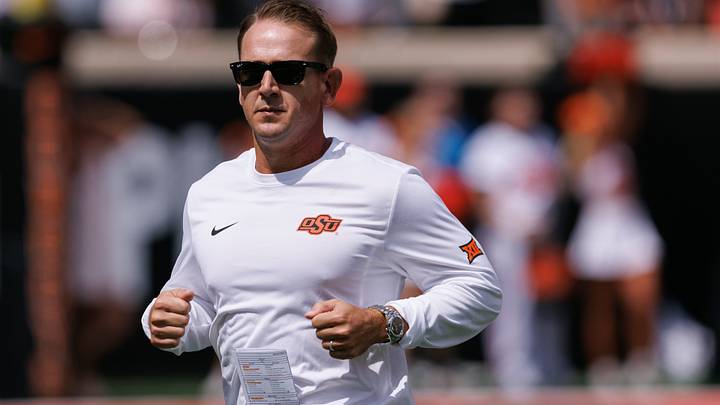
The stubbornness that Oklahoma State coach Eric Morris showed in Week 1 against Tulsa has been replaced by more conservative decisions when it matters most.
Morris isn’t a fan of it. But, for now, this offense’s struggles in the red zone are hindering the traditional aggressiveness he treats decision making in that part of the field.
So frustrated by it, he had members of his staff self-scout the offense during the bye week. They also researched play calling and play success in the red zone and on third down.
The takeaway? The Cowboys just haven’t been good there so far and going into the UCF game on Saturday, the goal is to turn it around. But looking at OSU’s red zone numbers in their three games against FBS teams is instructive of his frustration.
Explaining OSU’s Red Zone Struggles

Excluding the Murray State game — a 59-0 win — the Cowboys have reached the red zone on 17 different drives against Tulsa, Oregon and West Virginia. For an offense that is ranked No. 2 in the country in total offense the inefficiency — or the inability to score touchdowns — is startling.
OSU has scored just six touchdowns. The Cowboys have eight field goals, turned the ball over twice and had one drive end on downs.
All but one of those field goals have come since the Tulsa loss, when the Cowboys had one touchdown in four red zone trips, with a field goal, a turnover and a drive end on downs. Morris quickly pivoted to opting for points.
“The most frustrating thing for me as a play caller right now is kicking the field goals and us not being super-efficient,” he said.
Against Oregon, the Cowboys reached the red zone eight times. But they only scored three touchdowns. After the offense struggled inside the 20 against Tulsa, Morris opted for four field goals, with the other drive ending in a pick-six.
He did something similar against West Virginia. At least this time the Cowboys scored on all five red zone trips. But it was two touchdowns and three field goals.
Morris clearly doesn’t like settling for three points.
“We’ve kind of shifted our philosophy to be able to take some points at times, and I just think that’s the best thing for our team right now,” Morris said.
The Playcalling, Efficiency Factors

The playcalling is incredibly balanced inside the 20-yard line. The Cowboys have rushed the ball 26 times and passed it 24 times. Two of the touchdowns have been on the run and four have been through the air. Quarterback Drew Mestemaker is responsible for five of them, including that epic leaping rushing score against Oregon.
Mestemaker has gotten more efficient since the opener, when he was 1-for-3 in the red zone with a touchdown and an interception. He was 6-for-14 with a touchdown and an interception against Oregon. He followed that with a 4-for-7 game against West Virginia with two scores. Combined he is 11-for-24 with four scores and two interceptions. That’s below 50% but some of those passes were throwaways.
It’s not all on the quarterback. The first red zone drive of the season saw the Cowboys run the ball five times and fail to score. Two drives were derailed due to penalties and led to field goals.
Aside from the self-scout, Morris said that the Cowboys could return to running the ball more in that area, something that consistently worked with running back Caleb Hawkins. The Mean Green also used three tight end sets last year that yielded good results in the red zone, something that Morris hasn’t used yet.
Some of it is playcalling. Some of it is execution. That’s led to Morris being far less conservative than he would like to be in the most important part of the field for his offense.
“We haven't been good offensively on third downs and sticking it in the end zone,” he said. “You know once we do get into the red zone, it's for us to be able to make a run here and continue to play at a high level. I think it's going to allow us to set ourselves apart if we can get better in those two areas.”
 Add us as a preferred source on Google
Matthew Postins is the publisher of Oklahoma State on SI. He is an award-winning sports journalist who was formerly the editor of the College Football America Yearbook and covers the Big 12 Conference for Heartland College Sports.
Follow PostinsPostcard