
Ole Miss Has a Serious Problem on Defense
In this story:
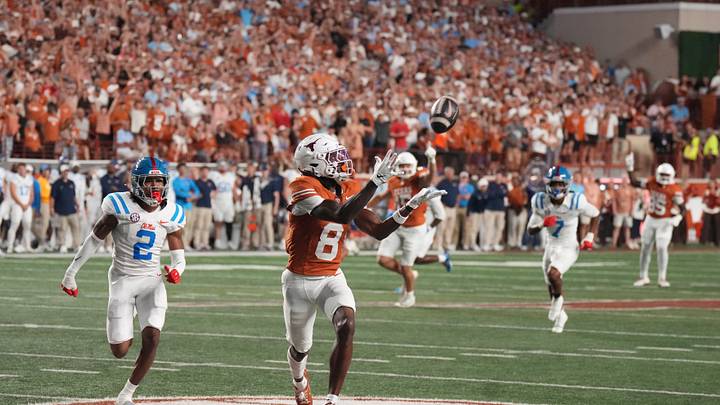
Opposing quarterbacks have found a favorite target against Ole Miss: the open space behind its secondary. The Rebels have surrendered 27 completions of at least 20 yards this season, tied for the most in the SEC. For a team chasing a spot in the College Football Playoff, the inability to keep opposing offenses from striking downfield is becoming impossible to ignore.
Pictured above, Cam Coleman gave Ole Miss a glimpse of its often-errant deep coverage, though the dropped pass prevented the play from costing the Rebels a score.
The problem is not new. It has followed Ole Miss through victories and defeats, against explosive offenses and teams the Rebels were expected to handle. Through seven games, opposing offenses have averaged 394.1 total yards per game against Ole Miss, including 233 passing yards per game. The Rebels have allowed 1,631 passing yards and six passing touchdowns while recording seven interceptions.
Those numbers paint a complicated picture. Ole Miss has generated turnovers, but its opponents have still found ways to move the football. The Rebels have surrendered 27 completions of at least 20 yards, suggesting that even when the defense makes a play, it has struggled to consistently prevent opponents from creating explosive gains.
Yards Coming in Bunches

The Rebels have been easily exploited this year by strong passing offenses.
Louisville threw for 336 yards in a 41-38 loss to Ole Miss on Sept. 6. LSU followed with 363 passing yards on Sept. 19, pushing the Rebels to the limit in a 32-24 Ole Miss victory. Florida then threw for 298 yards in a 52-28 win over Ole Miss on Sept. 26.
Three completely different situations. Three completely different opponents. One very concerning pattern.
Heading into their matchup with Texas, the Rebels' secondary was expected to join the list of groups to hold Arch Manning at bay, though that could not have been more necessary. Despite the immense criticism the Longhorn quarterback has garnered this season, his showing against Ole Miss showed that, even with his talent concerns, Manning can win big ball games. But was it more about the secondary gifting him deep shots?
Ole Miss' struggles in the secondary cannot be pinned on one issue. The numbers suggest the Rebels have a problem with both coverage and tackling, and the combination has made explosive plays increasingly difficult to prevent.
Ole Miss has missed 69 tackles in its first six games, mostly from its safety group. The Rebels also rank near the bottom nationally in tackling grade and coverage grade, illustrating how the issues extend beyond a handful of bad plays. Ole Miss' five lowest-graded players by PFF are in the secondary.
The coverage problems have been evident since the season opener against Louisville, when the Cardinals found opportunities to attack downfield. Miscommunication in the secondary and missed assignments contributed to the Rebels' struggles, while missed tackles allowed opposing players to capitalize once they got the ball in space.
The two problems feed into each other. When a defensive back loses his assignment, the result can be an uncontested completion downfield. When coverage holds, but a defender fails to finish a tackle, a short gain can turn into an explosive play. Either way, Ole Miss gives its opponent another chance to move the chains without forcing a long drive.
The Rebels have shown they can improve in both areas. Against Missouri, Ole Miss held the Tigers to three points and just 39 rushing yards, demonstrating what the defense can accomplish when it controls the line of scrimmage and tackles more effectively. But the performance against Texas revealed that the improvement hasn't become consistent.
Ole Miss does not have to choose between fixing its coverage and improving its tackling. It needs both. Better communication can prevent receivers from getting open downfield, while improved tackling can keep completed passes from turning into game-changing gains. Until the Rebels address both problems, opposing offenses will keep finding ways to exploit the secondary.
Entering the business end of the campaign, the Rebels need to sure up their coverage and tackling if the playoffs are something the program wants to still be in the picture come decision day.
Sign up for our free newsletter and follow us on Facebook and X for the latest news.
 Add us as a preferred source on Google

Cooper Ferguson is a sophomore at the University of Mississippi pursuing a degree in Integrated Marketing Communications. He is a staff writer for The Daily Mississippian, covering football and soccer while contributing sports coverage for the campus community. Outside of journalism, Cooper enjoys following sports, playing golf, weightlifting, and supporting Arsenal FC.