
Ole Miss Report Card: Just How Ugly the Georgia Blowout Really Was
In this story:
Earlier this season, I made a comment on how disappointing a season Ole Miss would have had should it end up playing in the ReliaQuest Bowl this postseason. Getting dominated by Georgia tonight, the Rebels would now be lucky to play in one of the higher-tier non-Playoff bowl games come late December.
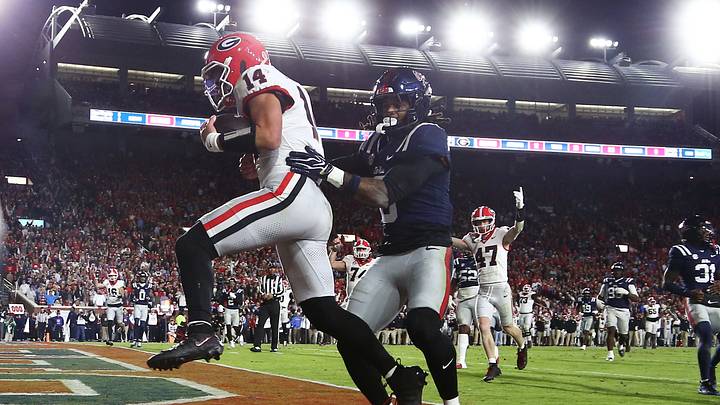
Performing its worst to date in 2026, Ole Miss was completely outmatched by Kirby Smart's Bulldogs. Falling behind by 14 points in the first quarter, despite starting with the ball, the Rebels looked absolutely incapable of stopping Georgia tailback Nate Frazier and the Bulldogs' methodical offensive scheming.
Rebel fans did not take the loss well, displaying their displeasure often in a variety of ways. The game was delayed for a decent portion when the Ole Miss student section rained objects onto the playing surface.
The offensive struggles were just as alarming. Trinidad Chambliss, who has been the driving force behind Ole Miss' success throughout the season, was given little opportunity to establish any rhythm. The offensive line struggled to protect him, the running game never got going and the Rebels' passing attack was largely neutralized. By the time the game reached its later stages, the outcome had long been decided.
With three games standing between the Rebels and an effectively meaningless bowl game, Pete Golding's first year at the helm in Oxford has left more questions than answers. Bookending Ole Miss' national prominence in 2026, tonight's loss to Georgia will be a massive roadblock to overcome in Oxford ahead of preparations for next season.
Here are the Rebels' position group grades for tonight's 42-7 loss to Georgia.
Quarterback - D

Trinidad Chambliss played one of his worst games for the Rebels tonight, though with how little went right for Ole Miss overall, an F would feel unwarranted for the usual savior of Vaught-Hemingway Stadium.
With limited time due to weak blocking and Georgia's strong pass rush, Chambliss was smothered within seconds of every snap. The senior quarterback struggled to establish any consistency against Kirby Smart's defense, finishing with 170 passing yards and an interception as the Rebels' offense failed to find the end zone until the game was already long over.
Chambliss cannot shoulder the entirety of the blame for this performance. The protection in front of him was consistently inadequate, and Georgia made it difficult for Ole Miss to establish any sort of offensive rhythm. Still, the Rebels needed their quarterback to make something happen, and he was unable to provide the spark that has carried this team through stretches of the season.
Tailbacks - F

There was practically nothing to celebrate from the Ole Miss rushing attack.
While Georgia's Nate Frazier surpassed the 100-yard mark, finishing with 107 rushing yards, the Rebels struggled to generate even a fraction of that production. Shekai Mills-Knight led the Ole Miss rushing attack with just 52 yards, as the Bulldogs consistently won the battle at the line of scrimmage.
With Kewan Lacy's absence evident, the rest of the backfield never established the physical presence needed to keep Georgia's defense honest. With the Bulldogs able to focus on Chambliss and the passing game, Ole Miss became increasingly one-dimensional.
A performance this ineffective on the ground simply cannot happen against an opponent of Georgia's caliber.
Pass Catchers - D

Horatio Fields was one of the few Rebels who managed to produce anything offensively, leading Ole Miss with 96 receiving yards and eight receptions, both team highs.
Unfortunately, the rest of the receiving corps struggled to make an impact. Georgia's secondary did an excellent job limiting opportunities downfield, and Chambliss was rarely given the time necessary to let routes develop.
Ole Miss needed a big performance from Deuce Alexander, Fields and the rest of its receiving group to keep pace with Georgia. Instead, the passing attack never found its footing.
Fields deserves credit for his production, but one productive receiver was never going to be enough against the Bulldogs.
Offensive Line - F
Georgia's defensive front dictated the game from the opening possession.
Chambliss was consistently forced to make decisions under pressure, and the Rebels' inability to create running lanes made an already difficult afternoon even worse. The offensive line struggled to match Georgia's physicality, allowing the Bulldogs to control the tempo and dictate what Ole Miss could accomplish offensively.


Parlayed with an early injury to Patrick Kutas, the Rebels never had a shot at stopping Georgia once its pass rush got going.
The 66 rushing yards produced by Ole Miss tell much of the story. There was no consistent push up front, and Georgia rarely had to respect the possibility of a successful running play.
Against one of the nation's premier defensive fronts, the Rebels needed their offensive line to deliver its best performance of the season. It did quite the opposite.
Defensive Line - F
Georgia ran the football with practically no resistance.
Nate Frazier surpassed 100 rushing yards, and the Bulldogs finished with 295 rushing yards as a team. That is an unacceptable showing for an Ole Miss defensive front that needed to establish itself early and prevent Georgia from controlling the game.
The Bulldogs consistently found room to operate, allowing Gunner Stockton to manage the game without needing to take unnecessary risks through the air.
Ole Miss was unable to generate enough disruption in the backfield or force Georgia into uncomfortable passing situations. When an opposing offense can dictate the game on the ground this easily, the defensive front deserves much of the blame.
Linebackers - D
The linebacking corps had an incredibly difficult night trying to contain Georgia's rushing attack.
Frazier consistently found space beyond the initial point of attack, and Ole Miss struggled to get enough defenders to the football before the Bulldogs moved the chains. The linebackers were unable to consistently clean up plays or prevent Georgia from turning routine rushing attempts into meaningful gains.
The group was also tasked with accounting for Stockton's mobility and Georgia's ability to create mismatches in the middle of the field.
While the defensive front deserves much of the blame, the linebackers did little to alleviate the pressure. Georgia's physicality won out, and Ole Miss had no answer.
Secondary - C
The secondary was arguably Ole Miss's least problematic unit, though that is hardly a compliment after the 42-7 defeat.
Georgia finished with 186 passing yards, a relatively modest figure compared to the damage it inflicted on the ground. The Bulldogs did not need to air the football out when Frazier and the rushing attack were consistently moving the chains.
Ole Miss' defensive backs were not completely overwhelmed through the air, but they also failed to generate the kind of momentum-changing plays needed to get the Rebels back into the contest.
Holding Georgia under 200 passing yards is one of the few statistical positives from the evening. Unfortunately, it meant very little when the Bulldogs could do whatever they wanted on the ground.
Special Teams - C+

Oscar Bird provided one of the few bright spots for Ole Miss, averaging nearly 50 yards on three punts, including one inside the 20-yard line.
Lucas Carneiro and the kicking unit had an opportunity to put 3 points on the board in the first half, though the placekicker's long field goal attempt soared wide left.
There was not much for special teams to work with, but Bird at least gave Ole Miss some respectable field position results. In a game where practically nothing went right, that counts for something.
Final Verdict
I had a really hard time justifying not utilizing a universal F-grade. There is no sugarcoating this one. Ole Miss was outplayed, outcoached and outmatched by Georgia, and the final score reflected that.
The Rebels have three games remaining to salvage some pride from a season that once carried legitimate College Football Playoff aspirations. After tonight, however, the questions surrounding Golding's program are becoming increasingly difficult to ignore.
Sign up for our free newsletter and follow us on Facebook and X for the latest news.
 Add us as a preferred source on Google

Cooper Ferguson is a sophomore at the University of Mississippi pursuing a degree in Integrated Marketing Communications. He is a staff writer for The Daily Mississippian, covering football and soccer while contributing sports coverage for the campus community. Outside of journalism, Cooper enjoys following sports, playing golf, weightlifting, and supporting Arsenal FC.