
How 'Slowing Down' Could Help Speed Up Purdue's Rushing Attack
In this story:
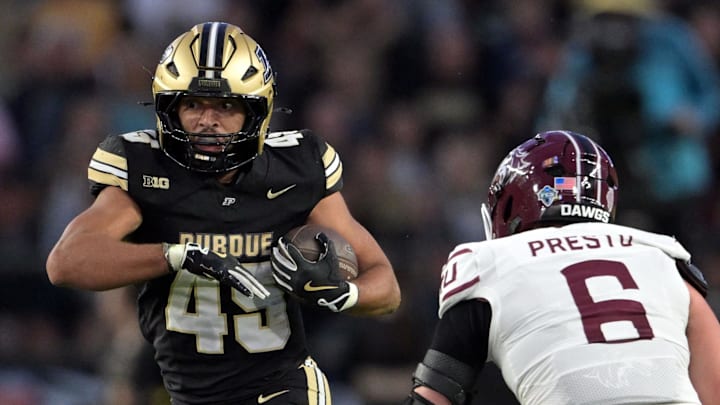
Establishing the run is something Barry Odom has wanted to accomplish since Day 1 on the job in West Lafayette. Yet through four games, Purdue's rushing attack hasn't shown much life.
The Boilermakers are averaging a paltry 106.3 yards on the ground through four games, an average that ranks 17th in the Big Ten, ahead of only Maryland. They have eclipsed the 100-yard mark in just one contest, the 34-17 win over Southern Illinois in Week 2. That night, Purdue piled up 214 yards and two touchdowns on 53 attempts.
Purdue's other three games? The Boilers totaled 93 yards against Ball State, 52 against USC, and 66 against Notre Dame. They averaged 2.45 yards per carry in those three contests.
With an off week to identify some of the troubles with Purdue's run game, offensive coordinator Josh Henson says players might be getting sped up during games and abandoning their technique.
“We’ve got to improve our run game. I feel like, at times, we’re reaching a little bit, both up front and at running back," Henson told reporters Monday. "We’re trying hard to make plays happen, and we just need to slow down and execute our fundamentals, get the fundamentals right. That’s what improves execution, it’s the fundamentals, not a major play.”
Certainly, Purdue has struggled to create running lanes and get a strong push up front. The Boilermakers have surrendered 28 tackles for loss this season, which ranks 15th in the Big Ten.
"Slowing down" and executing the play properly would certainly benefit the Boilers, especially against some of the big, burly defensive fronts they'll see across the league.

Odom had a few more thoughts on Purdue's issues in the run game.
"It's game-planning, it's blocking at the point of attack, it's making an extra guy miss, it's running tough," Odom said. "And when I say blocking, it's not just the offensive line, it's receivers on the perimeter, it's a tight end at the point of attack or second level."
Purdue has a skilled and experienced ball carrier in Devin Mockobee in the backfield. He was spectacular in the Week 2 win over Southern Illinois, piling up 126 yards and two touchdowns in the win. In the last two games, though, he's failed to reach the 50-yard barrier.
Additionally, Purdue hasn't been able to locate another running back who can provide consistency. Behind Mockobee, the second-leading running back is Antonio Harris, who has just 41 yards on 12 attempts.
A lack of depth at the position also appears to be an issue right now.
Purdue "eager" to run the football more effectively

Purdue's inability to run the football through four games isn't for lack of desire. Everyone in the locker room understands how important it is to win games, especially in the Big Ten.
At times, though, everyone is trying to do too much. Henson says that's when he sees most of the mistakes, whether it's from the offensive line, running backs, or another position group.
"The offensive line is eager to run the ball better, I know our running backs are," Henson said. "We just have to trust and believe in our fundamentals and just execute the things we have called. If we do that, we’ll be fine.”
The key to fielding a strong offensive team is having an effective rushing game. Not only does it wear opponents down, but it also opens things up down the field in the passing attack.
Improving on the ground isn't just about converting short-yardage situations; it helps offenses stay on schedule, opens up the playbook, and aids with ball control.
"There are so many things that go into how you run the ball effectively. We have to do a great job of doing what we feel like our players can do to have success. We have to execute those things," Odom said. "We would love to establish and really, really feel good about it, not just in 3rd-and-short situations, but 1st-and-10 to start (a drive)."
Related stories on Purdue football
HOW PURDUE CAN IMPROVE DEFENSIVELY: After giving up 56 points and 539 yards to Notre Dame, Purdue defensive coordinator Mike Scherer says there are some "glaring issues" to fix moving forward. CLICK HERE
PURDUE MOVES UP IN ESPN FPI: The Boilermakers are slowly climbing up ESPN's Football Power Index (FPI) after an off week. Where does Purdue stand after Week 5 of the season? CLICK HERE
 Add us as a preferred source on Google
Dustin Schutte is the publisher of Purdue Boilermakers on SI and has spent more than a decade working in sports journalism. His career began in 2013, when he covered Big Ten football. He remained in that role for eight years before working at On SI to cover the Boilermakers. Dustin graduated from Manchester University in Indiana in 2010, where he played for the men's tennis team.
Follow SchutteDustin