
Sam Leavitt's Nine Interceptions Reveal an Opportunity for Texas' Defense
In this story:
Nine interceptions. Nine games.
At first glance, LSU quarterback Sam Leavitt’s turnover numbers would seem to present an obvious opportunity for a Texas defense that ranks among the nation’s best against the pass.
But a closer look reveals a much more complicated story.
Entering last Saturday's matchup against Alabama, Leavitt had thrown eight interceptions despite recording five turnover-worthy plays, according to Pro Football Focus. His 1.6% turnover-worthy play rate ranked 12th-lowest nationally.
Several of those turnovers came off tipped passes and deflections, circumstances that aren’t always within Leavitt’s control.
Still, not every interception has been a product of bad luck.
Several have revealed occasional lapses in coverage recognition and a willingness to challenge passing windows that defenders have already closed.
And with defensive coordinator Will Muschamp's use of disguised pressures and shifting coverages, Texas could be particularly well-equipped to capitalize.
A Closer Look at Leavitt's Interceptions

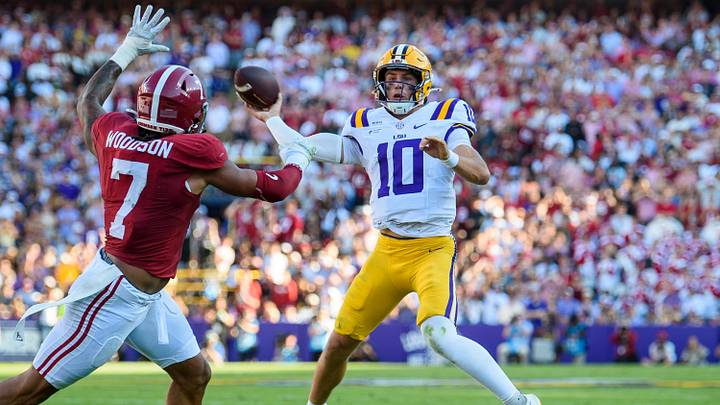
LSU's 31-13 loss to Alabama last Saturday was a rather peculiar offensive performance.
The Tigers accumulated 457 total yards, including 380 through the air from Leavitt, yet only managed 13 points. LSU failed on all of its fourth-down attempts, while Alabama recorded four sacks and an interception.
But we’re here to talk about interceptions. And in the second quarter, one particular play showed that Leavitt doesn’t necessarily need to be under pressure to make a costly mistake.
After Alabama defensive lineman Devan Thompkins sacked Leavitt for a nine-yard loss, LSU faced second-and-19 from Alabama's 36-yard line.
This time, the Crimson Tide sent a standard four-man rush, generating little noticeable pressure. But linebacker Luke Metz had his eyes on Leavitt, anticipating where the quarterback wanted to go with the football.
He read him like a book, and as Leavitt released his pass, Metz stepped into the throwing lane and came away with an interception.
"I was just reading his eyes and his reads," Metz said after the game. "Route recognition from having the bye week helped too."



And it wasn't the first time a defender had taken advantage of a similar mistake.
Against McNeese, Leavitt appeared to lose track of Lorenzell Dubose sneaking into the passing lane, allowing the defender to intercept his pass near the goal line.
Against Louisiana Tech, Leavitt forced a pass across the middle despite the Bulldogs rushing just three defenders and blanketing his receivers in tight coverage.
"I tried to force that one a little bit," Leavitt said afterward.
Another interception in that same game revealed a different issue. Feeling pressure from his right, Leavitt overthrew an open Trey'Dez Green, later admitting he had predetermined the throw.
While Leavitt's turnover-worthy play rate suggests these mistakes aren't necessarily habitual, they nevertheless reveal opportunities for opposing defenses.
How Texas Can Exploit Leavitt’s Mistakes

Under Muschamp, the Longhorns rank seventh nationally in passing-efficiency defense, allowing opponents to complete just 57.7% of their passes.
But beyond the numbers, Texas has demonstrated an ability to complicate opposing quarterbacks' reads through shifting coverages, disguised pressures and pre-snap movement.
Muschamp can show pressure before dropping additional defenders into coverage, or bring extra rushers from unexpected areas of the field. Safeties can rotate post-snap, changing the passing lanes available to a quarterback.
For Leavitt, that presents problems on multiple fronts.
Pressure can replicate the same mistake he made against Louisiana Tech. Meanwhile, rotating defenders could capitalize on the occasional lapses in coverage recognition that surfaced against McNeese and Alabama.
Rasheem Biles is a clear example of Texas’ versatility. Against Missouri, he disrupted the Tigers’ passing attack in two very different ways on consecutive plays, first blitzing and tipping a pass before dropping into coverage and forcing an incompletion on the following snap.
That ability to threaten pressure without always bringing it could make Leavitt's job considerably more difficult.
So while Leavitt's nine interceptions may not tell the full story of his season, they reveal vulnerabilities in his game. They offer exploits that a Texas defense built around disguising coverages, generating pressure and confusing opposing quarterbacks is particularly well-equipped to capitalize on.
Sign up to our free newsletter and follow us on Facebook, X and Instagram for the latest news.
 Add us as a preferred source on Google

Leo Barnes is a junior journalism major at the University of Texas at Austin. He is also a senior sports reporter for The Daily Texan, where he currently covers the men’s basketball beat. Born and raised in Austin, Barnes roots for all things Texas, as well as the San Antonio Spurs and Dallas Cowboys.