
Texas Cannot Afford to Let Its Offensive Line Dictate Another Loss
In this story:
Texas entered the season with championship expectations and a roster built to compete with the best teams in the country. Two consecutive losses have changed the conversation, however, and the offensive line is becoming an increasingly difficult problem to ignore.
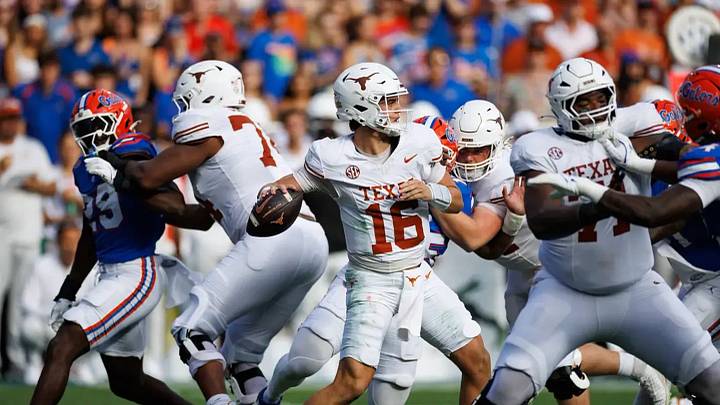
The Longhorns fell 27-24 to Florida on Oct. 17, managing just 272 total yards while allowing five sacks and 11 tackles for loss. Those negative plays repeatedly put Texas behind the chains, disrupted its rushing attack and made sustaining drives unnecessarily difficult.
Arch Manning and the passing game have received plenty of criticism, but Texas cannot evaluate its offensive struggles without examining what is happening in front of the quarterback. Against Florida, the line failed to consistently protect the pocket or create the push needed in critical short-yardage situations.
Texas Must Win the Battle Up Front

The most concerning part of Texas' performance was how often Florida created negative plays. The Gators recorded five sacks and 11 tackles for loss against an offensive line that needed to establish control at home. Not every sack was necessarily the line's responsibility, but the overall number of disrupted plays illustrates how frequently Texas found itself fighting to recover from a lost down.
One of the clearest examples came on a fourth-and-one situation near midfield. Texas lined up in shotgun and attempted a slow-developing rushing play, only for Florida's defense to penetrate the backfield and stop the runner for a loss. Instead of extending the possession, the Longhorns turned a manageable situation into a turnover on downs.
That failure was especially damaging because Texas needed to sustain drives to keep its offense on the field and prevent Florida from building momentum. Short-yardage situations are where an offensive line must impose its will, create movement and give the ball carrier a reasonable opportunity to reach the marker. Texas did not consistently accomplish that against the Gators.
Pass protection presented another problem. During a second-quarter possession, Hollywood Smothers broke off a 21-yard run, and Raleek Brown followed with a seven-yard gain. Arch Manning then converted third-and-one with an eight-yard scramble, putting Texas in position to continue the drive.
But Florida sacked Manning for a six-yard loss on the next play, immediately putting the offense behind schedule. Texas eventually faced fourth-and-one at midfield and failed to convert.

That sequence captured the inconsistency up front. The Longhorns could produce positive plays, but one protection breakdown or unsuccessful block erased much of the progress. Against a defense that had struggled in previous weeks, Texas should have been able to sustain more of those promising possessions.
The consequences extended into the running game. Texas finished with just 99 rushing yards, compared with Florida's 158. The Longhorns had explosive runs from Smothers and Raleek Brown, but those flashes never developed into a dependable ground attack. Without consistent blocking, Texas struggled to keep itself in favorable down-and-distance situations.
Steve Sarkisian and the offensive staff must determine whether the solution involves personnel changes, adjustments to blocking assignments or a different rotation across the line. A wholesale shake-up is not automatically the answer, but the current approach cannot remain untouched when the same problems continue to disrupt the offense.
Texas also needs to identify which linemen are handling their assignments consistently and which combinations perform best in obvious passing and short-yardage situations. Accountability matters, but so does putting players in positions where they can execute successfully.
With Ole Miss coming to Austin, the urgency is clear. The Rebels possess a dangerous offense capable of putting pressure on Texas to keep pace. If the Longhorns continue surrendering sacks, losing at the line of scrimmage and failing to convert crucial short-yardage plays, their margin for error will shrink again.
Texas cannot fix every offensive problem overnight. But until its offensive line becomes more reliable, the Longhorns will struggle to establish the physical identity their season demands.
Sign up for our free newsletterand follow us on Facebook, Xand Instagram for the latest news.
 Add us as a preferred source on Google

Phoenix Haigis is a staff writer for the Texas Longhorns on SI. He is a junior at the University of Texas at Austin as a journalism major with a minor in sports media. He is also a staff writer for the Daily Texan’s sports department. Haigis was born and raised in Cincinnati, OH., where he became a lifelong Bengals fan and Skyline Chili defender.
Follow phoenix_haigis