
Texas Can't Make Arch Manning the Scapegoat for Its Offensive Issues
In this story:
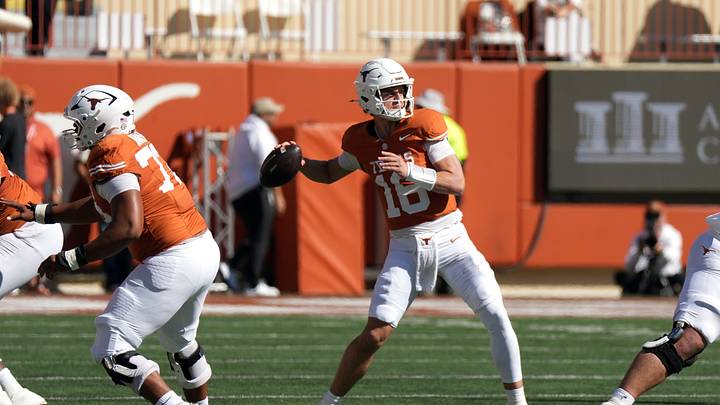
Arch Manning and game-sealing turnovers have seemingly gone hand-in-hand these past two weeks.
It was Manning who lost the football against Florida, which virtually ended the game, and it was Manning who threw two fourth-quarter interceptions against Oklahoma that contributed to Texas’ first loss of the season.
His mistakes have been costly and deserve the criticism he’s getting.
But with Texas’ offense continuing to struggle, singling out Manning would overlook the problems with the unit surrounding him.
Texas has struggled to protect its quarterback, establish a consistent run game and execute in critical situations.
Simply replacing the quarterback isn’t going to make them disappear.
The Protection Problems Extend Beyond Manning

Through three SEC games, the Longhorns have surrendered 26 tackles for loss, with 11 alone coming against Florida.
Those losses reflect Texas' inability to consistently create running lanes and protect its quarterback, with Manning having been sacked eight times over the past two weeks.
Of course, not every sack can simply be chalked up to poor line play. Manning has a tendency to hold on to the ball too long and be far too indecisive when facing pressure. But the players responsible for protecting him haven’t been all too consistent when defenses rush extra men.
“We haven’t hurt the blitz enough, and we haven’t discouraged the blitz enough,” Steve Sarkisian said on Monday. “I do think there’s a couple of things schematically that we can do better … and I think there’s some things that individuals can do better in blocking those blitzes.”
Although Manning has a responsibility to recognize pressure and make timely decisions, the offensive line, tight ends and running backs must execute their assignments for the offense to function efficiently.
That hasn’t been the case.
Execution Has Been a Problem Across the Offense

Whether it’s handoffs on crucial fourth-and-ones or sacks taken in third-and-short situations, Texas goes backwards on the plays where it matters most.
Take a late first-half possession, when Texas still held a 17–3 lead. It’s fourth-and-one, Texas calls a handoff to Hollywood Smothers, but Florida stuffs the A-gap before the play can even develop.
That trend continued into the second half, where Texas failed to convert a single third- or fourth-and-short opportunity.
Manning certainly bears responsibility for the fourth-quarter failure, but what about the plays where he simply hands the ball off? There’s no difficult read or open receiver to find, yet Texas still can’t consistently get the one or two yards it needs to keep a drive alive.
Those failures won’t be as memorable as a fourth-quarter fumble, but they can be just as costly.
Does that absolve Manning of his mistakes? Not at all. His pocket presence and his decision-making need to improve.
But an interception is easy to point to. So is a fumble on the final possession. The failed blitz pickups and short-yardage breakdowns that come before them, well, they don't get placed under the magnifying glass the same way Manning's mishaps do.
So yes, with No. 7 Ole Miss coming to Austin on Saturday, Texas needs more from Manning.
But just as importantly, it needs more from the rest of its offense.
Sign up to our free newsletter and follow us on Facebook, X and Instagram for the latest news.
 Add us as a preferred source on Google

Leo Barnes is a junior journalism major at the University of Texas at Austin. He is also a senior sports reporter for The Daily Texan, where he currently covers the men’s basketball beat. Born and raised in Austin, Barnes roots for all things Texas, as well as the San Antonio Spurs and Dallas Cowboys.