
BT's Breakdown: How the UCF Knights Slayed a Giant
In this story:
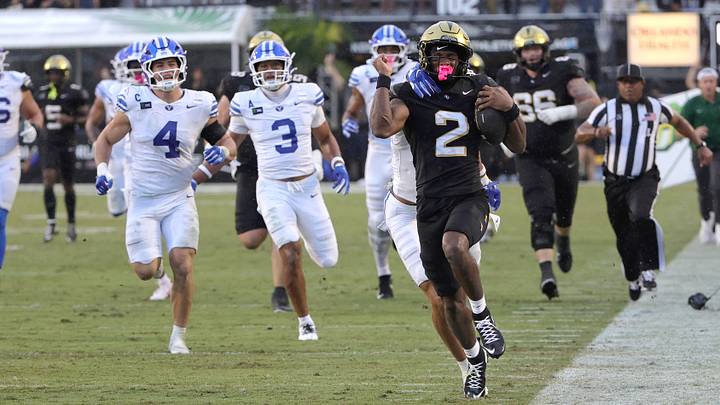
The recent chaos of the college football world made a stop in Orlando on Saturday night as the UCF Knights took down No. 2 BYU, 39-31.
Coach Scott Frost and the Knights took advantage of it being the program's first time hosting an AP Top 5-ranked team with its highest-ranked win in program history.
"I think I've been part of a few of the coolest games in UCF history now, and that one's right up there," Frost said after the game.
So, as UCF employees attempt to repair the northern cabanas in time for the Space Game on Friday night against Baylor, here is a breakdown of just how the Knights pulled it all off:
1. Success on the Deep Ball

If there was one issue with Keyone Jenkins’ tenure as the Knights’ starting quarterback, it was his ability to throw deep.
UCF has found a rhythm with Jenkins on short passes, with screens and dump-off passes coming in handy on Saturday night, but once pass attempts started going a certain distance, they became off-target or risked interception.
On Saturday night, Jenkins still did not throw the ball deep (throw the ball 15+ yards) very often, doing so just twice. However, when he did, he was successful both times, one of which was his 25-yard touchdown pass to Josh Derry to force double overtime.
"I was really, really hoping he saw me in the end zone, and he got it to me, and we got the touchdown," Derry said.
As for Jenkins' other deep pass, it was hauled in by the Knights' breakout receiving star of the night: true freshman Tyren Hornes. During his radio interview on Wednesday, Frost said Hornes was "going to be special," and on Saturday night, the Bradenton native showed why. Not only could he reel in a deep ball, which he did late in the first half to help set up a UCF touchdown to take the lead at the half, but he can also take one of Jenkins' signature short passes and make the most of them, with 86 of his yards coming after the catch.
By game's end, Hornes tallied 137 yards. He entered the game with 111 yards for the entire season.
“I knew what he could do," Jenkins said. "We talked all throughout the game, all before the game. That dude's a beast, man.”
While Jenkins’ ability to throw deep may only be a skill that affects one or two plays a game, it can preserve, maintain or outright change the momentum of a drive, and even the entire game. On Saturday night, when he needed to push it downfield, he succeeded.
2. Stepping Up on Defense

While deep passes are not going to be a core part of Jenkins’ game, it was for BYU quarterback Bear Beachmeier, who let it fly more than 15 yards 13 times. However, he only completed seven of those passes. That is thanks to a UCF secondary that, while not perfect, did what it needed to do, along with the rest of the Knights’ defense, to keep the Cougars within reach.
The most obvious play that did this on Saturday night was its lone takeaway. After a holding penalty halted the Knights' offense late in the second half, BYU got the ball back with the opportunity to go up by two scores while also being in position to start with the ball in the second half. The Cougars managed to get it into the Knights’ territory, and then defensive tackle Thomas Collins put his hands up.
"I went full power, jumped up, did it, and then I knew Tackett [Curtis] was up back there somewhere," Collins said. "You know, I've seen him do it before, so we just have full faith in everything going our way and, yeah, he came down with a huge play."
It was the second interception of Curtis' season and career, and led to the Knights taking the halftime lead after scoring a touchdown on the ensuing drive.
"It was awesome seeing that after I was able to make that play, that the offense came and matched it," Curtis said. "That's just complementary football, and that definitely wins games."
Aside from the turnover, however, the Knights also put a lid on a BYU rushing attack that was missing its star player in LJ Martin. If it was not for a 27-yard run by Preston Rex to open the second half, the Cougars would have been held of under 100 team rushing yards.
The unit also responded well. Both drives began unfavorably for defensive coordinator Alex Grinch’s side of the ball, with BYU scoring touchdowns on both of their opening drives of the half. However, on the following drives, they kept the Cougars out of the end zone, forcing a pair of three-and-outs in the first half, then holding them to a field goal, followed by another pair of three-and-outs in the second.
Those three-and-outs also had the benefit of keeping the Cougars' time of possession down, allowing the Knights to get the advantage there and have a comparatively fresher defense for what turned out to be an extended ballgame.
3. The Landen Chambers Section

Running back Landen Chambers serves as the shining example of one of the overarching themes of what the Knights' offense needed to do to pull off such a historic win: pairing talents he's already known for with abilities that have yet to be properly showcased.
Jenkins did it with his throws downfield. Hornes did it by becoming one of Jenkins’ main targets and racking up yards after the catch. As for Chambers, he did it by becoming a receiver.
It only happened twice, but he was wide open both times, and he made them count, scoring the first receiving touchdown of his career to put the Knights ahead at the half and taking it 21 yards to convert on third down, putting the Knights into BYU territory with under 30 seconds to go in regulation. Frost gave credit to offensive coordinator Steve Cooper, calling the plays “well-designed.”
Chambers then paired those plays with his signature abilities as a power back: plowing it into the end zone from two yards out to get the Knights on the board in the first, reaching the line to gain on two third downs and getting them right to the front steps of the end zone so that one of his teammates could finish the job. One such play saw Chambers have to put in a second effort to reach the first-down line, a play Frost said was "huge" and called it "one of the biggest plays in the game."
"All I need is 18 inches," Chambers said. "I mean, that's what we go by in our running back room. 18 inches is all you need to go make a hole."
Despite the significance of this win, the Knights now have a short week ahead of them as they prepare to host Baylor in the Space Game on Friday night at 7:30 p.m.
 Add us as a preferred source on Google

Bryson Turner is a sports journalist who covers UCF Athletics. Turner has contributed to the Black and Gold Banneret, the home for UCF Athletics on SB Nation. He has called the Orlando area home since the age of 8 and received his bachelor's and master's degrees from UCF.
Follow itsBrysonTurner