
New College Football Rule Makes Faking an Injury a Risky Play
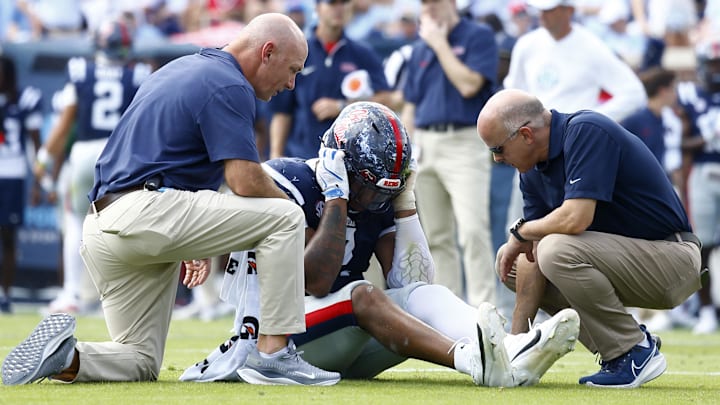
Without making any direct accusations, college football teams have faked injuries to gain an advantage. Whether its slowing down a no-huddle offense or stopping the clock without using a timeout, teams do it.
But now there’s more impactful in-game consequences for teams that fake an injury, like this one:
Blatant fake injury from Ole Miss vs. Kentucky😬
— On3 (@On3sports) September 28, 2024
(via @ESPN)pic.twitter.com/l09rrJ7cA1
The NCAA Playing Rules Oversight Panel approved modifications to the injury timeout rules on Wednesday. These rules will be in place for the upcoming season. The new rule states that “if medical personnel enter the field to evaluate an injured player after the ball is spotted by the officiating crew for the next play, that player's team will be charged a timeout. If the team does not have any timeouts remaining, a 5-yard delay-of-game penalty will be assessed.”
There were several obvious instances of teams doing it last year, including one SEC team that got a lot of coverage for some of its “injuries” during games. It got to be so much that SEC commissioner Greg Sankey issued a memo to SEC athletic directors and head coaches, saying “As plainly as it can be stated: Stop any and all activity related to faking injuries to create time-outs…Play football and stop the feigned injury nonsense.”
The SEC also instituted a structure of public reprimand (because SEC coaches aren’t already reprimanded weekly by fans), fines and suspensions. However, nothing was done during the game. It was all afterwards, but not anymore.
Kirk Herbstreit and Chris Fowler were pretty sure that Tennessee's Omarr Norman-Lott was faking this injury.
— Awful Announcing (@awfulannouncing) November 17, 2024
"He's right here and looks to be fine. Looking over to the sideline and takes it down."
"When you look at the sidelines before going down, it's suspicious." pic.twitter.com/4UzFJYKcoC
This new rule is what was missing. Previously, there wasn't much to deter teams from having a player "fall down" during a game. Sure, if it happened the final two minutes that team would be charged with a timeout or 10-second runoff if the team didn't have any timeouts. But that left teams with 56 minutes of game time where a player could go down with an injury and all that would happen is the clock stops.
Something had to be done because it was becoming too blatantly obvious, like this:
The worst fake injury you will ever see. Unreal. pic.twitter.com/kUCctR1LZr
— Jordan Dajani (@JordanDajani) October 19, 2024
Having an actual in game impact will do more to curtail the “feigned injury nonsense” but it’ll probably still happen. Coaches will just have to weigh the pros and cons and it’s guaranteed someone, at some point will decide the pros outweigh the cons.
Another rule change involving timeouts is the addition of one timeout in games that reach a third overtime and no more. Previously, teams were allotted one timeout for each overtime period.
Here are the other rule changes the panel announced Wednesday:
- When the decision on instant replay is announced, the referee will only say that the call on the field is "upheld" or "overturned." The terms "confirmed" and "stands" will not be used.
- No offensive player can be in the direct line of the snap to the potential kicker or within the frame of the snapper on punts for the formation to qualify as a scrimmage kick formation. If a team is not in scrimmage kick formation, it must have five players numbered 50 through 79 on the line of scrimmage. Additionally, if the snapper is on the end of the line by formation, the snapper will lose scrimmage kick protection, and the opposition can line a player over the snapper.
- If any player on a kickoff-return team makes a "T" signal with his arms during the kick, the team gives up the right to return the kick, and the play will be whistled dead.
Enhanced rules regarding simulating action at the snap and words or signals that distract opponents when they are preparing to put the ball in play will also be effective next season. No player can call defensive signals that simulate the sound or cadence of the offensive signals. - The defensive terms "move" and "stem" would be reserved for players on that side of the ball and could not be used by the offense.
- After the two-minute timeout in either half, if the defense commits a foul with 12 or more players on the field and all the players participate in the play, the officials will administer a 5-yard penalty. The offensive team would have the option to reset the game clock back to the time at the start of the play. If the 12th player is attempting to leave the field and has no influence on the play, the defensive team will be penalized 5 yards with no adjustment to the game clock.
- Coach-to-player communication, similar to technology implemented for the Football Bowl Subdivision last year, will be a permissive option for teams that compete in the Football Championship Subdivision.
More SEC News:
 Add us as a preferred source on Google
Award-winning sports editor, writer, columnist, and photographer with 15 years’ experience offering his opinion and insight about the sports world in Mississippi and Texas, but he was taken to Razorback pep rallies at Billy Bob's Texas in Fort Worth before he could walk. Taylor has covered all levels of sports, from small high schools in the Mississippi Delta to NFL games. Follow Taylor on Twitter and Facebook.