
HUGHES: Virginia Tech's 5-2 Start Still Carries Tone of Work-In-Progress
In this story:
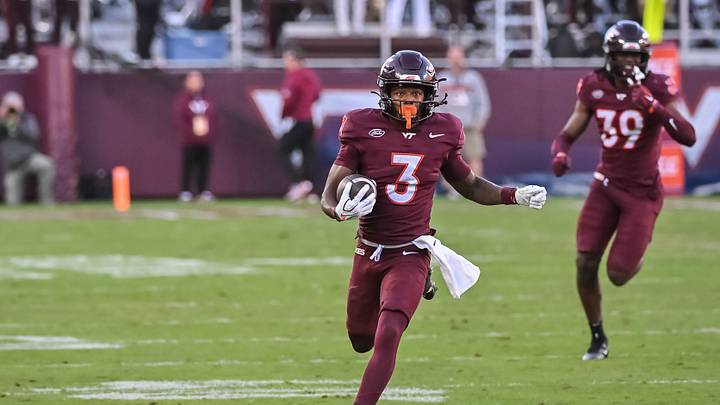
BLACKSBURG — Virginia Tech's 34-24 victory over Georgia Tech Saturday served as a sort of cleansing. The Hokies, who hadn't won since Sept. 26, could have keeled over. Holding a 24-3 lead over the Yellow Jackets, Virginia Tech faltered.
The Hokies (5-2, 2-2 ACC) conceded back-to-back touchdowns to the Yellow Jackets in a sub-three-minute stretch, putting them up by one touchdown with a quarter-plus to go. But Virginia Tech came through. It was not a flawless victory — quarterback Ethan Grunkemeyer threw for 35 yards in the second half — but it was a victory nonetheless.
Virginia Tech has been outscored in the second half in five of its last six games; two instances, against Pitt and Cal, directly resulted in losses. When the Hokies took on Pitt, they lost in spite of Ethan Grunkemeyer's career-high 434-yard output. Why? Turnovers. Four of them.
Against California, Virginia Tech was done in by untimely penalties, including back-to-back flags on the Golden Bears' final drive for roughing the passer (linebacker Kaleb Spencer) and defensive pass interference (cornerback Cam Chadwick Jr.). Fifth-year kicker John Love's two missed field goals did not help matters, but the Hokies' inconsistent offense shares some of the culpability for Oct. 10's loss as well.
While those trends didn't fully subside in Virginia Tech's win over Georgia Tech, they weren't enough to sink the Hokies. Virginia Tech, which leapt out to a 21-point lead at intermission, amassed 215 receiving yards over the first half, though its total cratered to 35 in the final two quarters.
It carries the tone of a work-in-progress label for Virginia Tech — a program that, though it has appeared to take steps, remains highly susceptible to falling to its own errors. Avoidable turnovers against Pitt and avoidable penalties against Cal proved to be the Hokies' downfall, and while neither issue was prevalent in Virginia Tech's game against the Yellow Jackets Saturday, a lingering issue persists: the Hokies' struggle against the passing game.
Virginia Tech has allowed 300-plus passing yards in three of its last four games, doing so twice to backup quarterbacks in Cal's Jackson Brousseau (321) and Georgia Tech's Alberto Mendoza (335). The other case came against Maryland's Malik Washington (359) in College Park, Md., on Sept. 26.
In five games — Old Dominion, Maryland, Pitt, Cal and Georgia Tech — Virginia Tech has conceded at least a 60% completion rate to its opponent, peaking with a 76.3% clip from Mendoza on Saturday. The Indiana transfer clocked in only 118 first-half passing yards, but his yardage ballooned to 217 in the second half.
While the Hokies have managed to overcome those deficiencies on several occasions, relying on offensive production to compensate for defensive lapses isn't always a dependable formula, even if it has yielded considerable success for Virginia Tech thus far in 2026.
That's not to paint a mere glass-half-empty picture, though. After all, Virginia Tech accomplished its first 4-0 start since the 2017 season. But it also didn't force a turnover for five straight games.
Virginia Tech's produced 23 sacks and 64 tackles for loss, both totals that are among the highest in the nation. Thirty-two of those 64 TFLs and 12 of those 23 sacks, though, came in the Hokies' first two games against VMI and Old Dominion. In the last five games, the Hokies have accrued 32 tackles for loss and 11 sacks.
A 5-2 record represents an encouraging position for a program seeking to reestablish itself, but the manner in which Virginia Tech has reached that mark — its last five games have been decided by 10 or fewer points — suggests there's still considerable room for improvement.
That's to be expected in Year 1 under Franklin — I was slightly bullish on Tech in my preseason projections, predicting a 8-4 record at the end of the regular season. I do believe the Hokies can still reach that total, but to do so, it'll need to take care of business against Stanford and win relatively even games (at least by ESPN's FPI) against Clemson and Virginia (Nov. 28). SMU and Miami present considerably tougher tests, but the Mustangs' loss to Louisville and the Hurricanes' double-overtime duel with Florida State serve as reminders that no ACC team is safe this year.
Virginia Tech's next contest comes against Clemson on the road on Saturday, Oct. 24, at 7 p.m. ET on ESPN.
 Add us as a preferred source on Google

Hughes serves as Virginia Tech On SI's lead editor, a position that he has held since July 2025. Hughes is a junior at Virginia Tech majoring in sports media and analytics. He also serves as the open-wheel correspondent for the motorsports outlet Steering Wheel Nation, where he has written on Formula 1, the NTT IndyCar Series, the NASCAR Cup Series and the NASCAR CRAFTSMAN Truck Series. Hughes has previously authored bylines in 3304 Sports, Virginia Tech's multimedia student journalism outlet.
Follow thomashughes_05