%20%20--%3E%0A%3Csvg%20version%3D%221.1%22%20id%3D%22Layer_1%22%20xmlns%3D%22http%3A%2F%2Fwww.w3.org%2F2000%2Fsvg%22%20xmlns%3Axlink%3D%22http%3A%2F%2Fwww.w3.org%2F1999%2Fxlink%22%20x%3D%220px%22%20y%3D%220px%22%0A%09%20width%3D%2239px%22%20height%3D%2240px%22%20viewBox%3D%220%200%2039%2040%22%20enable-background%3D%22new%200%200%2039%2040%22%20xml%3Aspace%3D%22preserve%22%3E%0A%3Cpath%20fill%3D%22%23FFFFFF%22%20d%3D%22M38.5%2C7H28.2v26h10.3V7z%22%2F%3E%0A%3Cpath%20fill-rule%3D%22evenodd%22%20clip-rule%3D%22evenodd%22%20fill%3D%22%23FFFFFF%22%20d%3D%22M26.1%2C25.5c0%2C5.8-4.1%2C7.5-12.9%2C7.5C3.9%2C33%2C0%2C31.2%2C0%2C25.2v-1.1h11.6%0A%09v2.4c0%2C0.7%2C0.1%2C1.4%2C1.2%2C1.4c1%2C0%2C1.2-0.4%2C1.2-1.3v-0.9c0-1.6-0.9-1.6-3.5-2.2C2.2%2C21.7%2C0%2C19.7%2C0%2C15.3v-0.9C0%2C9.3%2C5.5%2C7%2C12.9%2C7%0A%09c10.2%2C0%2C12.8%2C2.6%2C12.8%2C7.4v1.8h-11v-2.9c0-0.6-0.4-1.1-1.2-1.1c-0.6%2C0-1.2%2C0.4-1.2%2C1.1v0.9c0%2C1.5%2C0.9%2C2%2C3.3%2C2.5%0A%09c8%2C1.6%2C10.5%2C3.3%2C10.5%2C7.5V25.5z%22%2F%3E%0A%3C%2Fsvg%3E%0A)
Mother's Day: Five Great Stories About College Football Coaches and Their Moms
In this story:
When observers inside and outside the game discuss college football coaching, they tend to speak in terms of its intimidating, old-fashioned value systems: capital-A Authoritarianism, capital-P Patriarchy, a rugged individualism that discounts family life in favor of winning.
Any study of the game’s great leaders, however, makes it clear that family (or the absence of it) in general tends to be a powerful motivator. That was true for the early coaches who came from society’s margins—Grambling’s Eddie Robinson (son of a sharecropper), Notre Dame’s Knute Rockne (son of Norwegian immigrants)—and it remains true today.
On this Mother’s Day, here is a look back at five stories from through the years about college football coaches and their mothers—and the pride, pain, joy, sacrifice and humor that comes with raising the future boss.
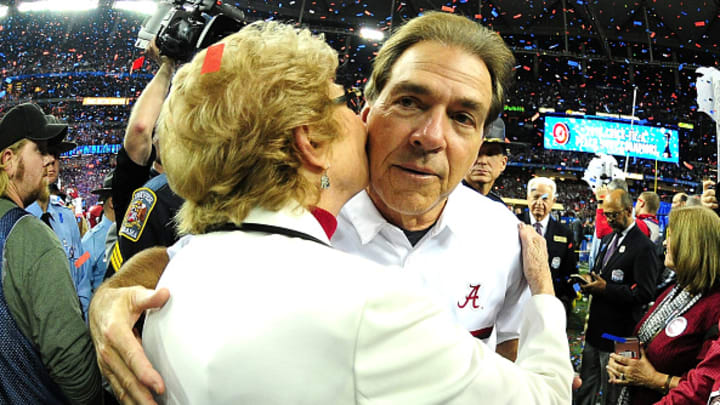
Nick Saban’s mom once called him during practice to tell him she made a hole-in-one
Saban told this story to Brett McMurphy of the Action Network at the SEC’s spring meetings in May 2023, and he published it in September of that year—which would turn out to be the legendary Alabama coach’s last on the sidelines.
It goes like this: Saban was running the Crimson Tide through a spring practice in 2013, at which point he was at the peak of his powers (he’d won three of the last four national championships). During drills, a staffer informed Saban he had a call from his mother, Mary, that couldn’t wait. Apprehensive, Saban took the phone.
“She says ‘brother’—everyone from West Virginia calls each other ‘brother’—‘Brother, I just wanted to let you know I just made a hole-in-one and you’ve never made one,’” Saban told McMurphy. “Yes, she really called me during practice to tell me she made a hole-in-one."
Later in the story, Saban said Mary claimed to be able to call plays better than him. She died in 2024 at 92, having worked for West Virginia’s Secretary of State and elsewhere for decades.
Dabo Swinney’s mom survived and thrived in spite of misfortune as a child and adult
Swinney, Clemson’s coach of 18 years, has told his mother Carol McIntosh’s story at multiple points in his tenure—always fondly but never romantically. First, McIntosh overcame a childhood diagnosis of polio that landed her in a body cast for over a year. Then, after Swinney was born, his father Ervil suffered financial losses, drank excessively, and became violent toward McIntosh. After McIntosh left Ervil, the family’s financial situation deteriorated so much that McIntosh briefly lived with Dabo while he studied at (and later played for) Alabama.
"Dabo was a very positive person, always saw the good and thought he could make it work. He was no different then than he is now. He kept me laughing and motivated me, even in my darkest days,” McIntosh told ESPN’s Mark Schlabach in January 2016.
“Thank you for all that you sacrifice to see that I have everything,” Dabo wrote his mother for Valentine’s Day as a young man in a note shared with Schlabach. McIntosh turned 80 in 2024.
Bear Bryant’s mom inspired a ubiquitous telephone commercial in the Deep South
Most fans readily associate Bryant with the Crimson Tide and the state of Alabama, but he was actually a native of rural Arkansas—the 11th of 12 children, born when his mother Ida Kilgore Bryant was in her late 30s. Ida wanted him to enter the clergy, but Bryant had been a terrific end for the Crimson Tide and embarked upon a long coaching career. His mother died in 1954, shortly before Bryant’s first season at Texas A&M.
Decades later, Bryant—now the successful head coach at Alabama—recorded a warmly received commercial for South Central Bell (a regional telephone company) in which he discussed encouraging his players to keep in touch with their families.
“Have you called your mama today?” he asked in the ad. “I sure wish I could call mine.”
Dan Lanning’s mom traded the city for the country with her children in mind
As hard as it is to remember now, the Oregon coach—a 36-year-old first-time boss—was a bit of an unknown quantity before taking over the Ducks before the 2022 season. To gain insight into Lanning, veteran Oregon sportswriter John Canzano talked to his parents in August of that year. Both of his parents were longtime teachers—father Don science, mother Janis English (Janis remains an avid writer on Christian topics).
In the late 1980s, the Lannings took a considerable leap of faith, moving from Kansas City to the rural Richmond, Mo., area—and vowing to stay there until all their children had finished school, making a “promise to the Lord and to ourselves and to our children.” Dan’s maternal grandfather, Oswald Tanner, had hundreds of acres of property there.
The city mice seemed to transition to country mice perfectly, however. Dan grew up, played for NAIA William Jewell, rose through the coaching ranks, and never forgot his roots—which included (seriously) a turn as Orin Scrivello in a school production of Little Shop of Horrors.
“Whether it be a team, a school play, a church activity, he had a high calling and demanded a lot of himself,” Janis told Canzano. “He worked at bringing everyone else along with him, too. He wasn’t domineering. He was always very encouraging.”
Frank Beamer’s mom told him to keep winning on her deathbed—and Beamer did
Like Lanning, Beamer grew up on a farm, coming of age in the dot town of Fancy Gap, Va. And like Lanning, the legendary Virginia Tech coach’s mother was a teacher. One key difference: Herma Beamer was born in 1918, so per this 2015 story by Jimmy Robertson for the Hokies’ website, much of her work was done in one-room schoolhouses.
Herma supported Frank throughout his 29-year career, until she fell ill during the 2004 season. As her heart faded, Herma’s instructions to Frank were clear, per Jim Reedy of the Washington Post: keep coaching, keep winning.
Herma died on Nov. 18, 2004 at the age of 86, and Frank did just that. Hours after her death, No. 15 Virginia Tech demolished Maryland 55–6; his players presented him with two game balls afterward. One for Frank, one for Herma.
“We take that just like she was our mother,” Hokies quarterback Bryan Randall said after the game.
More College Football from Sports Illustrated
 Add us as a preferred source on Google
Patrick Andres is a staff writer on the Breaking and Trending News team at Sports Illustrated. He joined SI in December 2022, having worked for The Blade, Athlon Sports, Fear the Sword and Diamond Digest. Andres has covered everything from zero-attendance Big Ten basketball to a seven-overtime college football game. He is a graduate of Northwestern University's Medill School of Journalism with a double major in history .
Follow PAndres2001