
Luke Fickell Details How Wisconsin Can Spark its Struggling Ground Game
In this story:
For all of the improvements the Badgers have made offensively this season, they still can't find a way to get their running game off the ground.
Though it hasn't always felt like it (i.e. two weeks ago in a 30-0 loss at Iowa), Wisconsin's offense has made been markedly improved this fall.
The Badgers have gone from 12.8 points per game to 24.4. They've gone from 136.4 passing yards per game to 186.7. Their total offense has gone from 253.1 yards per game to 323.2.
While there's certainly still plenty of room for improvement in those categories — most of them rank in the bottom third of the nation — Wisconsin finally has its offense pointed in the right direction. This unit still doesn't strike fear into opposing teams' hearts, but it's no longer the laughing stock of the Power Four.
One area the Badgers still haven't seen much improvement? The ground game. Last season, Wisconsin ran for 116.7 yards per game. This fall, it's only increased that average by 20 yards, as the Badgers average 136.6 yards per game on the ground.
That's the case even with a revamped running back room featuring three transfers, a new highly-regarded offensive line coach in Eric Mateos and a (now benched) dynamic mobile quarterback who stresses defenses with his legs in Colton Joseph. With three games to go in 2026, widespread improvement within the rushing attack is unrealistic. But Wisconsin faces two porous defenses back-to-back in Rutgers and Maryland; it should be able to make some progress getting this rushing offense off the ground.
How can Wisconsin jumpstart its ground game? Luke Fickell was asked at his weekly press conference on Monday, and he seems to have something in mind.
How the Badgers can spark their ground game




“There’s gotta be some more consistency. The backs have to have the ball in their hand a little more, we have to find ways. Sometimes it's harder when you’re playing multiple guys back there, you don’t give a guy a chance to get a little bit hot. That’s always been an issue for me," he said.
"I think we’ve had some injuries back there that’s put us in a position where, ‘hey, Abu (Sama)’s not super healthy, so we can’t overuse him so let's roll the backs through there.’ And I think sometimes that puts us in a position where nobody has a chance to get hot."
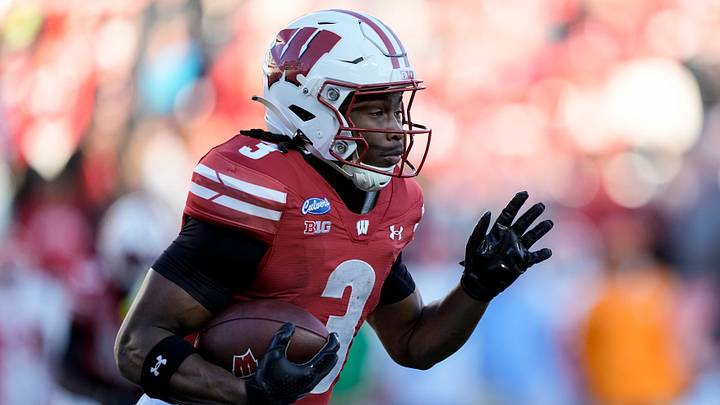
The way Wisconsin has distributed carries has been interesting to say the least. Starter Abu Sama, who is easily the most experienced and productive back in the room and one of the Badgers' biggest transfer portal pickups this winter, is averaging 9.4 carries per game, but the real story has been how much they've fluctuated.
On the road at UCLA, he only notched six carries. The next week, he tallied 17 against USC and it appeared Wisconsin was finally ready to lean on the former Iowa State Cyclone. Lo and behold, the very next week against Iowa, he had just six carries once again.
Meanwhile, though Sama has missed two games with injuries, Darrion Dupree has the most snaps in the running back room with 106 (Sama has 89). Power back and de-facto RB3 Bryan Jackson has 58 snaps. Last week against Rutgers, Sama had nine carries, Jackson had five and Dupree had four; that's a committee approach if I've ever seen one.
"I’ve kinda challenged them, I said look, I’m not saying you go to a one-back system, where only one guy is in there, I’m not even saying go to a two-back system. But I think it’s much more difficult to think you’re gonna go with more than two guys. If you need a third guy, then he’s there," Fickell continued. "I think we gotta hone in and give some of these guys a greater opportunity to get on a little bit of a roll.”
I tend to agree; Wisconsin hasn't let any of its three main backs truly take over a game and ride the hot hand. The Badgers' run blocking could certainly be improved upon as well, and without the threat of Joseph's legs, the math changes on certain option looks. Nonetheless, Wisconsin must pick a top ball-carrier and feed him touches over the final three games of the season.
 Add us as a preferred source on Google

Badgers ON SI lead editor Seamus Rohrer hails from Brooklyn, NY and is a University of Wisconsin J-School grad. He's covered the Badgers since 2020 for outlets including BadgerBlitz, The Daily Cardinal and BadgerNotes.
Follow seamus_rohrer