
Ohio State is Surprise No. 1 in Updated Controversial College Football Rankings
In this story:
While there may not be a perfect consensus around which is the best team in the Big Ten right now, there is a consensus that it’s not Ohio State.
That is, unless you’re a part of the computer algorithmic model that ESPN analysts devised to rank college football teams heading into the regular season finale.
Buckeyes top Big Ten rankings
According to the ESPN College Football Power Index, that is.
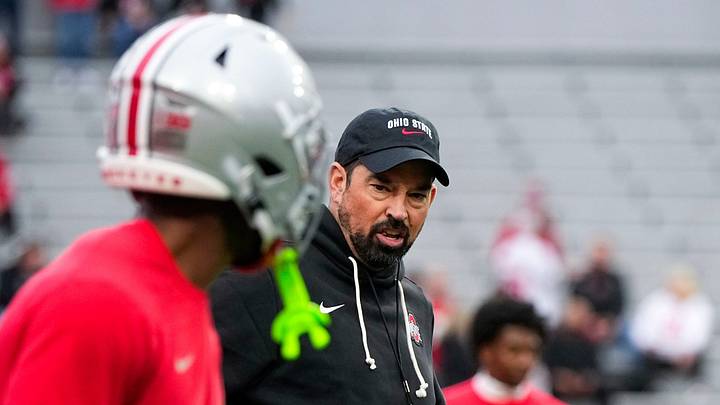
Ohio State, which sits at a meager 7-4 in a 2026 season it would rather forget, still leads the way as the No. 1 ranked team in the Big Ten, by that metric.
Oregon, which beat the Buckeyes in a 41-28 result in Columbus a few weeks ago, place second in the conference, followed by No. 3 Indiana, No. 4 Iowa, and fifth-ranked Nebraska.
Why the FPI Sparks Debate

ESPN’s Football Power Index remains one of college football’s most polarizing metrics.
Unlike the AP Poll or College Football Playoff rankings, which weigh wins, losses, and résumé heavily, FPI is a predictive model.
It estimates how many points better or worse a team is than an average FBS opponent on a neutral field.
Ratings update daily and rest on tens of thousands of season simulations that incorporate efficiency data, results to date, and remaining schedule strength.
More: ESPN Reveals New Top 25 College Football Rankings for Rivalry Week
Critics routinely dismiss the results as “absurd” when a team with multiple losses sits above undefeated or one-loss squads.
Fans and even coaches have accused the system of bias or over-reliance on historical data and recruiting talent rather than pure on-field outcomes.
Defenders counter that FPI is designed to forecast future performance, not crown a current champion, exactly why it often diverges from human polls.
How FPI Actually Ranks Teams
The index produces a continuous rating (for example, +24 means roughly 24 points better than average). Teams are then ordered by that number.
Projected win totals, conference title odds, and playoff probabilities flow from the same simulations.
Because the model prioritizes underlying strength of play over raw records, a talented but injury-hit or schedule-tough team can stay high even after setbacks.
That predictive focus is both its strength and the source of most controversy.
Why the Buckeyes Sit Atop the Big Ten

Despite a rocky stretch that dropped Ohio State to 7-4 overall and 5-3 in conference play, the Buckeyes remain the highest-rated Big Ten team in the latest FPI updates.
Their efficiency metrics, especially on the offensive side led by standout wide receiver Jeremiah Smith, continue to grade out strongly despite everything.
The model still views Ohio State’s talent and underlying performance as superior to other conference contenders, even as human rankings and the CFP committee have slid the Buckeyes well outside the top 20.
That gap between FPI and traditional polls is precisely why the ranking feels controversial to many observers.
Big Ten Title Picture Entering Rivalry Week
The conference race is down to a few teams heading into the final weekend.
UCLA leads at 7-1 in Big Ten play but must host USC. Indiana, Iowa, and Oregon sit at 6-2 and control their own destinies in varying degrees, all with winnable rivalry games.
Saturday’s slate — Ohio State hosting Michigan, UCLA versus USC, Oregon against Washington, Indiana against Purdue, and Iowa versus Nebraska — will all play some role in deciding who reaches Indianapolis.
Multiple scenarios still exist for the two championship-game spots, turning Rivalry Week into a genuine conference-title free-for-all.
 Add us as a preferred source on Google

James Parks is the founder and publisher of College Football HQ. He has covered football for a decade, previously managing several team sites and publishing national content for 247Sports.com for five years. His work has also been published on CBSSports.com. He founded College Football HQ in 2020, and the site joined the Sports Illustrated Fannation Network in 2022 and the On SI network in 2024.