%22%3E%0A%3Cpath%20d%3D%22M0%205.12903H12.8817C17.559%205.12903%2020.5268%206.30107%2022.3762%208.13977C23.9569%209.7204%2024.7848%2011.6881%2024.7848%2014.3978V14.4731C24.7848%2018.3118%2022.7848%2020.9892%2019.5805%2022.5375L25.7203%2031.5052H15.6558L10.6774%2023.9676H8.79565V31.5052H0V5.12903ZM12.6236%2017.6773C14.7311%2017.6773%2016.0107%2016.7311%2016.0107%2015.1182V15.043C16.0107%2013.344%2014.6881%2012.5161%2012.6558%2012.5161H8.81716V17.6773H12.6236Z%22%20fill%3D%22white%22%2F%3E%0A%3Cpath%20d%3D%22M25.8506%2021.3008V21.2256C25.8506%2015.4191%2030.6785%2010.4514%2037.4527%2010.4514C44.2268%2010.4514%2048.9795%2015.3546%2048.9795%2021.1503V21.2256C48.9795%2027.032%2044.1516%2031.9997%2037.3774%2031.9997C30.6032%2031.9997%2025.8506%2027.0965%2025.8506%2021.3008ZM40.7752%2021.3008V21.2256C40.7752%2019.1933%2039.2699%2017.5697%2037.3882%2017.5697C35.5064%2017.5697%2034.0763%2019.1933%2034.0763%2021.1503V21.2256C34.0763%2023.2578%2035.5817%2024.8814%2037.4634%2024.8814C39.3451%2024.8814%2040.7752%2023.2578%2040.7752%2021.3008Z%22%20fill%3D%22white%22%2F%3E%0A%3Cpath%20d%3D%22M50.4629%2021.3762V21.301C50.4629%2014.7849%2054.3768%2010.4516%2059.237%2010.4516C62.3661%2010.4516%2064.0972%2011.8064%2065.4198%2013.2795V4H73.9681V31.5052H65.4198V28.9784C64.022%2030.4837%2062.4413%2031.9891%2059.3123%2031.9891C54.3338%2031.9891%2050.4629%2027.6558%2050.4629%2021.3655V21.3762ZM65.6133%2021.258V21.1827C65.6133%2019.1505%2064.1402%2017.4945%2062.1833%2017.4945C60.2263%2017.4945%2058.7532%2019.1182%2058.7532%2021.1827V21.258C58.7532%2023.3332%2060.2263%2024.9461%2062.1833%2024.9461C64.1402%2024.9461%2065.6133%2023.3225%2065.6133%2021.258Z%22%20fill%3D%22white%22%2F%3E%0A%3Cpath%20d%3D%22M76.0537%2021.3333V21.2581C76.0537%2015.1183%2080.4623%2010.4409%2086.6451%2010.4409C93.9569%2010.4409%2097.3439%2015.5269%2097.3439%2021.7849C97.3439%2022.2366%2097.3439%2022.7634%2097.3009%2023.215H84.0752C84.6773%2025.0215%2086.1074%2025.9677%2087.9569%2025.9677C89.5053%2025.9677%2090.7848%2025.2473%2092.1397%2023.8602L96.731%2027.5161C94.6988%2030.1505%2091.7956%2031.9999%2087.344%2031.9999C80.6021%2031.9999%2076.043%2027.7419%2076.043%2021.3333H76.0537ZM89.5375%2019.4516C89.344%2017.4946%2088.1827%2016.3656%2086.6773%2016.3656C85.172%2016.3656%2084.2257%2017.5699%2083.9677%2019.4516H89.5483H89.5375Z%22%20fill%3D%22white%22%2F%3E%0A%3Cpath%20d%3D%22M98.7305%2021.3008V21.2256C98.7305%2015.4191%20103.558%2010.4514%20110.333%2010.4514C117.107%2010.4514%20121.859%2015.3546%20121.859%2021.1503V21.2256C121.859%2027.032%20117.031%2031.9997%20110.257%2031.9997C103.483%2031.9997%2098.7305%2027.0965%2098.7305%2021.3008ZM113.655%2021.3008V21.2256C113.655%2019.1933%20112.15%2017.5697%20110.268%2017.5697C108.386%2017.5697%20106.956%2019.1933%20106.956%2021.1503V21.2256C106.956%2023.2578%20108.462%2024.8814%20110.343%2024.8814C112.225%2024.8814%20113.655%2023.2578%20113.655%2021.3008Z%22%20fill%3D%22white%22%2F%3E%0A%3Cpath%20fill-rule%3D%22evenodd%22%20clip-rule%3D%22evenodd%22%20d%3D%22M131.368%204.36764C137.191%20-1.45588%20146.632%20-1.45588%20152.456%204.36764C158.279%2010.1912%20158.279%2019.6324%20152.456%2025.4559L141.912%2036L131.368%2025.4559C125.544%2019.6324%20125.544%2010.1912%20131.368%204.36764ZM134.009%207.55761C133.948%207.86849%20133.916%208.39718%20133.916%209.14566V10.4189C133.916%2011.1832%20133.948%2011.7198%20134.013%2012.0267C134.078%2012.3317%20134.278%2012.6168%20134.617%2012.8762C134.956%2013.1376%20135.403%2013.3316%20135.958%2013.4623C136.512%2013.593%20137.1%2013.6583%20137.837%2013.6583C138.573%2013.6583%20139.217%2013.591%20139.769%2013.4524C140.322%2013.3158%20140.761%2013.1178%20141.086%2012.8604C141.411%2012.6029%20141.605%2012.3178%20141.666%2012.0069C141.728%2011.6961%20141.759%2011.1674%20141.759%2010.4189V9.14566C141.759%208.38134%20141.728%207.84473%20141.662%207.53781C141.597%207.23287%20141.397%206.94972%20141.058%206.68834C140.72%206.42696%20140.272%206.23291%20139.718%206.10223C139.163%205.97154%20138.536%205.90619%20137.839%205.90619C137.102%205.90619%20136.459%205.97352%20135.906%206.11213C135.352%206.24875%20134.914%206.44677%20134.589%206.70418C134.265%206.9616%20134.071%207.24673%20134.009%207.55761ZM139.276%2024.8638C142.876%2024.8638%20144.557%2024.2064%20144.557%2021.862V21.858V21.3155C144.557%2019.6581%20143.516%2018.971%20140.252%2018.3136C139.278%2018.1136%20138.908%2017.9136%20138.908%2017.3136V16.9414C138.908%2016.6543%20139.177%2016.5117%20139.413%2016.5117C139.749%2016.5117%20139.918%2016.7137%20139.918%2016.9414V18.1136H144.391V17.3988C144.391%2015.4563%20143.347%2014.4266%20139.177%2014.4266C136.15%2014.4266%20133.896%2015.3414%20133.896%2017.3711V17.7433C133.896%2019.5155%20134.805%2020.3155%20138.201%2021.0303C138.28%2021.0472%20138.355%2021.063%20138.427%2021.0781C139.329%2021.2674%20139.647%2021.3341%20139.647%2021.9174V22.2897C139.647%2022.6619%20139.546%2022.8045%20139.142%2022.8045C138.67%2022.8045%20138.637%2022.5471%20138.637%2022.262V21.2897H133.894V21.7471C133.894%2024.149%20135.476%2024.8638%20139.276%2024.8638ZM145.424%2024.5569H149.925V14.7355H145.424V24.5569ZM146.955%2013.5019H149.925V6.06064H147.092V9.411L145.193%206.06064H142.359V13.5019H145.193V10.1199L146.955%2013.5019ZM138.269%2012.152C138.204%2012.2688%20138.055%2012.3262%20137.825%2012.3262L137.827%2012.3282C137.604%2012.3282%20137.459%2012.2767%20137.398%2012.1757C137.336%2012.0748%20137.305%2011.8074%20137.305%2011.3758V7.90068C137.305%207.51852%20137.352%207.28684%20137.445%207.20962C137.538%207.13239%20137.675%207.09279%20137.851%207.09279C138.059%207.09279%20138.198%207.14031%20138.265%207.23734C138.332%207.33239%20138.366%207.55416%20138.366%207.90068V11.3203C138.366%2011.7579%20138.334%2012.0352%20138.269%2012.152Z%22%20fill%3D%22white%22%2F%3E%0A%3C%2Fg%3E%0A%3Cdefs%3E%0A%3CclipPath%20id%3D%22clip0_15247_3552%22%3E%0A%3Crect%20width%3D%22157%22%20height%3D%2236%22%20fill%3D%22white%22%2F%3E%0A%3C%2FclipPath%3E%0A%3C%2Fdefs%3E%0A%3C%2Fsvg%3E%0A)
Muhammad Ali Was the Greatest. He Was Also a Cowboy.
He was known, simply, as The Greatest.
Muhammad Ali bestowed the name upon himself – shouted loud and proud yet in a playful way that convinced people of all ages and backgrounds on every inhabitable continent to allow him into their hearts.
Early on, before Ali became the most recognizable and beloved athlete on the planet, the media had their own nickname for him: “The Louisville Lip.”
The Greatest? They played along suspiciously. The audacity to anoint oneself with a status beyond real accomplishment! But Ali brought artistry to pre-fight trash talk, backed up the braggadocio like a fleet-footed brawling ballerina, and charmed the socks off everyone afterward, often adding that he was a poet and prophet and savior of boxing, and the name stuck.
The Greatest.
Nobody was faster – with a punch or a quip. Or funnier. Or prettier.

But the name Muhammad Ali still resonates today not because of his razor-sharp wit or his Adonis physique or his record as the world’s first three-time heavyweight champion (1964, 1974, 1978). His true greatness – and the reason his name still conjures warm thoughts and feelings – came from what happened outside the ropes.
Ali was a man of steadfast convictions and a passionate humanitarian – a relentless champion of the downtrodden and needy, turning his fame into a force for good.
Understanding that the marvelous movement of Ali’s life could inspire human beings to be and do better, more than 20 years ago he and his wife Lonnie conceived of the Muhammad Ali Center in Louisville. The Center, which opened in 2005, provides a vivid and thorough museum-experience journey through every act of Ali’s meaningful and never dull life. He passed in 2016.
“There are so many lessons we can learn from Muhammad,” Lonnie Ali said. “He had a sincere, authentic love for all of humanity; he was curious about people's paths – their lives, their families. He was curious about different cultures that led him to go around the world. But at the core of this, he really had a sincere love for people and for children. I share that love, too.
“Later in his life, he just had to show up, and it inspired people and put smiles on their faces. Even today, if you say Muhammad’s name, people smile. The Center is here to mobilize Muhammad’s legacy to inspire greatness, to cultivate curious and courageous leaders and to hopefully inspire people to live with courage and create a more compassionate world.”
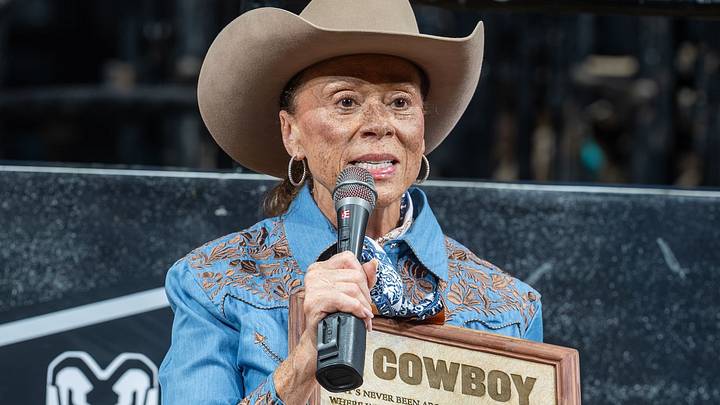
For keeping her husband’s legacy alive with purpose, courage and conviction, Lonnie Ali was presented PBR’s Be Cowboy Award at the PBR Ram Challenger Series event at the KFC Yum! Center in Louisville on Saturday night.

The award is given to those who embody integrity, service and compassion to make their communities and the world a better place.
Recent recipients include Scott Rukan, a rookie Coast Guard swimmer on his first mission who is credited with saving 165 lives in the flooding at Camp Mystic in Texas; Richard Casper, a combat-injured Marine who founded a nonprofit using art and music to help veterans heal; and Principal Kirk Moore, who saved his students by tackling an armed intruder at their high school, suffering a gunshot wound in the process.
“Receiving the Be Cowboy honor is awe-inspiring for me because I know this is really a blessing; it’s a gift that Muhammad gave me, because people receive me the way they received him, and that has been transferred to me,” Ali said. “I am extremely grateful and appreciative, and I don't take it for granted.”

Giving back traces to Ali’s first professional fight. Acting on the courage of his convictions nearly ended it.
After the world fell in love with Cassius Clay from Louisville during his Gold Medal performance at the 1960 Olympics in Rome, he turned pro and fought in his hometown. He made $2,000 for his six-round unanimous decision. The 18-year-old who had already been training intensely for years in pursuing his childhood dream of becoming world champion donated the winnings to a local children’s hospital.
It wasn’t a publicity stunt. It was who he was. Over the years, Ali donated and helped raise millions of dollars for organizations like Feed the Children and UNICEF.
His daily acts of kindness were usually away from the public eye, like handing out hundred-dollar bills to downtrodden people he encountered on the street or the time he emptied his refrigerator and brought the food to a soup kitchen. They needed it more than he did.

Ali lived on his terms, beholden to no one. Not even the U.S. government.
With war raging in Vietnam, Ali was made eligible for the draft in 1966. In April 1967, he refused to be inducted into the United States Armed Services, claiming he had no problem with the Viet Cong and certainly no desire to kill any of them. Charged with draft evasion, he lost his license to box in his prime and faced five years in prison. After four years of court appeals, the US Supreme Court overturned his conviction.
Ali once declared “I’m too beautiful to be a fighter!” but it was all he ever wanted to do. He got back to a grueling training regimen to try to win back a World Championship lost not to an opponent but the legal process.
Ali’s anti-war stance, and outspoken nature about social injustice, made him a symbol bigger than any other man. He was a beautiful, strong, successful, highly opinionated Black man who spoke his mind about racial inequality. He also changed his name from Cassius Clay (he called it “a slave name”) to Muhammad Ali, finding emotional shelter in the controversial Nation of Islam and signaling his full freedom from the constraints of anything anyone demanded of him.
Ali’s time away from boxing meant he had to take on other jobs to get his finances straight. Even when he returned to fighting, he continued making paid public appearances, including promoting a landmark Black rodeo in New York City held on Labor Day weekend in 1971 – just six months after his brutal loss to Joe Frazier at Madison Square Garden in what became known as “The Fight of the Century.”
The rodeo, which drew the best Black cowboys from all over the country, began with a 3-mile parade into Harlem. Ali appeared on horseback in front of the Apollo Theater. The rodeo was held at the stadium on Randall's Island, produced by Bud Bramwell and Cleo Hearn through their American Black Cowboy Association with the help of a Newark politician named George Richardson. The parade and event were chronicled in a rare documentary “Black Rodeo,” directed by Jeff Kanew.

“Ali’s appearance, which was featured in the climatic third act of Kanew’s documentary, established the rodeo as pivotal moment for all Black Cowboys – past and present,” said Keith Cartwright, author of Black Cowboys of Rodeo: Unsung Heroes from Harlem to Hollywood and the American West.
At the rodeo, Ali rode atop a docile, aging bull, according to Cartwright in an article in The Undefeated. As Cartwright recounts the scene, Ali was cautious mounting the bull due to his prodigious horns. “If this bull bucks, sucker, you better run like hell,” Ali told the bull’s handler. “I’ll whip you worse than I whipped Joe Frazier.”
For Lonnie Ali, mounting a bull was quintessential Muhammad given his affection for Cowboys and the friendships he struck up with cowboy country singers including Waylon Jennings, Kris Kristopherson, Willie Nelson and Johnny Cash.
“Just like Johnny Cash, Muhammed considered himself somewhat of an outlaw as well,” Lonnie Ali said. “He had that cowboy flavor. He liked their originality, and he liked their authenticity and their fearless way of living.
“What being a cowboy says is that you are living an authentic life with values that the Cowboys hold sacred – it’s about courage, it’s about authenticity, it’s about loyalty, respect for others and compassion,” Lonnie said. “These are cowboy values and these were the same values that Muhammad held. And I have to tell you, Muhammad was a real cowboy. I mean when you think about it the way he was, he didn’t mind being alone blazing his own path. That’s what Cowboys do.”

Ali also enjoyed watching lightweight cowboys trying to take on heavyweight bulls ten times their size. He attended PBR events in Arizona, where he had a home, often with his sister Marilyn in tow.
Ali would never publicly call himself a cowboy. On the way to becoming the most beloved athlete on the planet, he introduced himself simply as “The Greatest.”
The life he lived, the people he lifted and the inspiration he continues to provide through the extraordinary Muhammad Ali Center proved that name true.
 Add us as a preferred source on Google
Andrew Giangola, who has held high-profile public relations positions with Pepsi-Cola, Simon & Schuster, Accenture, McKinsey & Co., and NASCAR, now serves as Vice President, Strategic Communications for PBR. In addition to serving in high-profile public relations positions over the past 25 years, Andrew Giangola is the author of the critically acclaimed books The Weekend Starts on Wednesday: True Stories of Remarkable NASCAR Fans and Love & Try: Stories of Gratitude and Grit in Professional Bull Riding, which benefits injured bull riders and was named the best nonfiction book of 2022 at the 62nd Annual Western Heritage Awards. Giangola graduated from Fordham University, concentrating in journalism, when he was able to concentrate. He lives in Brooklyn with his wife Malvina.