%22%3E%0A%3Cpath%20d%3D%22M0%205.12903H12.8817C17.559%205.12903%2020.5268%206.30107%2022.3762%208.13977C23.9569%209.7204%2024.7848%2011.6881%2024.7848%2014.3978V14.4731C24.7848%2018.3118%2022.7848%2020.9892%2019.5805%2022.5375L25.7203%2031.5052H15.6558L10.6774%2023.9676H8.79565V31.5052H0V5.12903ZM12.6236%2017.6773C14.7311%2017.6773%2016.0107%2016.7311%2016.0107%2015.1182V15.043C16.0107%2013.344%2014.6881%2012.5161%2012.6558%2012.5161H8.81716V17.6773H12.6236Z%22%20fill%3D%22white%22%2F%3E%0A%3Cpath%20d%3D%22M25.8506%2021.3008V21.2256C25.8506%2015.4191%2030.6785%2010.4514%2037.4527%2010.4514C44.2268%2010.4514%2048.9795%2015.3546%2048.9795%2021.1503V21.2256C48.9795%2027.032%2044.1516%2031.9997%2037.3774%2031.9997C30.6032%2031.9997%2025.8506%2027.0965%2025.8506%2021.3008ZM40.7752%2021.3008V21.2256C40.7752%2019.1933%2039.2699%2017.5697%2037.3882%2017.5697C35.5064%2017.5697%2034.0763%2019.1933%2034.0763%2021.1503V21.2256C34.0763%2023.2578%2035.5817%2024.8814%2037.4634%2024.8814C39.3451%2024.8814%2040.7752%2023.2578%2040.7752%2021.3008Z%22%20fill%3D%22white%22%2F%3E%0A%3Cpath%20d%3D%22M50.4629%2021.3762V21.301C50.4629%2014.7849%2054.3768%2010.4516%2059.237%2010.4516C62.3661%2010.4516%2064.0972%2011.8064%2065.4198%2013.2795V4H73.9681V31.5052H65.4198V28.9784C64.022%2030.4837%2062.4413%2031.9891%2059.3123%2031.9891C54.3338%2031.9891%2050.4629%2027.6558%2050.4629%2021.3655V21.3762ZM65.6133%2021.258V21.1827C65.6133%2019.1505%2064.1402%2017.4945%2062.1833%2017.4945C60.2263%2017.4945%2058.7532%2019.1182%2058.7532%2021.1827V21.258C58.7532%2023.3332%2060.2263%2024.9461%2062.1833%2024.9461C64.1402%2024.9461%2065.6133%2023.3225%2065.6133%2021.258Z%22%20fill%3D%22white%22%2F%3E%0A%3Cpath%20d%3D%22M76.0537%2021.3333V21.2581C76.0537%2015.1183%2080.4623%2010.4409%2086.6451%2010.4409C93.9569%2010.4409%2097.3439%2015.5269%2097.3439%2021.7849C97.3439%2022.2366%2097.3439%2022.7634%2097.3009%2023.215H84.0752C84.6773%2025.0215%2086.1074%2025.9677%2087.9569%2025.9677C89.5053%2025.9677%2090.7848%2025.2473%2092.1397%2023.8602L96.731%2027.5161C94.6988%2030.1505%2091.7956%2031.9999%2087.344%2031.9999C80.6021%2031.9999%2076.043%2027.7419%2076.043%2021.3333H76.0537ZM89.5375%2019.4516C89.344%2017.4946%2088.1827%2016.3656%2086.6773%2016.3656C85.172%2016.3656%2084.2257%2017.5699%2083.9677%2019.4516H89.5483H89.5375Z%22%20fill%3D%22white%22%2F%3E%0A%3Cpath%20d%3D%22M98.7305%2021.3008V21.2256C98.7305%2015.4191%20103.558%2010.4514%20110.333%2010.4514C117.107%2010.4514%20121.859%2015.3546%20121.859%2021.1503V21.2256C121.859%2027.032%20117.031%2031.9997%20110.257%2031.9997C103.483%2031.9997%2098.7305%2027.0965%2098.7305%2021.3008ZM113.655%2021.3008V21.2256C113.655%2019.1933%20112.15%2017.5697%20110.268%2017.5697C108.386%2017.5697%20106.956%2019.1933%20106.956%2021.1503V21.2256C106.956%2023.2578%20108.462%2024.8814%20110.343%2024.8814C112.225%2024.8814%20113.655%2023.2578%20113.655%2021.3008Z%22%20fill%3D%22white%22%2F%3E%0A%3Cpath%20fill-rule%3D%22evenodd%22%20clip-rule%3D%22evenodd%22%20d%3D%22M131.368%204.36764C137.191%20-1.45588%20146.632%20-1.45588%20152.456%204.36764C158.279%2010.1912%20158.279%2019.6324%20152.456%2025.4559L141.912%2036L131.368%2025.4559C125.544%2019.6324%20125.544%2010.1912%20131.368%204.36764ZM134.009%207.55761C133.948%207.86849%20133.916%208.39718%20133.916%209.14566V10.4189C133.916%2011.1832%20133.948%2011.7198%20134.013%2012.0267C134.078%2012.3317%20134.278%2012.6168%20134.617%2012.8762C134.956%2013.1376%20135.403%2013.3316%20135.958%2013.4623C136.512%2013.593%20137.1%2013.6583%20137.837%2013.6583C138.573%2013.6583%20139.217%2013.591%20139.769%2013.4524C140.322%2013.3158%20140.761%2013.1178%20141.086%2012.8604C141.411%2012.6029%20141.605%2012.3178%20141.666%2012.0069C141.728%2011.6961%20141.759%2011.1674%20141.759%2010.4189V9.14566C141.759%208.38134%20141.728%207.84473%20141.662%207.53781C141.597%207.23287%20141.397%206.94972%20141.058%206.68834C140.72%206.42696%20140.272%206.23291%20139.718%206.10223C139.163%205.97154%20138.536%205.90619%20137.839%205.90619C137.102%205.90619%20136.459%205.97352%20135.906%206.11213C135.352%206.24875%20134.914%206.44677%20134.589%206.70418C134.265%206.9616%20134.071%207.24673%20134.009%207.55761ZM139.276%2024.8638C142.876%2024.8638%20144.557%2024.2064%20144.557%2021.862V21.858V21.3155C144.557%2019.6581%20143.516%2018.971%20140.252%2018.3136C139.278%2018.1136%20138.908%2017.9136%20138.908%2017.3136V16.9414C138.908%2016.6543%20139.177%2016.5117%20139.413%2016.5117C139.749%2016.5117%20139.918%2016.7137%20139.918%2016.9414V18.1136H144.391V17.3988C144.391%2015.4563%20143.347%2014.4266%20139.177%2014.4266C136.15%2014.4266%20133.896%2015.3414%20133.896%2017.3711V17.7433C133.896%2019.5155%20134.805%2020.3155%20138.201%2021.0303C138.28%2021.0472%20138.355%2021.063%20138.427%2021.0781C139.329%2021.2674%20139.647%2021.3341%20139.647%2021.9174V22.2897C139.647%2022.6619%20139.546%2022.8045%20139.142%2022.8045C138.67%2022.8045%20138.637%2022.5471%20138.637%2022.262V21.2897H133.894V21.7471C133.894%2024.149%20135.476%2024.8638%20139.276%2024.8638ZM145.424%2024.5569H149.925V14.7355H145.424V24.5569ZM146.955%2013.5019H149.925V6.06064H147.092V9.411L145.193%206.06064H142.359V13.5019H145.193V10.1199L146.955%2013.5019ZM138.269%2012.152C138.204%2012.2688%20138.055%2012.3262%20137.825%2012.3262L137.827%2012.3282C137.604%2012.3282%20137.459%2012.2767%20137.398%2012.1757C137.336%2012.0748%20137.305%2011.8074%20137.305%2011.3758V7.90068C137.305%207.51852%20137.352%207.28684%20137.445%207.20962C137.538%207.13239%20137.675%207.09279%20137.851%207.09279C138.059%207.09279%20138.198%207.14031%20138.265%207.23734C138.332%207.33239%20138.366%207.55416%20138.366%207.90068V11.3203C138.366%2011.7579%20138.334%2012.0352%20138.269%2012.152Z%22%20fill%3D%22white%22%2F%3E%0A%3C%2Fg%3E%0A%3Cdefs%3E%0A%3CclipPath%20id%3D%22clip0_15247_3552%22%3E%0A%3Crect%20width%3D%22157%22%20height%3D%2236%22%20fill%3D%22white%22%2F%3E%0A%3C%2FclipPath%3E%0A%3C%2Fdefs%3E%0A%3C%2Fsvg%3E%0A)
PBR Team Series: How A Global Experiment Became Bull Riding’s Biggest Evolution
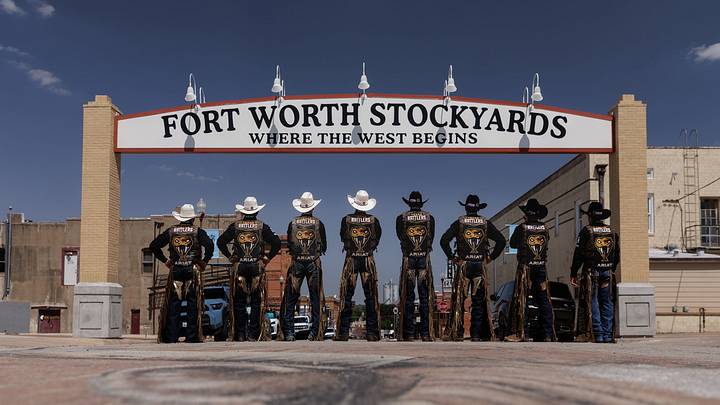
When the PBR Team Series launched in 2022, many fans saw it as a bold shift, a sport built on individual grit suddenly embracing the dynamics of team competition. But the roots of this transformation stretch back decades, shaped by global experiments, athlete feedback, and a vision to professionalize bull riding in ways the sport had never seen.
To understand how the Team Series came to life, you must start with a few of the people who helped build it. Rodeo on SI recently sat down with some of the driving forces behind the Texas Rattlers Team to hear it firsthand.
Chad Blakenship, President and General Manager for the Texas Rattlers Team. After seven years with the PBR, Blakenship led the launch and execution of PBR Teams, watching the idea evolve from skepticism to undeniable momentum.
Cody Lambert, Head Coach of the Texas Rattlers. Coach Lambert was a professional bull rider, a co‑founder of the PBR, a driving force behind the creation and implementation of the modern protective vest and spent roughly 25 years in leadership with the PBR, primarily as Director of Livestock and Vice President, before transitioning into coaching in 2022.
Morgan Wallace is a marketing and social media professional who worked for the Professional Bull Riders (PBR) before joining the Texas Rattlers. Her career centers on promoting western sports, rodeo culture, and agricultural heritage.
Who Created the Concept? Blakenship is very clear that the idea came from Commissioner Sean Gleason: “The concept really comes from Sean Gleason, who’s the commissioner and CEO of PBR.”
So, the origin looks like this:
- Sean Gleason → conceived the idea
- Chad Blankenship → led the launch and execution
- Morgan Wallace → worked on marketing, content, and fan experience
- Coaches like Cody Lambert → shaped the competitive and cultural side
- Ownership groups → invested and built the league structure
The Global Cup: The Spark That Started It All
The earliest seeds of the Team Series were planted in an event that happened years before the league existed: the PBR Global Cup, the spark that started it all.
The Global Cup brought together national teams: the U.S., Canada, Mexico, Australia, and Brazil, competing under their country’s flag. Events were staged in massive venues like AT&T Stadium, Edmonton’s Rogers Place, and Sydney’s Qudos Bank Arena. Fans loved it. National pride is a powerful force, and the Global Cup tapped into that energy instantly.
But the real surprise wasn’t the fans, it was the riders. Bull riders are individual athletes by nature. They travel alone, compete alone, and earn alone. But when they rode for their country, something changed. They talked openly about how meaningful it felt to win for someone else. They felt accountable to teammates. They felt supported. They felt part of something bigger. That emotional shift lit the fuse.
As Blakenship explained, riders said things like: “It was suddenly bigger than themselves.” That realization that bull riders wanted team dynamics became the foundation for the Team Series.
COVID, Reinvention, And The Birth Of The Team Series

Coming out of COVID, PBR leadership saw an opportunity to reshape the sport. Commissioner Sean Gleason took the lessons of the Global Cup and asked a simple question: What if we built a full league around teams, and not just a one‑off event? And the answer became the PBR Team Series.
Launching the league created: New earning opportunities for riders, new coaching jobs, new front‑office roles, new ownership groups, and new pathways for young athletes. It also brought major sports investors into Western sports, owners with stakes in MLB, MLS, Formula One, European soccer, the NFL, and more. That level of investment signaled something important: the business world believed bull riding was ready for a leap forward.
The Texas Rattlers were the first team purchased, led by the Fisher family, owners of the Oakland A’s, San Jose Earthquakes, and Ariat, along with Fort Worth Businessman Leonard Firestone. Other teams followed, backed by names like Johnny Morris (Bass Pro Shops), Richard Childress (NASCAR), Teton Ridge, Avenue Capital, and professional athletes like Austin Dillon and Taylor Gooch. Bull riding was no longer just a sport. It was becoming a league.
Why Teams Matter: Coaching, Development, And Professionalization
One of the biggest advantages of the Team Series is something bull riding has never truly had: coaching. In most sports, even niche ones like cycling, elite coaching is everywhere. Thousands of coaches work with athletes daily. But bull riding has historically relied on: Family tradition, mentorship, occasional clinics, and self‑teaching. There was no system. No pipeline. No structured development. But the Team Series changed that. Teams now employ: Head coaches, assistant coaches, strength and conditioning staff, recovery specialists, and performance analysts.
Recently, the Fort Worth based Texas Rattlers built and opened the first dedicated bull riding performance center, a facility designed for training, recovery, and year‑round development. Blankenship predicts that within five years, most teams will have similar facilities.
The results are already visible: ride percentages are rising in both the Team Series and the individual PBR season. Riders are getting better - technically, physically, and mentally. The sport is leveling up.
A New Pathway For Young Athletes
Before the Team Series, becoming a bull rider often depended on: Family involvement, geographic proximity, access to livestock, and luck. Now, young riders can declare for the draft at 18. They can be scouted. They can be coached. They can join a team with resources, mentorship, and structure.
There are 100 bull riding jobs in the Team Series; far more than the 40 spots available in the elite Unleash the Beast season. That depth gives young riders a chance to grow, learn, and earn in ways the sport never offered before.
As Blankenship put it: “This is a huge opportunity, not just for bull riders, but for the entire industry.”
The Fan Experience: Making Bull Riding Family‑friendly
Morgan’s perspective highlights another evolution: the fan experience.
Coming from a traditional rodeo background, she was initially skeptical. But once she saw families, kids, and newcomers engaging with the sport in a team format, she realized the potential.
Mascots, team branding, community outreach, these are staples of mainstream sports, and they work. Kids understand teams. They understand scoring. They understand cheering for “their” side.
The Team Series makes bull riding accessible to new audiences, especially families.
Expansion And The Future

The league currently has 10 teams, but expansion is already underway. PBR has announced plans to add up to two more teams, likely in 2027 or 2028. Markets like Edmonton, home of a wildly successful Global Cup event, are being discussed publicly.
International teams aren’t here yet, but the door is open.
The ownership groups exploring expansion all have major sports investments. That’s a sign of confidence — and a sign of growth.
The Bottom Line: The Team Series Is Changing Western Sports
The PBR Team Series isn’t just a new format. It’s a structural evolution — one that:
- Professionalizes bull riding
- Creates new opportunities
- Elevates athlete performance
- Attracts major investors
- Expands fan engagement
- Builds a pathway for future generations
It’s the biggest shift in bull riding since the founding of PBR itself back in April 1992. And according to the people who helped build it, this is only the beginning.
The Power Of A Team: “We’ve All Got Skin In The Game”
Lambert’s explanation of the Team Series begins with something simple: support.
As a former rider, he knows firsthand how much your traveling partners matter. In rodeo, the people you surround yourself with can make or break your career. They coach you, challenge you, hold you accountable, and sometimes tell you the hard truths you don’t want to hear.
The Team Series takes that dynamic and elevates it. “With teams, there’s an opportunity to share a locker room with only the elite bull riders,” Lambert says. “You get grown men together working for one common goal.”
It’s not just camaraderie; it’s structure. Coaching. Planning. Strategy. Riders aren’t just showing up and hoping for the best. They’re preparing, studying film, managing their careers, and learning from each other.
And everyone has something at stake. “We’ve all got skin in the game,” Lambert says. “I’m not riding a single bull, but I’ve got to win these games. I’ve got to have our guys physically and mentally ready.” That shared responsibility is something bull riding has never truly had before.
Lambert doesn’t sugarcoat it: the Team Series is the highest level of bull riding in the world. “The toughest bulls in the PBR are what come to the team events,” he says. “They come from all over.” The bulls are harder. The stakes are higher. The money is better. And the riders who make it to a team have already proven themselves at the top of the sport.
This isn’t a developmental league — it’s the pinnacle. But Lambert believes the Team Series does influence the developmental side of bull riding. Young riders see the professionalism, the coaching, the facilities, and the opportunities, and they aspire to reach that level. It raises the bar for everyone.
Lambert has watched bull riding grow from a rodeo event to a televised global sport. With that growth comes opportunity and distraction. “You have to be a more focused pro to survive in today’s bull riding,” he says. “Everything you do is going to be exposed.”
The money is bigger. The endorsements are bigger. The spotlight is brighter. Riders must manage their careers with discipline and intention. But one thing hasn’t changed: “The guy that rides the best always gets paid the most.”
That’s the purity of bull riding — and the reason Lambert believes it will always stand apart.
The Future: Growth, Expansion, And Global Potential
In its fifth season, the Team Series continues to grow across America, and many inside the sport believe expansion into other countries is only a matter of time. Regional pride, team identity, and hometown loyalty are the foundations of every major sport. Now, they’re part of bull riding too.
Here’s the remaining 2026 PBR Team Series schedule:
- October 16–18, 2026 — hosted by the New York Mavericks, Belmont, NY
- October 23–25, 2026 — hosted by the Kansas City Outlaws at T-Mobile Center in Kansas City, Missouri
- November 6–8, 2026 — Las Vegas, NV
- 2026 PBR Teams Championship – T-Mobile Arena All 10 teams compete in a progressive elimination format to crown the season champion.
Current PBR Teams:
- Arizona Ridge Riders
- Austin Gamblers
- Carolina Cowboys
- Florida Freedom
- Kansas City Outlaws
- Missouri Thunder
- Nashville Stampede
- New York Mavericks
- Oklahoma Wildcatters
- Texas Rattlers
 Add us as a preferred source on Google
Tresha Glowacki grew up on a dairy farm in East Tennessee, where hard work and storytelling went hand in hand. Now living in Texas, she’s a devoted writer with a love for all things Western-horses, rodeos, and music. Her writing reflects the life she lives: grounded, spirited, and full of heart. When she’s not riding or writing, she’s spending time with her kids and animals that keep her world turning.