%22%3E%0A%3Cpath%20d%3D%22M0%204.9397H7.3484V12.6932H14.0649V4.9397H21.4133V26.912H14.0649V19.037H7.3484V26.912H0V4.9397Z%22%20fill%3D%22white%22%2F%3E%0A%3Cpath%20d%3D%22M23.6572%204H31.0299V8.55326H23.6572V4ZM23.7788%209.77664H30.9003V26.9121H23.7788V9.77664Z%22%20fill%3D%22white%22%2F%3E%0A%3Cpath%20d%3D%22M32.7241%2029.861L34.9197%2025.5589C36.8317%2026.5635%2038.7519%2027.1955%2041.1014%2027.1955C43.7669%2027.1955%2045.1848%2025.8101%2045.1848%2023.4281V22.9258C44.2125%2024.0276%2042.6084%2025.2834%2040.2264%2025.2834C35.8028%2025.2834%2032.6025%2022.1399%2032.6025%2017.4084V17.3436C32.6025%2012.5392%2035.8676%209.37134%2039.8213%209.37134C42.3329%209.37134%2043.8074%2010.3112%2045.0632%2011.5994V9.77643H52.1848V22.5855C52.1848%2025.7533%2051.5285%2027.9246%2049.9568%2029.4883C48.4174%2031.0277%2046.0679%2031.9999%2042.2357%2031.9999C38.4035%2031.9999%2035.4868%2031.2464%2032.7241%2029.8691V29.861ZM45.2172%2017.3679V17.3031C45.2172%2015.8285%2044.091%2014.6376%2042.3572%2014.6376C40.6234%2014.6376%2039.4972%2015.8609%2039.4972%2017.3679V17.4327C39.4972%2018.9073%2040.6234%2020.0658%2042.3572%2020.0658C44.091%2020.0658%2045.2172%2018.8748%2045.2172%2017.3679Z%22%20fill%3D%22white%22%2F%3E%0A%3Cpath%20d%3D%22M54.3145%204H61.436V12.0695C62.5379%2010.6597%2064.2636%209.37155%2066.6779%209.37155C70.2914%209.37155%2072.5437%2011.7535%2072.5437%2015.6181V26.9202H65.4221V17.9109C65.4221%2016.4364%2064.5471%2015.5857%2063.4777%2015.5857C62.4082%2015.5857%2061.436%2016.4364%2061.436%2017.9109V26.9202H54.3145V4Z%22%20fill%3D%22white%22%2F%3E%0A%3Cpath%20d%3D%22M80.8983%2023.6146L84.8196%2018.9398C87.2016%2020.7627%2089.9319%2021.5162%2092.5083%2021.5162C93.8289%2021.5162%2094.388%2021.1678%2094.388%2020.5764V20.5116C94.388%2019.8796%2093.6993%2019.5393%2091.3417%2019.0694C86.4157%2018.0648%2082.0812%2016.6551%2082.0812%2012.0046V11.9398C82.0812%207.76732%2085.3463%204.53467%2091.4065%204.53467C95.6437%204.53467%2098.7792%205.5393%20101.323%207.54857L97.7421%2012.5069C95.6681%2011%2093.1889%2010.3437%2091.1472%2010.3437C90.0454%2010.3437%2089.543%2010.7245%2089.543%2011.2511V11.3159C89.543%2011.9155%2090.1426%2012.2882%2092.4597%2012.7257C98.0743%2013.7627%20101.842%2015.3912%20101.842%2019.8148V19.8796C101.842%2024.4977%2098.0419%2027.3172%2092.1437%2027.3172C87.6877%2027.3172%2083.6692%2026.0614%2080.874%2023.6146H80.8983Z%22%20fill%3D%22white%22%2F%3E%0A%3Cpath%20d%3D%22M102.838%2018.4374V18.3726C102.838%2013.5682%20106.605%209.39575%20112.187%209.39575C115.955%209.39575%20118.62%2011.3402%20119.941%2014.1354L114.829%2017.0196C114.229%2015.9178%20113.476%2015.2939%20112.317%2015.2939C110.81%2015.2939%20109.684%2016.6145%20109.684%2018.3078V18.3726C109.684%2020.1631%20110.81%2021.4513%20112.228%2021.4513C113.484%2021.4513%20114.205%2020.8194%20114.893%2019.7256L120.071%2022.6747C118.531%2025.5347%20115.931%2027.3495%20111.847%2027.3495C106.638%2027.3495%20102.838%2023.2338%20102.838%2018.4374Z%22%20fill%3D%22white%22%2F%3E%0A%3Cpath%20d%3D%22M121.164%204H128.286V12.0695C129.387%2010.6597%20131.113%209.37155%20133.528%209.37155C137.141%209.37155%20139.393%2011.7535%20139.393%2015.6181V26.9202H132.272V17.9109C132.272%2016.4364%20131.397%2015.5857%20130.327%2015.5857C129.258%2015.5857%20128.286%2016.4364%20128.286%2017.9109V26.9202H121.164V4Z%22%20fill%3D%22white%22%2F%3E%0A%3Cpath%20d%3D%22M140.867%2018.405V18.3402C140.867%2013.5033%20144.886%209.36328%20150.533%209.36328C156.18%209.36328%20160.142%2013.4466%20160.142%2018.2753V18.3402C160.142%2023.177%20156.123%2027.317%20150.476%2027.317C144.829%2027.317%20140.867%2023.2337%20140.867%2018.405ZM153.295%2018.405V18.3402C153.295%2016.6469%20152.04%2015.2939%20150.468%2015.2939C148.896%2015.2939%20147.705%2016.6469%20147.705%2018.2753V18.3402C147.705%2020.0335%20148.961%2021.3865%20150.533%2021.3865C152.104%2021.3865%20153.295%2020.0335%20153.295%2018.405Z%22%20fill%3D%22white%22%2F%3E%0A%3Cpath%20d%3D%22M161.203%2018.405V18.3402C161.203%2013.5033%20165.222%209.36328%20170.869%209.36328C176.516%209.36328%20180.477%2013.4466%20180.477%2018.2753V18.3402C180.477%2023.177%20176.459%2027.317%20170.812%2027.317C165.165%2027.317%20161.203%2023.2337%20161.203%2018.405ZM173.631%2018.405V18.3402C173.631%2016.6469%20172.376%2015.2939%20170.804%2015.2939C169.232%2015.2939%20168.041%2016.6469%20168.041%2018.2753V18.3402C168.041%2020.0335%20169.297%2021.3865%20170.869%2021.3865C172.44%2021.3865%20173.631%2020.0335%20173.631%2018.405Z%22%20fill%3D%22white%22%2F%3E%0A%3Cpath%20d%3D%22M182.139%204H189.26V26.9121H182.139V4Z%22%20fill%3D%22white%22%2F%3E%0A%3Cpath%20fill-rule%3D%22evenodd%22%20clip-rule%3D%22evenodd%22%20d%3D%22M199.368%204.36764C205.191%20-1.45588%20214.632%20-1.45588%20220.456%204.36764C226.279%2010.1912%20226.279%2019.6324%20220.456%2025.4559L209.912%2036L199.368%2025.4559C193.544%2019.6324%20193.544%2010.1912%20199.368%204.36764ZM202.009%207.55761C201.948%207.86849%20201.916%208.39718%20201.916%209.14566V10.4189C201.916%2011.1832%20201.948%2011.7198%20202.013%2012.0267C202.078%2012.3317%20202.278%2012.6168%20202.617%2012.8762C202.956%2013.1376%20203.403%2013.3316%20203.958%2013.4623C204.512%2013.593%20205.1%2013.6583%20205.837%2013.6583C206.573%2013.6583%20207.217%2013.591%20207.769%2013.4524C208.322%2013.3158%20208.761%2013.1178%20209.086%2012.8604C209.411%2012.6029%20209.605%2012.3178%20209.666%2012.0069C209.728%2011.6961%20209.759%2011.1674%20209.759%2010.4189V9.14566C209.759%208.38134%20209.728%207.84473%20209.662%207.53781C209.597%207.23287%20209.397%206.94972%20209.058%206.68834C208.72%206.42696%20208.272%206.23291%20207.718%206.10223C207.163%205.97154%20206.536%205.90619%20205.839%205.90619C205.102%205.90619%20204.459%205.97352%20203.906%206.11213C203.352%206.24875%20202.914%206.44677%20202.589%206.70418C202.265%206.9616%20202.071%207.24673%20202.009%207.55761ZM207.276%2024.8638C210.876%2024.8638%20212.557%2024.2064%20212.557%2021.862V21.858V21.3155C212.557%2019.6581%20211.516%2018.971%20208.252%2018.3136C207.278%2018.1136%20206.908%2017.9136%20206.908%2017.3136V16.9414C206.908%2016.6543%20207.177%2016.5117%20207.413%2016.5117C207.749%2016.5117%20207.918%2016.7137%20207.918%2016.9414V18.1136H212.391V17.3988C212.391%2015.4563%20211.347%2014.4266%20207.177%2014.4266C204.15%2014.4266%20201.896%2015.3414%20201.896%2017.3711V17.7433C201.896%2019.5155%20202.805%2020.3155%20206.201%2021.0303C206.28%2021.0472%20206.355%2021.063%20206.427%2021.0781C207.329%2021.2674%20207.647%2021.3341%20207.647%2021.9174V22.2897C207.647%2022.6619%20207.546%2022.8045%20207.142%2022.8045C206.67%2022.8045%20206.637%2022.5471%20206.637%2022.262V21.2897H201.894V21.7471C201.894%2024.149%20203.476%2024.8638%20207.276%2024.8638ZM213.424%2024.5569H217.925V14.7355H213.424V24.5569ZM214.955%2013.5019H217.925V6.06064H215.092V9.411L213.193%206.06064H210.359V13.5019H213.193V10.1199L214.955%2013.5019ZM206.269%2012.152C206.204%2012.2688%20206.055%2012.3262%20205.825%2012.3262L205.827%2012.3282C205.604%2012.3282%20205.459%2012.2767%20205.398%2012.1757C205.336%2012.0748%20205.305%2011.8074%20205.305%2011.3758V7.90068C205.305%207.51852%20205.352%207.28684%20205.445%207.20962C205.538%207.13239%20205.675%207.09279%20205.851%207.09279C206.059%207.09279%20206.198%207.14031%20206.265%207.23734C206.332%207.33239%20206.366%207.55416%20206.366%207.90068V11.3203C206.366%2011.7579%20206.334%2012.0352%20206.269%2012.152Z%22%20fill%3D%22white%22%2F%3E%0A%3C%2Fg%3E%0A%3Cdefs%3E%0A%3CclipPath%20id%3D%22clip0_15247_3714%22%3E%0A%3Crect%20width%3D%22225%22%20height%3D%2236%22%20fill%3D%22white%22%2F%3E%0A%3C%2FclipPath%3E%0A%3C%2Fdefs%3E%0A%3C%2Fsvg%3E%0A)
Is the 60-Yard Dash Outdated? Coaches, Scouts and Trainers Debate Baseball’s Favorite Speed Test
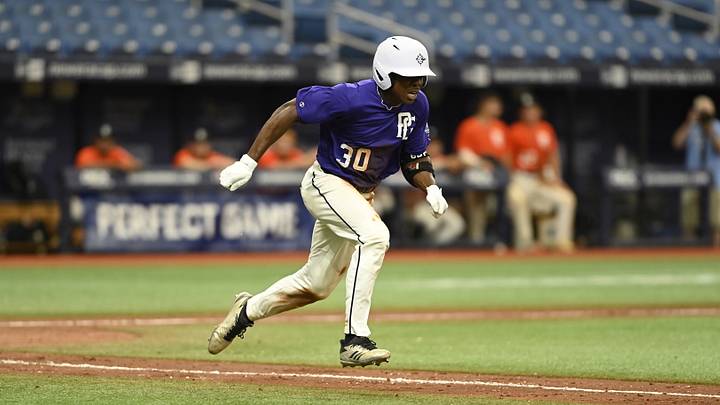
The 60-yard dash has been a staple measurement of baseball speed and athleticism for generations.
On par with the 40-yard dash in football.
Recently, however, its influence has started to fade. Tellingly, the MLB Draft Combine has shifted to the 30-yard dash to quantify speed.
High school baseball and showcase circuits still rely heavily on the 60. That includes high school and showcases.
Well-known showcase provider Perfect Game uses the 60-yard dash as a speed determiner in scouting profiles.
“We’ve been doing the 60-yard dash for kind of as long as we've been doing showcases,” said Vinnie Cervino, the Perfect Game director of scouting operations. “It’s one of those things that has always been a conventional wisdom way to measure speed. And I think it's a very good starting point in analyzing the speed and the transferable speed on the baseball field.”
Cervino said the 60 can basically indicate if a player is capable as a base-stealing threat or is just a baserunner.
Does the 60 Actually Matter
But is the 60-yard dash really useful?
There are those — several of those — who see it as an erroneous and antiquated metric in defining speed on the diamond.
Certified Physical Preparation Specialist Gerry DeFilippo, who has served as a special advisor to New York Yankees’ player development, and is the owner of Challenger Strength in northern New Jersey, where he has trained more than 100 college-bound, college and professional athletes, does not think so.
DeFilippo’s stance goes beyond skepticism. He believes the metric is fundamentally flawed.
“This is something I have been quite passionate about for a decade now, but the 60-yard dash is NOT the most ideal way to measure a baseball player on the quality of their speed tool,” he said in an email sent to High School On SI.
He also says baseball is steeped in historical practices, but new methods and measurements, based on science and technology, have begun to usurp tradition.
A Google search of the baseball 60-yard dash quickly reveals a blog post by batting glove maker Bruce Bolt. It tilts to the 60-yard side of the scale, explaining that the distance is a benchmark qualifier of a player’s speed attributes.
“It’s a measurement of a baseball player's quickness and form, right from the get-go to the finish line. For a sport that is won in seconds, knowing where you stand with your dash time is vital,” reads the post.
The blog post was reviewed for Bruce Bolt by Robert Anthony Cruz, a former collegiate All-American and professional infielder for the Washington Nationals organization.
“I think the 60 kind of separates your elite runner,” said RJ Farrell, baseball coach at nationally rankedOrange Lutheran High School. “And I don't know if in the game of baseball, to be successful, you have to be an elite runner.”
Why Baseball Adopted the 60
Maybe we can thank or admonish two baseball icons for the choice of the 60-yard dash: the visionary baseball executive Branch Rickey and the dubious “salesman” Charlie Finley, the former owner of the Oakland A’s.
Some say Rickey was the one who brought the 60-yard dash to baseball.
We do know that Finley brought the 60-yard mentality to the game.
Herb Washington. 1974. The Oakland A’s World Series team. Finley signed the Michigan State sprinter solely for designated/pinch runner duties. No defensive assignment or ABs.
The franchise owner believed Washington could make an impact; after all, the Spartan speedster owned the world record in the 60-yard dash (5.8).
Washington lasted a season and some change. According to the Sacramento Bee, he stole 29 bases (45 attempts) and scored 29 runs in ’74. The Lansing State Journal indicated Washington swiped 31 bags and scored 33 times.
Washington provided a comment to the Bee in 2014 that was perhaps profound: “I came from track, where everything was straight ahead.”

Why Straight-Line Speed Doesn’t Fully Translate
Everyone agrees that no one runs 60 yards on a line in baseball. And just as significant is this: a baseball 60-yard segment includes rounding bases and is subject to more pronounced physics.
When considering the differences between the two, I’m reminded that a straight 60-yard sprint is much different than a 60-yard sprint replete with centrifugal force (the sensation of being pushed out of your path) and a change of direction. So, how could baseball’s version of the 60 allow a runner to reach top-end speed?
It’s a rhetorical question.
And let’s define top-end speed. It means, when a person who is sprinting reaches maximum velocity.
“It’s a curved angle, right? There's not really times when you're going to be going that full 180-feet at your full pace because you're going to be breaking down,” Farrell said. “The reality is we're probably running further than that due to the angles and not top-end speed towards the back half of it.”
DeFilippo explained that the sport comprises a series of short bursts of sprinting, making it nearly impossible to reach top-end speed.
“When going first to home to score or rounding the bases on an extra base hit, you are NOT able to fully reach top-end speed due to the curvilinear nature of the base paths,” he said. “Positionally, fielders RARELY perform a hard sprint of anything over 30 yards.”
Baseball Speed Isn’t Just Running
Another variable is situational awareness, where the eyes have to make reads about where the ball is while traveling between bases. I think it’s safe to assume that Herb Washington wasn’t pondering the stride length of the sprinter in lane one when he set the 60-yard world record.
Coach Pete Lotus of St. Laurence High School (Burbank, Illinois), currently ranked No. 5 in the USA Today national rankings, told High School on SI that awareness is definitely a factor.
“Absolutely. To be honest, we've had some guys who were really, really good at running the 60, and fast, but that didn't really translate to running the bases,” he said. “And then, I've had the opposite too, where guys’ 60 times aren't necessarily what you would consider above average, but they're really good base runners. So, I completely agree with you about the situational awareness and the experience of doing some of those things in the context of the game as well.”
DeFilippo’s explanation aligns with Lotus’s observation about individual characteristics informing a player’s capability on the base paths.
“A player could be a GREAT accelerator (10-15 yards) with a great first few steps,” he said. “They are an effective base runner and get great jumps in the field because of it. However, they run a lackluster 60-yard dash time because they are below average from yards 30-60. I have seen MANY players, who are above average in their first 10-15 yards (key for baseball) run a 7.3, or 7.4 second 60 (which most college scouts would run from if not from a power hitter or catcher).”
Cervino says that 10-yard splits and 60 times correlate but there are situations when they don’t.
“I’ve seen those specific cases before where somebody has an above-average 10-yard split, but maybe not an above-average 60 or vice versa.”
The Case for Split Times
Many coaches and sports performance/physical preparation specialists are adopting the short-burst splits — 10, 20, 30 yards — as measurements. They believe they’re a much better reflection of any given player’s true or necessary baseball speed.
“Why would we place a huge emphasis on a test that is highly impacted by yards 30-60 for a sport that rarely experiences that range of straight line, top speed,” DeFilippo asks. “To me, at the very least, coaches need to be gathering data on 10 yard, 20 yard and 30-yard splits when athletes run their 60…Once enough data is accrued by showcase companies, we can lean closer on the 10-30 yard splits.”
Lawrence Free State High School (Lawrence, Kansas) baseball coach Mike Hill concurs about the use of splits as accurate feedback about speed.
“Certainly, there are a number of indicators for speed as it relates to baseball,” said Hill in an email sent to High School on SI. “The 20 and 30-yard dash are viable options, particularly the 30-yard dash as it correlates to 90-foot bases. So too, are home to first, turn and steal times. “
Farrell also feels that split data is more useful and relevant than the linear 60.
“I think understanding what the 10, 20 and 30-yard splits look like is more important because they show more who's got that first step quickness maybe a little bit better, rather than the top-end speed.”
Cervino agrees with the importance of 10-yard split feedback. (He indicated that it’s one of the Perfect Game measurements.)
“I think the 10-yard split is super significant,” he said. “But just the start…to 10-yard split is really good at measuring that burst of speed, which is obviously what you want when you're leading off a base and going to steal, but also when you're still in the outfield, and you have to make a break on a fly ball right away.”
Where Coaches Stand
So what’s the verdict on the controversial distance?
We know where DeFilippo stands.
DeFilippo says the push back on eliminating the 60 is coming from the traditionalist crowd or those who argue, “fast is fast.”
“No players who run a 7.3 in the 60 are fast,” he said. “I have just grown tired of seeing athletes who are great accelerators be spurned by coaches because they do not possess straight line, top-end track speed. It makes ZERO sense.”
But how about our three high school coaches?
“Purely baseball perspective, I think there's better ways to measure the effectiveness and the functionality of speed in baseball,” Lotus said. “I think, probably 30, is more relevant, because of the bases.”
Farrell sees value in the 60 — but only to a point.
“I don't think the 60 is outdated. I think there's aspects to it that still work, but if we're thinking just strictly baseball and how we're using that sort of data for baseball, I'm more of a 10, 20, 30-yard split guy.”
Hill offered perhaps the most practical view.
“At the high school level, our task is to provide college coaches and professional scouts with the information they request in order to properly evaluate…an athlete. My sense is that until they change what they are looking for, we will continue to use the 60 as a barometer for overall speed.”
For Cervino and Perfect Game, it will be a measurement for the foreseeable future.
“We’re always looking at ways to improve the showcase environment, the showcase experience,” Cervino said. “And I think 60 speed, 60-yard dash, workouts are definitely something that's always on the forefront of that conversation.”
More Than a 60-Yard Dash Time
Once upon a time, it seemed that if one clocked a 6.5 to 6.7, one suddenly appeared on DI radars. And if you ran sub-6.5, bypass DI and go straight to the MLB draft.
The fastest Perfect Game 60-yard dash time was set by Michael Gupton in 2021. Gupton ran 5.96, and Perfect Game rated him as one of the top 40 outfielders in his class. However, Gupton went undrafted in 2022, and has bounced around the college world ever since — North Carolina State, Gulf Coast Community College, Samford and now the University of Memphis. He has collected 27 stolen bases in 116 games.
In all fairness, Gupton’s case probably begs further questions; ones about the totality of his baseball skill set.
And that brings us to a larger point.
Perhaps the best way to consider baseball speed comes from Thurman Hendrix, an Illinois-based performance enhancement coach and former minor league baseball player. Hendrix distills what has already been said.
“Baseball speed in general is really hard to predict since there's also a reaction component involved,” he said in an email sent to High School on SI. “Often times, the fastest players are not always the best baserunners because baseball IQ and experience play a huge factor. Speed is a factor, but I would argue that stealing bases is more contingent on the jump... tracking fly balls is more about taking the correct path... and even home-to-first time is more about who ‘flips the switch’ faster to become a sprinter (instead of taking a few strides out of the box in which they're running emotionally and not focused because they just hit a weak ground ball to the shortstop).”
He added that whether using the 60, split times, vertical jump, broad jump or the 5-10-5 pro agility, it’s hard to forecast the eventual speed transfer to the field. Instead, these measurements are more useful in understanding individual athleticism and nervous system disposition.
Where the Sport Goes Next
The 60-yard dash still carries influence, but the conversation around measuring baseball speed is clearly evolving. But as Hill mentioned, the 60 is still here. And it doesn’t appear to be retiring any time soon. At least, for some.
 Add us as a preferred source on Google
Chris Adams has been in sports media since 2013. Currently, he freelances high school sports coverage for the Emporia Gazette (remotely), located in Emporia, Kansas. In 2024, Chris covered sports full-time for The News Enterprise in Elizabethtown, Kentucky. His first stint with the Gazette (remote) began in 2021 and ended in 2023. From 2013 to 2017, he was a reporter at two Texas newspapers, covering high school sports. He began contributing to High School On SI in 2025.