%22%3E%0A%3Cpath%20d%3D%22M0%204.9397H7.3484V12.6932H14.0649V4.9397H21.4133V26.912H14.0649V19.037H7.3484V26.912H0V4.9397Z%22%20fill%3D%22white%22%2F%3E%0A%3Cpath%20d%3D%22M23.6572%204H31.0299V8.55326H23.6572V4ZM23.7788%209.77664H30.9003V26.9121H23.7788V9.77664Z%22%20fill%3D%22white%22%2F%3E%0A%3Cpath%20d%3D%22M32.7241%2029.861L34.9197%2025.5589C36.8317%2026.5635%2038.7519%2027.1955%2041.1014%2027.1955C43.7669%2027.1955%2045.1848%2025.8101%2045.1848%2023.4281V22.9258C44.2125%2024.0276%2042.6084%2025.2834%2040.2264%2025.2834C35.8028%2025.2834%2032.6025%2022.1399%2032.6025%2017.4084V17.3436C32.6025%2012.5392%2035.8676%209.37134%2039.8213%209.37134C42.3329%209.37134%2043.8074%2010.3112%2045.0632%2011.5994V9.77643H52.1848V22.5855C52.1848%2025.7533%2051.5285%2027.9246%2049.9568%2029.4883C48.4174%2031.0277%2046.0679%2031.9999%2042.2357%2031.9999C38.4035%2031.9999%2035.4868%2031.2464%2032.7241%2029.8691V29.861ZM45.2172%2017.3679V17.3031C45.2172%2015.8285%2044.091%2014.6376%2042.3572%2014.6376C40.6234%2014.6376%2039.4972%2015.8609%2039.4972%2017.3679V17.4327C39.4972%2018.9073%2040.6234%2020.0658%2042.3572%2020.0658C44.091%2020.0658%2045.2172%2018.8748%2045.2172%2017.3679Z%22%20fill%3D%22white%22%2F%3E%0A%3Cpath%20d%3D%22M54.3145%204H61.436V12.0695C62.5379%2010.6597%2064.2636%209.37155%2066.6779%209.37155C70.2914%209.37155%2072.5437%2011.7535%2072.5437%2015.6181V26.9202H65.4221V17.9109C65.4221%2016.4364%2064.5471%2015.5857%2063.4777%2015.5857C62.4082%2015.5857%2061.436%2016.4364%2061.436%2017.9109V26.9202H54.3145V4Z%22%20fill%3D%22white%22%2F%3E%0A%3Cpath%20d%3D%22M80.8983%2023.6146L84.8196%2018.9398C87.2016%2020.7627%2089.9319%2021.5162%2092.5083%2021.5162C93.8289%2021.5162%2094.388%2021.1678%2094.388%2020.5764V20.5116C94.388%2019.8796%2093.6993%2019.5393%2091.3417%2019.0694C86.4157%2018.0648%2082.0812%2016.6551%2082.0812%2012.0046V11.9398C82.0812%207.76732%2085.3463%204.53467%2091.4065%204.53467C95.6437%204.53467%2098.7792%205.5393%20101.323%207.54857L97.7421%2012.5069C95.6681%2011%2093.1889%2010.3437%2091.1472%2010.3437C90.0454%2010.3437%2089.543%2010.7245%2089.543%2011.2511V11.3159C89.543%2011.9155%2090.1426%2012.2882%2092.4597%2012.7257C98.0743%2013.7627%20101.842%2015.3912%20101.842%2019.8148V19.8796C101.842%2024.4977%2098.0419%2027.3172%2092.1437%2027.3172C87.6877%2027.3172%2083.6692%2026.0614%2080.874%2023.6146H80.8983Z%22%20fill%3D%22white%22%2F%3E%0A%3Cpath%20d%3D%22M102.838%2018.4374V18.3726C102.838%2013.5682%20106.605%209.39575%20112.187%209.39575C115.955%209.39575%20118.62%2011.3402%20119.941%2014.1354L114.829%2017.0196C114.229%2015.9178%20113.476%2015.2939%20112.317%2015.2939C110.81%2015.2939%20109.684%2016.6145%20109.684%2018.3078V18.3726C109.684%2020.1631%20110.81%2021.4513%20112.228%2021.4513C113.484%2021.4513%20114.205%2020.8194%20114.893%2019.7256L120.071%2022.6747C118.531%2025.5347%20115.931%2027.3495%20111.847%2027.3495C106.638%2027.3495%20102.838%2023.2338%20102.838%2018.4374Z%22%20fill%3D%22white%22%2F%3E%0A%3Cpath%20d%3D%22M121.164%204H128.286V12.0695C129.387%2010.6597%20131.113%209.37155%20133.528%209.37155C137.141%209.37155%20139.393%2011.7535%20139.393%2015.6181V26.9202H132.272V17.9109C132.272%2016.4364%20131.397%2015.5857%20130.327%2015.5857C129.258%2015.5857%20128.286%2016.4364%20128.286%2017.9109V26.9202H121.164V4Z%22%20fill%3D%22white%22%2F%3E%0A%3Cpath%20d%3D%22M140.867%2018.405V18.3402C140.867%2013.5033%20144.886%209.36328%20150.533%209.36328C156.18%209.36328%20160.142%2013.4466%20160.142%2018.2753V18.3402C160.142%2023.177%20156.123%2027.317%20150.476%2027.317C144.829%2027.317%20140.867%2023.2337%20140.867%2018.405ZM153.295%2018.405V18.3402C153.295%2016.6469%20152.04%2015.2939%20150.468%2015.2939C148.896%2015.2939%20147.705%2016.6469%20147.705%2018.2753V18.3402C147.705%2020.0335%20148.961%2021.3865%20150.533%2021.3865C152.104%2021.3865%20153.295%2020.0335%20153.295%2018.405Z%22%20fill%3D%22white%22%2F%3E%0A%3Cpath%20d%3D%22M161.203%2018.405V18.3402C161.203%2013.5033%20165.222%209.36328%20170.869%209.36328C176.516%209.36328%20180.477%2013.4466%20180.477%2018.2753V18.3402C180.477%2023.177%20176.459%2027.317%20170.812%2027.317C165.165%2027.317%20161.203%2023.2337%20161.203%2018.405ZM173.631%2018.405V18.3402C173.631%2016.6469%20172.376%2015.2939%20170.804%2015.2939C169.232%2015.2939%20168.041%2016.6469%20168.041%2018.2753V18.3402C168.041%2020.0335%20169.297%2021.3865%20170.869%2021.3865C172.44%2021.3865%20173.631%2020.0335%20173.631%2018.405Z%22%20fill%3D%22white%22%2F%3E%0A%3Cpath%20d%3D%22M182.139%204H189.26V26.9121H182.139V4Z%22%20fill%3D%22white%22%2F%3E%0A%3Cpath%20fill-rule%3D%22evenodd%22%20clip-rule%3D%22evenodd%22%20d%3D%22M199.368%204.36764C205.191%20-1.45588%20214.632%20-1.45588%20220.456%204.36764C226.279%2010.1912%20226.279%2019.6324%20220.456%2025.4559L209.912%2036L199.368%2025.4559C193.544%2019.6324%20193.544%2010.1912%20199.368%204.36764ZM202.009%207.55761C201.948%207.86849%20201.916%208.39718%20201.916%209.14566V10.4189C201.916%2011.1832%20201.948%2011.7198%20202.013%2012.0267C202.078%2012.3317%20202.278%2012.6168%20202.617%2012.8762C202.956%2013.1376%20203.403%2013.3316%20203.958%2013.4623C204.512%2013.593%20205.1%2013.6583%20205.837%2013.6583C206.573%2013.6583%20207.217%2013.591%20207.769%2013.4524C208.322%2013.3158%20208.761%2013.1178%20209.086%2012.8604C209.411%2012.6029%20209.605%2012.3178%20209.666%2012.0069C209.728%2011.6961%20209.759%2011.1674%20209.759%2010.4189V9.14566C209.759%208.38134%20209.728%207.84473%20209.662%207.53781C209.597%207.23287%20209.397%206.94972%20209.058%206.68834C208.72%206.42696%20208.272%206.23291%20207.718%206.10223C207.163%205.97154%20206.536%205.90619%20205.839%205.90619C205.102%205.90619%20204.459%205.97352%20203.906%206.11213C203.352%206.24875%20202.914%206.44677%20202.589%206.70418C202.265%206.9616%20202.071%207.24673%20202.009%207.55761ZM207.276%2024.8638C210.876%2024.8638%20212.557%2024.2064%20212.557%2021.862V21.858V21.3155C212.557%2019.6581%20211.516%2018.971%20208.252%2018.3136C207.278%2018.1136%20206.908%2017.9136%20206.908%2017.3136V16.9414C206.908%2016.6543%20207.177%2016.5117%20207.413%2016.5117C207.749%2016.5117%20207.918%2016.7137%20207.918%2016.9414V18.1136H212.391V17.3988C212.391%2015.4563%20211.347%2014.4266%20207.177%2014.4266C204.15%2014.4266%20201.896%2015.3414%20201.896%2017.3711V17.7433C201.896%2019.5155%20202.805%2020.3155%20206.201%2021.0303C206.28%2021.0472%20206.355%2021.063%20206.427%2021.0781C207.329%2021.2674%20207.647%2021.3341%20207.647%2021.9174V22.2897C207.647%2022.6619%20207.546%2022.8045%20207.142%2022.8045C206.67%2022.8045%20206.637%2022.5471%20206.637%2022.262V21.2897H201.894V21.7471C201.894%2024.149%20203.476%2024.8638%20207.276%2024.8638ZM213.424%2024.5569H217.925V14.7355H213.424V24.5569ZM214.955%2013.5019H217.925V6.06064H215.092V9.411L213.193%206.06064H210.359V13.5019H213.193V10.1199L214.955%2013.5019ZM206.269%2012.152C206.204%2012.2688%20206.055%2012.3262%20205.825%2012.3262L205.827%2012.3282C205.604%2012.3282%20205.459%2012.2767%20205.398%2012.1757C205.336%2012.0748%20205.305%2011.8074%20205.305%2011.3758V7.90068C205.305%207.51852%20205.352%207.28684%20205.445%207.20962C205.538%207.13239%20205.675%207.09279%20205.851%207.09279C206.059%207.09279%20206.198%207.14031%20206.265%207.23734C206.332%207.33239%20206.366%207.55416%20206.366%207.90068V11.3203C206.366%2011.7579%20206.334%2012.0352%20206.269%2012.152Z%22%20fill%3D%22white%22%2F%3E%0A%3C%2Fg%3E%0A%3Cdefs%3E%0A%3CclipPath%20id%3D%22clip0_15247_3714%22%3E%0A%3Crect%20width%3D%22225%22%20height%3D%2236%22%20fill%3D%22white%22%2F%3E%0A%3C%2FclipPath%3E%0A%3C%2Fdefs%3E%0A%3C%2Fsvg%3E%0A)
Learning How to Hit a Breaking Ball on the High School Level
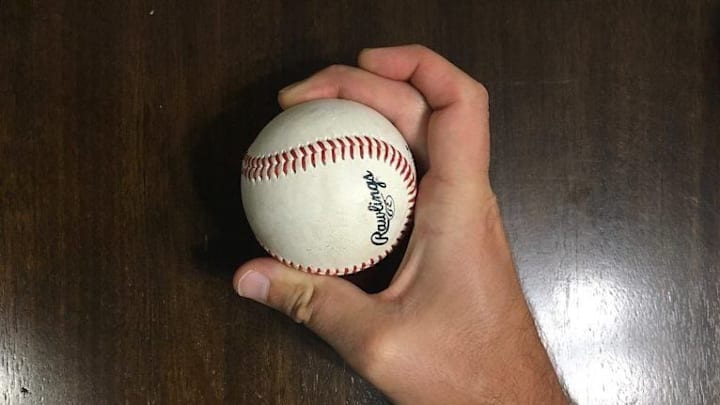
There’s a scary moment every baseball hitter eventually experiences.
Regardless of how hard and how far a player may hit a fastball, once a pitch floats out of the pitcher’s hand and looks hittable, before it disappears into the dirt, the batter has not yet proven he can progress in the game of baseball.
Welcome to the breaking ball.
I experienced this firsthand. As a freshman, trying to make my high school’s JV team. I stepped to the plate in a scrimmage against the varsity looking to make an impression. On the mound was a senior who would eventually pitch professionally, reaching the Triple-A level.
I entered the box brimming with confidence and worked my way into a 2-2 count. I had never faced a pitcher with a real curveball, but this one was more than real. Out of his hand, my eyes lit up as the ball appeared headed to the upper outer third of the plate, my sweet spot. I set out to attack and nearly spun out of my cleats as the pitch dove to the inner third, just inches off the ground.
The Pitch Which Has Humbled the Game’s Best
In the history of baseball, many would-be sluggers have had their rising careers derailed when they first began facing breaking balls.
With nicknames such as hook, bender, hammer and deuce, just to name a few, the breaking pitch is the make-or-break challenge for a hitter seeking to advance through the upper levels of amateur and professional baseball.
“Hitting the breaking ball is one of the toughest things you’ll have to learn,” wrote New York Yankees' legend Don Mattingly, in his book “Don Mattingly’s Hitting Is Simple: The ABC’s of Batting .300.”
Mattingly, who served seven seasons as a Major League manager, with the Los Angeles Dodgers and Miami Marlins, and is currently a bench coach with the Philadelphia Phillies, explained that the difficulty centers around the fact that the breaking ball only spends a brief window in the strike zone.
You see, even a hitter with a moderate talent level can eventually time up a heater with no movement. Mix in a pitch, however, which appears headed to one spot but moves several inches after the batter has already committed to his swing path, and hitting gets a lot more difficult.
No matter how much bat speed you may generate, it is absolutely useless if you can’t make contact. Regardless of how far you can launch a fastball, your career will stall if you can’t figure out how to recognize and hit a ball that spins and moves.
High School Baseball Is the Time to Learn
When an athlete reaches high school baseball, it is likely the first time he will see quality breaking pitches. Whether you are talking about a curve, slider, slurve, sweeper or one of dozens of variations of these pitches, the ability to identify a breaking pitch is critical to hitting success.
According to Rich Denardi, a longtime youth and high school coach in Maryland who currently works with young hitters at Loyola Blakefield, it all comes down to a batter’s ability to identify a pitcher’s patterns, knowing when to look for the breaking ball and how to attack it.
“We talk about the shape of the pitch and the pitcher’s release point,” said DeNardi. “Oftentimes, this gives a significant clue as to what pitch will be thrown.”
According to Denardi, the key is not to try to do too much.
“If a batter gets a hanger, we expect our guys to blast it. Otherwise, trying to stay back and thinking middle/oppo is a very good approach.”
In training his hitters, Denardi uses a pitching machine to deliver a varrying mix of pitches, over three rounds. Here is the breakdown:
- Round 1: 7 Fastballs at 80 MPH
- Round 2: 4 Fastball at 80 MPH and 3 Curveballs at 68-70 MPH
- Round 3: 2 Side-by-side machines, one throwing 80 MPH Fastballs and one throwing 68-70 MPH curveballs
Other Drills to Train Your Eyes
Other coaches employ other drills geared to training a hitter’s eyes to identifying pitches, out of the hand, which is more than 50% of the battle.
Colored Ball Drill
Colored dots are placed on baseballs and the hitter must call out the color of the dot before the ball reaches home plate. This trains the eyes to track the ball early.
Spin Recognition Drill
Balls are tossed softly towards the hitter, with a visible spin, and the hitter must call out “fastball” or “breaking ball.” This helps build instant recognition.
No Swing Track Rounds
This drill requires the batter to stand in against live pitching, without swinging, and observe each pitch, tracking whether it was a fastball or curveball.
DeNardi also recommends studying opposing pitchers for clues.
“Another point of emphasis is whether or not the pitcher is tipping his pitches,” said DeNardi. “Does his elbow flare out when he establishes his grip? Does he dig into his glove? Does his arm slow down in his delivery? These are all clues that something other than a fastball is coming.”
Hitting the Breaking Pitch Once You Recognize it
OK. Whether you picked up a clue or just guessed correctly, you know a breaking pitch is on its way. Now, how do you hit it.
Many high school hitters have a tendency to commit too early and drift forward.
Doug Clark of Northern Baseball Training in Prince George BC, Canada, offered three tips.
First you can’t be scared of the baseball and bail on every ball headed in your direction.
“If it’s righty vs. righty or lefty vs. lefty and they are throwing a curveball for a strike, it has to start coming at you and then curve into the zone,” said Clark. “You have to be prepared to let it hang so you can crush it or you have to be prepared to wear one.”
Tip two is to “stay in your legs, sit back and let the ball travel.”
What this means is that the hitter should not drift forward early once loading his weight on his back foot. Drifting forward will cause the hands to follow, leaving no opportunity to reach the ball once it begins to move.
Finally, Clark suggests coming to the plate with a hitting strategy.
“The approach we teach and the approach you see with most great major league hitters, is they let the ball travel and hit the fastball to the opposite field.”
Clark explains, if a hitter is bang on with his timing, he will drive the ball into the opposite field gap. If he is off a little bit he still has plenty of room to turn on the ball and drive it into the pull gap.
Other keys recommended by experts include:
- Slow down the front foot
- Land softly for extra milliseconds of reaction time
- Keep your weight centered and do not lunge
- Don’t try to crush the ball, but hit it where it is pitched
The key takeaway is to time the fastball and adjust to the breaking ball.
Some Once Wanted to Outlaw the Curveball
Documented accounts of the curve ball date back to the 1800s and those who mastered it early, including Alphonse “Phonney” Martin, who pitched for three National Association of Base Ball Players teams, between 1864-1869, and college pitchers Clarence Emir Allen (Western Reserve College, 1870s) and Clinton Scollard (Hamilton College, 1880s) were marveled at for their ability to make the baseball “curve.”
Not everyone was a fan, however.
Charles Eliot, who served as President of Harvard University, from 1869-1909, famously called for the banning of the pitch.
According to a 2013 throwback story in the Harvard Crimson, Eliot was quoted as saying the following.
“Well, this year I’m told the team did well because one pitcher had a fine curveball. I understand that a curveball is thrown with a deliberate attempt to deceive. Surely this is not an ability we should want to foster at Harvard.”
Unfortunately for hitters of the that time through to the present day, Eliot’s opinion did not win out. Pitchers have continued to refine their ability to manipulate the movement of a baseball, over the last century and a half, and the most successful hitters in the game are the ones who have found a way to recognize and handle the breaking pitch.
 Add us as a preferred source on Google
Gary Adornato is the Publisher of High School On SI. He began covering high school sports with the Baltimore Sun in 1982. In 2003, he became one of the first journalists to cover high school sports online while operating MIAASports.com, the official website of the Maryland Interscholastic Athletic Association. Later, Adornato pioneered market-wide coverage of high school sports with DigitalSports.com, introducing video highlights and player interviews while assembling an award-winning editorial staff. In 2010, he launched VarsitySportsNetwork.com which became the premier source of high school media coverage in the state of Maryland. In 2022, he sold VSN to The Baltimore Banner and joined High School On SI as East Coast Managing Editor. He took over as VP of Content in 2024 and assumed the title of Publisher in 2026.