%22%3E%0A%3Cpath%20d%3D%22M0%204.9397H7.3484V12.6932H14.0649V4.9397H21.4133V26.912H14.0649V19.037H7.3484V26.912H0V4.9397Z%22%20fill%3D%22white%22%2F%3E%0A%3Cpath%20d%3D%22M23.6572%204H31.0299V8.55326H23.6572V4ZM23.7788%209.77664H30.9003V26.9121H23.7788V9.77664Z%22%20fill%3D%22white%22%2F%3E%0A%3Cpath%20d%3D%22M32.7241%2029.861L34.9197%2025.5589C36.8317%2026.5635%2038.7519%2027.1955%2041.1014%2027.1955C43.7669%2027.1955%2045.1848%2025.8101%2045.1848%2023.4281V22.9258C44.2125%2024.0276%2042.6084%2025.2834%2040.2264%2025.2834C35.8028%2025.2834%2032.6025%2022.1399%2032.6025%2017.4084V17.3436C32.6025%2012.5392%2035.8676%209.37134%2039.8213%209.37134C42.3329%209.37134%2043.8074%2010.3112%2045.0632%2011.5994V9.77643H52.1848V22.5855C52.1848%2025.7533%2051.5285%2027.9246%2049.9568%2029.4883C48.4174%2031.0277%2046.0679%2031.9999%2042.2357%2031.9999C38.4035%2031.9999%2035.4868%2031.2464%2032.7241%2029.8691V29.861ZM45.2172%2017.3679V17.3031C45.2172%2015.8285%2044.091%2014.6376%2042.3572%2014.6376C40.6234%2014.6376%2039.4972%2015.8609%2039.4972%2017.3679V17.4327C39.4972%2018.9073%2040.6234%2020.0658%2042.3572%2020.0658C44.091%2020.0658%2045.2172%2018.8748%2045.2172%2017.3679Z%22%20fill%3D%22white%22%2F%3E%0A%3Cpath%20d%3D%22M54.3145%204H61.436V12.0695C62.5379%2010.6597%2064.2636%209.37155%2066.6779%209.37155C70.2914%209.37155%2072.5437%2011.7535%2072.5437%2015.6181V26.9202H65.4221V17.9109C65.4221%2016.4364%2064.5471%2015.5857%2063.4777%2015.5857C62.4082%2015.5857%2061.436%2016.4364%2061.436%2017.9109V26.9202H54.3145V4Z%22%20fill%3D%22white%22%2F%3E%0A%3Cpath%20d%3D%22M80.8983%2023.6146L84.8196%2018.9398C87.2016%2020.7627%2089.9319%2021.5162%2092.5083%2021.5162C93.8289%2021.5162%2094.388%2021.1678%2094.388%2020.5764V20.5116C94.388%2019.8796%2093.6993%2019.5393%2091.3417%2019.0694C86.4157%2018.0648%2082.0812%2016.6551%2082.0812%2012.0046V11.9398C82.0812%207.76732%2085.3463%204.53467%2091.4065%204.53467C95.6437%204.53467%2098.7792%205.5393%20101.323%207.54857L97.7421%2012.5069C95.6681%2011%2093.1889%2010.3437%2091.1472%2010.3437C90.0454%2010.3437%2089.543%2010.7245%2089.543%2011.2511V11.3159C89.543%2011.9155%2090.1426%2012.2882%2092.4597%2012.7257C98.0743%2013.7627%20101.842%2015.3912%20101.842%2019.8148V19.8796C101.842%2024.4977%2098.0419%2027.3172%2092.1437%2027.3172C87.6877%2027.3172%2083.6692%2026.0614%2080.874%2023.6146H80.8983Z%22%20fill%3D%22white%22%2F%3E%0A%3Cpath%20d%3D%22M102.838%2018.4374V18.3726C102.838%2013.5682%20106.605%209.39575%20112.187%209.39575C115.955%209.39575%20118.62%2011.3402%20119.941%2014.1354L114.829%2017.0196C114.229%2015.9178%20113.476%2015.2939%20112.317%2015.2939C110.81%2015.2939%20109.684%2016.6145%20109.684%2018.3078V18.3726C109.684%2020.1631%20110.81%2021.4513%20112.228%2021.4513C113.484%2021.4513%20114.205%2020.8194%20114.893%2019.7256L120.071%2022.6747C118.531%2025.5347%20115.931%2027.3495%20111.847%2027.3495C106.638%2027.3495%20102.838%2023.2338%20102.838%2018.4374Z%22%20fill%3D%22white%22%2F%3E%0A%3Cpath%20d%3D%22M121.164%204H128.286V12.0695C129.387%2010.6597%20131.113%209.37155%20133.528%209.37155C137.141%209.37155%20139.393%2011.7535%20139.393%2015.6181V26.9202H132.272V17.9109C132.272%2016.4364%20131.397%2015.5857%20130.327%2015.5857C129.258%2015.5857%20128.286%2016.4364%20128.286%2017.9109V26.9202H121.164V4Z%22%20fill%3D%22white%22%2F%3E%0A%3Cpath%20d%3D%22M140.867%2018.405V18.3402C140.867%2013.5033%20144.886%209.36328%20150.533%209.36328C156.18%209.36328%20160.142%2013.4466%20160.142%2018.2753V18.3402C160.142%2023.177%20156.123%2027.317%20150.476%2027.317C144.829%2027.317%20140.867%2023.2337%20140.867%2018.405ZM153.295%2018.405V18.3402C153.295%2016.6469%20152.04%2015.2939%20150.468%2015.2939C148.896%2015.2939%20147.705%2016.6469%20147.705%2018.2753V18.3402C147.705%2020.0335%20148.961%2021.3865%20150.533%2021.3865C152.104%2021.3865%20153.295%2020.0335%20153.295%2018.405Z%22%20fill%3D%22white%22%2F%3E%0A%3Cpath%20d%3D%22M161.203%2018.405V18.3402C161.203%2013.5033%20165.222%209.36328%20170.869%209.36328C176.516%209.36328%20180.477%2013.4466%20180.477%2018.2753V18.3402C180.477%2023.177%20176.459%2027.317%20170.812%2027.317C165.165%2027.317%20161.203%2023.2337%20161.203%2018.405ZM173.631%2018.405V18.3402C173.631%2016.6469%20172.376%2015.2939%20170.804%2015.2939C169.232%2015.2939%20168.041%2016.6469%20168.041%2018.2753V18.3402C168.041%2020.0335%20169.297%2021.3865%20170.869%2021.3865C172.44%2021.3865%20173.631%2020.0335%20173.631%2018.405Z%22%20fill%3D%22white%22%2F%3E%0A%3Cpath%20d%3D%22M182.139%204H189.26V26.9121H182.139V4Z%22%20fill%3D%22white%22%2F%3E%0A%3Cpath%20fill-rule%3D%22evenodd%22%20clip-rule%3D%22evenodd%22%20d%3D%22M199.368%204.36764C205.191%20-1.45588%20214.632%20-1.45588%20220.456%204.36764C226.279%2010.1912%20226.279%2019.6324%20220.456%2025.4559L209.912%2036L199.368%2025.4559C193.544%2019.6324%20193.544%2010.1912%20199.368%204.36764ZM202.009%207.55761C201.948%207.86849%20201.916%208.39718%20201.916%209.14566V10.4189C201.916%2011.1832%20201.948%2011.7198%20202.013%2012.0267C202.078%2012.3317%20202.278%2012.6168%20202.617%2012.8762C202.956%2013.1376%20203.403%2013.3316%20203.958%2013.4623C204.512%2013.593%20205.1%2013.6583%20205.837%2013.6583C206.573%2013.6583%20207.217%2013.591%20207.769%2013.4524C208.322%2013.3158%20208.761%2013.1178%20209.086%2012.8604C209.411%2012.6029%20209.605%2012.3178%20209.666%2012.0069C209.728%2011.6961%20209.759%2011.1674%20209.759%2010.4189V9.14566C209.759%208.38134%20209.728%207.84473%20209.662%207.53781C209.597%207.23287%20209.397%206.94972%20209.058%206.68834C208.72%206.42696%20208.272%206.23291%20207.718%206.10223C207.163%205.97154%20206.536%205.90619%20205.839%205.90619C205.102%205.90619%20204.459%205.97352%20203.906%206.11213C203.352%206.24875%20202.914%206.44677%20202.589%206.70418C202.265%206.9616%20202.071%207.24673%20202.009%207.55761ZM207.276%2024.8638C210.876%2024.8638%20212.557%2024.2064%20212.557%2021.862V21.858V21.3155C212.557%2019.6581%20211.516%2018.971%20208.252%2018.3136C207.278%2018.1136%20206.908%2017.9136%20206.908%2017.3136V16.9414C206.908%2016.6543%20207.177%2016.5117%20207.413%2016.5117C207.749%2016.5117%20207.918%2016.7137%20207.918%2016.9414V18.1136H212.391V17.3988C212.391%2015.4563%20211.347%2014.4266%20207.177%2014.4266C204.15%2014.4266%20201.896%2015.3414%20201.896%2017.3711V17.7433C201.896%2019.5155%20202.805%2020.3155%20206.201%2021.0303C206.28%2021.0472%20206.355%2021.063%20206.427%2021.0781C207.329%2021.2674%20207.647%2021.3341%20207.647%2021.9174V22.2897C207.647%2022.6619%20207.546%2022.8045%20207.142%2022.8045C206.67%2022.8045%20206.637%2022.5471%20206.637%2022.262V21.2897H201.894V21.7471C201.894%2024.149%20203.476%2024.8638%20207.276%2024.8638ZM213.424%2024.5569H217.925V14.7355H213.424V24.5569ZM214.955%2013.5019H217.925V6.06064H215.092V9.411L213.193%206.06064H210.359V13.5019H213.193V10.1199L214.955%2013.5019ZM206.269%2012.152C206.204%2012.2688%20206.055%2012.3262%20205.825%2012.3262L205.827%2012.3282C205.604%2012.3282%20205.459%2012.2767%20205.398%2012.1757C205.336%2012.0748%20205.305%2011.8074%20205.305%2011.3758V7.90068C205.305%207.51852%20205.352%207.28684%20205.445%207.20962C205.538%207.13239%20205.675%207.09279%20205.851%207.09279C206.059%207.09279%20206.198%207.14031%20206.265%207.23734C206.332%207.33239%20206.366%207.55416%20206.366%207.90068V11.3203C206.366%2011.7579%20206.334%2012.0352%20206.269%2012.152Z%22%20fill%3D%22white%22%2F%3E%0A%3C%2Fg%3E%0A%3Cdefs%3E%0A%3CclipPath%20id%3D%22clip0_15247_3714%22%3E%0A%3Crect%20width%3D%22225%22%20height%3D%2236%22%20fill%3D%22white%22%2F%3E%0A%3C%2FclipPath%3E%0A%3C%2Fdefs%3E%0A%3C%2Fsvg%3E%0A)
President Trump Calls for NIL Reform Before It 'Destroys' College, And High School, Sports
For decades, the structure of American sports development has been remarkably consistent.
Young athletes learned the fundamentals in youth leagues. High school athletics served as the training ground for discipline, teamwork, and academic responsibility. College sports refined those skills while providing educational opportunities and preparing athletes for professional and Olympic competition.
The system wasn’t perfect. But it worked.
Now that system is being fundamentally reshaped — and not necessarily for the better.
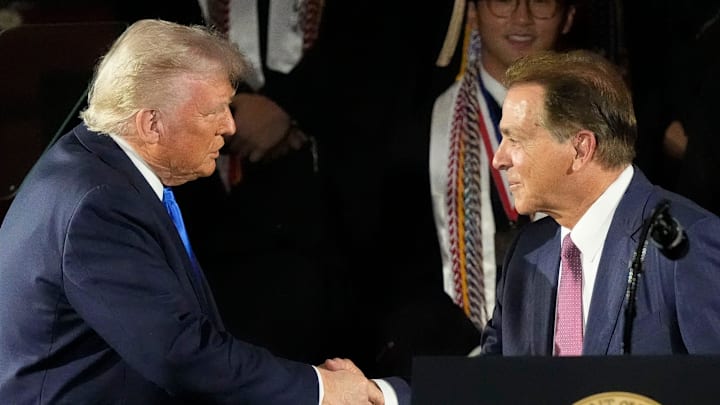
On March 6, President Donald Trump convened a White House roundtable titled “Saving College Sports,” bringing together leaders from across the athletic landscape: conference commissioners, NCAA officials, media executives, and legendary coaches. Their focus was the rapidly evolving Name, Image and Likeness (NIL) economy that has transformed college athletics.
While the conversation centered on college sports, those of us who cover high school athletics understand a basic truth:
What Happens in College Sports Never Stays in College Sports
It trickles down.
And when it does, high school sports inevitably change as well.
That’s why the conversation about NIL reform should matter deeply to everyone involved in scholastic athletics.
Because if the system at the college level is unstable, the foundation beneath high school sports will eventually feel the tremors.
The Warning From Washington
President Trump didn’t mince words during the roundtable.
“The amount of money being spent and lost by otherwise very successful schools is astounding,” Trump said during the meeting. “We have to save college sports, and, I believe, colleges.”
At another point, he warned the current trajectory could have consequences far beyond athletics.
“The whole educational system is going to go out of business because of this,” Trump said while discussing the financial pressures created by NIL payments.
Whether one agrees with that level of alarm or not, it is clear that many leaders in the college sports ecosystem believe reform is necessary.
The roundtable included figures such as NCAA president Charlie Baker and former Alabama football coach Nick Saban, who have been among the most outspoken critics of the current NIL structure.
Their concerns are not simply about money.
They are about the purpose of sports within education.
For decades, college athletics balanced competition with education, scholarships, and life preparation. The NIL era has dramatically altered that balance, introducing a marketplace dynamic that many believe is pushing college sports toward professionalization.
And if college sports becomes purely transactional, high school sports won’t be far behind.
The Trickledown Effect
High school sports has always been connected to college athletics.
Recruiting drives exposure. Exposure drives opportunity.
But in recent years, a new dynamic has entered the equation.
Branding.
More and more high school athletes are being told — sometimes explicitly — that their value is tied not only to their performance but also to their personal brand. Social media followers, highlight videos, and marketing potential have become part of the conversation long before an athlete ever signs a scholarship.
That’s where the NIL economy begins to blur the lines between amateur and professional sports.
Instead of focusing solely on development — becoming a better player, a better teammate, and a better student — some athletes are increasingly focused on positioning themselves for the next financial opportunity.
The goal is no longer just to earn a scholarship.
The goal is to maximize earning potential.
That shift in priorities should concern anyone who cares about the long-term health of high school athletics.
Because the primary mission of scholastic sports has never been about financial opportunity.
It has been about education, development, and life preparation.
The Changing Mindset
Spend enough time around high school athletics today and you can see the cultural shift happening in real time.
Athletes are building personal brands before they have fully developed their games.
Some are prioritizing highlight clips over fundamentals.
Others are focusing on social media engagement as much as they are on training.
None of this is inherently bad. The modern world rewards digital savvy, and athletes should absolutely understand their market value.
But when branding begins to outweigh development, the priorities of youth sports become distorted.
That’s where the NIL conversation becomes more than just a college issue.
If the perception grows that sports are primarily a pathway to financial reward, the developmental purpose of high school athletics risks being overshadowed.
And that would be a fundamental shift from the system that has produced generations of successful athletes.
The System That Worked
Before NIL reshaped college sports, the traditional model had a clear structure.
Athletes competed for scholarships. They developed their skills. They earned degrees. A small percentage advanced to professional leagues.
But even those who didn’t go pro left college with an education and life experience that helped them succeed in other careers.
Trump referenced that earlier system directly during the White House discussion.
“I thought the system of scholarships was great,” he said.
That system also played a critical role in the development of Olympic athletes and professional stars.
College athletics served as a training ground — not just financially, but competitively and educationally.
If the current NIL structure destabilizes that system, the consequences will ripple across the entire sports development pipeline.
Including high schools.
Why Reform Matters
To be clear, NIL itself is not inherently the problem.
Athletes absolutely deserve the right to profit from their name, image, and likeness.
For years, the system restricted athletes from earning money while others profited from their performances. Correcting that imbalance was inevitable.
But the current environment lacks consistent national regulation.
Different states have different laws. Collectives operate under different rules. The result is a chaotic marketplace where the boundaries between recruiting, compensation, and inducement are often unclear.
That’s why the White House roundtable emphasized the need for national standards.
“If Congress doesn’t take action fast, it could destroy college sports,” Trump said during the meeting.
That may sound dramatic.
But the concern is real.
Without structure, the NIL economy could continue escalating in ways that alter the entire ecosystem of amateur athletics.
The High School Reality
The question high school leaders should be asking is simple: What happens when the NIL mindset reaches the high school level in full force?
In some states, it already has.
High school athletes are signing massive endorsement deals. Our pages are filled with stories documenting such deals. Social media sponsorships are becoming more common. Recruiting exposure is increasingly tied to brand visibility.
If the financial incentives of sports continue to move downward through the system, high school athletics will inevitably face new challenges.
One of the ill effects of NIL on the college level is the massive amount athletes which enter the transfer portal each year, most in search of a better financial deal. There is no official transfer portal on the high school level, but there might as well be. Just like their college counterparts, high school athletes are transferring at alarming rates, often to better position themselves for NIL riches.
Recruiting pressures could intensify.
And the focus on personal branding could further overshadow the educational mission of scholastic sports.
A Moment for Reflection
The conversation that took place at the White House last week wasn’t just about college football contracts or booster collectives.
It was about the future of sports in education.
Those of us who cover high school athletics should pay close attention. Because what happens at the college level rarely stays there.
It trickles down — just as it always has.
And if the priorities of college sports change, the culture of high school sports will change with it.
The challenge now is ensuring that when the system evolves, it still protects the values that made scholastic athletics so powerful in the first place.
Development.
Education.
Opportunity.
If those priorities remain intact, the future of sports will remain bright.
If they don’t, the consequences will reach far beyond college campuses — all the way to high school gyms and stadiums across America.
 Add us as a preferred source on Google
Gary Adornato is the Publisher of High School On SI. He began covering high school sports with the Baltimore Sun in 1982. In 2003, he became one of the first journalists to cover high school sports online while operating MIAASports.com, the official website of the Maryland Interscholastic Athletic Association. Later, Adornato pioneered market-wide coverage of high school sports with DigitalSports.com, introducing video highlights and player interviews while assembling an award-winning editorial staff. In 2010, he launched VarsitySportsNetwork.com which became the premier source of high school media coverage in the state of Maryland. In 2022, he sold VSN to The Baltimore Banner and joined High School On SI as East Coast Managing Editor. He took over as VP of Content in 2024 and assumed the title of Publisher in 2026.