%22%3E%0A%3Cpath%20d%3D%22M0%205.37646H8.15061L17.4195%2016.8819V5.37646H26.0647V31.4412H18.3227L8.64523%2019.4196V31.4412H0V5.37646Z%22%20fill%3D%22white%22%2F%3E%0A%3Cpath%20d%3D%22M29.2041%205.37649H43.8064C47.4193%205.37649%2049.6989%206.1937%2051.2258%207.72059C52.1505%208.64533%2052.8172%2010.0002%2052.8172%2011.7851V11.8497C52.8172%2014.9465%2050.9462%2016.8389%2048.172%2017.8067C51.5269%2018.7744%2053.6774%2020.5594%2053.6774%2024.1293V24.1938C53.6774%2028.3659%2050.258%2031.4197%2043.6558%2031.4197H29.2041V5.35498V5.37649ZM44.258%2013.7637C44.258%2012.6024%2043.3333%2011.9787%2041.4623%2011.9787H37.6988V15.6346H41.5053C43.3763%2015.6346%2044.258%2015.011%2044.258%2013.8497V13.7852V13.7637ZM42.0859%2020.9895H37.6988V24.8605H42.0644C43.9569%2024.8605%2044.9247%2024.0863%2044.9247%2022.968V22.9035C44.9247%2021.7852%2043.9999%2021.011%2042.0859%2021.011V20.9895Z%22%20fill%3D%22white%22%2F%3E%0A%3Cpath%20d%3D%22M64.8174%205.18286H73.4627L84.452%2031.4411H74.9896L73.6132%2027.9357H64.4949L63.1615%2031.4411H53.8496L64.8389%205.18286H64.8174ZM71.4412%2021.7636L69.054%2015.441L66.6669%2021.7636H71.4412Z%22%20fill%3D%22white%22%2F%3E%0A%3Cpath%20d%3D%22M95.2695%205.37646H105.248C115.592%205.37646%20120.775%2010.4733%20120.775%2018.1938V18.2583C120.775%2025.9788%20115.485%2031.4412%20104.947%2031.4412H95.2695V5.37646ZM104.001%2012.9679V23.8497H105.463C109.442%2023.8497%20112.022%2022.2153%20112.022%2018.4518V18.3873C112.022%2014.6239%20109.463%2012.9894%20105.463%2012.9894H104.001V12.9679Z%22%20fill%3D%22white%22%2F%3E%0A%3Cpath%20d%3D%22M123.098%2011.1182H131.549V15.2258C132.711%2012.4731%20134.56%2010.6881%20137.915%2010.8387V19.8065H137.012C133.442%2019.8065%20131.528%2021.785%20131.528%2026.2797V31.4625H123.076V11.1182H123.098Z%22%20fill%3D%22white%22%2F%3E%0A%3Cpath%20d%3D%22M137.808%2025.6772V25.6127C137.808%2021.5482%20140.818%2019.2901%20145.55%2019.2901C147.27%2019.2901%20149.464%2019.6557%20150.345%2020.0428V19.6987C150.345%2017.8277%20149.184%2016.7524%20146.582%2016.7524C144.496%2016.7524%20142.754%2017.204%20140.969%2017.9137L139.485%2012.3008C141.829%2011.3975%20144.517%2010.8169%20148.044%2010.8169C152.173%2010.8169%20154.862%2011.6771%20156.646%2013.4621C158.173%2014.989%20158.776%2016.9675%20158.776%2019.9137V31.5052H150.324V29.4622C148.904%2030.9891%20147.012%2031.9999%20144.474%2031.9999C140.56%2031.9999%20137.808%2029.7633%20137.808%2025.7417V25.6772ZM150.431%2023.9138V23.0536C149.937%2022.86%20149.206%2022.7095%20148.496%2022.7095C146.818%2022.7095%20145.894%2023.7202%20145.894%2024.9891V25.0536C145.894%2026.2364%20146.754%2027.0321%20147.829%2027.0321C149.313%2027.0321%20150.431%2025.8493%20150.431%2023.9138Z%22%20fill%3D%22white%22%2F%3E%0A%3Cpath%20d%3D%22M162.883%2017.6345H160.496V11.1183H162.883C162.926%208.96778%20163.442%207.20433%20164.711%205.9355C166.088%204.55915%20167.872%204%20170.668%204C173.163%204%20174.69%204.21506%20175.851%204.55914V9.84951C175.034%209.65596%20174.217%209.54843%20173.141%209.54843C171.83%209.54843%20171.163%2010.0646%20171.163%2011.1829V11.3334H175.851V17.6345H171.335V31.4411H162.883V17.6345Z%22%20fill%3D%22white%22%2F%3E%0A%3Cpath%20d%3D%22M178.883%2024.6238V17.613H176.496V11.0968H178.883V6H187.335V11.0968H192.023V17.613H187.335V22.7528C187.335%2024.2797%20188.045%2024.8389%20189.378%2024.8389C190.152%2024.8389%20191.055%2024.6238%20191.937%2024.2152V30.7314C190.604%2031.4411%20188.582%2031.8927%20186.539%2031.8927C181.55%2031.8927%20178.862%2029.5916%20178.862%2024.6238H178.883Z%22%20fill%3D%22white%22%2F%3E%0A%3Cpath%20fill-rule%3D%22evenodd%22%20clip-rule%3D%22evenodd%22%20d%3D%22M201.368%204.36764C207.191%20-1.45588%20216.632%20-1.45588%20222.456%204.36764C228.279%2010.1912%20228.279%2019.6324%20222.456%2025.4559L211.912%2036L201.368%2025.4559C195.544%2019.6324%20195.544%2010.1912%20201.368%204.36764ZM204.009%207.55761C203.948%207.86849%20203.916%208.39718%20203.916%209.14566V10.4189C203.916%2011.1832%20203.948%2011.7198%20204.013%2012.0267C204.078%2012.3317%20204.278%2012.6168%20204.617%2012.8762C204.956%2013.1376%20205.403%2013.3316%20205.958%2013.4623C206.512%2013.593%20207.1%2013.6583%20207.837%2013.6583C208.573%2013.6583%20209.217%2013.591%20209.769%2013.4524C210.322%2013.3158%20210.761%2013.1178%20211.086%2012.8604C211.411%2012.6029%20211.605%2012.3178%20211.666%2012.0069C211.728%2011.6961%20211.759%2011.1674%20211.759%2010.4189V9.14566C211.759%208.38134%20211.728%207.84473%20211.662%207.53781C211.597%207.23287%20211.397%206.94972%20211.058%206.68834C210.72%206.42696%20210.272%206.23291%20209.718%206.10223C209.163%205.97154%20208.536%205.90619%20207.839%205.90619C207.102%205.90619%20206.459%205.97352%20205.906%206.11213C205.352%206.24875%20204.914%206.44677%20204.589%206.70418C204.265%206.9616%20204.071%207.24673%20204.009%207.55761ZM209.276%2024.8638C212.876%2024.8638%20214.557%2024.2064%20214.557%2021.862V21.858V21.3155C214.557%2019.6581%20213.516%2018.971%20210.252%2018.3136C209.278%2018.1136%20208.908%2017.9136%20208.908%2017.3136V16.9414C208.908%2016.6543%20209.177%2016.5117%20209.413%2016.5117C209.749%2016.5117%20209.918%2016.7137%20209.918%2016.9414V18.1136H214.391V17.3988C214.391%2015.4563%20213.347%2014.4266%20209.177%2014.4266C206.15%2014.4266%20203.896%2015.3414%20203.896%2017.3711V17.7433C203.896%2019.5155%20204.805%2020.3155%20208.201%2021.0303C208.28%2021.0472%20208.355%2021.063%20208.427%2021.0781C209.329%2021.2674%20209.647%2021.3341%20209.647%2021.9174V22.2897C209.647%2022.6619%20209.546%2022.8045%20209.142%2022.8045C208.67%2022.8045%20208.637%2022.5471%20208.637%2022.262V21.2897H203.894V21.7471C203.894%2024.149%20205.476%2024.8638%20209.276%2024.8638ZM215.424%2024.5569H219.925V14.7355H215.424V24.5569ZM216.955%2013.5019H219.925V6.06064H217.092V9.411L215.193%206.06064H212.359V13.5019H215.193V10.1199L216.955%2013.5019ZM208.269%2012.152C208.204%2012.2688%20208.055%2012.3262%20207.825%2012.3262L207.827%2012.3282C207.604%2012.3282%20207.459%2012.2767%20207.398%2012.1757C207.336%2012.0748%20207.305%2011.8074%20207.305%2011.3758V7.90068C207.305%207.51852%20207.352%207.28684%20207.445%207.20962C207.538%207.13239%20207.675%207.09279%20207.851%207.09279C208.059%207.09279%20208.198%207.14031%20208.265%207.23734C208.332%207.33239%20208.366%207.55416%20208.366%207.90068V11.3203C208.366%2011.7579%20208.334%2012.0352%20208.269%2012.152Z%22%20fill%3D%22white%22%2F%3E%0A%3C%2Fg%3E%0A%3Cdefs%3E%0A%3CclipPath%20id%3D%22clip0_15247_3640%22%3E%0A%3Crect%20width%3D%22227%22%20height%3D%2236%22%20fill%3D%22white%22%2F%3E%0A%3C%2FclipPath%3E%0A%3C%2Fdefs%3E%0A%3C%2Fsvg%3E%0A)
2026 NBA Draft: The Productive Sophomore Query
The Productive Sophomore Query
- Introduction: The Study
- Productive Sophomore Query: Player Outcomes
- Projecting Into the Future
- Who Qualified for the Productive Sophomore Query this past Season?
- Conclusion
Introduction: The Study
The NBA Draft is undoubtedly not an exact science. Front office members and agents take many factors into account -- film, analytics, intel, medicals, and more. Everyone wants to find a diamond in the rough or feel more certain about players projected to be picked in the first round. In order to do this, it has become increasingly popular to design statistical queries to identify NBA talent.
Before we dive into the statistical analysis, it’s important to define what “stick” means in my study. In this case, I considered a prospect to “stick” if they played five-plus seasons in the NBA. Prospects who qualified in recent seasons had projections created for them based on career statistics and overall performance thus far.
There were 58 sophomores throughout the 15 college basketball seasons from 2010-2024 who played at least 40% of their team's minutes, had a Box Plus-Minus of at least +9, and met the minimum athletic threshold of four total dunks. 72.4% (42/58) of those sophomores played five-plus years in the NBA or are projected to stick in the league.
The purpose of this query is to find sophomore breakouts and players who are still underclassmen (but not freshmen) who are being trusted to play almost a majority of their team's minutes, meet a certain production threshold, and also meet a minimum athletic threshold throughout the season.
Read More: The Productive Young Athlete Query
Productive Sophomore Query: Player Outcomes
Sticking in the NBA is one thing, but how impactful were the players who stuck? Below I grouped the 58 players (including the two with unknown outcomes) who have met the Productive Sophomore Query from 2010-2024 into four subcategories based on Draft Express Pick Expectations. One highlight: Nearly 45% of players to meet the criteria (26 of the 58 players) became NBA starters or multi-time All-Stars.
Players were grouped into the following five categories:
Did Not Stick
Players who met the Productive Sophomore Query (PSQ) but did not stick in the NBA or are projected to not stick: Kyle Weems ('10), Chris Johnson ('10), Jordan Hamilton ('11), PJ Hairston ('13), Briante Weber ('13), Ron Baker ('14), Chinanu Onuaku ('16), Ethan Happ ('17), Jacob Evans III ('17), Armoni Brooks ('18), Killian Tille ('18), Jarrett Culver ('19), Alan Griffin ('20), Daniel Oturu ('20), Drew Timme ('21), and Hunter Dickinson ('22)
In an effort to make the player outcomes more accurate, the two players in the "Unknown" category (Drew Timme and Hunter Dickinson) were grouped into "Did Not Stick" based on current career statistics.
Backup: Five NBA seasons, with career 10-24 minutes per game, or over 4000 career NBA minutes
Backup Players who met the Productive Sophomore Query: Jordan Crawford ('10), Derrick Williams ('11), Jared Sullinger ('12), Terrence Jones ('12), Trey Burke ('13), Cody Zeller ('13), Kyle Anderson ('14), Robert Williams ('18), Xavier Tillman ('19), Chuma Okeke ('19), Bruno Fernando ('19), Obi Toppin ('20), Jalen Smith ('20), Tari Eason ('22), Ryan Kalkbrenner ('22), and Kyle Filipowski ('24)
Based on their current careers thus far, Kalkbrenner and Filipowski were both grouped into the Backup category. With these queries being updated consistently, the categories in which players are grouped into are fluid as careers continue.
Starter: Career 24 minutes per game or higher, or started over half of career NBA games (minimum 21 minutes per game)
Starters who met the Productive Sophomore Query: Dion Waiters ('12), Otto Porter ('13), Kentavious Caldwell-Pope ('13), Willie Cauley-Stein ('14), Marcus Smart ('14), TJ Warren ('14), Gary Harris ('14), Kris Dunn ('15), Josh Hart ('15), Jakob Poetl ('16), Mikal Bridges ('17), John Collins ('17), PJ Washington ('19), De'Andre Hunter ('19), Devin Vassell ('20), Franz Wagner ('21), Keegan Murray ('22), Walker Kessler ('22), Mark Williams ('22), Brandin Podziemski ('23), Zach Edey ('22), and Donovan Clingan ('24)
Both Edey and Clingan were grouped into the Starter category based on current career statistics.
All-Star: Two or more appearances in the NBA All-Star Game
All-Star Players who met the Productive Sophomore Query: Draymond Green ('10), Donovan Mitchell ('17), Ja Morant ('19), and Tyrese Haliburton ('20)
The Results
Out of the 58 players who have met the Productive Sophomore Query from the 2010-2024 college basketball seasons...
- 27.6% of them did not stick in the NBA (16 players)
- 27.6% of them became Backups (16 players)
- 37.9% of them became Starters (22 players)
- 6.9% of them became multi-time All-Stars (4 players)

To put these outcomes into context, let's compare it to the results of draft picks over a similar timeframe.
If we look at the 2010-2021 NBA Draft classes utilizing Draft Express Pick Expectations, players who meet the Productive Sophomore Query have a comparable All-Star/Starter rates as Picks 6-10, where 38% of players became Starters and 8% of players became multi-time All-Stars.

Interestingly, players who meet the Productive Sophomore Query have a comparable rate to "not stick" as players drafted between Picks 16-25 across a similar timeframe, with a player hitting the query to have a higher historical probability to stick than Picks 21-25 -- shown below.

Similar to players who meet the Productive Young Athlete query, players who meet the Productive Sophomore Query are at an intriguing crossroads: a similar probability as Picks 6-10 to become an All-Star or Starter while simultaneously having a comparable probability as Picks 16-25 to not stick in the NBA at all.
Let's compare the Productive Sophomore Query to the Productive Young Athlete query as a whole:

Outcome | PYA Query | PSQ |
|---|---|---|
All-Star | 17.8% | 6.9% |
Starter | 32.2% | 37.9% |
Backup | 27.8% | 27.6% |
Did Not Stick | 22.2% | 27.6% |
Here we can see that players who meet the Productive Young Athlete Query have a much higher rate of becoming a multi-time All-Star. However, the overall rate of becoming a Starter/All-Star is at 50% for the PYA Query and 45% for the PSQ -- not a significant decline. Additionally, we can see players who meet the PYA Query are slightly more likely to stick overall -- a rate of 77.8% compared to 72.4% for players who meet the Productive Sophomore Query. The Productive Young Athlete query is also based on a much larger sample size of players who have met the criteria -- 90 -- compared to only 58 for the PSQ.
Read More: The Productive Young Athlete Query
Projecting Into the Future
Who Qualified for the Productive Sophomore Query in 2025?
Six players met the Productive Sophomore Query in 2025: JT Toppin, Collin Murray-Boyles, Thomas Haugh, Tomislav Ivisic, Nolan Winter, and Alex Condon.
Toppin and Murray-Boyles had both met the Productive Young Athlete query the season before. Toppin is a 2026 NBA Draft prospect, and Collin Murray-Boyles established himself during his rookie season this past year as a projected impactful NBA player.
Thomas Haugh was part of a collection of projected first round picks to return to college this draft cycle, something we've never seen before at the degree in which it occurred. The combination of Braylon Mullins, Thomas Haugh, Patrick Ngongba II, and Motiejus Krivas all deciding to return while being projected as first round picks was truly unprecedented. Haugh projects to be a lottery pick in the 2027 NBA Draft and will be one of the best players in college basketball this upcoming season.
Tomislav Ivisic is a unique case, and will not be counted towards the Productive Sophomore Query due to being ruled a "sophomore" by the NCAA after playing three years professionally overseas prior to playing college basketball. He was 21 years old during his sophomore season, while most sophomores are 19 or 20 years old.
Nolan Winter has improved every season at Wisconsin, and is returning to Madison for his senior season in 2026-27.
Alex Condon was also projected to be drafted in the 2026 NBA Draft, but will return to Florida to play alongside Haugh for their senior seasons. He's someone to continue monitoring as NBA prospect for the 2027 NBA Draft.
Who Qualified for the Productive Sophomore Query this past Season?
Five players met the Productive Sophomore Query in 2026. Players are listed below in highest to lowest Box Plus-Minus, along with a small statistical summary of each player.
Tyler Tanner, Vanderbilt

The 6-foot, 170-pound guard had the 16th-highest Box Plus-Minus for a sophomore since it began being tracked on Barttorvik.com in 2008 -- higher than Collin Murray-Boyles, Marcus Smart, Tyrese Haliburton, and Franz Wagner. This past season, Tanner averaged 19.5 points, 5.1 assists, 3.6 rebounds, 2.4 steals, and 0.3 blocks per game while shooting 64.4% at the rim (194 attempts), 38.1% on non-rim twos (113 attempts), 36.8% from beyond the arc (7.7 three point attempts per 100 possessions | 163 attempts), and 85.3% from the free throw line (218 attempts).
He recorded an incredible 4.1 steal percentage, the 27th-highest in all of Division I this past season (of players who played at least 40% of their team's minutes). Additionally, Tanner created offense for both himself and teammates at an impressive rate this past season. He was unassisted on 63.6% of his made field goals while assisting an estimated 28.9% of his teammates' made field goals when on the floor.
While only four guards listed at 6-foot or shorter have stuck in the NBA since 2013 and the overall stick rate for those drafted since then is 21.5% (4-of-19), perhaps Tanner can be the exception.
Read More: A Study on Undersized Guards
Labaron Philon, Alabama

Philon is a 6-foot-4, 175-pound guard who improved his draft stock after returning to school for his sophomore season. He averaged 22 points, five assists, 3.5 rebounds, 1.2 steals, and 0.2 blocks per game while shooting at 65.7% at the rim (172 attempts), 44.5% on non-rim twos (110 attempts), 39.9% from three (10.7 three point attempts per 100 possessions | 203 attempts), and 79.8% from the free throw line (198 attempts) -- incredibly efficient scoring numbers all around.
Similar to Tanner, Philon created an immense amount of offense for the Crimson Tide -- he was unassisted on 73.7% of his made field goal attempts this past season while assisting an estimated 31.9% of his teammates' made field goals when on the floor. He may have one of the best single-season offensive statistical profiles in recent memory.
Morez Johnson Jr, Michigan

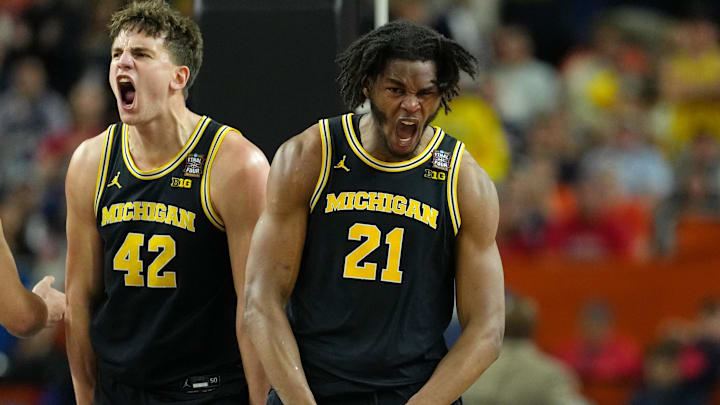
The 6-foot-10, 250-pound, 7-foot-3.5 wingspan sophomore averaged 13.1 points, 7.3 rebounds, 1.2 assists, 0.7 steals, and 1.1 blocks for the National Champion Michigan Wolverines this past season. Additionally, he shot 72.9% at the rim (225 attempts), 35.8% on non-rim twos (53 attempts), 34.3% from beyond the arc (35 attempts), and 78.2% from the free throw line -- the latter a sign of potential touch. Johnson Jr. also recorded a 12.8 offensive rebound percentage, a 1.5 steal percentage, and a 4.8 block percentage this past season.
Patrick Ngongba II, Duke

A player who would have likely been selected in the first round of the 2026 NBA Draft alongside Thomas Haugh, Ngongba II decided to return to school for his junior season--a decision that could lead to another increase in his draft stock in 2027. The 6-foot-11, 250-pound sophomore averaged 10.1 points, 5.8 rebounds, two assists, 0.6 steals, and 1.1 blocks per game while shooting 71.2% at the rim (139 attempts), 38.9% on non-rim twos (only 18 attempts), 25.8% from three (only 31 attempts), and 66.4% from the line (131 attempts). Showing some level of free throw touch or ability to space the floor could improve his draft stock significantly in 2027.
Additionally, Ngongba II recorded an offensive rebound percentage of 12.4, an assist percentage of 16.7, a steal percentage of 1.6, and a block percentage of six this past season.
Flory Bidunga, Kansas

The 6-foot-9, 230-pound, 7-foot-3 wingspan big is currently going through the 2026 NBA Draft process with the plan to transfer to Louisville if he opts to return to college. He averaged 13.3 points, nine rebounds, 1.5 assists, 0.7 steals, and 2.6 blocks per game this past season while shooting 75% at the rim (216 attempts) and 38.9% on non-rim twos (90 attempts). Bidunga has shot 66% from the free throw line the past two seasons, however, and had only two three point attempts last year.
Additionally, Bidunga recorded an 11.2 offensive rebound percentage, a 1.4 steal percentage, and a block percentage of nine this past season. His block percentage was 27th-highest in college basketball while he also had the second most dunks in college basketball with 82.
Bidunga is likely on the border of late first round pick and early second round pick. Expect most players who have not exhausted their eligibility, like Bidunga, and are not guaranteed a roster spot (usually picks 1-40ish) to return to school. In the 2025 NBA Draft, in fact, 22 college players were taken in the 2nd round. Of those 22, only three players were not seniors or graduate students. Those three players were Rasheer Fleming, Adou Thiero, and Tyrese Proctor--all three signed contracts with at least their first two years guaranteed.
Recap
Players in the 2026 NBA Draft who met the Productive Sophomore Query this past season or a prior season: Tyler Tanner, Labaron Philon, Morez Johnson Jr,, Patrick Ngongba II, Flory Bidunga, and JT Toppin ('25).
Players who returned to college who have previously met the Productive Sophomore Query in 2025: Thomas Haugh, Nolan Winter, and Alex Condon.
Conclusion
The Productive Sophomore Query is best used when attempting to identify talent or when weighing the potential risks of drafting a player.
For example, if a college basketball player is on track to meet the four criteria during the season, then the player may be worth looking into. Similarly, if you're considering drafting a player who's met the Productive Sophomore Query, it may be a sense of comfort that 74% of players to hit the same criteria have played five-plus seasons in the NBA or that 45% of players who hit the same criteria became NBA Starters or multi-time All-Stars.
This is especially important to take into account when you realize only 65% of players picked between picks 21-30 from the 2010-2021 NBA Drafts have stuck in the NBA. This number drops to 47% for picks 31-40, 37% for picks 41-50, and 15% for picks 51-60.
Additionally, from the 2010-2021 NBA Draft classes, only 36% of players picked between 11-20 became Starters or All-Stars, and this number drops significantly to 23% for players picked 21-30, 15% of players picked 31-40, 4% of players picked 41-50, and 1% of players picked 51-60.
The PSQ query should be used in conjunction with film, other key statistics, intel, intangibles, and medical information when evaluating a prospect.
 Add us as a preferred source on Google
Jordan is a senior at Cornell University where he is an analytics consultant for the men’s basketball team and Co-President of the Cornell ILR Sports Business Society. He has also interned for Sports Aptitude, where he helped interview former front office members and current professional basketball players with the goal of improving the pre-draft process.
Follow JMonacoScouting