%22%3E%0A%3Cpath%20d%3D%22M0%205.37646H8.15061L17.4195%2016.8819V5.37646H26.0647V31.4412H18.3227L8.64523%2019.4196V31.4412H0V5.37646Z%22%20fill%3D%22white%22%2F%3E%0A%3Cpath%20d%3D%22M29.2041%205.37649H43.8064C47.4193%205.37649%2049.6989%206.1937%2051.2258%207.72059C52.1505%208.64533%2052.8172%2010.0002%2052.8172%2011.7851V11.8497C52.8172%2014.9465%2050.9462%2016.8389%2048.172%2017.8067C51.5269%2018.7744%2053.6774%2020.5594%2053.6774%2024.1293V24.1938C53.6774%2028.3659%2050.258%2031.4197%2043.6558%2031.4197H29.2041V5.35498V5.37649ZM44.258%2013.7637C44.258%2012.6024%2043.3333%2011.9787%2041.4623%2011.9787H37.6988V15.6346H41.5053C43.3763%2015.6346%2044.258%2015.011%2044.258%2013.8497V13.7852V13.7637ZM42.0859%2020.9895H37.6988V24.8605H42.0644C43.9569%2024.8605%2044.9247%2024.0863%2044.9247%2022.968V22.9035C44.9247%2021.7852%2043.9999%2021.011%2042.0859%2021.011V20.9895Z%22%20fill%3D%22white%22%2F%3E%0A%3Cpath%20d%3D%22M64.8174%205.18286H73.4627L84.452%2031.4411H74.9896L73.6132%2027.9357H64.4949L63.1615%2031.4411H53.8496L64.8389%205.18286H64.8174ZM71.4412%2021.7636L69.054%2015.441L66.6669%2021.7636H71.4412Z%22%20fill%3D%22white%22%2F%3E%0A%3Cpath%20d%3D%22M95.2695%205.37646H105.248C115.592%205.37646%20120.775%2010.4733%20120.775%2018.1938V18.2583C120.775%2025.9788%20115.485%2031.4412%20104.947%2031.4412H95.2695V5.37646ZM104.001%2012.9679V23.8497H105.463C109.442%2023.8497%20112.022%2022.2153%20112.022%2018.4518V18.3873C112.022%2014.6239%20109.463%2012.9894%20105.463%2012.9894H104.001V12.9679Z%22%20fill%3D%22white%22%2F%3E%0A%3Cpath%20d%3D%22M123.098%2011.1182H131.549V15.2258C132.711%2012.4731%20134.56%2010.6881%20137.915%2010.8387V19.8065H137.012C133.442%2019.8065%20131.528%2021.785%20131.528%2026.2797V31.4625H123.076V11.1182H123.098Z%22%20fill%3D%22white%22%2F%3E%0A%3Cpath%20d%3D%22M137.808%2025.6772V25.6127C137.808%2021.5482%20140.818%2019.2901%20145.55%2019.2901C147.27%2019.2901%20149.464%2019.6557%20150.345%2020.0428V19.6987C150.345%2017.8277%20149.184%2016.7524%20146.582%2016.7524C144.496%2016.7524%20142.754%2017.204%20140.969%2017.9137L139.485%2012.3008C141.829%2011.3975%20144.517%2010.8169%20148.044%2010.8169C152.173%2010.8169%20154.862%2011.6771%20156.646%2013.4621C158.173%2014.989%20158.776%2016.9675%20158.776%2019.9137V31.5052H150.324V29.4622C148.904%2030.9891%20147.012%2031.9999%20144.474%2031.9999C140.56%2031.9999%20137.808%2029.7633%20137.808%2025.7417V25.6772ZM150.431%2023.9138V23.0536C149.937%2022.86%20149.206%2022.7095%20148.496%2022.7095C146.818%2022.7095%20145.894%2023.7202%20145.894%2024.9891V25.0536C145.894%2026.2364%20146.754%2027.0321%20147.829%2027.0321C149.313%2027.0321%20150.431%2025.8493%20150.431%2023.9138Z%22%20fill%3D%22white%22%2F%3E%0A%3Cpath%20d%3D%22M162.883%2017.6345H160.496V11.1183H162.883C162.926%208.96778%20163.442%207.20433%20164.711%205.9355C166.088%204.55915%20167.872%204%20170.668%204C173.163%204%20174.69%204.21506%20175.851%204.55914V9.84951C175.034%209.65596%20174.217%209.54843%20173.141%209.54843C171.83%209.54843%20171.163%2010.0646%20171.163%2011.1829V11.3334H175.851V17.6345H171.335V31.4411H162.883V17.6345Z%22%20fill%3D%22white%22%2F%3E%0A%3Cpath%20d%3D%22M178.883%2024.6238V17.613H176.496V11.0968H178.883V6H187.335V11.0968H192.023V17.613H187.335V22.7528C187.335%2024.2797%20188.045%2024.8389%20189.378%2024.8389C190.152%2024.8389%20191.055%2024.6238%20191.937%2024.2152V30.7314C190.604%2031.4411%20188.582%2031.8927%20186.539%2031.8927C181.55%2031.8927%20178.862%2029.5916%20178.862%2024.6238H178.883Z%22%20fill%3D%22white%22%2F%3E%0A%3Cpath%20fill-rule%3D%22evenodd%22%20clip-rule%3D%22evenodd%22%20d%3D%22M201.368%204.36764C207.191%20-1.45588%20216.632%20-1.45588%20222.456%204.36764C228.279%2010.1912%20228.279%2019.6324%20222.456%2025.4559L211.912%2036L201.368%2025.4559C195.544%2019.6324%20195.544%2010.1912%20201.368%204.36764ZM204.009%207.55761C203.948%207.86849%20203.916%208.39718%20203.916%209.14566V10.4189C203.916%2011.1832%20203.948%2011.7198%20204.013%2012.0267C204.078%2012.3317%20204.278%2012.6168%20204.617%2012.8762C204.956%2013.1376%20205.403%2013.3316%20205.958%2013.4623C206.512%2013.593%20207.1%2013.6583%20207.837%2013.6583C208.573%2013.6583%20209.217%2013.591%20209.769%2013.4524C210.322%2013.3158%20210.761%2013.1178%20211.086%2012.8604C211.411%2012.6029%20211.605%2012.3178%20211.666%2012.0069C211.728%2011.6961%20211.759%2011.1674%20211.759%2010.4189V9.14566C211.759%208.38134%20211.728%207.84473%20211.662%207.53781C211.597%207.23287%20211.397%206.94972%20211.058%206.68834C210.72%206.42696%20210.272%206.23291%20209.718%206.10223C209.163%205.97154%20208.536%205.90619%20207.839%205.90619C207.102%205.90619%20206.459%205.97352%20205.906%206.11213C205.352%206.24875%20204.914%206.44677%20204.589%206.70418C204.265%206.9616%20204.071%207.24673%20204.009%207.55761ZM209.276%2024.8638C212.876%2024.8638%20214.557%2024.2064%20214.557%2021.862V21.858V21.3155C214.557%2019.6581%20213.516%2018.971%20210.252%2018.3136C209.278%2018.1136%20208.908%2017.9136%20208.908%2017.3136V16.9414C208.908%2016.6543%20209.177%2016.5117%20209.413%2016.5117C209.749%2016.5117%20209.918%2016.7137%20209.918%2016.9414V18.1136H214.391V17.3988C214.391%2015.4563%20213.347%2014.4266%20209.177%2014.4266C206.15%2014.4266%20203.896%2015.3414%20203.896%2017.3711V17.7433C203.896%2019.5155%20204.805%2020.3155%20208.201%2021.0303C208.28%2021.0472%20208.355%2021.063%20208.427%2021.0781C209.329%2021.2674%20209.647%2021.3341%20209.647%2021.9174V22.2897C209.647%2022.6619%20209.546%2022.8045%20209.142%2022.8045C208.67%2022.8045%20208.637%2022.5471%20208.637%2022.262V21.2897H203.894V21.7471C203.894%2024.149%20205.476%2024.8638%20209.276%2024.8638ZM215.424%2024.5569H219.925V14.7355H215.424V24.5569ZM216.955%2013.5019H219.925V6.06064H217.092V9.411L215.193%206.06064H212.359V13.5019H215.193V10.1199L216.955%2013.5019ZM208.269%2012.152C208.204%2012.2688%20208.055%2012.3262%20207.825%2012.3262L207.827%2012.3282C207.604%2012.3282%20207.459%2012.2767%20207.398%2012.1757C207.336%2012.0748%20207.305%2011.8074%20207.305%2011.3758V7.90068C207.305%207.51852%20207.352%207.28684%20207.445%207.20962C207.538%207.13239%20207.675%207.09279%20207.851%207.09279C208.059%207.09279%20208.198%207.14031%20208.265%207.23734C208.332%207.33239%20208.366%207.55416%20208.366%207.90068V11.3203C208.366%2011.7579%20208.334%2012.0352%20208.269%2012.152Z%22%20fill%3D%22white%22%2F%3E%0A%3C%2Fg%3E%0A%3Cdefs%3E%0A%3CclipPath%20id%3D%22clip0_15247_3640%22%3E%0A%3Crect%20width%3D%22227%22%20height%3D%2236%22%20fill%3D%22white%22%2F%3E%0A%3C%2FclipPath%3E%0A%3C%2Fdefs%3E%0A%3C%2Fsvg%3E%0A)
2026 NBA Draft: The Productive Young Athlete Query
The Productive Young Athlete Query
- Introduction
- The Main Study
- Who Didn’t Stick?
- Productive Young Athlete Query: Player Outcomes
- Projecting Into The Future
- Conclusion: Why is this Useful?
Introduction
The 2026 NBA Draft is becoming interesting, with an unprecedented four projected first rounders deciding to return to college: Braylon Mullins, Thomas Haugh, Patrick Ngongba II, and Motiejus Krivas. This was just the tip of the iceberg, with players like Ivan Kharchenkov, Alijah Arenas, and other legitimate prospects also deciding to return to school. In total, there were only 71 early entrants--the lowest number since 2003. As a result, this draft may see an increased contrast between the one-and-done lottery selections, the sophomore breakouts, the occasional late first round upperclassman, and the larger group of players who have exhausted their eligibility.
Expect most players who have not exhausted their eligibility and are not guaranteed a roster spot (usually picks 1-40ish) to likely return to school. In the 2025 NBA Draft, in fact, 22 college players were taken in the 2nd round. Of those 22, only three players were not seniors or graduate students. Those three players were Rasheer Fleming, Adou Thiero, and Tyrese Proctor--all three signed contracts with at least their first two years guaranteed.
In an ever-changing draft landscape, there is increased uncertainty -- even amongst the one-and-done players projected in the lottery. To reduce uncertainty, it has become increasingly popular to design statistical queries to identify NBA talent. That being said, it is of the utmost importance to consider the logic behind the factors included in these queries. While exploring different statistics, I came across a combination of criteria that is logical through the “eye” test and reliably predicts talent. Let’s call it the Productive Young Athlete (PYA) query.
Before we dive into the statistical analysis, it’s important to define what “stick” means in my study. In this case, I considered a prospect to “stick” if they played five-plus seasons in the NBA. Prospects in the 2022 or 2023 NBA Drafts met the criteria of “sticking” if they are still in the league, due to the impossibility of them reaching five NBA seasons.
The Main Study
Since 2008, 78% of Freshmen with a MIN% ≥ 40, BPM ≥ 7.5, and 4+ Total Dunks throughout the season “stick” in the NBA. Out of the 86 prospects who matched these four criteria from the 2008-2023 college basketball seasons, 67 of them went on to play 5+ seasons in the NBA or are currently in the league. Although it’s fun to toggle around with different queries and Barttorvik.com to discover what metrics are most indicative of future success for prospects, it’s important to ask: “What do these four criteria really mean? What picture does it paint about prospects with these four criteria in common?”
Well, let’s define each. A freshman is the first-year of a player at a college or university, indicating a young age of around 18 years old. MIN% is the percentage of the team’s total minutes that a prospect plays in. These two criteria alone help narrow prospects down into college basketball players that are young, but are already trusted by their college coach and talented enough to play significant (defined here as ≥40% of the team’s total) minutes.
Next indicator, and this is the most important one, is a Box Plus-Minus greater than or equal to 7.5. Box Plus-Minus, or BPM, is a box score estimate of the points per 100 possessions a player contributed above a league-average player, translated to an average team. Widely considered as one of the most relevant publicly-available advanced statistics in the basketball world, BPM is applied to the NBA game as well. For example, to show its relevance, the four NBA players with the highest BPMs this season are the four favorites for MVP: Nikola Jokic (14.2), Shai Gilgeous-Alexander (11.7), Victor Wembanyama (10.7), and Luke Doncic (9.3). Therefore, if a prospect is a freshman with a MIN%≥40 and a BPM≥7.5, this means they are likely to be young, playing almost a majority of their team’s minutes, and contributing to the game significantly over a replacement-level player when out on the floor.
The final layer to this statistical Productive Young Athlete query is the threshold of four total dunks throughout the season. Despite this not seeming like a lot, it makes a significant difference. There have been only seven freshmen from 2008-2023 to play more than 40% of their team's minutes, have a Box Plus-Minus of 7.5 or greater, but have only three or less dunks throughout that entire season. Only two of those seven players (28.6%) stuck in the NBA and those players were Tyus Jones and Trae Young--both of whom are impactful both at the rim and as primary ball-handlers without needing to dunk. Interestingly enough, this is where projected lottery pick Keaton Wagler finds himself, as does his Illinois teammate David Mirkovic. In 2024 and 2025, respectively, we saw Jared McCain then Kon Knueppel meet this same unique situation as well. Assuming McCain and Knueppel both stick, four-for-nine (44.4%) is an undoubtedly low sample size but is still significantly lower than the 78% players who meet the Productive Young Athlete query find themselves in (on a much larger sample size). Overall, this dunk threshold helps to incorporate a baseline athleticism metric.
Therefore, 78% of freshmen with a MIN%≥40, BPM≥7.5, and Four Total Dunks throughout the season (Productive Young Athlete query) have “stuck” in the NBA historically due to them being young players trusted and talented enough to play big minutes, significantly contributing positively to the game, and having a baseline level of athleticism.
Who Didn’t Stick?
You may be wondering: “If these four criteria combined are so indicative, who are the 19 prospects since 2008 who met the criteria but didn't stick?”
Let's walk through each year:
2008: In the 2008 criteria-meeting class, Robbie Hummel and LaceDarius Dunn both met all four criteria but neither played five-plus seasons in the NBA. Robbie Hummel dealt with nagging injuries in his first two years in the NBA, and continued to deal with them overseas professionally. He retired in 2017 to become one of the best TV analysts in college basketball. On the other hand, LaceDarius Dunn had significant off-the-court question-marks and was indefinitely suspended from the Baylor Bears men’s basketball team.
2009: All three of the players who met the criteria “stuck” in the NBA, which included the likes of Gordon Hayward, Greg Monroe and Tyreke Evans.
2010: Xavier Henry was the only player not to “stick,” and he played in 185 NBA games over the course of five seasons and ruptured his left Achilles tendon nine games into his fifth season. Unfortunately, this ended his career and he was waived by the Lakers.
2011: Javon McCrea was the only player not to “stick,” and this was due to a clear lack of a perimeter game. He attempted only 4 threes his entire career at 6-foot-7 and shot only 66.7% from the free throw line. Lack of a perimeter game, in addition to unfortunate injuries, are the most common causes of why prospects didn’t “stick.”
2012: Four players didn’t “stick” out of the eight who qualified, and all four of whom struggled from the perimeter.
2013: Two players didn’t “stick” out of the six who qualified: Anthony Bennett and Sam Dekker. Regarding Bennett, nothing more really needs to be said as he is widely considered one of the bigger draft misses of all time. Dekker, meanwhile, appeared in 201 NBA games and fell just short of playing for five-plus NBA seasons (not counting his one minute played in one game on the Raptors in the 2021-22 NBA season).
2014: The one player who met the criteria “stuck” in the NBA (Joel Embiid).
2015: Eight out of nine players who met the criteria “stuck” in the NBA. The only player who didn't "stick" was Gary Clark out of Cincinnati, and he played 170 games over his four NBA seasons.
2016: The only player who qualified this season that didn’t “stick” was Mike Daum. The 6’9” South Dakota State phenom was a poor defender and didn’t provide much NBA-level athleticism.
2017: Two of the thirteen players who qualified in 2017 didn’t “stick,” and they were Justin Patton and TJ Leaf. Patton needed two surgeries to repair a broken left foot that limited him in his first season, then suffered a broken right foot the season after. Patton is another unfortunate example of injuries cutting a career short. TJ Leaf played in 146 NBA games over his first four NBA seasons, but eventually fizzled out of the rotations for both the Pacers and Blazers and subsequently signed a deal in China.
2018: Two players didn't "stick" out of the nine who qualified: Zhaire Smith and Jarrett Culver. Smith unfortunately fractured his foot in camp prior to his rookie season beginning, then dealt with a lingering knee injury the rest of his two-year career on the Sixers. Culver suffered a right ankle injury in his second season that required surgery and played 144 games over his four-year NBA career.
2019: Two players who met the criteria didn’t “stick” in the NBA, and they were Nick Musynski and Ignas Brazdeikis. Musynski, like a couple of the other prospects who didn’t “stick” despite meeting the four criteria, struggled shooting on the perimeter. When he qualified as a freshman, he was shooting 19% from beyond the arc. Despite improving his 3-point percentage as his college career progressed, Musynski wasn't heavily considered as a draftable prospect.
Ignas Brazdeikis is a unique case. Despite being considered someone who didn't "stick," as he appeared in only 65 NBA games over his first three NBA seasons, he won a championship with Žalgiris Kaunas in his home country of Lithuania in 2022-23 and was subsequently invited to the Toronto Raptors minicamp during the 2023 offseason. While he shot the ball efficiently in college (39.2% from three), Brazdeikis converted only 31.5% of his shots beyond the arc throughout his three year career (124 attempts).
2020: Vernon Carey Jr was the only player who met the criteria that didn’t stick in the NBA, and he struggled with injuries throughout his three years in the league.
2021: Both players who met the criteria in 2021, Jalen Suggs and Evan Mobley, have solidified themselves in the NBA.
2022: Both players who met the criteria in 2022, Chet Holmgren and Jabari Smith, have been impactful NBA players.
2023: All four players who met the criteria in 2023 are on track to stick in the NBA: Brandon Miller, Brice Sensabaugh, Jarace Walker, and Dereck Lively II.
Therefore, out of the 19 players who qualified by meeting the four criteria of Freshman with a MIN% ≥ 40, BPM ≥ 7.5, and 4 Total Dunks and didn't "stick":
- 7 of them lacked any sort of perimeter shooting
- 6 of them struggled with significant or continuous injuries
- 6 of them played in over 143 NBA Games over four-plus seasons
- 1 of them lacked significant degrees of NBA-level athleticism
- 1 of them had significant off-court issues
- 1 of them is widely considered one of the biggest draft misses of all time
*Some of the 19 prospects suffered from multiple of these commonalities
Note: Four players who met the criteria from 2008-2023 are currently excluded from both the 67 players who "stuck" number and the 86 player sample size. Those players are Trayce Jackson-Davis ('20), Oscar Tshiebwe ('20), DaRon Holmes II ('22), and Kennedy Chandler ('22), due to uncertainty surrounding whether they will stick in the NBA. More on this is discussed below.
Productive Young Athlete Query: Player Outcomes
Rather than wondering why certain players who met the criteria didn't stick, you may be wondering what were the outcomes of players who did stick. Sticking in the NBA is one thing, but how impactful were the players who stuck? Below I grouped the 90 players (including the four with unknown outcomes) who have met the Productive Young Athlete query from 2008-2023 into four subcategories based on Draft Express Pick Expectations. The highlight: 50% (45 of the 90 players) became NBA starters or All-Stars.
Players were grouped into the following five categories:
Unknown: Players who have uncertainty surrounding whether or not they will stick in the NBA, as it may be too early to tell.
Unknown Players who met the PYA Query: Trayce Jackson-Davis ('20), Oscar Tshiebwe ('20), DaRon Holmes II ('22), and Kennedy Chandler ('22)
Did Not Stick
Examples all shown above.
Backup: Five NBA seasons, with career 10-24 minutes per game, or over 4000 career NBA minutes
Backup Players who met the PYA Query: Michael Beasley ('08), Austin Daye ('08), John Jenkins ('10), Jared Sullinger ('11), Cody Zeller ('12), Ben Mclemore ('13), Nerlens Noel ('13), Jahlil Okafor ('15), Stanley Johnson ('15), Markelle Fultz ('17), Malik Monk ('17), Josh Jackson ('17), Landry Shamet ('17), Jonathan Isaac ('17), Robert Williams ('17), Zach Collins ('17), Mo Bamba ('18), Marvin Bagley III ('18), Jaxson Hayes ('19), Obi Toppin ('19), Brice Sensabaugh ('23), and Jarace Walker ('23)
Starter: Career 24 minutes per game or higher, or started over half of career NBA games (minimum 21 minutes per game)
Starter Players who met the PYA Query: OJ Mayo ('08), Gordon Hayward ('09), Tyreke Evans ('09), Greg Monroe ('09), Tristan Thompson ('11), Otto Porter ('12), Gary Harris ('13), Marcus Smart ('13), Justice Winslow ('15), Myles Turner ('15), Kelly Oubre ('15), D'Angelo Russell ('15), Jamal Murray ('16), Mikal Bridges ('16), Lonzo Ball ('17), Lauri Markkanen ('17), Miles Bridges ('17), Bruce Brown ('17), DeAndre Ayton ('18), Wendell Carter Jr ('18), De'Andre Hunter ('18), Tyler Herro ('19), Onyeka Okongwu ('20), Evan Mobley ('21)*, Jalen Suggs ('21), Chet Holmgren ('22)*, Jabari Smith ('22), Brandon Miller ('23), and Dereck Lively II ('23)
All-Star: Two or more appearances in the NBA All-Star Game
All-Star Players who met the PYA Query: Kevin Love ('08), James Harden ('08), Derrick Rose ('08), Blake Griffin ('08), John Wall ('10), Demarcus Cousins ('10), Anthony Davis ('12), Bradley Beal ('12), Joel Embiid ('14), Karl-Anthony Towns ('15), Devin Booker ('15), Ben Simmons ('16), Shai Gilgeous-Alexander ('18), Jaren Jackson Jr. ('18), Zion Williamson ('19), and Tyrese Haliburton ('19)
The Results
Out of the 90 players who have met the Productive Young Athlete Query from the 2008-2023 college basketball seasons...
- 21.1% of them did not stick in the NBA (19 players)
- 24.4% of them became Backups (22 players)
- 32.2% of them became Starters (29 players)
- 17.8% of them became multi-time All-Stars (16 players)
- 4.4% of them have outcomes that are still unknown and are uncertain to stick in the NBA (4 players)

To put these outcomes into context, let's compare it to the results of draft picks over a similar timeframe and make predictions for the unknowns. We'll assume three of the unknowns become backups and one of the four does not stick in the NBA.
- 22.2% of players did not stick in the NBA (20/90 players)
- 27.8% of players became Backups (25/90 players)
- 32.2% of players became Starters (29/90 players)
- 17.8% of players became multi-time All-Stars (16/90 players)
If we look at the 2008-2021 NBA Draft classes utilizing DraftExpress Pick Expectations, players who meet the Productive Young Athlete Query have a similar All-Star/Starter rates as lottery picks, but a similar overall stick rate (and not-stick rate) as picks 16-30. So, the average player who meets the PYA query has proportional upside to a historic lottery pick and the proportional floor of a non-lottery first round pick.
For context, as shown below, 53% of players drafted between picks 1-15 from 2008-2021 became All-Stars or Starters. Additionally, across the same time period, 29% of players drafted between picks 16-30 did not stick in the NBA. The results of the Productive Young Athlete query have historically been an intriguing, volatile mashup: a similar probability as a top-15 pick to become an All-Star or Starter but a also a similar probability as a 16-30 pick to not stick in the NBA at all.

If we want to get even more granular, picks 6-10 have the most similar proportion of high outcomes as a player who meets the Productive Young Athlete Query. 49% of players drafted between picks 6-10 from the 2008-2021 NBA Drafts have become All-Stars or Starters, compared to 50% for players who have met the Productive Young Athlete query from 2008-2023.

Projecting Into The Future
Who Qualified for the Productive Young Athlete query in 2024 and 2025?
2024: Three freshmen met the criteria of the Productive Young Athlete query in 2024 – Reed Sheppard, Collin Murray-Boyles, and JT Toppin.
Sheppard was drafted third overall by the Rockets in 2024 and is enjoying somewhat of a breakout sophomore season, as he averaged 13.5 points, 3.4 assists, 2.9 rebounds, 1.5 steals, and 0.7 blocks in 26.2 minutes per game during the regular season while shooting 39.4% from beyond the arc (576 attempts). His minutes have increased to 32 minutes per game during the 2026 playoffs as well.
Read More: Reed Sheppard Scouting Report (June 21, 2024)
Collin Murray-Boyles met the Productive Young Athlete query as a freshman, then returned to school for another impactful season and met the Productive Sophomore Query. CMB has had an impressive rookie season, making a significant positive impact for the Raptors during these playoffs.
Similar to Collin Murray-Boyles, JT Toppin met the Productive Young Athlete Query as a freshman while he was at New Mexico, then transferred to Texas Tech where he met the Productive Sophomore query. Toppin then returned to Texas Tech for his junior season and now declared for the draft as a 2026 NBA Draft prospect. It should be noted he is the only player outside of the freshmen who met the criteria during the 2026 season who is projected to be in the 2026 NBA Draft class.
2025: Eight players met the Productive Young Athlete query from the 2024-25 college basketball season--Cooper Flagg, Jase Richardson, VJ Edgecombe, Khaman Maluach, Asa Newell, Dylan Harper, Derik Queen, and Carter Bryant. All eight players were first round picks and, while it's early in their careers, a handful of those players have already established themselves as long-term, impactful NBA players.
2026
Eleven freshmen met the Productive Young Athlete Query in 2026, the second-highest ever--only less than the 13 players who met the query in 2017. Players listed below in highest to lowest Box Plus-Minus, along with a small statistical summary of each player.
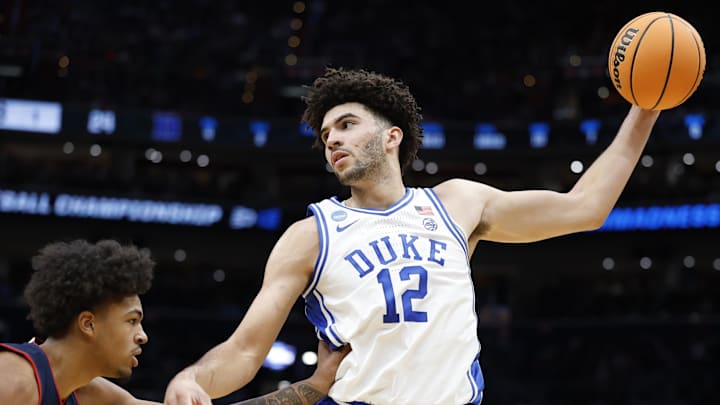
Cameron Boozer, Duke

The Wooden Award winner had the second-highest Box Plus-Minus in a single season for any player since 2008, behind only Zion Williamson in 2019. The 6-foot-9, 250-pound forward averaged 22.5 points, 10.2 rebounds, 4.1 assists, and 1.4 steals, and 0.6 blocks per game while shooting 64.5% at the rim (332 attempts), 42.3% on non-rim twos (52 attempts), 39.1% from three (138 attempts), and 78.9% from the free throw line (280 attempts).
Additionally, Boozer recorded a 12.5 offensive rebound percentage, 22.1 defensive rebound percentage, a 25.6 assist percentage, and a 4.7 stock percentage. Boozer is a projected top five pick in the 2026 NBA Draft.
Caleb Wilson, North Carolina

The 6-foot-10, 215-pound forward appeared in 24 games before going down with a left-hand injury and then a thumb injury. He averaged 19.8 points, 9.4 rebounds, 2.7 assists, and 1.5 steals, and 1.4 blocks per game while shooting 72.3% at the rim (159 attempts), 44.4% on non-rim twos (108 attempts), 25.9% from three (27 attempts), and 71.3% from the free throw line (181 attempts).
He also recorded a 10.5 offensive rebound percentage, a 22.2 defensive rebound percentage, an 18.1 assist percentage, a 2.8 steal percentage, and a 4.4 block percentage. Wilson is a projected top five pick in the 2026 NBA Draft.
Allen Graves, Santa Clara

The 6-foot-9, 220-pound forward averaged 11.8 points, 6.5 rebounds, 1.8 assists, 1.9 steals, and 0.9 blocks per game while shooting 63.3% at the rim (120 attempts), 44.6% on non-rim twos (65 attempts), 41.3% from three (92 attempts | 6.7 three point attempts per 100 possessions), and 75% from the free throw line (112 attempts).
Additionally, Graves recorded a 13.8 offensive rebound percentage, a 19.8 defensive rebound percentage, a 13.9 assist percentage, a 4.9 steal percentage, and a 4.9 block percentage--very high defensive playmaking numbers. Graves is a projected first round pick in the 2026 NBA Draft.
Darryn Peterson, Kansas

The 6-foot-5, 205-pound guard only played in 49.4% of Kansas' minutes this season, the lowest percentage of their team's minutes of anyone who met the necessary criteria. However, the production when on the court was undeniable: Peterson averaged 20.2 points, 4.2 rebounds, 1.6 assists, 1.4 steals, and 0.6 blocks per game while shooting 59.7% at the rim (67 attempts), 42.7% on non-rim twos (124 attempts), 38.2% from three (165 attempts | 13.9 three point attempts per 100 possessions), and 82.6% from the free throw line (132 attempts). Peterson also recorded a 5.2 stock percentage for the season. He's a projected top five pick in the 2026 NBA Draft.
Kingston Flemings, Houston

The 6-foot-4, 190-pound guard averaged 16.1 points, 5.2 assists, 4.1 rebounds, and 1.8 stocks per game while shooting 57.2% at the rim (166 attempts), 44.3% on non-rim twos (194 attempts), 38.7% from beyond the arc (106 attempts | 5.6 three point attempts per 100 possessions), and 84.5% from the free throw line (129 attempts).
Flemings was often the offensive engine for the Cougars, as he was unassisted on 74.3% of his made field goals this season while assisting on an estimated 32.6% of his teammates' made field goals when on the floor this season. He's a consensus top-seven prospect in the 2026 NBA Draft.
Brayden Burries, Arizona

The 6-foot-4, 205-pound guard averaged 16.1 points, 4.9 rebounds, 2.4 assists, and 1.7 stocks per game while shooting 65% at the rim (140 attempts), 45% on non-rim twos (109 attempts), 39.1% from three (179 attempts | 8.6 three point attempts per 100 possessions), and 80.5% from the free throw line (169 attempts). Burries is projected to be a lottery pick in the 2026 NBA Draft.
AJ Dybantsa, BYU

The 6-foot-9, 210-pound wing averaged 25.5 points, 6.8 rebounds, 3.7 assists, and 1.4 stocks per game while shooting 72.3% at the rim (184 attempts), 46.3% on non-rim twos, 33.1% from three (148 attempts | 6.9 three point attempts per 100 possessions), and 77.4% from the free throw line (296 attempts).
Dybanta's offensive production was impressive, as he was unassisted on 75.3% of his made field goals while assisting an estimated 22.1% of his teammates' made field goals when on the floor this past season. He's a projected top three pick in the 2026 NBA Draft.
Ebuka Okorie, Stanford

The 6-foot-2, 185-pound guard averaged 23.2 points, 3.6 assists, 3.6 rebounds, and 1.9 stocks per game while shooting 56.3% at the rim (240 attempts), 42.4% on non-rim twos (85 attempts), 35.4% from three (178 attempts | 9.6 three point attempts per 100 possessions), and 83.2% from the free throw line (226 attempts).
Okorie was also the offensive engine for Stanford, as he was unassisted on 79.5% of his made field goals while assisting on an estimated 23.9% of his teammates' field goals when on the floor this past season. He's currently projected as a late first round pick in the 2026 NBA Draft.
Hannes Steinbach, Washington

The 6-foot-11, 220-pound big averaged 18.5 points, 11.8 rebounds, 1.6 assists, 1.1 steals, and 1.2 blocks while shooting 70.6% at the rim (204 attempts), 44.8% on non-rim twos (105 attempts), 34% from three (53 attempts), and 75.9% from the free throw line (158 attempts) this past season.
Steinbach also recorded a 25 defensive rebound percentage, a 14.3 offensive rebound percentage, and a 5.7 stock percentage. He's a projected late-lottery pick in the 2026 NBA Draft.
Darius Acuff Jr, Arkansas

The 6-foot-3, 190-pound guard averaged 23.5 points, 6.4 assists, 3.1 rebounds, and 1.1 stocks per game while shooting 59.7% at the rim (211 attempts), 40.1% on non-rim twos (177 attempts), 44% from three (207 attempts | nine three point attempts per 100 possessions), and 80.9% from the free throw line (220 attempts). Acuff Jr. also recorded a 32.2 assist percentage this past season. He's a projected top-seven pick in the 2026 NBA Draft.
Ivan Kharchenkov, Arizona

The only player on this list who did not declare for the 2026 NBA Draft--mentioned in the beginning of this article--averaged 10.4 points, 4.3 rebounds, 2.3 assists, and 1.7 stocks per game while shooting 66.7% at the rim (129 attempts), 43.1% on non-rim twos (72 attempts), 31.7% from three (104 attempts | 5.3 three point attempts per 100 possessions), and 72.3% from the free throw line (101 attempts). The 6-foot-7 wing will be one of the top prospects in college basketball next season and is a prospect to watch regarding the 2027 NBA Draft.
Conclusion: Why is this Useful?
The Productive Young Athlete query is best used when attempting to identify talent or when weighing the potential risks of drafting a player.
For example, if a college basketball player is on track to meet the four criteria during the season, then the player may be worth looking into. Similarly, if you're considering drafting a player who's met the Productive Young Athlete query, it may be a sense of comfort that 78% of players to hit the same criteria have played five-plus seasons in the NBA or that 50% of players who hit the same criteria became NBA Starters or multi-time All-Stars.
This is especially important to take into account when you realize only 67% of players picked between picks 21-30 from the 2008-2021 NBA Drafts have stuck in the NBA. This number drops to 47% for picks 31-40, 37% for picks 41-50, and 15% for picks 51-60.
Additionally, from the 2008-2021 NBA Draft classes, only 34% of players picked between 11-20 became Starters or All Stars, and this number drops significantly to 23% for players picked 21-30, 15% of players picked 31-40, 6% of players picked 41-50, and 1% of players picked 51-60.
Regardless, the PYA query should be used in conjunction with film, other key statistics, intel, intangibles, and medical information when evaluating a prospect.
 Add us as a preferred source on Google
Jordan is a senior at Cornell University where he is an analytics consultant for the men’s basketball team and Co-President of the Cornell ILR Sports Business Society. He has also interned for Sports Aptitude, where he helped interview former front office members and current professional basketball players with the goal of improving the pre-draft process.
Follow JMonacoScouting