%22%3E%0A%3Cpath%20d%3D%22M0%205.37646H8.15061L17.4195%2016.8819V5.37646H26.0647V31.4412H18.3227L8.64523%2019.4196V31.4412H0V5.37646Z%22%20fill%3D%22white%22%2F%3E%0A%3Cpath%20d%3D%22M29.2041%205.37649H43.8064C47.4193%205.37649%2049.6989%206.1937%2051.2258%207.72059C52.1505%208.64533%2052.8172%2010.0002%2052.8172%2011.7851V11.8497C52.8172%2014.9465%2050.9462%2016.8389%2048.172%2017.8067C51.5269%2018.7744%2053.6774%2020.5594%2053.6774%2024.1293V24.1938C53.6774%2028.3659%2050.258%2031.4197%2043.6558%2031.4197H29.2041V5.35498V5.37649ZM44.258%2013.7637C44.258%2012.6024%2043.3333%2011.9787%2041.4623%2011.9787H37.6988V15.6346H41.5053C43.3763%2015.6346%2044.258%2015.011%2044.258%2013.8497V13.7852V13.7637ZM42.0859%2020.9895H37.6988V24.8605H42.0644C43.9569%2024.8605%2044.9247%2024.0863%2044.9247%2022.968V22.9035C44.9247%2021.7852%2043.9999%2021.011%2042.0859%2021.011V20.9895Z%22%20fill%3D%22white%22%2F%3E%0A%3Cpath%20d%3D%22M64.8174%205.18286H73.4627L84.452%2031.4411H74.9896L73.6132%2027.9357H64.4949L63.1615%2031.4411H53.8496L64.8389%205.18286H64.8174ZM71.4412%2021.7636L69.054%2015.441L66.6669%2021.7636H71.4412Z%22%20fill%3D%22white%22%2F%3E%0A%3Cpath%20d%3D%22M95.2695%205.37646H105.248C115.592%205.37646%20120.775%2010.4733%20120.775%2018.1938V18.2583C120.775%2025.9788%20115.485%2031.4412%20104.947%2031.4412H95.2695V5.37646ZM104.001%2012.9679V23.8497H105.463C109.442%2023.8497%20112.022%2022.2153%20112.022%2018.4518V18.3873C112.022%2014.6239%20109.463%2012.9894%20105.463%2012.9894H104.001V12.9679Z%22%20fill%3D%22white%22%2F%3E%0A%3Cpath%20d%3D%22M123.098%2011.1182H131.549V15.2258C132.711%2012.4731%20134.56%2010.6881%20137.915%2010.8387V19.8065H137.012C133.442%2019.8065%20131.528%2021.785%20131.528%2026.2797V31.4625H123.076V11.1182H123.098Z%22%20fill%3D%22white%22%2F%3E%0A%3Cpath%20d%3D%22M137.808%2025.6772V25.6127C137.808%2021.5482%20140.818%2019.2901%20145.55%2019.2901C147.27%2019.2901%20149.464%2019.6557%20150.345%2020.0428V19.6987C150.345%2017.8277%20149.184%2016.7524%20146.582%2016.7524C144.496%2016.7524%20142.754%2017.204%20140.969%2017.9137L139.485%2012.3008C141.829%2011.3975%20144.517%2010.8169%20148.044%2010.8169C152.173%2010.8169%20154.862%2011.6771%20156.646%2013.4621C158.173%2014.989%20158.776%2016.9675%20158.776%2019.9137V31.5052H150.324V29.4622C148.904%2030.9891%20147.012%2031.9999%20144.474%2031.9999C140.56%2031.9999%20137.808%2029.7633%20137.808%2025.7417V25.6772ZM150.431%2023.9138V23.0536C149.937%2022.86%20149.206%2022.7095%20148.496%2022.7095C146.818%2022.7095%20145.894%2023.7202%20145.894%2024.9891V25.0536C145.894%2026.2364%20146.754%2027.0321%20147.829%2027.0321C149.313%2027.0321%20150.431%2025.8493%20150.431%2023.9138Z%22%20fill%3D%22white%22%2F%3E%0A%3Cpath%20d%3D%22M162.883%2017.6345H160.496V11.1183H162.883C162.926%208.96778%20163.442%207.20433%20164.711%205.9355C166.088%204.55915%20167.872%204%20170.668%204C173.163%204%20174.69%204.21506%20175.851%204.55914V9.84951C175.034%209.65596%20174.217%209.54843%20173.141%209.54843C171.83%209.54843%20171.163%2010.0646%20171.163%2011.1829V11.3334H175.851V17.6345H171.335V31.4411H162.883V17.6345Z%22%20fill%3D%22white%22%2F%3E%0A%3Cpath%20d%3D%22M178.883%2024.6238V17.613H176.496V11.0968H178.883V6H187.335V11.0968H192.023V17.613H187.335V22.7528C187.335%2024.2797%20188.045%2024.8389%20189.378%2024.8389C190.152%2024.8389%20191.055%2024.6238%20191.937%2024.2152V30.7314C190.604%2031.4411%20188.582%2031.8927%20186.539%2031.8927C181.55%2031.8927%20178.862%2029.5916%20178.862%2024.6238H178.883Z%22%20fill%3D%22white%22%2F%3E%0A%3Cpath%20fill-rule%3D%22evenodd%22%20clip-rule%3D%22evenodd%22%20d%3D%22M201.368%204.36764C207.191%20-1.45588%20216.632%20-1.45588%20222.456%204.36764C228.279%2010.1912%20228.279%2019.6324%20222.456%2025.4559L211.912%2036L201.368%2025.4559C195.544%2019.6324%20195.544%2010.1912%20201.368%204.36764ZM204.009%207.55761C203.948%207.86849%20203.916%208.39718%20203.916%209.14566V10.4189C203.916%2011.1832%20203.948%2011.7198%20204.013%2012.0267C204.078%2012.3317%20204.278%2012.6168%20204.617%2012.8762C204.956%2013.1376%20205.403%2013.3316%20205.958%2013.4623C206.512%2013.593%20207.1%2013.6583%20207.837%2013.6583C208.573%2013.6583%20209.217%2013.591%20209.769%2013.4524C210.322%2013.3158%20210.761%2013.1178%20211.086%2012.8604C211.411%2012.6029%20211.605%2012.3178%20211.666%2012.0069C211.728%2011.6961%20211.759%2011.1674%20211.759%2010.4189V9.14566C211.759%208.38134%20211.728%207.84473%20211.662%207.53781C211.597%207.23287%20211.397%206.94972%20211.058%206.68834C210.72%206.42696%20210.272%206.23291%20209.718%206.10223C209.163%205.97154%20208.536%205.90619%20207.839%205.90619C207.102%205.90619%20206.459%205.97352%20205.906%206.11213C205.352%206.24875%20204.914%206.44677%20204.589%206.70418C204.265%206.9616%20204.071%207.24673%20204.009%207.55761ZM209.276%2024.8638C212.876%2024.8638%20214.557%2024.2064%20214.557%2021.862V21.858V21.3155C214.557%2019.6581%20213.516%2018.971%20210.252%2018.3136C209.278%2018.1136%20208.908%2017.9136%20208.908%2017.3136V16.9414C208.908%2016.6543%20209.177%2016.5117%20209.413%2016.5117C209.749%2016.5117%20209.918%2016.7137%20209.918%2016.9414V18.1136H214.391V17.3988C214.391%2015.4563%20213.347%2014.4266%20209.177%2014.4266C206.15%2014.4266%20203.896%2015.3414%20203.896%2017.3711V17.7433C203.896%2019.5155%20204.805%2020.3155%20208.201%2021.0303C208.28%2021.0472%20208.355%2021.063%20208.427%2021.0781C209.329%2021.2674%20209.647%2021.3341%20209.647%2021.9174V22.2897C209.647%2022.6619%20209.546%2022.8045%20209.142%2022.8045C208.67%2022.8045%20208.637%2022.5471%20208.637%2022.262V21.2897H203.894V21.7471C203.894%2024.149%20205.476%2024.8638%20209.276%2024.8638ZM215.424%2024.5569H219.925V14.7355H215.424V24.5569ZM216.955%2013.5019H219.925V6.06064H217.092V9.411L215.193%206.06064H212.359V13.5019H215.193V10.1199L216.955%2013.5019ZM208.269%2012.152C208.204%2012.2688%20208.055%2012.3262%20207.825%2012.3262L207.827%2012.3282C207.604%2012.3282%20207.459%2012.2767%20207.398%2012.1757C207.336%2012.0748%20207.305%2011.8074%20207.305%2011.3758V7.90068C207.305%207.51852%20207.352%207.28684%20207.445%207.20962C207.538%207.13239%20207.675%207.09279%20207.851%207.09279C208.059%207.09279%20208.198%207.14031%20208.265%207.23734C208.332%207.33239%20208.366%207.55416%20208.366%207.90068V11.3203C208.366%2011.7579%20208.334%2012.0352%20208.269%2012.152Z%22%20fill%3D%22white%22%2F%3E%0A%3C%2Fg%3E%0A%3Cdefs%3E%0A%3CclipPath%20id%3D%22clip0_15247_3640%22%3E%0A%3Crect%20width%3D%22227%22%20height%3D%2236%22%20fill%3D%22white%22%2F%3E%0A%3C%2FclipPath%3E%0A%3C%2Fdefs%3E%0A%3C%2Fsvg%3E%0A)
NBA Draft Scouting Report: Arizona's Koa Peat
In this story:
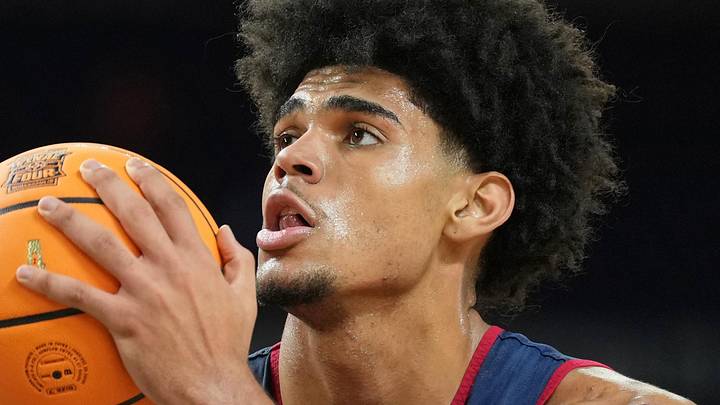
Arizona forward Koa Peat offers one of the more interesting and wide-ranging prospects in the 2026 NBA Draft class, having been a highly-impactful five-star contributor for the Wildcats en route to the Final Four, though only making a late-decision to stay in the draft due to some NBA translation questions.
Still, Peat’s likely to be a first-round pick, standing at 6-foot-7 barefoot with a 6-foot-11-and-a-quarter wingspan, and a bulky, 245-pound frame. He has a standing reach of 8-foot-8, offering a really nice buildable prospect overall.
Peat’s major strengths include his physical tools and athleticism, his finishing ability and touch, defensive impact and upside, as well as connective passing.
Strengths:
Physical Tools and Athleticism
Most of Koa Peat’s Arizona success and future value is built on his physical tools and athleticism, which blend together to create one of the tooslier and professionally adaptable players in the class.
As mentioned, Peat stood 6-foot-7 barefoot at the combine, with a 6-11 wingspan and 8-8 standing reach. I think it’s ultimately going to be more ideal for Peat to play more as a strength wing than a true power forward, but his frame should allow for the latter.
Outside of just the measurements, Peat also has one of the best blends of athleticism in the class. It starts with his pure strength. He’s an immensely strong player at 245 pounds, who can overpower opponents in a variety of situations. He’s got wide shoulders, big arms, and very functional use of this on both ends in crashing the glass, finishing through contact, walling up on defense.
When you bake in the fact he’s a very fluid and coordinated mover, you can see why he offered a real two-way handful at the college level, even as a true freshman.
Additionally, Peat has good athleticism vertically. We’ve touched on his horizontal movement — directional change, lateral quickness — but he’s also a good vertical spacer who posted 50 dunks in 36 games.
One of the best ways Peat’s level of strength and physicality can be seen is in his offensive rebounding numbers. It didn’t warrant a section of its own, but Peat’s a very solid rebounder, having posted 5.6 per game, 2.1 of which were offensive, where opposing bigs were really unable to keep him from getting where he wanted.
When looking at who can play in the NBA’s postseason, strength and physicality can sometimes go undersold, and there’s little question that Peat has the requisite physical tools and athleticism to check those boxes.
Finishing and Touch
Given his level of tools and athleticism, Peat was the second-leading scorer on one of the best teams in the country in Arizona as a true freshman, being narrowly ousted by fellow draftee Brayden Burries. There’s tons to get into regarding Peat’s offensive game, but his finishing ability and general level of touch are two major plusses.
Far-and-away the most impressive part of Peat’s offensive profile is his at-rim finishing, with his touch extending out a bit into deeper two-point range. At the rim, though, Peat was a mightily effective player, shooting a great 67% as a whole on high volume. He shot a good 57% on layups and 91% on dunks, leading to an excellent grade overall per Synergy.
His natural tools and athleticism make him a solid play-finisher as a whole, and there’s a little more face-up funk than your typical player of this power archetype.
Peat is really great at staying composed on the interior, keeping control of the ball and positioning himself with power dribbles, shoulders or blast-offs that make him a real handful if he can carve his way inside. He has modes to get into the paint himself, with a pretty serviceable handle for his size and position.
Peat wasn’t singularly incredible at any one play-type, but was fine to good on several, spreading his production across transition play, cutting, rolling, posting-up, putting the ball back and spotting up. Anything that helped him get closer to the cup was a boost efficiency-wise: he shot 60% in transition, 62% as the roll-man, 71% on put-backs.
He graded out average per Synergy as a cutter, post-up and spot-up player, with a little more jump-shooting sprinkled across the latter two.
As previously mentioned, Peat’s touch does extend to the mid-range somewhat, with him having showcased some very interesting wrinkles at the second level. I would not yet call this a strength, rather the opposite, but there’s enough here to touch on.
Peat ranked in the 96th percentile of mid-range attempts per 100 possessions, shooting just 36% on two-point jumpshots. That efficiency is not sparkling, but there’s clearly some touch and feel in the way he can navigate to spots, rise high and knock shots down. Despite the numbers not being great, and the lack of a third-level entirely, there’s still some moments where Peat can make you somewhat of a believer outside the paint.
Defensive Impact and Upside
Peat isn’t the flashiest defensive player in the class, but I think he’s a little undersold in this regard, and offers both some immediate impact as well as upside.
As a whole, Peat garnered just 0.7 blocks and 0.6 steals per game on the season, numbers that at face value don’t project elite defensive upside. He totaled just 25 blocks and 23 steals across 36 games, posting a 1.3 steal percentage and 2.5 block percentage. His statistical saving grace was the fact that Arizona was an elite team defense, in addition to a defensive box-plus-minus of 3.9, which is pretty good.
The core of why Peat was a very solid, albeit not flashy, defender, is that his combination of strength and lateral mobility make him a hard to create advantages in general, especially on the ball. He battles on the interior with his low center of gravity and strength — he is just insanely hard to move and push past — and he has success in space as well, fanning out and sliding along with bigs and large wings.
He’s not the handiest player, but is pretty prone to avoiding silly mistakes that a lot of players hunting steals and blocks make too. Peat also doesn’t have the quickest foot speed, able to completely contain guards, but he does a really great job recovering to the point he’s still able to affect the play more often than not.
He might not be a stock machine, though there’s probably more than meets the eye there too, but he just feels like a player who could be a really tough matchup even at the NBA level. I think that’s referenced by the fact opposing players shoot a paltry 32% overall with Peat in the vicinity, 40% at the rim and 31% on jumpers.
There’s certainly areas where Peat can stand to improve. There needs to be more off-ball attentiveness, and improving his reaction time to how plays develop would probably help him to nab a few more steals and blocks. And he likely won’t be able to contain true NBA fives that have immense length and potentially similar strength.
Connective Passing
Another feather in Koa Peat’s offensive cap was his connective passing, which I think is a complement to his overall scoring game, and another reason that NBA teams might be fine to gamble on his physical tools and skill.
Peat posted 2.6 assists per game with Arizona to just 1.6 turnovers, good for an assist-to-turnover ratio of 1.6. He made plays and largely took care of the ball, dishing 93 assists to 58 turnovers in total, and finishing with a positionally great assist percentage of 16.7.
Peat was a smart and unselfish player, an essential must in the Arizona system, and that led him to have a very connective passing skillset overall. With weapons such as Brayden Burries, Mo Krivas, Ivan Kharchenkov and more, he was able to quickly read the floor and throw concise passes often.
His passing as a whole adds a real element to his game, especially when posting up. He can lob post-entries, rip hit-aheads with speed and touch, has some game in slower developing short-rolls and is especially good at hitting back-cutters when their man is expecting dribble-handoffs, which his wider frame is perfect for.
Peat’s certainly better surveying the floor face-up or while posting-up than he is making plays while on the move, and his accuracy is slightly up and down as a whole. But there’s still a lot to like about the way he can connect offense from the forward position.
I don’t know that being a true point forward will ever be in Peat’s bag, but he has a habit of consistently making the right play, which NBA teams should value.
Areas of Improvement:
Shooting
Far-and-away the biggest area of improvement for Koa Peat will be his 3-point shooting, and I’d wager this is actually one of the single most polarizing skills in the entire 2026 draft class. The difference in a consistent 3-point shot for Peat would make him a bonafide top-10 pick with some star-power, or a player that waffled on returning to school, which he was.
Peat took just 20 triples attempts across 36 games with Arizona, hitting on just seven at a 35% rate. The attempts aren’t even close to consider the percentage real, and many would likely consider him an essential non-shooter as of now.
All but one of his 3-point attempts were simply catch-and-shoot looks, but again, just not enough volume at all to really parse anything out of the numbers, even hitting five of his eight completely open looks.
The actual shot mechanics have been a huge subject of discussion with Koa Peat, with his form never really having been in a great place, and a recent overhaul taking people even more out of it. Optically it is not impressive, and it seems like the guide hand is just really out of place on both the old and new mechanics.
The pros of Peat having a consistent 3-point shot are glaringly obvious. In addition to the added spacing it would give teams, it would also make his downhill game all the more dangerous, potentially giving him some Aaron Gordon-like ability to impact the game as both an interior and exterior play-finisher that can torch bigs and punish smaller players.
Most of the leg-work here is done by Peat’s aforementioned mid-range game, which truthfully is just a different thing entirely. And doesn’t much project to the 3-point line, at least for me. His 62% free throw conversation also doesn’t spell rapid 3-point ascension. And it seems like if Peat is to ever be a legitimate 3-point shooter, it could be a ways off in the distance.
Handling and Creation
Peat’s handling and creation ability isn’t necessarily a weakness right now, with his ability to put the ball on the floor above average for his size and position. But, if the shooting doesn’t get to a workable point now or later, then his being able to truly handle and create for himself will be a must in terms of versatility.
Peat can be almost too power-reliant at times, and when matching up against big and strong bigs — which will be much more common in the NBA — some more speed and finesse would go a long way in terms of mismatch hunting. Handling plays into that, with him unable to get really advanced separation with the handle. He tends to fall away on his shots, and he could also stand to just have a little more ball-control in general.
An even better handle and more advanced dribble moves would make him even more dangerous in transition and as a spot-up driver, potentially even helping out his mid-range more by putting matchups more on their heels if they think he has the ability to go by them.
Again, it’s relatively small potatoes in terms of his true weakness, but a better handle and creation ability would serve Peat well.
Outlook:
Koa Peat offers one of the more interesting developmental bets in the ’26 draft class. A player who really only needs to improve in one singular skill to be highly impactful, but one who feels like a long shot contributor as a tweener if he can’t ultimately refine that skill.
One can get to a point where they understand the first-round risk on Peat given the intangibles, immense physicality, the feel and production it seems like he’s going to offer. Especially if a team believes in the touch and confidence translating to 3-point shooting. He feels like a good bet to go in the middle-to-late-first range, with his floor being the start of the second round.
Some strong developmental fits for Peat could be the Nuggets, Cavaliers and Hawks, due to already-good 3-point shooting or a history of making more with less.
Range: Mid-First to Early-Second
Role: Connective Play-Finisher
Impact: Starter Upside, Rotation
Swing Skills: Shooting
Teams: Nuggets, Cavaliers, Hawks
You can find NBA Draft on SI's full scouting report archive here.
 Add us as a preferred source on Google
Derek Parker covers the National Basketball Association, and has brought On SI five seasons of coverage across several different teams. He graduated from the University of Central Oklahoma in 2020, and has experience working in print, video and radio.
Follow DParkOK