%22%3E%0A%3Cpath%20d%3D%22M0%205.37646H8.15061L17.4195%2016.8819V5.37646H26.0647V31.4412H18.3227L8.64523%2019.4196V31.4412H0V5.37646Z%22%20fill%3D%22white%22%2F%3E%0A%3Cpath%20d%3D%22M29.2041%205.37649H43.8064C47.4193%205.37649%2049.6989%206.1937%2051.2258%207.72059C52.1505%208.64533%2052.8172%2010.0002%2052.8172%2011.7851V11.8497C52.8172%2014.9465%2050.9462%2016.8389%2048.172%2017.8067C51.5269%2018.7744%2053.6774%2020.5594%2053.6774%2024.1293V24.1938C53.6774%2028.3659%2050.258%2031.4197%2043.6558%2031.4197H29.2041V5.35498V5.37649ZM44.258%2013.7637C44.258%2012.6024%2043.3333%2011.9787%2041.4623%2011.9787H37.6988V15.6346H41.5053C43.3763%2015.6346%2044.258%2015.011%2044.258%2013.8497V13.7852V13.7637ZM42.0859%2020.9895H37.6988V24.8605H42.0644C43.9569%2024.8605%2044.9247%2024.0863%2044.9247%2022.968V22.9035C44.9247%2021.7852%2043.9999%2021.011%2042.0859%2021.011V20.9895Z%22%20fill%3D%22white%22%2F%3E%0A%3Cpath%20d%3D%22M64.8174%205.18286H73.4627L84.452%2031.4411H74.9896L73.6132%2027.9357H64.4949L63.1615%2031.4411H53.8496L64.8389%205.18286H64.8174ZM71.4412%2021.7636L69.054%2015.441L66.6669%2021.7636H71.4412Z%22%20fill%3D%22white%22%2F%3E%0A%3Cpath%20d%3D%22M95.2695%205.37646H105.248C115.592%205.37646%20120.775%2010.4733%20120.775%2018.1938V18.2583C120.775%2025.9788%20115.485%2031.4412%20104.947%2031.4412H95.2695V5.37646ZM104.001%2012.9679V23.8497H105.463C109.442%2023.8497%20112.022%2022.2153%20112.022%2018.4518V18.3873C112.022%2014.6239%20109.463%2012.9894%20105.463%2012.9894H104.001V12.9679Z%22%20fill%3D%22white%22%2F%3E%0A%3Cpath%20d%3D%22M123.098%2011.1182H131.549V15.2258C132.711%2012.4731%20134.56%2010.6881%20137.915%2010.8387V19.8065H137.012C133.442%2019.8065%20131.528%2021.785%20131.528%2026.2797V31.4625H123.076V11.1182H123.098Z%22%20fill%3D%22white%22%2F%3E%0A%3Cpath%20d%3D%22M137.808%2025.6772V25.6127C137.808%2021.5482%20140.818%2019.2901%20145.55%2019.2901C147.27%2019.2901%20149.464%2019.6557%20150.345%2020.0428V19.6987C150.345%2017.8277%20149.184%2016.7524%20146.582%2016.7524C144.496%2016.7524%20142.754%2017.204%20140.969%2017.9137L139.485%2012.3008C141.829%2011.3975%20144.517%2010.8169%20148.044%2010.8169C152.173%2010.8169%20154.862%2011.6771%20156.646%2013.4621C158.173%2014.989%20158.776%2016.9675%20158.776%2019.9137V31.5052H150.324V29.4622C148.904%2030.9891%20147.012%2031.9999%20144.474%2031.9999C140.56%2031.9999%20137.808%2029.7633%20137.808%2025.7417V25.6772ZM150.431%2023.9138V23.0536C149.937%2022.86%20149.206%2022.7095%20148.496%2022.7095C146.818%2022.7095%20145.894%2023.7202%20145.894%2024.9891V25.0536C145.894%2026.2364%20146.754%2027.0321%20147.829%2027.0321C149.313%2027.0321%20150.431%2025.8493%20150.431%2023.9138Z%22%20fill%3D%22white%22%2F%3E%0A%3Cpath%20d%3D%22M162.883%2017.6345H160.496V11.1183H162.883C162.926%208.96778%20163.442%207.20433%20164.711%205.9355C166.088%204.55915%20167.872%204%20170.668%204C173.163%204%20174.69%204.21506%20175.851%204.55914V9.84951C175.034%209.65596%20174.217%209.54843%20173.141%209.54843C171.83%209.54843%20171.163%2010.0646%20171.163%2011.1829V11.3334H175.851V17.6345H171.335V31.4411H162.883V17.6345Z%22%20fill%3D%22white%22%2F%3E%0A%3Cpath%20d%3D%22M178.883%2024.6238V17.613H176.496V11.0968H178.883V6H187.335V11.0968H192.023V17.613H187.335V22.7528C187.335%2024.2797%20188.045%2024.8389%20189.378%2024.8389C190.152%2024.8389%20191.055%2024.6238%20191.937%2024.2152V30.7314C190.604%2031.4411%20188.582%2031.8927%20186.539%2031.8927C181.55%2031.8927%20178.862%2029.5916%20178.862%2024.6238H178.883Z%22%20fill%3D%22white%22%2F%3E%0A%3Cpath%20fill-rule%3D%22evenodd%22%20clip-rule%3D%22evenodd%22%20d%3D%22M201.368%204.36764C207.191%20-1.45588%20216.632%20-1.45588%20222.456%204.36764C228.279%2010.1912%20228.279%2019.6324%20222.456%2025.4559L211.912%2036L201.368%2025.4559C195.544%2019.6324%20195.544%2010.1912%20201.368%204.36764ZM204.009%207.55761C203.948%207.86849%20203.916%208.39718%20203.916%209.14566V10.4189C203.916%2011.1832%20203.948%2011.7198%20204.013%2012.0267C204.078%2012.3317%20204.278%2012.6168%20204.617%2012.8762C204.956%2013.1376%20205.403%2013.3316%20205.958%2013.4623C206.512%2013.593%20207.1%2013.6583%20207.837%2013.6583C208.573%2013.6583%20209.217%2013.591%20209.769%2013.4524C210.322%2013.3158%20210.761%2013.1178%20211.086%2012.8604C211.411%2012.6029%20211.605%2012.3178%20211.666%2012.0069C211.728%2011.6961%20211.759%2011.1674%20211.759%2010.4189V9.14566C211.759%208.38134%20211.728%207.84473%20211.662%207.53781C211.597%207.23287%20211.397%206.94972%20211.058%206.68834C210.72%206.42696%20210.272%206.23291%20209.718%206.10223C209.163%205.97154%20208.536%205.90619%20207.839%205.90619C207.102%205.90619%20206.459%205.97352%20205.906%206.11213C205.352%206.24875%20204.914%206.44677%20204.589%206.70418C204.265%206.9616%20204.071%207.24673%20204.009%207.55761ZM209.276%2024.8638C212.876%2024.8638%20214.557%2024.2064%20214.557%2021.862V21.858V21.3155C214.557%2019.6581%20213.516%2018.971%20210.252%2018.3136C209.278%2018.1136%20208.908%2017.9136%20208.908%2017.3136V16.9414C208.908%2016.6543%20209.177%2016.5117%20209.413%2016.5117C209.749%2016.5117%20209.918%2016.7137%20209.918%2016.9414V18.1136H214.391V17.3988C214.391%2015.4563%20213.347%2014.4266%20209.177%2014.4266C206.15%2014.4266%20203.896%2015.3414%20203.896%2017.3711V17.7433C203.896%2019.5155%20204.805%2020.3155%20208.201%2021.0303C208.28%2021.0472%20208.355%2021.063%20208.427%2021.0781C209.329%2021.2674%20209.647%2021.3341%20209.647%2021.9174V22.2897C209.647%2022.6619%20209.546%2022.8045%20209.142%2022.8045C208.67%2022.8045%20208.637%2022.5471%20208.637%2022.262V21.2897H203.894V21.7471C203.894%2024.149%20205.476%2024.8638%20209.276%2024.8638ZM215.424%2024.5569H219.925V14.7355H215.424V24.5569ZM216.955%2013.5019H219.925V6.06064H217.092V9.411L215.193%206.06064H212.359V13.5019H215.193V10.1199L216.955%2013.5019ZM208.269%2012.152C208.204%2012.2688%20208.055%2012.3262%20207.825%2012.3262L207.827%2012.3282C207.604%2012.3282%20207.459%2012.2767%20207.398%2012.1757C207.336%2012.0748%20207.305%2011.8074%20207.305%2011.3758V7.90068C207.305%207.51852%20207.352%207.28684%20207.445%207.20962C207.538%207.13239%20207.675%207.09279%20207.851%207.09279C208.059%207.09279%20208.198%207.14031%20208.265%207.23734C208.332%207.33239%20208.366%207.55416%20208.366%207.90068V11.3203C208.366%2011.7579%20208.334%2012.0352%20208.269%2012.152Z%22%20fill%3D%22white%22%2F%3E%0A%3C%2Fg%3E%0A%3Cdefs%3E%0A%3CclipPath%20id%3D%22clip0_15247_3640%22%3E%0A%3Crect%20width%3D%22227%22%20height%3D%2236%22%20fill%3D%22white%22%2F%3E%0A%3C%2FclipPath%3E%0A%3C%2Fdefs%3E%0A%3C%2Fsvg%3E%0A)
NBA Draft Scouting Report: BYU's AJ Dybantsa
In this story:
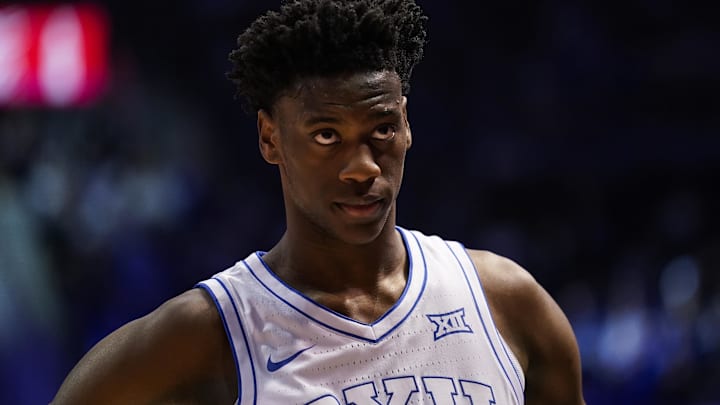
BYU’s AJ Dybantsa put together one of the most prolific scoring seasons we’ve ever seen from a true freshman, cementing himself in the top tier of prospects in the process.
The 6-foot-9 wing-slash-forward has long been apart of this class’s top group, ranking as the No. 1 player per RSCI, but averages of 25.5 points, 6.8 rebounds and 3.7 assists per game for a top-25 team certainly aided his cause to becoming the potential No. 1 overall pick in the 2026 draft.
Dybantsa’s major strengths include his physical tools and athleticism, three-level scoring, scoring versatility, play-making upside and defensive upside. You can read on or watch the video version below:
Strengths:
Physical Tools and Athleticism
Dybantsa’s a highly skilled player, but his immense production and potential are tied to his prototypical physical tools and all-around athleticism, which put him in pretty rare air as a prospect.
Dybantsa stands at a legitimate 6-foot-9 with an unconfirmed wingspan, but one that definitely hovers in the 7-foot range, likely at about 6-foot-11. Regardless, he’s tall, long, and while he’s not bulky, he’s not spindly either, with a frame that certainly stands to bulk up over the next several years.
In terms of traditional run-and-jump athleticism, Dybantsa’s good to great, albeit not elite. He takes long strides and can leap off one or both feet, offering just about everything but pure vertical explosion. He doesn’t blast off but can elevate high, using it to his advantage on both ends.
Where Dybantsa thrives is horizontally, using a truly elite combination of traits to create a real handful in tandem with his size.
He has one of the best first steps and burst I’ve seen in a prospect his size, able to get A-to-B lightning quick despite his forward frame. When he’s moving, his fluidity, flexibility and bend really pop. He has great balance and control, able to quickly change directions, showcase herky-jerky, stop-start movement, acceleration and deceleration and plenty more.
When you put all of this together, you have a player who offers so many counters and can advantage create in so many different ways, he’s hard to stop. He can speed by you, change directions quickly, cover ground with regular strides or wide-arcing spins, and elevate at the rim.
This is really where his more wing-like qualities stand out, as he’s among the more comfortably moving, face-up players at 6-foot-9 I’ve ever scouted. While he’s forward-sized and certainly exhibits some positive forward qualities, his highest-upside position will be a fluid-moving wing, maximizing his combination of tools and modern athleticism.
Three-Level Scoring
The primary draw with Dybantsa as a Tier-1 prospect is his scoring ability, which was verifiably engine-like at the college level, and feels projectable enough at the NBA level too.
Dybantsa was one of the most prolific true freshman scorers we’ve ever seen, averaging 25.5 points on 51% shooting, showcasing good to elite fire-power at all three levels.
Given his combination of athletic tools, Dybantsa was at his best getting to the rim, which accounted for 40% of his total field goals. He shot 63% at the rim — 56% on layups and 90% on dunks, both ranked ‘good’ per Synergy.
All of the previous rules apply, making it near-impossible to keep Dybantsa out of the paint when he wants to get there. He can toggle between speed, power or finesse, uses elite footwork and craftiness, and has the elevation and touch to see the ball through once at the rim.
He’s an unbelievably well-rounded driver with counter after counter for defenses, and it made him an effective at-rim finisher on high volume. Notably, he drove 183 times, 107 of which came left and 70 of which were right, at about .98 points per possession per drive. So a pretty even split efficiency and frequency-wise.
Secondary to his rim-finishing in terms of efficiency, though still one of Dybantsa’s best skills, is his mid-range scoring, which is among the best we’ve ever seen for a Tier 1 draft prospect.
Dybantsa’s general coordination, ability to fluidly navigate toward space and access all parts of the court, quickly decelerate, lift in the air and fire off smooth, high-release jumpers was on full display with the Cougars all season long. He shot a ‘very good’ 42% on dribble jumpers in general, doing so at an elite 47% on twos.
Dybantsa just has a truly innate sense for the mid-range, and while it’s not basketball’s most efficient shot, we’re also seeing a renascence in terms of its effectiveness and the gravity it can bring, with several of the NBA’s top stars as frames of reference.
Tying a bow on his inside-the-arc optionality and success, Dybantsa shot 44% on 36 total runners with BYU, a good mark that speaks to his general finishing touch and success in in-between areas.
Lastly there’s Dybantsa’s beyond the arc work, which was much more up-and-down than the previous two areas, but has great indicators and shouldn’t offer tons of pause in terms of upside.
Volume-wise, Dybantsa shot over four threes per game, hitting on 33% of those. Much like his mid-range game — which is a stellar indicator for his eventual 3-point success — all of his shooting mechanics and preparation feel just fine when actually getting into his shot.
Dybantsa shot 83 catch-and-shoot attempts to 67 3-point dribble-jumpers, miraculously shooting better on the latter at 36%, opposed to just 30% catching and shooting. He did shoot a good 36% on unguarded catch-and-shoot shots, which were few and far between given his gravity. He hit just 27% of his guarded shots.
Dybantsa’s obviously more comfortable generating his own space right now, but I think other NBA-level creators stand to help boost his 3-point percentage in total, with his ability to create his own 3-point looks as a pretty solid back-pocket option.
Other outside indicators include a 78% free throw conversion mark on absurdly high volume, again making for a pretty workable shooting prospect all things considered.
When you pair all three of these things together — tenacious at-rim scoring, optional mid-range and seemingly workable 3-point shooting — it creates an offensive supernova, with defenses constantly guessing what Dybantsa’s going to do next, and more often than not simply in a place athletically to throw him off his game.
Scoring Versatility
We’ve touched on the levels at which Dybantsa can score, which is all of them. But there’s also a lot more nuance in terms of the actual ways he’s doing that, which we’ll chalk up to his general scoring versatility, another reason he’s among the top group of prospects.
We’ve established Dybantsa has prototypical size and athleticism, is elite at two levels and improving in the third. But how he’s actually managing all this is another big piece to the puzzle. Especially in trying to work out his position and role long-term.
Dybantsa spread his 894 total points out well, seeing five primary play-types on the better side of 100 points: 227 as the pick-and-roll handler, 182 in transition, 119 spotting up, 109 posting up and 107 in isolation. Per Synergy, he shot good, very good or excellent in all five of these areas, which all signal a pretty nice blend of both wing-initiator and forward-finisher styles.
Dybantsa’s primary mode of offense was as the pick-and-roll handler, sending ball screens his way, which freed up more space and gave him some pretty specific pathways to score. He shot 48% as the handler, hitting 51% on twos and 36% on threes.
In sticking with more primary-esque roles, Dybantsa also shot 48% in isolation, again, with his size and combination of tools offering a real handful for all types of defenders. He rightfully looked to get downhill in these situations, with his ISO three possessions tanking his efficiency somewhat at just 2-for-16 overall.
Dybantsa also shot 59% posting up, using his size and craftiness in a more limited area, really showing off the skill in nuance in creating mid-range looks and hitting them, even through good contests. His strength stands out here as well, creating space or holding his ground with his frame.
With his size and handling ability, Dybantsa was a handful in both transition and spot-up situations, able to carve pathways to the ring with more space, allowing him to get some more lift overall. He shot a great 57% in transition and 41% spotting up, two effective methods of letting the game come to him.
There’s plenty more we could tough on regarding his scoring, but a few of the more notable areas include his drastic self-creation and foul rates, which point to him being a legitimate No. 1 or 2 scoring option at any level of basketball.
Dybantsa wasn’t the single most efficient player in basketball, but given the volume and way he was used, he was a mightily effective scorer. That’s made even better by his unassisted percentages: just 20% of his at-rim shots were assisted, just 12% on his non-rim twos were assisted, and just 25% of his threes were assisted.
Those are some truly elite levels of self-creation, which point toward him continuing to be a primary or secondary creator at the NBA level, and give him some grace in terms of the more true forward numbers.
Lastly, Dybantsa shot 8.5 free throws per game with BYU, good for a free throw rate of .49. His size and athleticism played a big factor in that, but he was also genuinely one of the craftiest players in college basketball, and him continuing to hone this area of his game in the pros is going to lead to ample opportunities at the line.
All this to say, Dybantsa’s useable in so many different ways as a scorer, scalable up to a pick-and-roll or ISO scorer, or down to capitalizing on transition and spot-up opportunities.
Play-Making Upside
At over 25 points per game and numerous pathways to score, Dybantsa obviously had the scoring gravity to parlay into play-making success. The results in his lone season at BYU were pretty mixed, but there’s obvious upside here with refinement, and a fine base to start building.
Overall, Dybantsa averaged 3.7 assists to 3.1 turnovers, good for 130 to 108 in total, and an assist-to-turnover ratio of 1.2. He posted a solid assist percentage of 22, and a turnover percentage of 12.7. He’s a willing passer overall, but certainly shades more toward wanting to get into his own shot, especially on a BYU team that needed that from him.
We’re going to stick with the positive flashes in this section because the negative will turn up later. Dybantsa has good and improving court-vision, with the ability to make a variety of different passes, most importantly doing so off a live-dribble, which is going to be massive for his development as a primarily on-ball player.
He’s at his best simply breaking down the first line of defense, drawing the attention of multiple defenders and kicking out to open shooters, or shoveling and lofting to open bigs. And the good news is that those easy opportunities are going to continue, again, given just how much overall gravity he has as a scorer.
The bones are very much there for Dybantsa to create advantages getting downhill, then quickly and accurately process the defense and create opportunities for others, even if it didn’t happen every time down the floor for the Cougars. NBA spacing and scorers should help aid that, and there are high-end flashes in the form of cross-court finds and ropes to the interior, though these are fewer and farther between.
There’s plenty of warts across this area generally — which we’ll touch on more specifically later — which is why we’ve gone with upside opposed to pure play-making impact for now. The good news being that this again feels like an area that’s going to tighten up with time as Dybantsa sees more initiating reps, sees more coverage and just generally develops his skills at an NBA level.
Defensive Upside
Much like his play-making upside, Dybantsa’s defensive potential is mostly theoretical at this point, though all of the tools and high-end flashes are there for real upside down the line.
Everything that makes Dybantsa an offensive handful gives him premier potential on the defensive end: positional size, fluidity, coordination, and a level of competitiveness that stretches to taking pride on this end of the floor.
The issue being, the production just did not carry over like it did on offense. It terms of 6-foot-9, lengthy, fluid-moving wings, his defensive numbers are pretty pedestrian, if not shockingly low. He averaged just 1.1 steals per game and served just 0.3 blocks, good for a 1.7 steal percentage, 1.1 block percentage and defensive box-plus-minus of 2.2
There’s some merit to the scoring load he was shouldering, but even accounting for that you’d like to see quite a bit more pure defensive production for a player of Dybantsa’s size and skill at the collegiate level.
There’s a real level of polish needed on Dybantsa’s defensive game overall. A better understanding of rotations, how offense is moving and flowing, and just a general layer of clear fundamentals. There’s a good level of engagement from Dybantsa across the board here, showcasing the same motor he plays with on offense, though there’s is some off-ball tendencies that certainly need to be shored up.
The good news is that, again, few are working with a better toolkit than Dybantsa.
Most of the good came in spurts and flashes. There’s times where he’ll fan out at the point of attack, flips his hips, completely stifles a drive then switches fluidly onto the next and does the same thing. A few plays later he might be grappling with a big on the interior, and send a shot flying from the weak-side with his range and instincts.
When he’s engaged on the ball he can be a nightmare to deal with, more often than not forcing others into tougher decisions even without directly stealing or deflecting the ball.
There’s a ton of room for growth in Dybantsa’s defense game, but even if he doesn’t hit that high-end outcome, he projects to be switchable, guard across multiple positions and, most importantly, offers a pretty nice baseline at 6-foot-9 with an competitive attitude.
Areas of Improvement:
Decision-Making and Shot-Selection
The first, and far-and-away the most important, area of improvement for AJ Dybantsa would be his decision-making and shot-selection, which can be summarized with his general processing right now.
We’ve talked a lot of good so far: ideal wing tools and athleticism, already elite offensive numbers that point to primary scoring potential in the NBA, sky-high upside play-making and even defending. But there’s a lot of fleshing out to be done with his general decision-making, which can bleed into all the aforementioned areas in worrying ways.
There’s plenty of ways Dybantsa could’ve simply been better.
On the scoring side, he was prone to being a little more sticky than he needed to be, sometimes driving pretty recklessly or unable to really feel where and when extra defensive pressure was coming from. While Dybantsa is certainly capable of taking and making tough shots, there’s a good chunk that are pretty unexplainable even accounting for BYU’s team-wide scoring woes.
Passing and play-making is one of the areas where this shows up the most, with about 80% of his total turnovers coming via strictly so-so to poor decision-making — trying passes that aren’t there, launching into well-covered areas of the floor or forcing shots through good contests.
Defensively those aforementioned slow rotations and some of the off-ball gunk can be chalked up to decision-making as well — opposed to when he’s hounding on the ball and just has a very clear and narrower vision of what’s happening.
It does feel like Dybantsa’s processing and floor game is just a tick behind right now, which is probably to be expected of a 19-year-old asked to do this much. He’s clearly just a still-developing decision-maker, who’s shown flashes of being able to put everything together in a superstar package.
And he certainly seems to have more of these lesser moments than his No. 1 counterparts, which some box scores and tape bears out: he had seven five-plus turnovers games, six games of less than 35% shooting from the floor, twelve zero-stock games.
Ultimately, there's still room for positivity here with Dybantsa. I think there’s a very high chance that these kinks are going to be worked out with general development, and that he’s simply in the process of still growing and developing. The biggest point to that being the fact he has the sole claim of the three top-tier guys to in-season development. We watched AJ Dybantsa figure things out in real-time with BYU, looking like a drastically different player to end the season opposed to when he began it.
On the flip-side of those down moments, Dybantsa showcased the highest flashes in the class. A 33-point triple-double, six games of 35 points or more, plenty of good defensive games.
Handling
One of the more tangible areas of improvement for Dybantsa, aside from the areas we just touched on, as well as simple shooting improvement, would be tightening the handle and continuing to refine his dribble arsenal.
Dybantsa is well above average as a handler for a 6-foot-9 wing, but continuing to improve in this area will push him toward true stardom even more, allowing him to continue using his elite movement while coupling together more advanced off-the-dribble moves and shots.
As stated earlier, the vast majority of Dybantsa’s turnovers were process-based, with just 22 total turnovers being due to a total loss of the handle, a measly 20%.
Still, there are certainly times Dybantsa can be loose with the ball or out of control. He’s usually good about reigning it back in, hence the low number of actually lost plays, but those moments do put a hitch in his rhythm, and sometimes lead to the questionable decisions.
Dybantsa can be prone to taking the ball pretty high, allowing defenders to poke and prod. Additionally, Dybantsa’s unbelievably long strides — and pretty reliant spin-move — can leave the handle looking slightly better than it is, allowing him to cover a lot of ground on the pick. This isn’t a major issue seeing as he’s not getting any shorter, but keeping the dribble alive longer will be a big boon to his overall game and optionality.
Overall, this is an area one should expect will naturally get better with time and general development.
Outlook:
AJ Dybantsa feels rightfully destined for NBA stardom. The question at this point is where is he going to land on the wide-ranging star-spectrum.
Will it be it as a tough shot-taker with seldom ability to impact needed areas like play-making and defense, eating up a large portion of a team’s cap? Or as a true do-it-all wing who’s processing catches up to his elite tools, who can score at all three levels, capitalize on his gravity by involving teammates with consistency and lock in on defense.
The question alone lands his range from being No. 1, to hearing his name third behind two others.
Regardless, Dybantsa projects to be a primary scoring option with superstar potential.
Some reasonably good fits for Dybantsa include the Pacers, Wizards and Nets. Indiana offers a play-maker that could simplify and maximize Dybantsa’s early-career, the Nets are a totally blank slate who could move forward in building to Dybantsa’s strengths, and the Wizards sit somewhere between in need of a star scorer.
Range: No. 1 through No. 3
Role: Primary Scoring Option, Team Defender
Impact: Star, Superstar Potential
Swing Skills: Decision-Making, Handling
Best Fits: Pacers, Wizards, Nets
 Add us as a preferred source on Google
Derek Parker covers the National Basketball Association, and has brought On SI five seasons of coverage across several different teams. He graduated from the University of Central Oklahoma in 2020, and has experience working in print, video and radio.
Follow DParkOK