%22%3E%0A%3Cpath%20d%3D%22M0%205.37646H8.15061L17.4195%2016.8819V5.37646H26.0647V31.4412H18.3227L8.64523%2019.4196V31.4412H0V5.37646Z%22%20fill%3D%22white%22%2F%3E%0A%3Cpath%20d%3D%22M29.2041%205.37649H43.8064C47.4193%205.37649%2049.6989%206.1937%2051.2258%207.72059C52.1505%208.64533%2052.8172%2010.0002%2052.8172%2011.7851V11.8497C52.8172%2014.9465%2050.9462%2016.8389%2048.172%2017.8067C51.5269%2018.7744%2053.6774%2020.5594%2053.6774%2024.1293V24.1938C53.6774%2028.3659%2050.258%2031.4197%2043.6558%2031.4197H29.2041V5.35498V5.37649ZM44.258%2013.7637C44.258%2012.6024%2043.3333%2011.9787%2041.4623%2011.9787H37.6988V15.6346H41.5053C43.3763%2015.6346%2044.258%2015.011%2044.258%2013.8497V13.7852V13.7637ZM42.0859%2020.9895H37.6988V24.8605H42.0644C43.9569%2024.8605%2044.9247%2024.0863%2044.9247%2022.968V22.9035C44.9247%2021.7852%2043.9999%2021.011%2042.0859%2021.011V20.9895Z%22%20fill%3D%22white%22%2F%3E%0A%3Cpath%20d%3D%22M64.8174%205.18286H73.4627L84.452%2031.4411H74.9896L73.6132%2027.9357H64.4949L63.1615%2031.4411H53.8496L64.8389%205.18286H64.8174ZM71.4412%2021.7636L69.054%2015.441L66.6669%2021.7636H71.4412Z%22%20fill%3D%22white%22%2F%3E%0A%3Cpath%20d%3D%22M95.2695%205.37646H105.248C115.592%205.37646%20120.775%2010.4733%20120.775%2018.1938V18.2583C120.775%2025.9788%20115.485%2031.4412%20104.947%2031.4412H95.2695V5.37646ZM104.001%2012.9679V23.8497H105.463C109.442%2023.8497%20112.022%2022.2153%20112.022%2018.4518V18.3873C112.022%2014.6239%20109.463%2012.9894%20105.463%2012.9894H104.001V12.9679Z%22%20fill%3D%22white%22%2F%3E%0A%3Cpath%20d%3D%22M123.098%2011.1182H131.549V15.2258C132.711%2012.4731%20134.56%2010.6881%20137.915%2010.8387V19.8065H137.012C133.442%2019.8065%20131.528%2021.785%20131.528%2026.2797V31.4625H123.076V11.1182H123.098Z%22%20fill%3D%22white%22%2F%3E%0A%3Cpath%20d%3D%22M137.808%2025.6772V25.6127C137.808%2021.5482%20140.818%2019.2901%20145.55%2019.2901C147.27%2019.2901%20149.464%2019.6557%20150.345%2020.0428V19.6987C150.345%2017.8277%20149.184%2016.7524%20146.582%2016.7524C144.496%2016.7524%20142.754%2017.204%20140.969%2017.9137L139.485%2012.3008C141.829%2011.3975%20144.517%2010.8169%20148.044%2010.8169C152.173%2010.8169%20154.862%2011.6771%20156.646%2013.4621C158.173%2014.989%20158.776%2016.9675%20158.776%2019.9137V31.5052H150.324V29.4622C148.904%2030.9891%20147.012%2031.9999%20144.474%2031.9999C140.56%2031.9999%20137.808%2029.7633%20137.808%2025.7417V25.6772ZM150.431%2023.9138V23.0536C149.937%2022.86%20149.206%2022.7095%20148.496%2022.7095C146.818%2022.7095%20145.894%2023.7202%20145.894%2024.9891V25.0536C145.894%2026.2364%20146.754%2027.0321%20147.829%2027.0321C149.313%2027.0321%20150.431%2025.8493%20150.431%2023.9138Z%22%20fill%3D%22white%22%2F%3E%0A%3Cpath%20d%3D%22M162.883%2017.6345H160.496V11.1183H162.883C162.926%208.96778%20163.442%207.20433%20164.711%205.9355C166.088%204.55915%20167.872%204%20170.668%204C173.163%204%20174.69%204.21506%20175.851%204.55914V9.84951C175.034%209.65596%20174.217%209.54843%20173.141%209.54843C171.83%209.54843%20171.163%2010.0646%20171.163%2011.1829V11.3334H175.851V17.6345H171.335V31.4411H162.883V17.6345Z%22%20fill%3D%22white%22%2F%3E%0A%3Cpath%20d%3D%22M178.883%2024.6238V17.613H176.496V11.0968H178.883V6H187.335V11.0968H192.023V17.613H187.335V22.7528C187.335%2024.2797%20188.045%2024.8389%20189.378%2024.8389C190.152%2024.8389%20191.055%2024.6238%20191.937%2024.2152V30.7314C190.604%2031.4411%20188.582%2031.8927%20186.539%2031.8927C181.55%2031.8927%20178.862%2029.5916%20178.862%2024.6238H178.883Z%22%20fill%3D%22white%22%2F%3E%0A%3Cpath%20fill-rule%3D%22evenodd%22%20clip-rule%3D%22evenodd%22%20d%3D%22M201.368%204.36764C207.191%20-1.45588%20216.632%20-1.45588%20222.456%204.36764C228.279%2010.1912%20228.279%2019.6324%20222.456%2025.4559L211.912%2036L201.368%2025.4559C195.544%2019.6324%20195.544%2010.1912%20201.368%204.36764ZM204.009%207.55761C203.948%207.86849%20203.916%208.39718%20203.916%209.14566V10.4189C203.916%2011.1832%20203.948%2011.7198%20204.013%2012.0267C204.078%2012.3317%20204.278%2012.6168%20204.617%2012.8762C204.956%2013.1376%20205.403%2013.3316%20205.958%2013.4623C206.512%2013.593%20207.1%2013.6583%20207.837%2013.6583C208.573%2013.6583%20209.217%2013.591%20209.769%2013.4524C210.322%2013.3158%20210.761%2013.1178%20211.086%2012.8604C211.411%2012.6029%20211.605%2012.3178%20211.666%2012.0069C211.728%2011.6961%20211.759%2011.1674%20211.759%2010.4189V9.14566C211.759%208.38134%20211.728%207.84473%20211.662%207.53781C211.597%207.23287%20211.397%206.94972%20211.058%206.68834C210.72%206.42696%20210.272%206.23291%20209.718%206.10223C209.163%205.97154%20208.536%205.90619%20207.839%205.90619C207.102%205.90619%20206.459%205.97352%20205.906%206.11213C205.352%206.24875%20204.914%206.44677%20204.589%206.70418C204.265%206.9616%20204.071%207.24673%20204.009%207.55761ZM209.276%2024.8638C212.876%2024.8638%20214.557%2024.2064%20214.557%2021.862V21.858V21.3155C214.557%2019.6581%20213.516%2018.971%20210.252%2018.3136C209.278%2018.1136%20208.908%2017.9136%20208.908%2017.3136V16.9414C208.908%2016.6543%20209.177%2016.5117%20209.413%2016.5117C209.749%2016.5117%20209.918%2016.7137%20209.918%2016.9414V18.1136H214.391V17.3988C214.391%2015.4563%20213.347%2014.4266%20209.177%2014.4266C206.15%2014.4266%20203.896%2015.3414%20203.896%2017.3711V17.7433C203.896%2019.5155%20204.805%2020.3155%20208.201%2021.0303C208.28%2021.0472%20208.355%2021.063%20208.427%2021.0781C209.329%2021.2674%20209.647%2021.3341%20209.647%2021.9174V22.2897C209.647%2022.6619%20209.546%2022.8045%20209.142%2022.8045C208.67%2022.8045%20208.637%2022.5471%20208.637%2022.262V21.2897H203.894V21.7471C203.894%2024.149%20205.476%2024.8638%20209.276%2024.8638ZM215.424%2024.5569H219.925V14.7355H215.424V24.5569ZM216.955%2013.5019H219.925V6.06064H217.092V9.411L215.193%206.06064H212.359V13.5019H215.193V10.1199L216.955%2013.5019ZM208.269%2012.152C208.204%2012.2688%20208.055%2012.3262%20207.825%2012.3262L207.827%2012.3282C207.604%2012.3282%20207.459%2012.2767%20207.398%2012.1757C207.336%2012.0748%20207.305%2011.8074%20207.305%2011.3758V7.90068C207.305%207.51852%20207.352%207.28684%20207.445%207.20962C207.538%207.13239%20207.675%207.09279%20207.851%207.09279C208.059%207.09279%20208.198%207.14031%20208.265%207.23734C208.332%207.33239%20208.366%207.55416%20208.366%207.90068V11.3203C208.366%2011.7579%20208.334%2012.0352%20208.269%2012.152Z%22%20fill%3D%22white%22%2F%3E%0A%3C%2Fg%3E%0A%3Cdefs%3E%0A%3CclipPath%20id%3D%22clip0_15247_3640%22%3E%0A%3Crect%20width%3D%22227%22%20height%3D%2236%22%20fill%3D%22white%22%2F%3E%0A%3C%2FclipPath%3E%0A%3C%2Fdefs%3E%0A%3C%2Fsvg%3E%0A)
NBA Draft Scouting Report: Ebuka Okorie
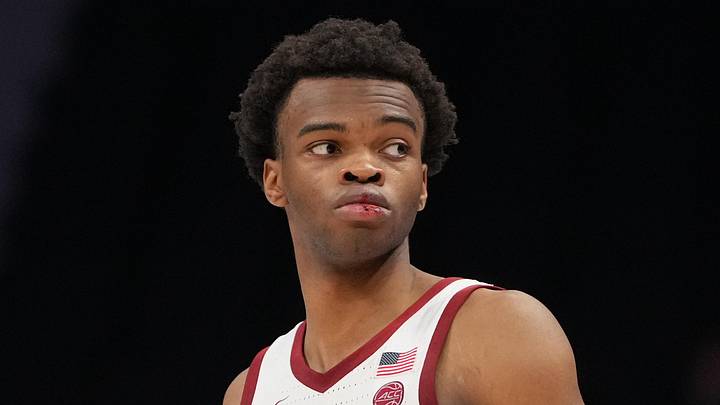
Stanford guard Ebuka Okorie saw a surprising one-and-done season with the Cardinal, breakout out as one of the best scorers not just among freshman, but in the nation period.
Okorie was a four-star point guard out of New Hamshire, who only received a handful of Division I offers. He ultimately signed on to play with Stanford, and ended up rankingn seventh in scoring in the entire nation, placing himself firmly in NBA Draft talks in the process.
His stock got another boost at the 2026 NBA Draft combine, where he expectedly measure out on the shorter side height-wise at 6-foot-1-and-a-quarter, but came back with a much more important 6-foot-7-and-three-quarters wingspan, which should help him to play bigger.
Okorie’s major strengths include his rim pressure, shooting and off-the-dribble shot-making, passing and decision-making, as well as defensive play-making.
Strengths:
Rim Pressure
The biggest allure to Okorie is his rim pressure, or his ability to generate paint touches and make things happen, usually buckets.
Okorie scored a blistering 23.2 points per game with Stanford on 47% shooting, with 50% of his field goals coming at the rim. He took 503 in total, with a mind-bending 250 shots coming at the rim. He was one of the single highest-driving guards in college baskeball, taking just over eight shots per game at the rim.
The reason he was able to see that really absurd level of volume at the rim was his combination of athletic tools, which I personally would call “non-traditional” athleticism.
Okorie is a traditionally athletic player, with blistering straight-line speed and great leaping ability relative to his size. But he also has this very unique blend of other stuff mixed in. He’s very bendy and flexible, able to fit himself through gaps and tight spaces often. His first step is among the best in the class, and his acceleration also jumps out, with him able to speed up on the move. He can also decelerate, and is generally very angular in punturing the defense. And finally, once at the rim, he has some of the best body control in the class, able to hang and contort to find the space necessary to get shots off, or draw fouls where he was absolutely elite in getting to the line 7.3 times per game.
This gumbo of athletic skills just makes him impossible to keep out of the paint. His rim attempts per 100 possessions ranked in the 99th percentile, and a blistering 89% of those were unassisted, pointing to elite creation ability.
As a whole, Okorie shot 54% at the rim, graded ‘average’ per Synergy. He shot 10-for-10 on dunks, but just 52% on 239 layups. I think the pure volume somewhat makes up for that number that isn’t massively exciting, but even still there needs to be some tangible improvement in terms of just seeing shots through.
In terms of play-types, Okorie was able to pressure the rim heavily as the pick-and-roll handler, in transition and in isolation, shooting 45%, 54% and 43%, respectively. All ways that he should be able to continue thriving in the NBA. Ball screens afford him more space overall, but he has no issues breaking down the first line of defense without them too, and he’s a blur in the open court.
There will be questions about his level to convert overall, especially as a shorter guard in the increasingly lengthy and more talented NBA. But there’s little question his ability to actually get to the rim and touch the paint are second to none in the class.
Shooting and Off-the-Dribble Shot-Making
In addition to unreal rim pressure, Okorie also showed a lot of promise as both a shooter and shot-maker with Stanford, primarily off the dribble. Increasing his threat-level as a driver and scorer in general.
Mechanically, his shot is not picture-esque, but the numbers bear out that it’s a viable weapon. To my eye, it looks like the release point is a little low, though the threat of his driving is seemingly always going to afford him some space to fire shots off.
About 80% of Okorie’s jumpers came from beyond the arc. He didn’t cut out the mid-range in its entirety, but in Morey-like fashion did resign to mostly shots at the rim or threes.
On 3-pointers in total, he hit on 35% of 5.7 per game, a very solid clip given the volume. It’s even more impressive given how difficult the shot diet was, with him taking just 70 catch-and-shoot triples to 108 off-the-dribble. He shot 34% on all catch-and-shoot threes, hitting on 39% of a limited number of unguarded, and 32% on guarded shots.
Interestingly, Okorie’s 3-point numbers in terms of play-type were a little all over the place: he shot just 26% as the pick-and-roll handler, where a lot of other talented shooters — like a Christian Anderson for example — really prefer the added space of a ball-screen. In isolation, however, he shot a blistering 57% in simply creating one-on-one, albeit on about half the volume. He also shot a great 39% in transition, as well as 33% spotting up.
Far-and-away the most impressive portion of Okorie’s jump-shooting was his ability to do it off-the-dribble. He converted on 35% of his dribble-jumpers, and a really impressive 34% of 108 threes taken off the dribble.
Okorie has no problem taking the ball from a live-dribble right into his shot, with just a little bit of prep-time needed. He has a great feel for when to drive versus when to shoot and keep the defense honest.
NBA scouts and decision-makers would maybe favor slightly higher clips across the board. But I think given the volume and difficulty, there’s little worries about Okorie’s long-term shooting and shot-making outcome. There’s more than enough gas in the tank here that defenders won’t be able to strictly play Okorie’s drive game, which is important.
Passing and Decision-Making
Given his scoring gravity as a whole, the next level for Okorie was parlaying his success into that for others, and while I think there’s was some to be desired in terms of true point guard facilitation, his passing and decision-making was still a positive as a whole.
Okorie averaged 3.6 assists per game to just 1.9 turnovers, totaling 111 and 58 altogether for about a 1.9 assist-to-turnover ratio. That alone is positive, even accounting for less-than-gaudy assist numbers.
Okorie’s passing and play-making was fairly simple, with him moreso captilizing on the easy chances created by driving and gravity opposed to showing off next-level vision, touch and accuracy. There were flashes of those things in cross-court dimes and interior feeds, but Okorie was largely just drawing doubles and easily kicking out to shooters.
Potentially the most important aspect of this is not the actual play-making numbers themselves, but just his lack of turnovers, highlighted by decision-making as a whole.
Okorie’s NBA value both as a draftee and eventual rotational player will be filling it up, at 23 points per game and 3 assists he’s simply a score-first guard. Now you can bake in the fact he’s not going to be a killer in terms of coughing up the ball. He had a high usage of 31%, mixed with a low turnover percentage of just 8.7, and less than two per game. Pretty strong indicators that giving him the basketball isn’t such a bad idea.
Defensive Play-Making
Given his size limitations at 6-foot-2, the defensive side of the ball is set to be more of a challenge for Okorie, espeically in the talent-laden NBA. But he was still a positive at the college level, with plenty of ways to carry it over profesionally, namely his play-making.
Okorie showed a lot of prowess in racking up steals at 1.6 per game, with a good steal percentage of 2.7%, and his combine measurement of a nearly 6-foot-8 wingspan more than backs up that play, in addition to offering him a high floor and ceiling as a defender in the NBA. Height is, of course, still important, but being able to fan out more and make more impact in gaps and lanes will be big for Okorie.
His hands are the standout trait, with him able to poke, prod and rip the ball with consistency when pressuring the ball. Most of his same athletic traits carry over as well, with him able to put his twitch to use by sliding his feet, changing directions and staying attached when engaged on-ball.
There’s also just a general layer of competitiveness strewn across Okorie’s defensive tape, which is impressive given the scoring and handling load he carried at Stanford.
There’s always going to be some level of hunt-ability for guards at this size, but teams should be able to take solace in the fact that Okorie can make some impact on the defense end, be it peskiness or even possession-winning steals.
Areas of Improvement:
Strength and Physicality
Listed at just 186 pounds with a spindlier frame, one of the primary ways that Ebuka Okorie can improve moving forward is to simply get stronger and continue playing with physicality, which the NBA is set to offer in bounds.
Adding usable core strength will be a must on several fronts for Okorie, not only helping him to simply hold up better against steeper competition in the biggest-faster-stronger NBA, but it will also help him to reach his high-end potential, as some of his lesser skills or pitfalls are brought on by his size or stature.
Okorie’s defense will benefit the most from added functional strength. Again, players of this type are certain to be hunted to some extent, and strength will help him to hold up against bigger matchups, mostly in maintaining his ground and not being easily displaced. And in combining that with his great hands, it could make him a much more useable defender as a whole.
His low center of gravity already makes him a bit more sturd and planted than one would assume in looking at him, but the strength of NBA guards and stars is also a different thing entirely.
Offensively, added strength would likely help some of the lesser rim-finishing numbers, which we’ll touch on next.
Okorie certainly isn’t contact-avoidant, again getting deep into the paint often, drawing contact with consistency and involving himself in defensive plays. The physicality aspect will just be about holding up at the NBA level and continuing that aggression.
Finishing
As previously mentioned, Okorie is a walking paint touch, able to pressure the rim and get deep into the paint very consistently. Once actually at the rim, the results were a little more mixed, with him shooting 54% there, graded ‘Average’ per Synergy.
In order to be an effective and usable scorer at the NBA level, that number’s simply going have to get better to justify high usage or really any usage, and there’s a few ways he can improve. He can be a little reliant on his hang-time, taking tough contested shots pretty often.
The previously mentioned added core strength is likely the No. 1 way he can improve, helping him to maintain his drives to the rim by getting bumped less, but most importantly being able to absorb and finish through contact. His balance is already good, but added strength is likely to make that even more of a weapon.
Added confidence in the float-game — which was use-able but not incredibly high-volume at Stanford — would also be a massive boost overall. Per Synergy, he shot a great 52% on runners, pointing to touch overall.
Okorie has all the tools to continue improving as a finisher. He has an already adept package in terms of going high off the glass, two-hand or difficult reverse finishes. And most importantly he has the combination of tools to find himself deep in the paint consistently.
Outlook:
Okorie has whittled himself into a draft prospect all season long, beginning with guady scoring numbers highlighted by positive ancillary areas, and capped by his nearly 6-foot-8 wingspan. In an already guard-laden class, he’s been able to set himself apart as likely the best rim-presssurer in the bunch.
Okorie won’t be a player for every team, but at a certain point, be it in the mid-first or late-first round, teams will see his combination of athletic tools, scoring ability, improvability and competitiveness, and posit him a steal relative to where he’s taken.
Nice fits for Okorie include the Raptors, Hawks and Rockets, who could all use some lead guard help, especially one that’s a bit more scoring slanted.
Range: Mid-First to Late-First
Role: Lead Guard, Secondary Creator
Impact: Starter Upside, Rotation
Swing Skills: Strength, Finishing
Teams: Raptors, Hawks, Rockets
 Add us as a preferred source on Google
Derek Parker covers the National Basketball Association, and has brought On SI five seasons of coverage across several different teams. He graduated from the University of Central Oklahoma in 2020, and has experience working in print, video and radio.
Follow DParkOK