%22%3E%0A%3Cpath%20d%3D%22M0%205.37646H8.15061L17.4195%2016.8819V5.37646H26.0647V31.4412H18.3227L8.64523%2019.4196V31.4412H0V5.37646Z%22%20fill%3D%22white%22%2F%3E%0A%3Cpath%20d%3D%22M29.2041%205.37649H43.8064C47.4193%205.37649%2049.6989%206.1937%2051.2258%207.72059C52.1505%208.64533%2052.8172%2010.0002%2052.8172%2011.7851V11.8497C52.8172%2014.9465%2050.9462%2016.8389%2048.172%2017.8067C51.5269%2018.7744%2053.6774%2020.5594%2053.6774%2024.1293V24.1938C53.6774%2028.3659%2050.258%2031.4197%2043.6558%2031.4197H29.2041V5.35498V5.37649ZM44.258%2013.7637C44.258%2012.6024%2043.3333%2011.9787%2041.4623%2011.9787H37.6988V15.6346H41.5053C43.3763%2015.6346%2044.258%2015.011%2044.258%2013.8497V13.7852V13.7637ZM42.0859%2020.9895H37.6988V24.8605H42.0644C43.9569%2024.8605%2044.9247%2024.0863%2044.9247%2022.968V22.9035C44.9247%2021.7852%2043.9999%2021.011%2042.0859%2021.011V20.9895Z%22%20fill%3D%22white%22%2F%3E%0A%3Cpath%20d%3D%22M64.8174%205.18286H73.4627L84.452%2031.4411H74.9896L73.6132%2027.9357H64.4949L63.1615%2031.4411H53.8496L64.8389%205.18286H64.8174ZM71.4412%2021.7636L69.054%2015.441L66.6669%2021.7636H71.4412Z%22%20fill%3D%22white%22%2F%3E%0A%3Cpath%20d%3D%22M95.2695%205.37646H105.248C115.592%205.37646%20120.775%2010.4733%20120.775%2018.1938V18.2583C120.775%2025.9788%20115.485%2031.4412%20104.947%2031.4412H95.2695V5.37646ZM104.001%2012.9679V23.8497H105.463C109.442%2023.8497%20112.022%2022.2153%20112.022%2018.4518V18.3873C112.022%2014.6239%20109.463%2012.9894%20105.463%2012.9894H104.001V12.9679Z%22%20fill%3D%22white%22%2F%3E%0A%3Cpath%20d%3D%22M123.098%2011.1182H131.549V15.2258C132.711%2012.4731%20134.56%2010.6881%20137.915%2010.8387V19.8065H137.012C133.442%2019.8065%20131.528%2021.785%20131.528%2026.2797V31.4625H123.076V11.1182H123.098Z%22%20fill%3D%22white%22%2F%3E%0A%3Cpath%20d%3D%22M137.808%2025.6772V25.6127C137.808%2021.5482%20140.818%2019.2901%20145.55%2019.2901C147.27%2019.2901%20149.464%2019.6557%20150.345%2020.0428V19.6987C150.345%2017.8277%20149.184%2016.7524%20146.582%2016.7524C144.496%2016.7524%20142.754%2017.204%20140.969%2017.9137L139.485%2012.3008C141.829%2011.3975%20144.517%2010.8169%20148.044%2010.8169C152.173%2010.8169%20154.862%2011.6771%20156.646%2013.4621C158.173%2014.989%20158.776%2016.9675%20158.776%2019.9137V31.5052H150.324V29.4622C148.904%2030.9891%20147.012%2031.9999%20144.474%2031.9999C140.56%2031.9999%20137.808%2029.7633%20137.808%2025.7417V25.6772ZM150.431%2023.9138V23.0536C149.937%2022.86%20149.206%2022.7095%20148.496%2022.7095C146.818%2022.7095%20145.894%2023.7202%20145.894%2024.9891V25.0536C145.894%2026.2364%20146.754%2027.0321%20147.829%2027.0321C149.313%2027.0321%20150.431%2025.8493%20150.431%2023.9138Z%22%20fill%3D%22white%22%2F%3E%0A%3Cpath%20d%3D%22M162.883%2017.6345H160.496V11.1183H162.883C162.926%208.96778%20163.442%207.20433%20164.711%205.9355C166.088%204.55915%20167.872%204%20170.668%204C173.163%204%20174.69%204.21506%20175.851%204.55914V9.84951C175.034%209.65596%20174.217%209.54843%20173.141%209.54843C171.83%209.54843%20171.163%2010.0646%20171.163%2011.1829V11.3334H175.851V17.6345H171.335V31.4411H162.883V17.6345Z%22%20fill%3D%22white%22%2F%3E%0A%3Cpath%20d%3D%22M178.883%2024.6238V17.613H176.496V11.0968H178.883V6H187.335V11.0968H192.023V17.613H187.335V22.7528C187.335%2024.2797%20188.045%2024.8389%20189.378%2024.8389C190.152%2024.8389%20191.055%2024.6238%20191.937%2024.2152V30.7314C190.604%2031.4411%20188.582%2031.8927%20186.539%2031.8927C181.55%2031.8927%20178.862%2029.5916%20178.862%2024.6238H178.883Z%22%20fill%3D%22white%22%2F%3E%0A%3Cpath%20fill-rule%3D%22evenodd%22%20clip-rule%3D%22evenodd%22%20d%3D%22M201.368%204.36764C207.191%20-1.45588%20216.632%20-1.45588%20222.456%204.36764C228.279%2010.1912%20228.279%2019.6324%20222.456%2025.4559L211.912%2036L201.368%2025.4559C195.544%2019.6324%20195.544%2010.1912%20201.368%204.36764ZM204.009%207.55761C203.948%207.86849%20203.916%208.39718%20203.916%209.14566V10.4189C203.916%2011.1832%20203.948%2011.7198%20204.013%2012.0267C204.078%2012.3317%20204.278%2012.6168%20204.617%2012.8762C204.956%2013.1376%20205.403%2013.3316%20205.958%2013.4623C206.512%2013.593%20207.1%2013.6583%20207.837%2013.6583C208.573%2013.6583%20209.217%2013.591%20209.769%2013.4524C210.322%2013.3158%20210.761%2013.1178%20211.086%2012.8604C211.411%2012.6029%20211.605%2012.3178%20211.666%2012.0069C211.728%2011.6961%20211.759%2011.1674%20211.759%2010.4189V9.14566C211.759%208.38134%20211.728%207.84473%20211.662%207.53781C211.597%207.23287%20211.397%206.94972%20211.058%206.68834C210.72%206.42696%20210.272%206.23291%20209.718%206.10223C209.163%205.97154%20208.536%205.90619%20207.839%205.90619C207.102%205.90619%20206.459%205.97352%20205.906%206.11213C205.352%206.24875%20204.914%206.44677%20204.589%206.70418C204.265%206.9616%20204.071%207.24673%20204.009%207.55761ZM209.276%2024.8638C212.876%2024.8638%20214.557%2024.2064%20214.557%2021.862V21.858V21.3155C214.557%2019.6581%20213.516%2018.971%20210.252%2018.3136C209.278%2018.1136%20208.908%2017.9136%20208.908%2017.3136V16.9414C208.908%2016.6543%20209.177%2016.5117%20209.413%2016.5117C209.749%2016.5117%20209.918%2016.7137%20209.918%2016.9414V18.1136H214.391V17.3988C214.391%2015.4563%20213.347%2014.4266%20209.177%2014.4266C206.15%2014.4266%20203.896%2015.3414%20203.896%2017.3711V17.7433C203.896%2019.5155%20204.805%2020.3155%20208.201%2021.0303C208.28%2021.0472%20208.355%2021.063%20208.427%2021.0781C209.329%2021.2674%20209.647%2021.3341%20209.647%2021.9174V22.2897C209.647%2022.6619%20209.546%2022.8045%20209.142%2022.8045C208.67%2022.8045%20208.637%2022.5471%20208.637%2022.262V21.2897H203.894V21.7471C203.894%2024.149%20205.476%2024.8638%20209.276%2024.8638ZM215.424%2024.5569H219.925V14.7355H215.424V24.5569ZM216.955%2013.5019H219.925V6.06064H217.092V9.411L215.193%206.06064H212.359V13.5019H215.193V10.1199L216.955%2013.5019ZM208.269%2012.152C208.204%2012.2688%20208.055%2012.3262%20207.825%2012.3262L207.827%2012.3282C207.604%2012.3282%20207.459%2012.2767%20207.398%2012.1757C207.336%2012.0748%20207.305%2011.8074%20207.305%2011.3758V7.90068C207.305%207.51852%20207.352%207.28684%20207.445%207.20962C207.538%207.13239%20207.675%207.09279%20207.851%207.09279C208.059%207.09279%20208.198%207.14031%20208.265%207.23734C208.332%207.33239%20208.366%207.55416%20208.366%207.90068V11.3203C208.366%2011.7579%20208.334%2012.0352%20208.269%2012.152Z%22%20fill%3D%22white%22%2F%3E%0A%3C%2Fg%3E%0A%3Cdefs%3E%0A%3CclipPath%20id%3D%22clip0_15247_3640%22%3E%0A%3Crect%20width%3D%22227%22%20height%3D%2236%22%20fill%3D%22white%22%2F%3E%0A%3C%2FclipPath%3E%0A%3C%2Fdefs%3E%0A%3C%2Fsvg%3E%0A)
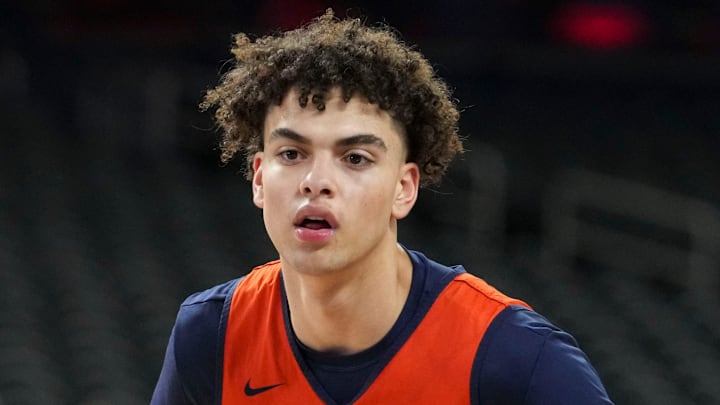
NBA Draft Scouting Report: Illinois Guard Keaton Wagler
In this story:
The 2026 NBA Draft class was already thought of to be a loaded one, and that was before Illinois guard Keaton Wagler broke onto the scene as a relative mystery with the Illini.
Wagler was a consensus four-star recruit out of Shawnee Mission, Kansas, ranking 261st nationally per 247Sports’ composite ranking, missing out entirely on ESPN’s top-100 and the RSCI’s top-100. Illinois and Minnesota were the only teams in the four major conferences to even offer Wagler, with him choosing the former and putting together a truly remarkable season that helped his squad to the Final Four and set his draft stock ablaze.
Wagler stands at a lean 6-foot-6, and averaged 17.9 points, 5.1 rebounds and 4.2 assists. His major strengths include his size, pace and craft, shooting and shot-making, creation ability and play-making and feel.
Strengths:
Size, Pace and Craft
Wagler’s success and NBA projection hinge on several different things, but the foundation of his game is built on his size, as well as the methodical pace and snake-like craft that he plays with.
Wagler’s plus positional size at 6-foot-6 is a real game-changer, functioning as the catalyst for his production across the board: scoring on mismatches, shooting over defenders, rebounding the ball well at over five per game, seeing over the defense while passing and more. There’s no official measurement for his wingspan, though he is seemingly working with a plus wingspan, which would account for his ridiculous production.
His size and length are also real separators in terms of his draft stock, giving him a leg up on fellow potential Tier 2 draftees in the form of positional versatility, with plenty of others in that range locked into lead guard roles. Some don't Wagler as a true lead guard prospect, at least in the early years of his NBA career, but moreso as a handling off-guard or wing, able to thrive with and without the ball in-hand. And his size makes that a tenable outcome.
There’s also the matter of the pace that he plays with and the craft he possesses, both of which are among the best in the class.
Wagler does not have premier athleticism, rather a blend of fluidity, balance, footwork and feel that really brings together his total scoring package. He is constantly operating at his own tempo, probing and inventing on the fly with grace. There’s little to no explosion in his game, but there’s just a real artistry to the way his fluid movement flows into dribble moves, which glides into footwork, and finally finesse-laden finishes or jumpers. He is really impossible to bother or speed up, as referenced by just 1.8 turnovers per game on the season.
Wagler is the true definition of a crafty player, using unconventional methods to get shots up at every level. He utilizes change-of-pace, elite handling, shot-fakes, deceptive footwork and real finishing versatility in the form of floaters, off-the-glass lays, scoops and more. He’s slippery but physical, able to take long strides that can throw defenders off-rhythm. This level of craft led to him getting to the line often, touting a .48 free throw rate, nearly six free throws taken per game at a great 80% clip.
Wagler’s athleticism does leave some to be desired, but his combination of size, natural feel for pacing and crafty game bridge the gap well.
Shooting and Shot-Making
There are numerous ways to start with Wagler's offense, though his shooting and shot-making was the catalyst for his overall scoring.
Wagler’s size and craft are great things, but aren’t as effective if he isn’t hitting shots. Luckily, he was one of the more prolific freshman shot-makers in the country. He took 221 total threes across 37 games, rounding out to 5.9 per game and 49% of his total shot diet. He hit on a blistering 40% of those, showcasing smooth, effortless mechanics across a variety of shot types. And all of that helped to build up his nearly 18 points per game on 45% shooting.
Wagler smoothly toggled between a spot-up shooter, and an off-the-dribble savant. He shot 246 jumpers in total, 40% of which were catch-and-shoot and 60% were off-the-dribble.
Elite numbers across the board, true NBA range, sparkling mechanics and uber-confidence all point to Wagler being a projectable off-the-catch shooter. He shot 41% from three on those, hitting on 42% of guarded shots and 40% on unguarded, pointing to real poise and composure while shooting, mixed with the fact his height allowed him to see over contests pretty well. He shot more threes while spotting up than any other play-type, hitting on 43% of 88 attempts, again showcasing positional versatility as a player that could space the floor and play off others.
The much more intriguing aspect of Wagler’s shooting and shot-making comes in his off-the-dribble work, which is where he’s able to tie his craft to this area. He hit on 37% of 147 total dribble jumpers, good for an excellent grade per Synergy. More than 80% of these shots were threes, with Wagler utilizing crossovers, hang dribbles, step-backs, side steps and so much more to get shots off. He’s phenomenal about probing for space, but is really decisive in getting into his actual shot, making him a really hard player to predict.
Wagler’s a pull-up threat essentially anywhere beyond the line, showing pretty incredible range that forced defenses to respect him, making his handling and downhill game all the more dangerous. Despite that, he’s not an exceptionally tough shot-taker, playing well within his limits, despite those limits having a lot of options. He won’t shoot you out of games catching and shooting or off the dribble, largely playing within the flow of offense and passing out if shots aren’t there.
There’s not much sample of Wagler shooting while on the move, be it on handoffs or off-screen, but he did shoot 42% on limited transition three attempts, and the body of work point to shooting versatility in pretty much every area.
All in all, Wagler’s shooting and shot-making is a pillar of his game, and will undoubtedly continue as such in the NBA.
Creation
When you pair Wagler’s size, pace, craft and composure with the fact he’s a highly-accurate shooter and shot-maker, it makes for a really good creator, able to keep defenders guessing whether he’s going to pick defenses apart on the way to the basket, or simply pull-up for efficient shots. And that eventually forced Brad Underwood’s hand midway through the season.
There’s been plenty of reporting that Wagler was effectively a star hiding in plain sight even in early practices with Illinois, as told by head coach Brad Underwood and any number of his Illini teammates. But, given his lack of notoriety, it made plenty of sense to start him in a more off-ball role alongside a really proven lead guard in Kylan Boswell earlier in the season.
That led to OK production through Wagler’s first handful of games. But Underwood outright said he wasn’t using him the right way, eventually moving him more on the ball, where he capped his final 29 games averaging 19.1 points, 5.0 rebounds and 4.9 assists while shooting 45% overall.
The vast majority of Wagler’s total offense came in the pick-and-roll, where he graded out excellent per Synergy on 263 total possessions, good for 1.08 points per possession and 48% shooting in total. It’s a very natural conclusion to draw: Wagler is a crafty handler and capable pull-up shooter, ball screens aiding both of those things immensely. When offense got stagnant, there were worse things Illinois could do than run this action with Wagler as the focal point, attacking space, getting quick shots off from the perimeter or making clean passes. His pick-and-roll actions were two-point heavy, with him shooting 53% on largely at-rim shots, but he also hit 39% of his threes here too.
Secondarily, Wagler was also used in isolation plenty, shooting 36% on 80 possessions, which were pretty split between two and three-pointers, where he shot around 36% on both. Those situations were a little less ideal given the athletic limitations, but Wagler still showed some real chops in creating something out of nothing, continuing to utilize every tool in his kit to create shots at the rim or smooth triples. Notably, 87% of his at-rim makes were unassisted, and 55% of his triples were unassisted, truly elite levels of creation ability.
It’s not a 100% guarantee that Wagler is a primary creator at the NBA level given some limitations that will be touched on, but there is tons of secondary and ancillary creation potential here given his prowess handling the ball, breaking down defense, operating in the pick-and-roll and even attacking and getting to his spots in isolation. And there’s longer-term upside as a primary creator if he continues honing the high points of his game.
Play-Making and Feel
Another feather in Wagler’s on-ball cap was his passing and play-making ability, in addition to his general feel for the game, which really hammers home just how dangerous an offensive player he is, now able to probe and get downhill, makes shots and parlay that into success for others while doing so.
Wagler averaged 4.2 assists to 1.8 turnovers per game, good for 157 to 66 in total, and an elite assist-to-turnover ratio of 2.3. He also touted an assist percentage of 23%, not quite pointing to point guard-level impact as a passer, but that was somewhat hampered by his early-season reps off the ball.
Wagler’s a pretty simplistic passer by design, limiting mistakes and capitalizing on easy chances by ball-moving and making easy, one-away reads. He’s not afraid to simply reset possessions, opposed to making flashy plays. His height at 6-foot-6 allows him to survey and see over defense better than most in this ’26 guard crop, and his general decision-making ranks among the best, just consistently making the right play. There isn't S-tier vision or 1-of-1 processing speed, but there is a player capable of capitalizing on easy chances, and building from there.
Wagler’s at his best working his way downhill, dropping the ball off to rollers, dunker-spot bigs or cutters. He’s also great at feeling where the coverage is shifting in the high pick-and-roll, quickly zipping the ball with either hand and allowing players quick chances at shots or drives. All of this adds another dynamic to his crafty on-ball game, with him consistently having options to pass elsewhere while probing.
Wagler’s at his most comfortable simply making two-hand passes or using his right hand to do the bulk of the work, but he does have a nice base of live-dribble play to build off. He could stand to add a little more cross-court versatility in the pick-and-roll, but the flashes are certainly there.
Wagler’s success in every area be summarized by his feel for the game. He’s not dominating with athleticism or out-muscling anyone. He’s thinking the game, reading and reacting, mentally countering and generally offering clean, mistake free basketball. In the least, NBA teams will feel comfortable that Wagler can move the ball off-ball, and won’t be a sticky creator, able to parlay his own success into chances for others.
Areas of Improvement:
Strength and Athleticism
The biggest hits to Wagler’s draft stock include his spindlier frame and lack of true strength, in addition to being one of the lesser pure athletes in the class. While there’s plenty of merit to these concerns, there’s also a lot of room for optimism here that we’ll touch on.
It is no real secret Wagler is a wiry, exceptionally thin player that isn’t very traditionally athletic. He reportedly joined the Illinois program at a measly 168 pounds, and his lack of verticality, explosiveness and quick-twitch athleticism is sprinkled all across his game. And that doesn’t necessarily scream NBA, even for a player who stands at 6-foot-6.
His lack of both strength and athleticism did show up tangibly some in his profile. Wagler’s driving frequency and ability to access the deepest parts of the paint were really good despite a lack of burst or acceleration, again pointing to next-level craft. But once actually at the rim, the lack of lift did hurt. Wagler shot just 55% in total. That’s not an abysmal number accounting for volume and the fact it was mostly in the half-court. But you’d certainly like that number higher. He was oft bumped off spots and struggled with bulkier, physical defenders.
Much more concerning was Wagler’s total lack of above-the-rim play, he attempted only one dunk on the entire season and missed it, finishing with zero total dunks as a 6-foot-6 NBA Draft prospect. Which, let me tell you, that is not an exceptionally long list. Wagler ins't contact-averse in the slightest, rather he’s a pretty physical player. But a lack of pro or even college strength did rear its head in his driving, finishing and defending.
Firstly, Wagler’s a late-bloomer as a prospect, and was 5-foot-8 as a high school freshman. That doesn’t excuse the total below-the-rim play, but could certainly factor into why he’s not a total dunk machine given he hasn’t been in this frame as long as others.
Additionally, while Wagler showed up to the Illinois program at 168 pounds, he bolstered that to 182 pounds in just the summer session with the team, and has likely very likely taken more strides over the course of his season with the program. Per that very same ESPN article, Wagler also boosted his vertical by three inches despite the weight gain. Pointing to more potential in both of those areas with general development, as well as NBA strength training.
Simply put, while Wagler is not yet strong or an NBA-level athlete, there does seem to be some workability given he’s 19, got a late start, and has proven he can thrive without it.
Defense
That lack of strength most rears its head for Wagler is on the defensive side of the ball. While he has the theoretical tools needed to be a capable defender at the NBA level, that simply wasn’t the case with Illinois per the numbers, impact or eye test.
Wagler averaged a paltry 0.9 steals and 0.4 blocks per game at Illinois, largely not creating much in the way of turnovers. He posted just 34 steals and 14 blocks in total across 37 games, touting a so-so 1.7 steal percentage and a 1.3 block percentage. He did at least post a 3.5 defensive box-plus-minus, pointing to his ability to impact the game seldomly on defense, especially within Illinois’ team scheme.
Again, strength and a lack of general athleticism are the real culprits here, consistently hurting Wagler’s chances of winning one-on-one matchups against stronger guards and wings, in addition to making his screen navigation pretty poor across the board. The bigger-faster-stronger NBA is going to present a real challenge in that regard, likely sending the top scorers in the world Wagler’s way pretty often.
Additionally, if Wagler is to have positional versatility like many think he can on offense, he’ll be sizing up on defense as well.
There’s some reason for upside here with Wagler. His general feel for the game didn’t quite carry over to the defensive metrics, but Illinois is a pretty conservative system, and Wagler has a pretty good sense of rotations, actions and more. Additionally, the instincts and effort were pretty good, but it does just seem like there needs to be a few more puzzle pieces added to his defensive game overall.
Wagler’s size and seemingly plus length does give him a slight leg up on potential Tier 2 peers such as Darius Acuff Jr., Mikel Brown Jr. and others. But again, that is largely theoretical and simply based on size.
Outlook:
There's tons to like in Wagler's offensive game, from his natural feel, to the NBA-level shot-making, deceptive driving, touch-y finishing and mistake-free play-making.
Wagler’s weaknesses in his thin build and lack of athleticism are very real, but a quick scan across the league also paints the picture that the association is currently being dominated by lesser athletic, high-feel players. Wagler may not be to that level, but given his rapid ascension it doesn’t feel out of the question. And in the event he doesn’t hit the high-end, 1-of-1 outcome, being left with a positionally malleable, high-feel guard-slash-wing that can fit into any system and won’t detract from others feels like a great bet.
Wagler’s range is likely to start at five, maybe as high as four if any teams are uber-confident in his further athletic development.
Wagler fits most everywhere, but the Wizards, Nets and Mavericks jump out as spots that could either use secondary creation, or have formerly valued positional size and perimeter prowess.
Range: Top-Five to Top-10
Role: Secondary Creator
Impact: Starter; Star or Superstar Upside
Swing Skills: Strength and Athleticism
Best Fits: Wizards, Nets, Mavericks
 Add us as a preferred source on Google
Derek Parker covers the National Basketball Association, and has brought On SI five seasons of coverage across several different teams. He graduated from the University of Central Oklahoma in 2020, and has experience working in print, video and radio.
Follow DParkOK