%22%3E%0A%3Cpath%20d%3D%22M0%205.37646H8.15061L17.4195%2016.8819V5.37646H26.0647V31.4412H18.3227L8.64523%2019.4196V31.4412H0V5.37646Z%22%20fill%3D%22white%22%2F%3E%0A%3Cpath%20d%3D%22M29.2041%205.37649H43.8064C47.4193%205.37649%2049.6989%206.1937%2051.2258%207.72059C52.1505%208.64533%2052.8172%2010.0002%2052.8172%2011.7851V11.8497C52.8172%2014.9465%2050.9462%2016.8389%2048.172%2017.8067C51.5269%2018.7744%2053.6774%2020.5594%2053.6774%2024.1293V24.1938C53.6774%2028.3659%2050.258%2031.4197%2043.6558%2031.4197H29.2041V5.35498V5.37649ZM44.258%2013.7637C44.258%2012.6024%2043.3333%2011.9787%2041.4623%2011.9787H37.6988V15.6346H41.5053C43.3763%2015.6346%2044.258%2015.011%2044.258%2013.8497V13.7852V13.7637ZM42.0859%2020.9895H37.6988V24.8605H42.0644C43.9569%2024.8605%2044.9247%2024.0863%2044.9247%2022.968V22.9035C44.9247%2021.7852%2043.9999%2021.011%2042.0859%2021.011V20.9895Z%22%20fill%3D%22white%22%2F%3E%0A%3Cpath%20d%3D%22M64.8174%205.18286H73.4627L84.452%2031.4411H74.9896L73.6132%2027.9357H64.4949L63.1615%2031.4411H53.8496L64.8389%205.18286H64.8174ZM71.4412%2021.7636L69.054%2015.441L66.6669%2021.7636H71.4412Z%22%20fill%3D%22white%22%2F%3E%0A%3Cpath%20d%3D%22M95.2695%205.37646H105.248C115.592%205.37646%20120.775%2010.4733%20120.775%2018.1938V18.2583C120.775%2025.9788%20115.485%2031.4412%20104.947%2031.4412H95.2695V5.37646ZM104.001%2012.9679V23.8497H105.463C109.442%2023.8497%20112.022%2022.2153%20112.022%2018.4518V18.3873C112.022%2014.6239%20109.463%2012.9894%20105.463%2012.9894H104.001V12.9679Z%22%20fill%3D%22white%22%2F%3E%0A%3Cpath%20d%3D%22M123.098%2011.1182H131.549V15.2258C132.711%2012.4731%20134.56%2010.6881%20137.915%2010.8387V19.8065H137.012C133.442%2019.8065%20131.528%2021.785%20131.528%2026.2797V31.4625H123.076V11.1182H123.098Z%22%20fill%3D%22white%22%2F%3E%0A%3Cpath%20d%3D%22M137.808%2025.6772V25.6127C137.808%2021.5482%20140.818%2019.2901%20145.55%2019.2901C147.27%2019.2901%20149.464%2019.6557%20150.345%2020.0428V19.6987C150.345%2017.8277%20149.184%2016.7524%20146.582%2016.7524C144.496%2016.7524%20142.754%2017.204%20140.969%2017.9137L139.485%2012.3008C141.829%2011.3975%20144.517%2010.8169%20148.044%2010.8169C152.173%2010.8169%20154.862%2011.6771%20156.646%2013.4621C158.173%2014.989%20158.776%2016.9675%20158.776%2019.9137V31.5052H150.324V29.4622C148.904%2030.9891%20147.012%2031.9999%20144.474%2031.9999C140.56%2031.9999%20137.808%2029.7633%20137.808%2025.7417V25.6772ZM150.431%2023.9138V23.0536C149.937%2022.86%20149.206%2022.7095%20148.496%2022.7095C146.818%2022.7095%20145.894%2023.7202%20145.894%2024.9891V25.0536C145.894%2026.2364%20146.754%2027.0321%20147.829%2027.0321C149.313%2027.0321%20150.431%2025.8493%20150.431%2023.9138Z%22%20fill%3D%22white%22%2F%3E%0A%3Cpath%20d%3D%22M162.883%2017.6345H160.496V11.1183H162.883C162.926%208.96778%20163.442%207.20433%20164.711%205.9355C166.088%204.55915%20167.872%204%20170.668%204C173.163%204%20174.69%204.21506%20175.851%204.55914V9.84951C175.034%209.65596%20174.217%209.54843%20173.141%209.54843C171.83%209.54843%20171.163%2010.0646%20171.163%2011.1829V11.3334H175.851V17.6345H171.335V31.4411H162.883V17.6345Z%22%20fill%3D%22white%22%2F%3E%0A%3Cpath%20d%3D%22M178.883%2024.6238V17.613H176.496V11.0968H178.883V6H187.335V11.0968H192.023V17.613H187.335V22.7528C187.335%2024.2797%20188.045%2024.8389%20189.378%2024.8389C190.152%2024.8389%20191.055%2024.6238%20191.937%2024.2152V30.7314C190.604%2031.4411%20188.582%2031.8927%20186.539%2031.8927C181.55%2031.8927%20178.862%2029.5916%20178.862%2024.6238H178.883Z%22%20fill%3D%22white%22%2F%3E%0A%3Cpath%20fill-rule%3D%22evenodd%22%20clip-rule%3D%22evenodd%22%20d%3D%22M201.368%204.36764C207.191%20-1.45588%20216.632%20-1.45588%20222.456%204.36764C228.279%2010.1912%20228.279%2019.6324%20222.456%2025.4559L211.912%2036L201.368%2025.4559C195.544%2019.6324%20195.544%2010.1912%20201.368%204.36764ZM204.009%207.55761C203.948%207.86849%20203.916%208.39718%20203.916%209.14566V10.4189C203.916%2011.1832%20203.948%2011.7198%20204.013%2012.0267C204.078%2012.3317%20204.278%2012.6168%20204.617%2012.8762C204.956%2013.1376%20205.403%2013.3316%20205.958%2013.4623C206.512%2013.593%20207.1%2013.6583%20207.837%2013.6583C208.573%2013.6583%20209.217%2013.591%20209.769%2013.4524C210.322%2013.3158%20210.761%2013.1178%20211.086%2012.8604C211.411%2012.6029%20211.605%2012.3178%20211.666%2012.0069C211.728%2011.6961%20211.759%2011.1674%20211.759%2010.4189V9.14566C211.759%208.38134%20211.728%207.84473%20211.662%207.53781C211.597%207.23287%20211.397%206.94972%20211.058%206.68834C210.72%206.42696%20210.272%206.23291%20209.718%206.10223C209.163%205.97154%20208.536%205.90619%20207.839%205.90619C207.102%205.90619%20206.459%205.97352%20205.906%206.11213C205.352%206.24875%20204.914%206.44677%20204.589%206.70418C204.265%206.9616%20204.071%207.24673%20204.009%207.55761ZM209.276%2024.8638C212.876%2024.8638%20214.557%2024.2064%20214.557%2021.862V21.858V21.3155C214.557%2019.6581%20213.516%2018.971%20210.252%2018.3136C209.278%2018.1136%20208.908%2017.9136%20208.908%2017.3136V16.9414C208.908%2016.6543%20209.177%2016.5117%20209.413%2016.5117C209.749%2016.5117%20209.918%2016.7137%20209.918%2016.9414V18.1136H214.391V17.3988C214.391%2015.4563%20213.347%2014.4266%20209.177%2014.4266C206.15%2014.4266%20203.896%2015.3414%20203.896%2017.3711V17.7433C203.896%2019.5155%20204.805%2020.3155%20208.201%2021.0303C208.28%2021.0472%20208.355%2021.063%20208.427%2021.0781C209.329%2021.2674%20209.647%2021.3341%20209.647%2021.9174V22.2897C209.647%2022.6619%20209.546%2022.8045%20209.142%2022.8045C208.67%2022.8045%20208.637%2022.5471%20208.637%2022.262V21.2897H203.894V21.7471C203.894%2024.149%20205.476%2024.8638%20209.276%2024.8638ZM215.424%2024.5569H219.925V14.7355H215.424V24.5569ZM216.955%2013.5019H219.925V6.06064H217.092V9.411L215.193%206.06064H212.359V13.5019H215.193V10.1199L216.955%2013.5019ZM208.269%2012.152C208.204%2012.2688%20208.055%2012.3262%20207.825%2012.3262L207.827%2012.3282C207.604%2012.3282%20207.459%2012.2767%20207.398%2012.1757C207.336%2012.0748%20207.305%2011.8074%20207.305%2011.3758V7.90068C207.305%207.51852%20207.352%207.28684%20207.445%207.20962C207.538%207.13239%20207.675%207.09279%20207.851%207.09279C208.059%207.09279%20208.198%207.14031%20208.265%207.23734C208.332%207.33239%20208.366%207.55416%20208.366%207.90068V11.3203C208.366%2011.7579%20208.334%2012.0352%20208.269%2012.152Z%22%20fill%3D%22white%22%2F%3E%0A%3C%2Fg%3E%0A%3Cdefs%3E%0A%3CclipPath%20id%3D%22clip0_15247_3640%22%3E%0A%3Crect%20width%3D%22227%22%20height%3D%2236%22%20fill%3D%22white%22%2F%3E%0A%3C%2FclipPath%3E%0A%3C%2Fdefs%3E%0A%3C%2Fsvg%3E%0A)
NBA Draft Scouting Report: Nate Ament
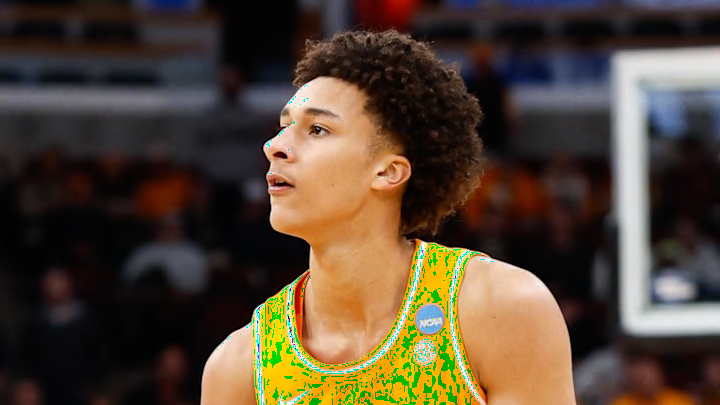
Tennessee wing Nate Ament came into the 2026 NBA Draft cycle as one of the top prospects, and while he didn’t fully live up to his potential as a top-five prospect, he still showed plenty of upside and NBA skill in his lone season with the Volunteers.
Ament stands at 6-foot-9-and-a-half without shoes with a 6-foot-11-and-a-half wingspan, weighing 210 and owning a standing reach of 9-foot-1-and-a-half, owning elite measureables and prototypcial size on the wing. Across 35 games with the Vols, Ament averaged 16.7 points, 6.3 rebounds, 2.3 assists, 1.0 steals and 0.6 blocks per game, shooting 40% from the field, 33% from three and 79% from the line.
While Tennessee was a little up-and-down during the regular season, they did punch their ticket to the Elite Eight in the NCAA Tournament, with Ament playing a large part in that.
Ament’s major strengths include his size and fluidity, face-up scoring upside, rebounding and defensive upside.
Strengths:
Size and Fluidity
As previously mentioned, a lot of Ament’s value and upside is tied to his size and length, in addition to the fluidity that he plays with at his size.
At a confirmed 6-10 in shoes, Ament has legitimate NBA size and length that rears its head across his game, helping him to shoot over defenders and offering him a really nice floor and ceiling on defense. He has great top-end speed in the open floor, able to cover ground on both ends.
In addition to being long and rangy, there’s also a certain level of mobility and coordination that Ament has that jumps out. He’s not an explosive athlete vertically or laterally, though his connectedness and coordination as a mover does offer a level of grace across his game in general.
When you pair all of this with Ament’s largely perimeter-based play-style, you get a very unique player that’s likely to be best-served as a massive wing.
Some will question why Ament is still a mid-to-late lottery pick on major mock drafts given some of the woes he saw as a college freshman. And the answer is usually that players of this size and mold just don’t grow on trees, and have elite upside if developed correctly.
Face-Up Scoring Upside
The primary long-term draw with Nate Ament will of course be his scoring, which was up-and-down through his lone season with Tennesee. As previously mentioned, Ament is far more perimeter-based than most players of his size, offering true face-up scoring potential at 6-10.
Across 35 games, Ament was able to score a great 16.7 points per contest — trailing only fellow draft hopeful Ja’Kobi Gillespie — though he did so on just 40% shooting overall, 33% shooting from beyond the arc and 79% at the line, pointing to some needed improvement across the board.
Given he’ll be roving around beyond the arc more often than not, Ament’s jumpshot and the ensuing results are far-and-away the most important part of the puzzle. Jumpers accounted for 58% of his total diet of field goal attempts, nearly evenly split between twos and threes. He shot 36% on jumpers in general, good for 40% on twos and 33% on threes.
In terms of the actual shot mechanics, they’re largely fine. They’re relatively smooth and his release-point is great for his size, not allowing defenders to affect it often. The release itself gives off some inconsistent power, sometimes going long or short.
Additionally positive is that Ament is great about keeping control through his shooting motion, able to contort his body or quickly go from handling to rising into a shot with ease, both marks of great jump-shooters.
Given he shot 33% as a whole on four attempts from beyond the arc, there’s no singularly reliable shot you can point to for Ament. But he did shoot 39% coming off-screen, which if continually developed and built on, will be major want out of NBA teams looking for an unguardable movement weapon.
Ament’s height and high-release allowed him to see easily over defenders and deliver pretty consistent shots, which played into some of the funky numbers. He split his jumpers nearly evenly between catch-and-shoot attempts and shots off the dribble — taking just 10 more of the former — but he actually shot better off the bounce than he did simply catching and shooting. He shot 33% on all catch-and-shoot shots, with basially no change on guarded and unguaded shots on dead even volume, but shot 41% on dribble jumpers, despite hitting on just 29% of dribble-jumper threes.
All of that points to in-rhythm, off-the-bounce twos having been Ament’s best mode of offense with Tennessee, which is not presently looked at as the best shot in basketball.
Ament was enough of a threat as a jump-shooter to leverage his above-average handle for his size, attacking closeouts and navigating the open floor pretty well, though the finishing itself presented issues that we’ll dive into later. On spot-up plays, Ament shot just 34% overall, with similar marks on both twos and threes.
Ament’s numbers, outside of the 16.7 points per game and some individual box scores, aren’t necessarily awe-inspiring. But when he runs the floor, flies around a screen and smoothly hits a high-rising triple at 6-foot-10, the vision is certainly there. And he can especially be a tough guard when attacking slower-footed bigs or capitilizing on smaller mismatches.
One won’t fault NBA teams and decision-makers for banking on upside with Ament, and the spaced-out NBA, and priortizing him as an off-wing opposed to a top scoring option will help him immediately at the professional level.
Defensive Upside
More theoretical than his scoring at this point is Ament’s defensive upside, though again at 6-foot-10 with length, range and fluiditiy, the bones of an impactful defender on the wing are there, and that flashed in moments at Tennessee.
Across his 35 games with the Vols, Ament nabbed 34 steals and 22 blocks in total, good for 1.0 and 0.6 per game, in addition to a 1.9 steal percentage and 2.7 block percentage. He also posted a 3.3 defensive-box-plus minus — all numbers that aren’t glaringly bad, but do leave plenty to be desired given his tools.
Even still, there are flashes of Ament fanning out, moving his feet, deflecting the ball, switching, showing some physicality on bigger matchups and even blocking shots. The consistency here is probably fewer and further between than the scoring flashes, but Ament is competitivess and a fine thinker of the game, able to put himself in decent position more often than not.
That’s likely the longer-term vision for NBA teams. A player that can guard on the wing in space across a few different positions, won’t be able to be targeted just due to the pure size, and can make plays when needed.
Just given the Tennessee output and his strengths shading more toward wing, Ament isn’t likely ever going to be destined to be a prolific shot-blocker or weak-side monster. But his combination of size and movement skills will allow him to contest and sort’ve stay in the way on the wing, seldomly allowing for some blocked shots.
Overall, this is yet another area that Ament needs to progress in, but has a lot of theoretical upside if strides are taken.
Rebounding and Passing
Given some of the volatility of Ament’s scoring and defense, there’s been a sort’ve boom or bust tag associated with him — as if he’s either going to be next-gen KD, or out of the league entirely. And that’s far from the truth.
We’ve established that Ament is more of a big wing, opposed to a true four or frontcourt player, and that makes his 6.3 rebounds per game — 4.6 defensive and 1.7 offensive — a real highlight to his game.
The line of both getting up 3-point attempts and coming down with boards can be a hard one to follow, and I think Ament does pretty well, of course seeing a largely jumper-heavy shot-diet, but also putting his nose in on the interior to crash the glass as well. A rebounding percentage of nearly 12 isn’t earth-shattering, but considering you’ll be able to play two frontcourt players alongside Ament, there’s some value here overall.
In terms of passing, Ament isn’t a locked-in big initiator, but his 2.3 assists per game were pretty strong relative to his archetype. His height allows him to see over defenses, granting him decent vision, and his wing play-style allows for some interesting wrinkles in terms of post-entry and even pick-and-roll passing.
In the least, he’s somewhat scalable as a wash on the passing front, and isn’t going to massively hurt you, which is another positive. All in all, if the shot’s not fallling, there’s still going to be ways Ament can add value when on the floor long-term.
Areas of Improvement:
Strength and Finising
For the first area of improvement for Nate Ament we’ve gone with strength and physicality. His positional size and upside are great, but a lack of true strength is holding him back in plenty of concrete ways.
Having weighed in at 210 at the combine, Ament has seemingly packed on some muscle and added a little bit of strength in the last few years, but he’ll need to continue doing so early in his NBA career, and then actually parlay that onto the court.
The biggest way this hampered him was finishing. Despite being 6-10, Ament shot just 48% at the rim, dunking the ball just 13 times on the season, and shooting just 43% on layups. He’s prone to getting bumped off spots while on line to the rim, and hasn’t yet mastered playing through contact on a few levels.
The finishing numbers are truly tough marks in terms of NBA projection, where interior players and rim protetectors are notably much bigger and more adept than the college level. Added strength would also help in holding up on defense, where he’s likely to guard wings, but still still be asked to guard fours and other similarly-sized players who are going to have strength advantages.
From a physicality perspective, Ament is a very physical player, not shying away from contact in the slightest, and this actually bears out in a few ways.
One of the best parts about Ament’s profile is spurred by this — he posted a great .58 free throw rate, shooting over seven free throws per game and hitting on 79%. That’s a legit skill that should be able to carry over to the professional level, drawing contact, getting to the line.
The issue is moreso holding up with that level of physcality in the NBA — which is, of course, a pretty sizable leap physically.
Again, Ament has prototypcial wing size, but adding muscle, getting functionally stronger and learning to play through contact are all going to be massive for his ability to actually capitilize on it.
Efficiency and Consistency
The last few areas of improvement for Nate Ament are of course his effeciency, which could use a boost across the board, in addition to his overall consistency.
Firstly, Ament is simply going to have to capitlize as a scorer more, finish better at the rim, see shots through from distance. Adding strength, playing through physicality, refining the shot mechanics, gaining confidence, learning the ins-and-outs of whatever system he lands with. Those will all be pathways toward doing so, but point blank he simply needs to convert more to be playable at the NBA level.
If he gets to that point, he’ll need to become more consistent overall. Ament’s season was highlighted by really high highs, but also some low lows, with no real line of demarcation outside of, loosely, conference play.
Ament started out averaging 19.0 points on 45% shooting across his first six games, before dipping to 12 points on 36% shooting in the next nine. He would see his best stretch of the season through the last 14 games of conference play, 20 points per game on 43% shooting, including just under 40% from three.
That stretch was what many would consider a positive trend toward growth, but he also capped his postseason with some really down performances: 1-for-13 shooting against Vanderbilt, zero field goals against Miami of Ohio, 2-for-12 against Michigan in the Elite Eight. And even that sandwhiched really good play against Virginia and Iowa State.
The best version of Nate Ament looks very special. Incredible shot-making, fluidity with the ball, able to put feelers into areas like defense and passing. He just needs to find that level with more consistency overall.
Outlook:
Nate Ament is going to offer as polarizing a player as there is in the 2026 NBA Draft class.
Decision-makers that beleive in his ability to get stronger and tighten things up across the board will envision a prototypcial modern wing capable of uncontestable shot-making and a dash of just about everything else. Those that don’t see everything syncing up may want to avoid him entirely.
Due to that, Ament’s range is likely to start around 10, give or take a few spots, but could also extend to somewhere in the late-teens to early-twenties if teams are dead set on grabbing bonafide contributors in a seemingly deep first round.
Given that Ament will obiously need some time to grow and develop and work through any defeciencies, any landing spot that’s available to grant him that, as well as some spots that can take the offensive pressure off of him and allow him to scale down early.
Some that are realsitic to where he might be selected are Atlanta, Charlotte as an ancillary scoring piece and Chicago with their second first-round pick.
Range: Late-Lottery to Mid-First
Role: Wing Scorer, Stretch Four
Impact: Starter Upside, Rotation
Swing Skills: Strength, Efficiency
Best Fits: Hawks, Hornets, Bulls
 Add us as a preferred source on Google
Derek Parker covers the National Basketball Association, and has brought On SI five seasons of coverage across several different teams. He graduated from the University of Central Oklahoma in 2020, and has experience working in print, video and radio.
Follow DParkOK