%22%3E%0A%3Cpath%20d%3D%22M0%205.37646H8.15061L17.4195%2016.8819V5.37646H26.0647V31.4412H18.3227L8.64523%2019.4196V31.4412H0V5.37646Z%22%20fill%3D%22white%22%2F%3E%0A%3Cpath%20d%3D%22M29.2041%205.37649H43.8064C47.4193%205.37649%2049.6989%206.1937%2051.2258%207.72059C52.1505%208.64533%2052.8172%2010.0002%2052.8172%2011.7851V11.8497C52.8172%2014.9465%2050.9462%2016.8389%2048.172%2017.8067C51.5269%2018.7744%2053.6774%2020.5594%2053.6774%2024.1293V24.1938C53.6774%2028.3659%2050.258%2031.4197%2043.6558%2031.4197H29.2041V5.35498V5.37649ZM44.258%2013.7637C44.258%2012.6024%2043.3333%2011.9787%2041.4623%2011.9787H37.6988V15.6346H41.5053C43.3763%2015.6346%2044.258%2015.011%2044.258%2013.8497V13.7852V13.7637ZM42.0859%2020.9895H37.6988V24.8605H42.0644C43.9569%2024.8605%2044.9247%2024.0863%2044.9247%2022.968V22.9035C44.9247%2021.7852%2043.9999%2021.011%2042.0859%2021.011V20.9895Z%22%20fill%3D%22white%22%2F%3E%0A%3Cpath%20d%3D%22M64.8174%205.18286H73.4627L84.452%2031.4411H74.9896L73.6132%2027.9357H64.4949L63.1615%2031.4411H53.8496L64.8389%205.18286H64.8174ZM71.4412%2021.7636L69.054%2015.441L66.6669%2021.7636H71.4412Z%22%20fill%3D%22white%22%2F%3E%0A%3Cpath%20d%3D%22M95.2695%205.37646H105.248C115.592%205.37646%20120.775%2010.4733%20120.775%2018.1938V18.2583C120.775%2025.9788%20115.485%2031.4412%20104.947%2031.4412H95.2695V5.37646ZM104.001%2012.9679V23.8497H105.463C109.442%2023.8497%20112.022%2022.2153%20112.022%2018.4518V18.3873C112.022%2014.6239%20109.463%2012.9894%20105.463%2012.9894H104.001V12.9679Z%22%20fill%3D%22white%22%2F%3E%0A%3Cpath%20d%3D%22M123.098%2011.1182H131.549V15.2258C132.711%2012.4731%20134.56%2010.6881%20137.915%2010.8387V19.8065H137.012C133.442%2019.8065%20131.528%2021.785%20131.528%2026.2797V31.4625H123.076V11.1182H123.098Z%22%20fill%3D%22white%22%2F%3E%0A%3Cpath%20d%3D%22M137.808%2025.6772V25.6127C137.808%2021.5482%20140.818%2019.2901%20145.55%2019.2901C147.27%2019.2901%20149.464%2019.6557%20150.345%2020.0428V19.6987C150.345%2017.8277%20149.184%2016.7524%20146.582%2016.7524C144.496%2016.7524%20142.754%2017.204%20140.969%2017.9137L139.485%2012.3008C141.829%2011.3975%20144.517%2010.8169%20148.044%2010.8169C152.173%2010.8169%20154.862%2011.6771%20156.646%2013.4621C158.173%2014.989%20158.776%2016.9675%20158.776%2019.9137V31.5052H150.324V29.4622C148.904%2030.9891%20147.012%2031.9999%20144.474%2031.9999C140.56%2031.9999%20137.808%2029.7633%20137.808%2025.7417V25.6772ZM150.431%2023.9138V23.0536C149.937%2022.86%20149.206%2022.7095%20148.496%2022.7095C146.818%2022.7095%20145.894%2023.7202%20145.894%2024.9891V25.0536C145.894%2026.2364%20146.754%2027.0321%20147.829%2027.0321C149.313%2027.0321%20150.431%2025.8493%20150.431%2023.9138Z%22%20fill%3D%22white%22%2F%3E%0A%3Cpath%20d%3D%22M162.883%2017.6345H160.496V11.1183H162.883C162.926%208.96778%20163.442%207.20433%20164.711%205.9355C166.088%204.55915%20167.872%204%20170.668%204C173.163%204%20174.69%204.21506%20175.851%204.55914V9.84951C175.034%209.65596%20174.217%209.54843%20173.141%209.54843C171.83%209.54843%20171.163%2010.0646%20171.163%2011.1829V11.3334H175.851V17.6345H171.335V31.4411H162.883V17.6345Z%22%20fill%3D%22white%22%2F%3E%0A%3Cpath%20d%3D%22M178.883%2024.6238V17.613H176.496V11.0968H178.883V6H187.335V11.0968H192.023V17.613H187.335V22.7528C187.335%2024.2797%20188.045%2024.8389%20189.378%2024.8389C190.152%2024.8389%20191.055%2024.6238%20191.937%2024.2152V30.7314C190.604%2031.4411%20188.582%2031.8927%20186.539%2031.8927C181.55%2031.8927%20178.862%2029.5916%20178.862%2024.6238H178.883Z%22%20fill%3D%22white%22%2F%3E%0A%3Cpath%20fill-rule%3D%22evenodd%22%20clip-rule%3D%22evenodd%22%20d%3D%22M201.368%204.36764C207.191%20-1.45588%20216.632%20-1.45588%20222.456%204.36764C228.279%2010.1912%20228.279%2019.6324%20222.456%2025.4559L211.912%2036L201.368%2025.4559C195.544%2019.6324%20195.544%2010.1912%20201.368%204.36764ZM204.009%207.55761C203.948%207.86849%20203.916%208.39718%20203.916%209.14566V10.4189C203.916%2011.1832%20203.948%2011.7198%20204.013%2012.0267C204.078%2012.3317%20204.278%2012.6168%20204.617%2012.8762C204.956%2013.1376%20205.403%2013.3316%20205.958%2013.4623C206.512%2013.593%20207.1%2013.6583%20207.837%2013.6583C208.573%2013.6583%20209.217%2013.591%20209.769%2013.4524C210.322%2013.3158%20210.761%2013.1178%20211.086%2012.8604C211.411%2012.6029%20211.605%2012.3178%20211.666%2012.0069C211.728%2011.6961%20211.759%2011.1674%20211.759%2010.4189V9.14566C211.759%208.38134%20211.728%207.84473%20211.662%207.53781C211.597%207.23287%20211.397%206.94972%20211.058%206.68834C210.72%206.42696%20210.272%206.23291%20209.718%206.10223C209.163%205.97154%20208.536%205.90619%20207.839%205.90619C207.102%205.90619%20206.459%205.97352%20205.906%206.11213C205.352%206.24875%20204.914%206.44677%20204.589%206.70418C204.265%206.9616%20204.071%207.24673%20204.009%207.55761ZM209.276%2024.8638C212.876%2024.8638%20214.557%2024.2064%20214.557%2021.862V21.858V21.3155C214.557%2019.6581%20213.516%2018.971%20210.252%2018.3136C209.278%2018.1136%20208.908%2017.9136%20208.908%2017.3136V16.9414C208.908%2016.6543%20209.177%2016.5117%20209.413%2016.5117C209.749%2016.5117%20209.918%2016.7137%20209.918%2016.9414V18.1136H214.391V17.3988C214.391%2015.4563%20213.347%2014.4266%20209.177%2014.4266C206.15%2014.4266%20203.896%2015.3414%20203.896%2017.3711V17.7433C203.896%2019.5155%20204.805%2020.3155%20208.201%2021.0303C208.28%2021.0472%20208.355%2021.063%20208.427%2021.0781C209.329%2021.2674%20209.647%2021.3341%20209.647%2021.9174V22.2897C209.647%2022.6619%20209.546%2022.8045%20209.142%2022.8045C208.67%2022.8045%20208.637%2022.5471%20208.637%2022.262V21.2897H203.894V21.7471C203.894%2024.149%20205.476%2024.8638%20209.276%2024.8638ZM215.424%2024.5569H219.925V14.7355H215.424V24.5569ZM216.955%2013.5019H219.925V6.06064H217.092V9.411L215.193%206.06064H212.359V13.5019H215.193V10.1199L216.955%2013.5019ZM208.269%2012.152C208.204%2012.2688%20208.055%2012.3262%20207.825%2012.3262L207.827%2012.3282C207.604%2012.3282%20207.459%2012.2767%20207.398%2012.1757C207.336%2012.0748%20207.305%2011.8074%20207.305%2011.3758V7.90068C207.305%207.51852%20207.352%207.28684%20207.445%207.20962C207.538%207.13239%20207.675%207.09279%20207.851%207.09279C208.059%207.09279%20208.198%207.14031%20208.265%207.23734C208.332%207.33239%20208.366%207.55416%20208.366%207.90068V11.3203C208.366%2011.7579%20208.334%2012.0352%20208.269%2012.152Z%22%20fill%3D%22white%22%2F%3E%0A%3C%2Fg%3E%0A%3Cdefs%3E%0A%3CclipPath%20id%3D%22clip0_15247_3640%22%3E%0A%3Crect%20width%3D%22227%22%20height%3D%2236%22%20fill%3D%22white%22%2F%3E%0A%3C%2FclipPath%3E%0A%3C%2Fdefs%3E%0A%3C%2Fsvg%3E%0A)
NBA Draft Scouting Report: Washington's Hannes Steinbach
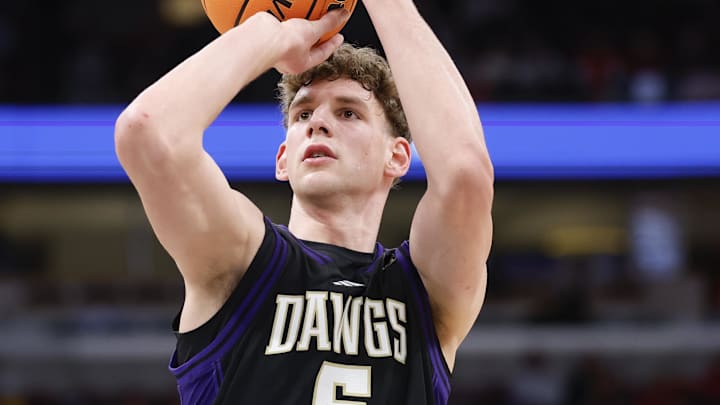
Washington big Hannes Steinbach put together a strong one-and-done season with the Huskies, cementing a reserved spot at the 2026 NBA Draft in the process.
Steinbach is a well-built forward-slash-center that stands at 6-foot-11, 220 pounds. He’s on the older side for a true freshman at over 20 on draft night, but has lengthy and well-accoladed international experience. He hails from Wurzburg, Germany, having helped Germany to runner-up at the 2025 FIBA U19’s, among World Cup, Bundesliga and other international achievements.
Steinbach’s major strengths include his combination of strength and skill, finishing and touch, two-way rebounding and pick-and-roll play.
Strengths:
Strength and Skill
For Steinbach’s pros, we’ll start with his combination of strength and skill, with stands at a pretty unique intersection as far as bigs go.
We’ll get the bad out of the way: Steinbach stands at 6-foot-11, 220-pounds per Washington, which would be slightly under-average for a modern NBA center. Nearly every team at this point employs a 7-footer in some capacity, with several standing taller and sturdier than Steinbach.
His counters here in immovable strength, length and skill with the ball more than bridge the gap.
Steinbach is an immensely strong player, able to anchor down in the paint on either end, or do the moving himself by bumping others out of the way. He isn’t contact averse in the slightest, instead welcoming physicality and embracing it on both ends.
He brings a very traditional paint presence in that sense, knowing full well what is role is on the interior, and what’s going to be required from a physical standpoint. Additionally, his length affords him some grace against big matchups. He has a reported but unconfirmed 7-1 wingspan, which I think would make plenty of sense given the numbers and impact.
Perhaps the best news here is that Steinbach isn’t simply a bruiser archetype, though he has a nose for involving himself. In addition to his more traditional skills, he’s also got a really nice blend of skill and finesse to his game.
He has touch, some ball skills, and is quicker on his feet than most with his statistical profile, able to show off some really solid mobility and especially balance. He’s great fundamentally, and has a general layer of feel for the game spread across his skillset.
While there may be some positional fit questions, his blend of strength and skill helps to quell some of the concerns.
Finishing and Touch
In sticking with Steinbach’s finesse, his finishing and touch around the rim are some of his key selling points, making him a consistent threat in the paint to see the ball through, as well as granting him some long-term upside.
At 18.5 points per game and just half a 3-point make per game, Steinbach is an obviously talented at-rim finisher, using all the aforementioned skills with a bit more: strength, ball-skill, footwork, balance, elite hands, coordination and all the fundamentals under the sun.
In total, Steinbach shot 68% at the rim on 236 total attempts, which were good for exactly two thirds of his field goal attempts, more if you count runners and hooks. Even more, Steinbach graded excellent per Synergy on both dunks and layups, finishing 26 of 27 attempts on dunks, and shooting around 65% on layups, which accounted for most of his paint attempts. He notably shot 56% on tip-shots, which is a weapon in his arsenal with his length and timing.
His crafty layup numbers feel especially helpful given that he could be smaller than most of his matchups, and it’s a plus he won’t be relying strictly on size and athleticism.
Steinbach’s blend here continues to be the focal point, not relying on any singular trait while standing out in plenty. He isn’t a tremendous vertical leaper, but certainly has enough pop, and the long arms help him to finish more often than not. He’s crafty on the inside, able to position himself with strength, but then use an acute sense of angles and balance to lay it up softly. His hands stand out so much with the ability to just come down with everything, but then toggle to release some unbelievably feathery shots.
Steinbach can often times be undeterred by contact, using his strength and frame to afford him some separation or just power through when necessary.
There’s plenty of play-type versatility here, too. Steinbach scored the bulk of his points as the roll-man and on put-backs, a notable blend of an involved action and simply creating his own opportunities. But his other types — cutting, posting up and transition — weren’t far behind in terms of total points. We’ll dive into both the pick-and-roll and put-back numbers in later sections, but Steinbach was efficient elsewhere as well, shooting 67% on cuts by mostly hanging around the basket and capitalizing, posting up with his blend of skills, and getting out in transition by running the floor well, filling lanes and using his speed to finish more with power.
Predictably, Steinbach shot a very good 46% on runners, and an average 41% on hook shots, albeit on pretty high volume on the latter.
Steinbach stands to be an efficient finisher at the NBA level, albeit in a slightly more traditional way. Though given just how much finishing touch he has, there’s also a world where he’s able to parlay his inside success and take it further out.
Two-Way Rebounding
Of all the tools in Steinbach’s kit, rebounding stands as his best and most elite, having been college basketball’s top rebounder and offering the 2026 draft class’s as well.
All of the face-value numbers, advanced numbers and tape are elite for Steinbach in the rebounding department. He brought down 11.8 rebounds per game with Washington — again, the best mark in all of college basketball — with 7.6 of those being defensive and a whopping 4.2 being offensive. He averaged 20.0 rebounds per 100 possessions, good for an elite rebounding percentage of nearly 20%.
As far as tools, he isn’t the biggest or highest jumping player on the court, and that will certainly be the case in the NBA, but he does have an elite understanding of positioning and timing, as well as that aforementioned combination of immovability and finesse in maneuvering around the paint.
Steinbach is the definition of a glass cleaner, able to quickly erase defensive boards with perfect timing. His ability to grab the ball at its apex, be it on defensive boards or tip-ins on offense, is a weapon and can often him to outmaneuver other huge players. His hands continue to stand out in this area, helping him to snatch, magnetize and wrangle the ball in plenty of scenarios he shouldn’t really be a factor. Additionally, his reaction speed grabbing rebounds, as well as his understanding for where its going next is a major plus.
To the naked eye, a lot of this could seem like pure puck or simply having been right time, right place. But in grabbing nearly 12 rebounds per game, four of which come on offense, Steinbach is certainly creating some of his own luck.
On 83 put-backs with Washington, Steinbach shot a blistering 64%, speaking to his general composure when coming down with the ball, and that level of touch around the rim. That earned him a ‘very good’ rating per Synergy, good for 1.3 points per possession by him simply hanging in and making something out of nothing.
Rebounding in general isn’t the flashiest skill, but Steinbach’s ability to wipe the glass clean, create more opportunities for his team and generally make things happen on the boards is a real strength.
Pick-and-Roll Play
We’ve touched on Steinbach’s finishing ability as a whole, but his pick-and-roll play stands alone as a skill that has some modernity to it, and could be especially utilized with elite guard play at the NBA level.
Steinbach ran 103 total possessions as the roll man with Washington, good for his highest-volume play with the Huskies. He converted shots at a dead-even 50% rate, making and missing 42 shots apiece. Among those possessions he saw a pretty even split of rolling and popping, processing the actions pretty well.
As a roller he shot around 57%, continuing to utilize his strength and spatial awareness to put himself in favorable positions downhill. His ability to finish through contact or go up and over the defense really shines in situations that the lane isn’t completely free.
In popping you think he’d be primarily shooting threes — and a good chunk of his total threes did come in pick-and-pop situations — but he also used these situations to free up some space to handle the ball, he shot 11-for-13 overall on pick-and-pop twos, not incredible volume but enough to raise the eyebrows some in tandem with the tape.
As a screener, Steinbach’s a big body who can generally just get in the way, but again, also isn’t shy to throw himself around and contact defenders. I think the pure fundamentals and contact could stand to get a touch better here, but the bones are there for a very diligent and effective screener.
There’s some general improvement needed across Steinbach’s pick-and-roll play, but this feels like a slightly underutilized or under-maximized part of his game given his tools, and again can offer a level of modernness to his profile. Especially if he can shoot the three-ball, which we’ll get into next.
Areas of Improvement:
Shooting
The first area of improvement for Steinbach, given his level of offensive impact and at-rim versatility, would obviously be shooting. Becoming a true stretch big and effectively modernizing his entire game.
The face-value numbers with Washington aren’t terrible, but continue to hammer the main point home in that there’s just not enough sample, volume or provenness across this area to really bank on it. Across 30 games he took 53 total threes hitting 18 at 1.8 attempts per game and 0.6 made per game. He shot 34% in total, not a terrible number for a project shooter. But again the volume at less than two per game, mixed with a history of so-so shooting across international play, just makes this somewhat of a mystery box.
The good news is that he certainly takes threes, which is an obvious first step. The form isn't spectaculr — there’s several inconsistencies across it in terms of the release, the base and more. In juxtaposition with his feathery at-rim finishing, the way it leaves his hand leaves a ton to be desired, and on top of that he has a pretty large dose of bad misses, be it missing the rim or air balls.
The free throw volume and percentage are solid indicators, and put him pretty favorable light when you mix it with his aforementioned finishing touch, which can extend into the mid-range on floaters, runners and more. He shot a great 76% at the line with Washington, even better given it was on over five attempts per game.
His point-per-shot ratings on Synergy are generally really good, grading very good on all jumpers at 39% and good on catch-and-shoot shots at 34%. Notably, he shot phenomenally on guarded shots and under-averaged on unguarded, hitting 35% of all his catch-and-shoot threes, 40% on guarded and 27% on unguarded on similar volume.
Three-point shooting would be a huge boost to Steinbach’s game, adding versatility to his already good offensive skillset, and potentially even making him positionally pliable given his mobility for his size.
Rim-Protection
The other of Steinbach’s major improvement areas would be his rim-protection and more generally his defense, which is a whole is a bit of a loaded category.
At 18.5 points per game with touch on the interior, Steinbach’s obviously more slanted toward offense, and few consider him a real impact defender. Despite that he has a penchant for making things happen, despite lacking more traditional rim-protection, which could be a deal-breaker for some.
Steinbach averaged 1.2 blocks per game and 1.1 steals, posting a good 1.8% steal percentage and a so-so 3.9% block percentage — all good for an overall box-plus-minus of 2.4. Opposing players shot 37% in total with Steinbach in the vicinity, and a good 45% at the rim with him around. Again, none of these are elite defensive numbers, but not necessarily damning either for such a talented offensive prospect.
Steinbach’s mobility and length both really shine here, allowing him to eat up ground, stick with smaller handlers on switches and generally play-making, stealing, deflecting and blocking. He has a hard time guarding the shiftiest guards, as all bigs do, but holds up a surprising amount switching across several positions.
Again, Steinbach’s pure rim-protection leaves plenty to be desired, calling into question his ability to play the five for extended minutes, but there are a few pros here. Much like his post-up and rebounding game, Steinbach’s an exceptionally hard player to move, so while he most not be at-risk of blocking shots often, he’s really hard to displace with positioning. He also continues to have a good level of understanding and floor game, allowing himself to position himself well.
Really, this boils down to Steinbach’s ability to guard true NBA fives and put a lid on the rim, which one probably shouldn’t expect full-time at this point, given how hard it is to improve in this area and how tied to tools it can be. His height is a pretty limiting factor even accounting for the long wingspan, his leaping remains up-and-down, and he just doesn’t have elite shot-blocking instincts even baking in some long-term improvement.
Overall, Steinbach will likely be best-served as a weak-side four or limited small-ball five that can excel in offensive-slanted lineups, where one expect he can at least impact the defensive side of the ball, despite not thriving.
Passing and Play-Making
Steinbach’s passing and play-making is certainly an area to note, though it doesn't need near the attention that shooting and rim-protection do in terms of further improvement.
Steinbach averaged 1.6 assists per game to 2.0 turnovers, posting a negative assist-to-turnover ratio of 0.8. Some of the low numbers were systemic, with Steinbach simply not having the opportunity to really churn out assists, which makes sense given his overall skillset, and also his preference for simply scoring the ball.
There should be few worries around Steinbach’s general passing, ball-moving, easy reads, dribble-handoffs and more. He shows a fine level of feel across all of these, with the ability to read the floor and process pretty quickly. The accuracy isn’t there 100% of the time, but more time in a specific system and a better understanding of teammate tendencies should make him more than passable as a ball-mover and action executor.
Steinbach lacks truly high-level passing and play-making ability, functioning far better as a quick-decision maker than a true surveyor of the floor. But there is some pretty solid stuff such as keen in-and-out plays or live-dribble passes that offer some upside.
Outlook:
Hannes Steinbach brings a myriad of NBA-ready tools to the table with the numbers to match: versatile and productive interior finishing, elite, game-changing rebounding, a layer of feel and IQ spread across his profile in its entirety. And while he packs a more traditional punch, there’s some modern upside with his mobility, shooting and passing potential.
That seems just fine for a lottery pick, with the potential to go higher depending on fit. Steinbach projects to be a rotational level big, with starting upside if he’s able to stretch the floor long-term.
The Spurs, Warriors and Bucks jump out as solid fits for Steinbach, San Antonio offering a shot-blocking, floor-spacing five that Steinbach could play alongside, and the others needing a frontcourt infusion, especially in the rebounding department.
Range: Top-10 to Late-Lottery
Role: Play-Finisher, Glass Cleaner
Impact: Rotation, Starter Upside
Swing Skills: Shooting, Rim-Protection
Best Fits: Spurs, Warriors, Bucks
 Add us as a preferred source on Google
Derek Parker covers the National Basketball Association, and has brought On SI five seasons of coverage across several different teams. He graduated from the University of Central Oklahoma in 2020, and has experience working in print, video and radio.
Follow DParkOK