
Are Your Old Sports Magazines Worth Thousands?
In this story:
For decades, magazines were not viewed as collectibles. Most sold for just a few dollars. They were read and then thrown in the trash. Bradley Griffith, a CGC consultant working to expand the graded magazine hobby, believes one of the biggest obstacles is changing how collectors think about magazines.
“The initial impression from everybody is ‘how can magazines be collectible’?” Griffith said. However, recent auction results have brought a lot of new attention to the graded magazine space. A 1956 Sports Illustrated with Mickey Mantle on the cover sold for a staggering $328,180 on June 28th. In September, a 1984 Sports Illustrated with Michael Jordan on the cover sold for $378,200.

And Mickey Mantle and Michael Jordan aren’t the only athletes attracting attention. A CGC 9.2 example of Larry Bird’s first Sports Illustrated cover from 1977 just sold for $21,960 in September. Also in September, a CGC 9.6 example of a 1996 issue of "The Fan" featuring Kobe Bryant sold for $11,950.

Of course, most magazines aren’t worth thousands of dollars. The extraordinary issues making record-breaking sales are generally high-grade iconic magazines graded by PSA or CGC. High-grade copies (like a PSA 9.6 or CGC 9.8, for example) of iconic magazines are exceptionally rare, especially when compared to their sports card counterparts.
“A magazine is a much harder object to keep sharp than a card… bigger surface, spines, rough handling due to reading…so a true 9.4+ newsstand is pretty rare,” said Paul Sjoberg, an experienced magazine collector who owns all 50 of Michael Jordan’s Sports Illustrated covers.
Surprisingly Low Graded Populations
“The fact that magazines are largely considered disposable is part of what makes them now so relevant,” Griffith said. One of the most fascinating aspects of graded magazines is how their population counts compare to some of the most popular and valuable sports cards. Newsstand editions of magazines are generally more popular and rarer than subscription editions. According to Paul Sjoberg, newsstand copies represent just 3% of magazine print runs. Sjoberg believes their scarcity is one of the most overlooked aspects of the hobby.
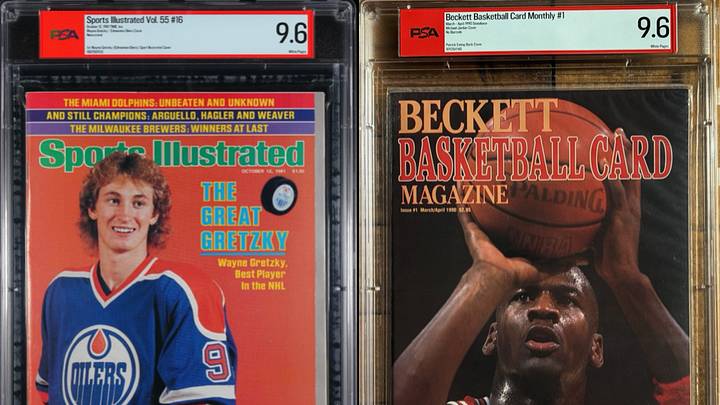
Both editions can be exceptionally rare, though, when dealing with older magazines. Consider Michael Jordan’s first NBA Sports Illustrated cover from 1984, Mantle’s first Sports Illustrated cover from 1956, LeBron James’ famous “The Chosen One” cover from February 2002, and Wayne Gretzky’s first-ever Sports Illustrated cover from 1981. Each of these magazines is on many people’s “Mount Rushmore of Sports Magazines” lists, but each magazine is extremely rare when compared to each athlete’s iconic rookie card.

Here is how the total graded populations of these four magazines compare to their iconic sports card counterparts:
Athlete | Iconic Sports Card Population | SI First Cover Population |
|---|---|---|
Michael Jordan | 51,612 (1986 Fleer) | 1,113 (187 newsstand) |
Mickey Mantle | 3,038 (1952 Topps) | 137 (81 newsstand) |
LeBron James | 21,070 (2003 Topps Chrome) | 829 (503 newsstand) |
Wayne Gretzky | 23,056 (1979 O-Pee-Chee) | 451 (151 newsstand) |
*Card populations include PSA, CGC, Beckett, and SGC. Magazine populations combine PSA and CGC. Newsstand populations are included in the magazine totals.
Not only are magazines rarer than sports cards, its much easier to pinpoint which magazines really matter. LeBron has 138 distinct rookie cards, but James only has one first Sports Illustrated cover. Many collectors have complained that the sports card hobby has become oversaturated with so many inserts, parallels, and sets. Magazines are simpler. “I think the lack of variations and simplicity is so refreshing,” said magazine collector Marty Ryan.
Just How Rare are These Iconic Magazines Really?

There are still some important distinctions to consider when interpreting population counts. Sports card grading started in 1991, while magazine grading began in 2009 with CGC. Many surviving magazines have never been submitted, and certified populations shouldn’t be confused with the total number of copies still in existence.
Nevertheless, the differences are remarkable. Sports cards have been viewed as a collectible for many decades, while magazines were purchased to be read and eventually discarded.

However, the magazine grading market has experienced significant growth in recent years. According to Griffith, approximately 13,000 Sports Illustrated magazines were graded by CGC between 2009 and 2022. From 2023 through 2026, another 36,000 were graded. If there really were many more of these iconic magazines out there, most would have made their way to the market by now.
Graded Magazines Are Exceptional Display Pieces

One of the most appealing aspects of graded magazines has nothing to do with their potential financial value or population counts. Graded magazines look amazing as centerpieces of a sports collectibles display. Unlike traditional trading cards, magazines feature large photographs and memorable headlines that perfectly capture the personality of an athlete or the significance of a particular moment.

Howard Chasser, a longtime collector and sports memorabilia dealer, believes the visual appeal of historic magazines is one of their greatest charms. “I see them as analogous to works of art,” Chasser said. For sports fans who already have extensive card collections, graded magazines offer an opportunity to display their favorite athletes in a different way. The larger format also allows collectors to appreciate details that might be difficult to capture on a small trading card.

Autographed magazines can be especially appealing. The larger surface provides more room for an athlete to leave a bold signature, while the combination of historic cover photography and an autograph can create an impressive display piece. Mark O’Bryan, who has collected more than 4,000 autographed Sports Illustrated magazines, has built themed collections featuring legendary athletes, Super Bowl covers, and his favorite sports teams.

And collectors do not have to grade all of their magazines. Raw copies provide the opportunity to read the original articles, look through historic advertisements, and experience the publication as it originally appeared. Chasser describes magazines as a “window into the past.” He believes the articles, advertisements, and photographs provide a unique look at the historical period when the magazine was published.

And Sports Illustrated isn’t the only publication worth collecting, either. Magazines such as SLAM, TIME, and SPORT have featured memorable covers that appeal to collectors.
3 Under-the-Radar Sports Magazines Worth Collecting
While magazines featuring Mickey Mantle and Michael Jordan have attracted considerable attention, experienced magazine collectors believe there are other historically significant magazines that deserve more recognition. Below are three historically significant magazines that collectors should take a closer look at.
1. 1947 Time Jackie Robinson (September 22, 1947)

CGC Population Report: 43 Newsstand and 12 Subscription Editions
PSA Population Report: 3 Newsstand and 6 Subscription Editions
Recent Sale: $995 for a CGC 4.5 on 9/2/26
This magazine came out in during Jackie Robinson’s groundbreaking rookie season with the Brooklyn Dodgers. The cover was a major milestone at a time when Black athletes did not on national magazine covers. “The historical significance of Jackie on the Time cover 1947 can't be overstated,” said magazine collector Mark Tanaka, who emphasized that this magazine represents the first time a black athlete appeared on a national magazine cover in the United States.
2. Beckett Basketball #1 Michael Jordan (March 1990)

CGC Population Report: 60 Newsstand and 1,720 Subscription Editions
PSA Population Report: 22 Newsstand and 355 Subscription Editions
Recent Sales: $339 for a PSA 9.6 on 10-21-26, $223 for a CGC 9.6 on 11-2-2026
For collectors who grew up collecting sports cards in the 1980s and 1990s, Marty Ryan believes another overlooked opportunity might be hiding in plain sight: old Beckett price guides. “If you were born before 1990 and collected cards, Beckett Magazine were a staple. You waited every month for the new magazine to arrive,” Ryan said.
Ryan is particularly interested in the first issue of Beckett Basketball, featuring Michael Jordan. He points out that PSA has graded 355 subscription copies compared to just 22 newsstand copies, according to the population figures he provided. “I think the nostalgia factor alone will drive the popularity of Beckett Magazines” Ryan said.
3. Sports Illustrated November 19, 1979 (Magic Johnson’s First NBA Sports Illustrated Cover)

Recent Sales: a CGC 7.5 sold for $150 on 11-6-2026, a CGC 8.0 sold for $250 on 9-20-26
CGC Population Report: 21 Newsstand and 65 Subscription Editions
PSA Population Report: 23 Newsstand and 9 Subscription Editions
Paul Sjoberg believes collectors are overlooking several important publications like the first Sports Illustrated covers of basketball legends such as Julius Erving and Magic Johnson. “Collectors pile into Jordan and stop. But they’re missing out,” Sjoberg said. Magic’s iconic 1980 Topps rookie card with Larry Bird and Julius Erving has a total population count of 27,076. Magic’s first magazine cover has a total population count of just 118, and can be found for less than $100 in decent condition.
An Under-the-Radar Magazine Grail: Babe Ruth's First Cover (March 4, 1916 issue of Sporting Life)

The issue features a young Ruth during his pitching days with the Boston Red Sox, long before he became baseball's home run king. Interestingly, the magazine mistakenly identifies Ruth as his teammate Dutch Leonard. Howard Chasser considers this one of the most difficult early baseball publications to find. In more than 30 years of collecting, Chasser says he has encountered fewer than five examples of this issue.
As collector Marty Ryan points out, one major difference between cards and magazines is the excitement of opening packs. While magazine collecting lacks the element of pack opening, Ryan believes the thrill comes from discovering forgotten treasures at estate sales and garage sales. For him, finding an overlooked magazine and improving its condition through cleaning and pressing is even more rewarding than pulling a valuable card from a pack.
 Add us as a preferred source on Google

David is a collector based in Georgia and a lifelong fan of the New York Yankees, New York Giants, and New York Knicks. He is an avid sports card collector with a strong passion for vintage baseball cards and vintage on-card autographs. David enjoys obtaining autographs through the mail and loves connecting with other knowledgeable collectors to discuss the history and evolution of the hobby. He also previously wrote about the New York Giants for GMENHQ.com