
Bo Jackson’s Iconic 1990 Score Card Is Up Over 100%—Here’s Why
In this story:
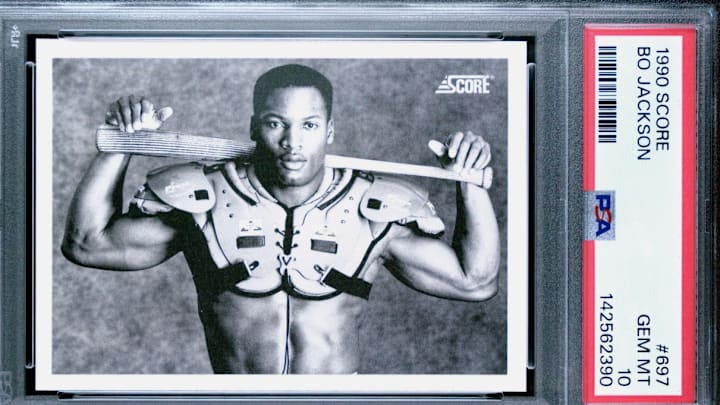
Few cards from the called junk-wax era have managed to break free from nostalgia and become true modern market movers. The 1990 Score #697 Bo Jackson, graded PSA 10, is doing exactly that. Over the past 12 months, its value has surged more than 110%—climbing from roughly $226 to about $475—according to Card Ladder data, with nearly 400 recorded sales and an average price now north of $400. For a base card from 1990, that kind of growth demands an explanation.
RELATED: Championship Athletes: Cards for Deion Sanders & Other Dual-Sport Players

The answer starts with the image itself.
The Definitive Bo Jackson Image
The black-and-white photo of Jackson wearing Raiders shoulder pads with a baseball bat resting across his shoulders isn’t just iconic—it’s foundational. Shot by photographer Richard Noble, the image became a visual anchor of Nike’s legendary “Bo Knows” campaign, appearing on posters, ads, and in card shops everywhere. Score leaned fully into that mythology. The front of the card feels more like a cultural statement than a standard issue, and the back famously reduces Bo’s resume to two letters: “BO,” with the B in Royals blue and the O in Raiders black.

At the time, collectors knew it mattered. In the summer of 1990, Beckett price guides had the card valued in double digits—an outlier in an era when most then-current base cards were literal pocket change. A similar photo from the shoot also appeared on the cover of June 1990’s Beckett Baseball Card Monthly, further cementing it as the Bo Jackson visual for an entire generation of collectors.

PSA 10s, Population Reality, and Market Momentum
While more than 27,000 copies of the card have been graded by PSA, the condition curve is steep. Only about 4,400 have earned PSA 10 status, and those gem-mint copies are where demand has concentrated. Lower grades remain accessible—PSA 9s still trade around $60–70—but PSA 10s have clearly separated from the pack.
RELATED: CardVault by Tom Brady Opens San Francisco Flagship Store Near Oracle Park
That separation reflects both nostalgia and a modern reassessment of the card as one of the defining images of late-’80s and early-’90s sports culture. It’s no longer just a fun memory—it’s a hobby gem.
The Controversy That Froze the Autograph Supply
The card’s recent momentum is also tied to a lesser-known legal backstory. In 2013, photographer Richard Noble sued Nike, alleging the company exceeded the scope of its original license by reusing the image in digital and promotional contexts without permission. The case was ultimately settled, but hobby reporting and signing-event disclosures point to a lasting consequence: Bo Jackson no longer signs items featuring the bat-over-shoulders image.
Modern private-signing flyers spell it out explicitly—Jackson will not autograph the 1990 Score #697, related posters, or similar photos.

As a result, authenticated signed examples are limited to a small number produced before 2013. That hard stop on supply adds a narrative premium even to unsigned PSA 10s, reinforcing the card’s status as a closed chapter in Bo’s collecting history.
The Earlier Companion: 1989 Score Supplemental #384S
Collectors tracking the 1990 card often circle back to its spiritual predecessor: the 1989 Score Football Supplemental Black & White #384S. Featuring a similar bat-and-pads image, the supplemental issue captures the same two-sport mythology at an earlier point in Bo’s rise. While it hasn’t seen the same explosive price action, high-grade examples have quietly climbed, with PSA 10s occasionally clearing a few hundred dollars.

Together, the two cards form a visual timeline of Bo Jackson at the height of his cultural power—football, baseball, marketing, and myth all converging in black and white.
Why This Card Doubled In Value
Most 1990 base cards still sit in dime boxes. The 1990 Score Bo Jackson does not. Its rise is fueled by a perfect storm: an unforgettable image, cross-sport superstardom, modern grading clarity, and a controversy that permanently capped autograph supply. It’s junk-wax nostalgia with real-world constraints—and that’s exactly why this card is having its moment now.
TOP TRENDING COLLECTIBLES ARTICLES:
 Add us as a preferred source on Google
Lucas Mast is a writer based in California’s Bay Area, where he’s a season ticket holder for St. Mary’s basketball and a die-hard Stanford athletics fan. A lifelong collector of sneakers, sports cards, and pop culture, he also advises companies shaping the future of the hobby and sports. He’s driven by a curiosity about why people collect—and what those items reveal about the moments and memories that matter most.
Follow sneakrz