
Five Baseball Card Firsts That May Surprise You
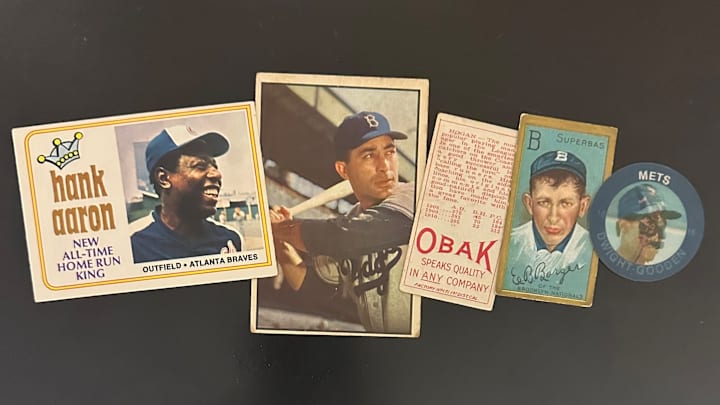
As rapidly as the Hobby seems to change these days, the truth is there remains relatively little that can be considered truly new. In fact, many of the Hobby "innovations" we see in modern Topps sets had their origins before the earliest Topps baseball cards even existed! This series of articles will highlight several baseball card innovations that are likely much older than you think.
Color Photography

These days we take it for granted that our baseball cards feature full color photography, even as we know this was not always the case. So when did color photos first appear on baseball cards? Within the Topps universe, the answer is 1957. However, color photos on baseball cards go back even further than that.
RELATED: Why the 1957 Topps Set is the Best Baseball Card Release of All Time
Four years before 1957 Topps, archrival Bowman introduced its own color photographs in a set many vintage collectors rank among the most beautiful ever produced: 1953 Bowman Color.

However, even these early Bowman cards were not the very first to use color photographs. That honor belongs instead to a set many collectors have never heard of, even as its checklist boasts a Hall of Famer as well as the earliest known card of legendary Yankee manager Billy Martin. That set, the first to use color photography, is the (drumroll please) 1948 Signal Gasoline Oakland Oaks.

Traded Cards
Collectors around my age remember the buzz when the 1981 Topps Traded set came out. Along with team updates for stars like Dave Winfield and Rollie Fingers, this end-of-season supplement more importantly delivered solo rookie cards of Fernando Valenzuela and Tim Raines, two cards still pursued by collectors today.
RELATED: Fernando Valenzuela’s Magical Rookie Cards of 1981

Of course, collectors going back even further will remember that "traded cards" were a thing almost a full decade earlier. After all, the Topps sets of 1972, 1974, and 1976 all included "Traded" subsets. One of these sets even included one of the decade's most iconic cards!

RELATED: The Ten Essential Topps Baseball Cards of the 1970s
What may surprise collectors is just how far back Traded cards really go. For example, take a close look at the name plate on this Turkey Red Vic Willis card from 1911: "NOW WITH ST. LOUIS NAT'L."

Depending on how one defines traded cards, the history of these cards may go even further back, possibly as early as the 1887-1890 Old Judge set, one of the Hobby's very first. Head here for even more history.
"Home Run King"
These days, collectors see the phrase "Home Run King" and presume the player in question is Barry Bonds or perhaps Hank Aaron. Certainly, vintage collectors remember the famous "Home Run King" card Topps issued in 1974, even before Aaron hit number 715 to topple Ruth.

If you imagined an even earlier instance of "Home Run King" would be found on a Babe Ruth card, you'd be correct. However, the year of the card might surprise you. The back of Babe Ruth's 1952 Topps Look 'n See card is one of a handful to use the phrase "Home Run King," a fitting enough title since the Bambino was at the time both the single season and career leader in home runs. Of course, the first use of "Home Run King" on a Babe Ruth card (or any card) came in 1920 (or possibly 1921) when the Sultan of Swat had as few as 49 career round-trippers!

World Series cards

World Series cards are another trading card innovation that dates back much further than you'd expect. While the first Topps World Series subset came in 1960, these cards highlighting the Dodgers' first Los Angeles championship were hardly the first cards to feature the World Series on cardboard. In fact, the very first Topps World Series cards date back to a set most collectors don't even know existed: 1948 Topps! Take a look!
Even more surprising, however, is that the first World Series cards came out years before Pittsburgh and Boston squared off in the very first Fall Classic. "How can this be," you ask! Well, before there was the World Series between the National and American Leagues, Baseball enjoyed a "World Series" between the National League and American Association going all the way back to 1884. But were there cards? There sure were. How about this 1888 set of die-cuts honoring the St. Louis Browns and Detroit Wolverines!

Baseball Card Rainbows
A collecting pursuit generally thought of as extremely modern involves chasing the "rainbow" of a favorite card. For the uninitiated, this involves collecting the full set of parallels (or colors) produced of that card. Beyond the sheer number of cards sometimes involved, one of the things that makes rainbows particularly challenging is (usually) the presence of a "1 of 1" card, meaning only a single copy of the card exists.
Behold the beauty of the 2024 Topps Gilded Goose Gossage 1/1 now in hand
— Ron Bartleet (@ngreenroom) February 18, 2025
I have officially completed this 6 auto card rainbow for a mere $301.50
Breakdown
/99 $11.50
/50 $16.50
/25 $21.00
/10 $90.00
/5 $45.00*
/1 $117.50
For reference, a single hobby box retails for $580… pic.twitter.com/h7UbgGBe3U
Identifying the earliest baseball card rainbow may depend on how you define rainbow. For example, it's well known that Ty Cobb has otherwise identical red and a green portrait cards in the famous T206 set. Similarly, Babe Ruth has nearly identical red and yellow cards in 1933 Goudey, though their card numbers differ. The 1910-11 Sporting Life (M116) set is another early release with multiple color variations for at least some players on the checklist.
But how about a set where every card has four different color variations? That would be the little known but much maligned 1941 Goudey set, which offered red, blue, yellow, and green versions of all 33 cards.

Oh, and even earlier than that, another set with multiple color variations for every player is the 1934 Diamond Matchbooks set, which featured 200 different players in green, blue, and orange, as well as some as yet unknown number of those same players available in red as well.
I hope you enjoyed this look at some less than famous baseball card firsts. In the next installment the firsts I'll cover include cards with stats on the back, an early precursor to the Topps NOW offering, and the original Sportflics cards!
 Add us as a preferred source on Google
Jason A. Schwartz is a collectibles expert whose work can be found regularly at SABR Baseball Cards, Hobby News Daily, and 1939Bruins.com. His collection of Hank Aaron baseball cards and memorabilia is currently on exhibit at the Atlanta History Center, and his collectibles-themed artwork is on display at the Honus Wagner Museum and PNC Park.