
The Truth About Patch Cards
The Illusion of Authenticity
In the high-stakes world of sports card collecting, memorabilia cards—especially those featuring jersey patches and player autographs—are among the most coveted. So when Panini released a Dutch auction for their Rookie Royalty WNBA set, collectors braced for premium pieces.
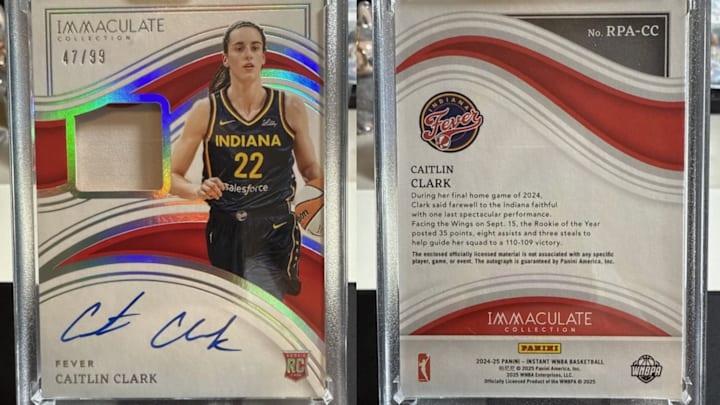
The auction began at $30,000 per box and eventually hit the $3,000 floor, with boxes guaranteeing premium cards of Caitlin Clark or Angel Reese. Collectors suspected they’d get game-used relics, but instead discovered vague disclaimers.
Wow…. pic.twitter.com/ImxXqgHWAg
— Midwest Box Breaks (@midwestboxbreak) July 2, 2025
Posts circulating on social media—and consistent with previous rookie patch autos—highlight the back of one of Clark’s cards, underscoring the problem: “The enclosed officially licensed material is not associated with any specific player, game, or event.” Translation? That jersey swatch could be from anyone—or no one at all. It wasn’t worn by Clark—or necessarily by any player.
RELATED: Collecting the Top 7 Living Hall of Famers' Cards
Why the Language Matters
To the untrained eye, a patch is a patch. But in the world of sports cards, a few small words on the back of the card can mean the difference between a piece of sports history and a meaningless swatch of fabric.

Game-Used or Game-Worn
This is the gold standard for collectors. When a card states that the patch is “game-used” or “game-worn,” it implies that the jersey was actually worn by the player depicted during a real game. These cards hold the highest value because they are directly connected to a moment in sports history. That said, even this term has grown murkier over the years, with manufacturers sometimes avoiding specifics, such as the game or season in which it was worn.
RELATED: When Sneaker Culture and Trading Cards Collide
Player-Worn or Event-Worn
Here, the player may have worn the jersey, but not during a game. It could be slipped on for a photoshoot or an autograph session. In some cases, players wear multiple jerseys simultaneously to meet memorabilia quotas. While technically accurate, this label diminishes the emotional and monetary value of the card, as the jersey holds no on-field significance.

Not Associated with Any Specific Player, Game, or Event
This is where the language becomes especially slippery. Cards with this phrase are telling you, in the most indirect way possible, that the patch has no connection whatsoever to the player shown. It might be a piece of generic fabric—licensed by the league, sure—but it was never worn by anyone of note. It's memorabilia in name only.

How We Got Here
Manufacturers used to proudly tout “game-used” memorabilia, with collectors confident they were holding a slice of sports history. But as demand soared and supply tightened, those claims became more expensive—and riskier.
Today, many cards are produced using:
- Photo shoot jerseys, worn for minutes (or seconds) at media days
- Layered jersey sessions, where players throw on multiple uniforms to fulfill quotas
- Generic patches, simply licensed fabric with no athlete connection

Why? Because vague language protects manufacturers legally while allowing them to continue producing memorabilia cards at scale.
Trust Issues in the Hobby
Collectors have long voiced skepticism. Some “game-worn” cards have turned out to contain mismatched patches, or worse—fabric from entirely different sports. Others bear logos or colors inconsistent with the player's team or era.

And while companies like Upper Deck are fighting back with tamper-proof slabs, QR code verification, and photo archives of each card as it left the factory, those innovations are still limited to high-end releases.
What You Can Do
If you're a collector, here’s your best defense:
- Read the back of the card (and auction listings) carefully—every word matters.
- Favor “game-used” or explicitly player-linked memorabilia when investing.
- Research the release—hobby forums and social media often uncover questionable practices early.
- Push for transparency—as a community, we have the power to demand better.
There’s nothing wrong with enjoying memorabilia cards, even if the patch wasn’t game-worn. But when $3,000 products feature relics with no link to the athlete on the front, it’s not just disappointing—it feels deceptive.
Collectors deserve clarity. And until manufacturers make “authentic” mean something again, the patch game will remain exactly that—a game.
TOP TRENDING COLLECTIBLES ARTICLES:
 Add us as a preferred source on Google
Lucas Mast is a writer based in California’s Bay Area, where he’s a season ticket holder for St. Mary’s basketball and a die-hard Stanford athletics fan. A lifelong collector of sneakers, sports cards, and pop culture, he also advises companies shaping the future of the hobby and sports. He’s driven by a curiosity about why people collect—and what those items reveal about the moments and memories that matter most.
Follow sneakrz