
How did the 1914 Baltimore News Babe Ruth rookie card lose $3 million in value?
In this story:
For more than two decades, a 1914 Baltimore News Babe Ruth rookie card sat quietly and undisturbed at the Babe Ruth Birthplace and Museum in Downtown Baltimore, less than 400 meters from Camden Yards. The Museum attracted baseball fans from all over, but it also attracted baseball card collectors. Card enthusiasts would make the pilgrimage to Baltimore just to admire one of the hobby's great relics - Ruth's first-ever appearance on a trading card.
Only 10-15 copies are known to exist, making the Babe Ruth Museum the perfect home for what is considered one of the greatest pre-war cards. But by 2021, the sports card market had gone into overdrive. With millions of dollars at stake, the owners of the card, whose family had owned it since 1914 and who lent it to the museum in 1998, decided it was the right time to sell.
RELATED: Babe Ruth 1914 Baltimore News card sells for huge $3 million loss

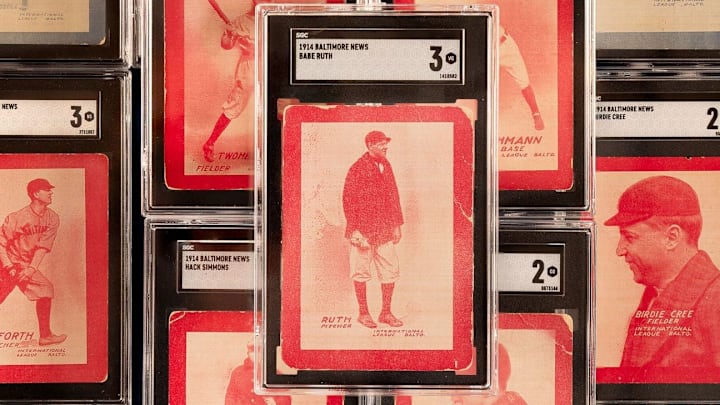
They were right. The card was reportedly sold for more than $5.2 million in a private sale—an important milestone because, at the time, it made the baseball card the most expensive ever sold. The card was temporarily removed from the Ruth Museum for grading and encapsulation by the grading company SGC. The card returned with a Very Good 3 grade, which describes cards with "moderate wear and rounded corners, possibly a wrinkle or crease." The card was then returned to the Museum, in its new slab.
Collectable
However, the sale was shrouded in mystery. No one knew exactly how much the card sold for. All that was known is that it was for more than $5.2 million.
Adding to the confusion is that the now-defunct company Collectable, a fractional investment company for sports cards and memorabilia, announced the sale, bound by a non-disclosure agreement that prevented it from revealing the sale price and the buyer.
What's more, Collectable announced it would make 1% of the card available for retail investment, offering 20,000 shares at $3 per share, for a total outside investment of $60,000. While the 1% offering was a small percentage, it created a $6 million valuation for the card on an SEC-regulated trading platform.
Not only was the price of the card never disclosed, but it now appeared that fractional investing was setting the market at $6 million, a markup over the "more than $5.2 million sale," though no one knew by how much. Within a day, shares were trading at about $2, pushing Ruth's market cap above $12 million.
RELATED: Is this Babe Ruth rookie card the greatest baseball card ever?
✨PRIMETIME DROP @ 8PM ET: Babe Ruth | 1914 Baltimore News SGC 3!
— Collectable (@CollectableApp) August 15, 2021
- $3 per share
- $6,006,000 All-in
- $66,000 IPO Seller retaining equity
- Investors are limited to 33 shares per investor for the first hour.https://t.co/yxLPT0IAxi
-https://t.co/KTBFNHsM2E#CollectableApp pic.twitter.com/CbigGRwBOu
But Collectable's secondary trading market ran into liquidity issues, with many items lagging in price. Most items traded below their initial public offering prices. However, the owner, still a mystery, was able to buy out the 1% of investors and remove the card from Collectable before the company went bankrupt.
1914 Baltimore News Babe Ruth Goes to Auction
The owner, armed with a private sale of about $6 million and a comparable market cap from Collectable, sent the card to auction in 2023 with REA. It was also around this time that the card was removed from the Ruth Museum. It was the first time a copy of the red variant (there are also blue versions of the card) had been made publicly available since 2013, when a PSA 1 sold for $450,300. The auction was a success for the buyer.
Amid great hype, the card sold for $7.2 million, the third-highest price ever for a baseball card. The sale put the Baltimore News card in the same company as the T206 Honus Wagner and the 1952 Topps Mickey Mantle, creating what some refer to as the "holy trinity" of baseball cards. Prior to the sale in 2023, REA President Bryan Dwyer said in a statement, "It is very likely to be the only example we’ll see available for purchase for years to come."
“The 1914 Baltimore News Babe Ruth rookie card is the most significant baseball card ever produced.” -Brian Dwyer, REA President#thehobby #whodoyoucollect #BabeRuth #vintagecards #rookiecards #halloffamercards pic.twitter.com/dFeIXay3r9
— REA (@collect_rea) November 20, 2023
But less than two years later, the same card was up for sale again at Heritage Auctions, where the company estimated its value at $7 million. However, bidding ended on Friday night, Oct. 24, with a thud. The final sale price was $4.02 million with buyer's premium - a staggering $3 million loss in value. After nearly 110 years of the card remaining unsold and being passed down from generation to generation, the card has been sold three times in the past four years.
Explaining a $3 million loss
Outside observers have speculated about why the card sold for $3 million less than its 2023 peak. The most direct explanation is that the card was never worth $7 million. The first sale in 2021 remains a mystery because details were never released. But even assuming that the card sold for about $6 million, the transaction occurred privately and not at auction, and it sold at a time when card prices were soaring, some of which still haven't recovered to those levels.
The private sale, coupled with the marketing from Collectable helped boost the value of the card to its record $7.2 million sale. Secrecy, hype, and market euphoria could have led to the card's price being inflated.
Also, buyers have matured over the past five years, becoming more knowledgeable thanks to the plethora of sites, podcasts, and card shows available to them that didn't exist in 2020. The Ruth card, great as it is, has been scrutinized more. Some argue that the SGC 3 wouldn't translate into a PSA 3, and it is more likely to be equivalent to a PSA 2. Such a drop in grade could change the price of a card like Ruth's by millions of dollars.
But those are all speculation. It's likely the public won't get a straight answer, as buyers of cards of this magnitude tend to stay private, which is their right.
What's stunning is the amount the Baltimore News card dropped in value. It's easy to forget that a $4 million card is still a hefty sum for a piece of cardboard, and that Ruth's rookie card is still one of the iconic pre-war baseball cards. But it's a reminder that the card hobby is ever-changing. You can be a card sitting peacefully in a museum for 25 years, looking at all the people passing by, and the next moment, you're being passed around, sitting in a vault in darkness.
TOP TRENDING COLLECTIBLES ARTICLES:
 Add us as a preferred source on Google
Horacio is an avid sports card collector and writes about trending card auctions and news across several major hobby sites, including Sports Collectors Daily and Collectibles on SI.
Follow murphreeman