
How Game-Used Items Get Authenticated In Real Time
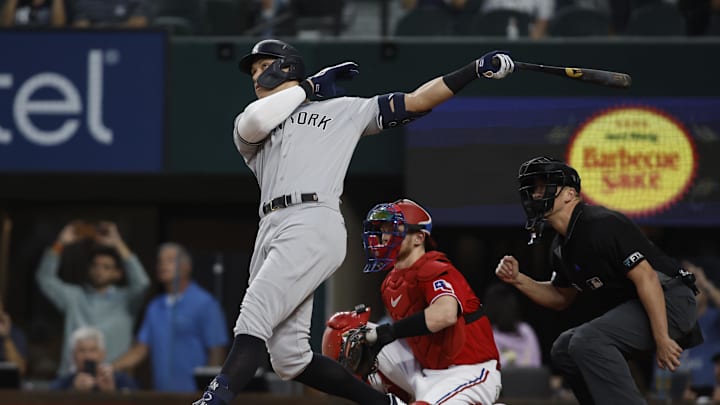
Shortly after New York Yankees slugger Aaron Judge’s record-setting 62nd home run landed in the left-field seats at Globe Life Field on Oct. 4, 2022, a whirlwind of events was set in motion. Security quickly ushered Dallas’s Cory Youmans into the bowels of the venue, where the fan who made the lucky catch met with members of an onsite team tasked with confirming the ball’s authenticity and following a standardized process to make things official—a process that often involves affixing a tamper-proof hologram. Certain milestone-alert balls are invisibly pre-marked before they even enter a pitcher’s grip, preventing an unscrupulous attendee from pulling the old switcheroo.
While not all notable in-game mementos end up in the hands of a spectator, they do make a stop in a location typically tucked away deep underneath all of the action. In the case of Major League Baseball, the aforementioned team usually includes off-duty law-enforcement officers assigned by Authenticators, Inc. to certify both autographs and game-used memorabilia at every tilt, regular- and postseason. The number of on-hand authenticators grows during marquee matchups like the World Series, where everything from bases to infield dirt can become a keepsake.
MLB’s rigid authentication program was born of sheer necessity, with fraudulent items running rampant throughout the industry—a problem that still permeates the space today. Many of these authenticated items end up in Halls of Fame, team museums, and memorabilia auctions, while others become part of special relic cards, giving collectors a chance to own a piece of history that often fits inside a top loader.

The other major sports have their own ways of certifying the real deal. Once a prized pigskin from the National Football League—say Patrick Mahomes’ overtime winner to Mecole Hardman in Super Bowl LVIII—reaches the sideline, it’s whisked away to a secure area elsewhere in the stadium. Long before kickoff, this football had already been tagged by a Professional Sports Authenticator (PSA) representative with synthetic DNA ink. Now that this particular ball is a part of history, it gets scanned, photographed, and catalogued. Some football memorabilia gets handled in a slightly different manner, with items validated through programs like the FanSecure QR/KeyCode sticker combination, but the end goal is the same. As is the case on the baseball diamond, gridiron grabs also get sliced and diced for game-used relic inserts.

Over on the hardwood—and across NHL ice—most officially released game-worn jerseys now funnel through MeiGray’s photo-match lab, which assigns each piece a searchable serial; others carry league or team holograms applied by different third-party programs. Pucks follow a comparable routine: an off-ice official retrieves those that leave play, passing them off to a secure arena station where staff affix a tamper-evident hologram and upload the serial to a database. Verified sweaters and hoops uniforms—and, on occasion, rubber—are later diced into collectibles like Panini or Upper Deck relic cards, most stamped to cite the game that supplied the fabric or puck material.
In a high-stakes business that continues to grow exponentially, the temptation to peddle phony game-used items unfortunately blossoms right along with it. As nefarious characters attempt to dupe the public, those involved in the day-to-day operations both on and off the fields, courts, and rinks of play must stay vigilant.
TOP TRENDING COLLECTIBLES ARTICLES:
 Add us as a preferred source on Google
Scott Orgera is a sportswriter and statistician with more than three decades of experience. He has covered thousands of MLB and NFL games, along with most other major sports. A member of the BBWAA, his bylines appear in the Associated Press, Baseball America, Baseball Prospectus, FanGraphs, and Forbes, among others. He also co‑authored 976‑1313: How Sports Phone Launched Careers and Broke New Ground. Having worked card shows with his family in the 1980s, Scott has remained active in the hobby ever since and now owns a card and memorabilia shop just outside New York City.