
Shaquille O’Neal’s Overdue Hobby Boom Gains More Momentum
In this story:
In the early 1990s, some years before serial-numbered parallels, case hits, and patch autos transformed the hobby, every kid in my middle school chased the same basketball grail: Shaquille O'Neal’s 1992 Upper Deck rookie card.
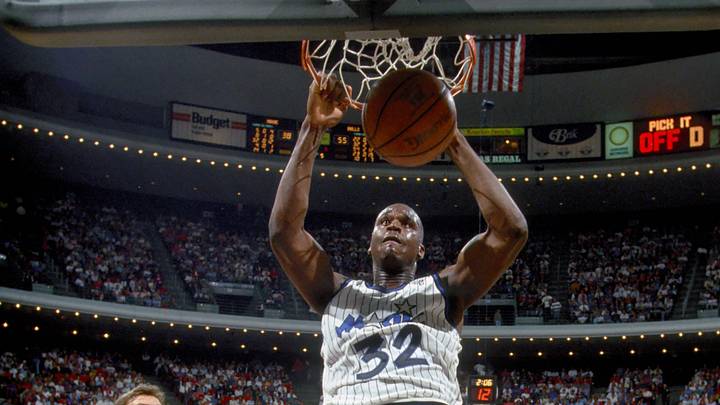
If you grew up in that era, you couldn't miss that iconic, triple-exposure image of the league's most dominant, most entertaining young big man rising and throwing down a monstrous slam, his legs outstretched as he hangs on the rim — either seconds from demolishing a backboard or enraging an unsuspecting Chris Dudley.

That card seemed to be everywhere, from local card shops to toy stores to mall-kiosk display cases, retailing around $25 (a fortune to a middle-schooler!). More often, it was stuffed into kids’ plastic nine-pocket sheets that destroyed the bottom corners or tucked into school binders.
If you were lucky enough to preserve one in pristine condition or hold on to any of Shaq’s other key rookie cards and sought-after inserts, those collectibles have never been more valuable.
For a long time, as Michael Jordan and Kobe Bryant cards surged and hit new peaks, O'Neal cards, by comparison, remained undervalued and underappreciated. But now, the big man is finally seeing a long-overdue hobby-market explosion.
What took so long? We're talking about "Superman," "The Diesel," "The Big Aristotle" here. No matter what you call him, O'Neal wasn't just unstoppable on the court, racking up just about every conceivable award and four championship rings. His decades in movies, music (raise your hand if you still nod your head to “(I Know I Got) Skillz”), and television have kept him in the public spotlight. Plus, his commercial endorsements are inescapable, from soft drinks to sneakers to sedans that are far too small to fit his 7-foot-1 frame.
Perhaps the hobby needed an influx of new collectors and renewed interest in 1990s basketball, or maybe collectors have overpaid for overhyped recent prospects one too many times. But O’Neal’s cards are finally commanding prices that better reflect his stature as one of the game’s defining superstars and larger-than-life figures.
That’s evident in the market for his low-numbered parallels such as Precious Metal Gems, Skybox Rubies and E-X Credentials, but that boost is at least partially driven by how relatively few have been unearthed and by how even fewer have sold on public platforms.
You certainly see it in how his condition-sensitive, higher-end cards have exploded.
1990s Shaq Inserts Going Up in Value

If you're looking to buy a PSA 9 1993 Ultra Scoring Kings, for instance (let's not even get into what an impossible-to-find PSA 10 might bring), that will now set you back between $4,500 and $4,800; three months ago, the same card was only $750, according to Card Ladder. Meanwhile, a PSA 8 skyrocketed from a modest $235 to over $1,800.
But the biggest indicator is the incredible uptick we're seeing in his base rookies, non-numbered inserts and even widely available subset cards in recent weeks and months.
Two years ago, a PSA 10 of that 1992 Upper Deck rookie card could easily be purchased for under $2,000. Six months ago, that number barely moved to around $2,600. The most recent sale? $8,000 on August 29 — a 205% rate of growth since March.
By now, it should be clear that kind of rise isn't an outlier. Over the last three months, Shaq's cards are up by 120% overall, per Card Ladder's index. Among O'Neal's 86 rookie-year cards in its database, more than half have doubled in price, and 19 have increased by 200% or more.
Think about that for a second: if you pick just about any major 1992 Shaq card in near-mint condition or better, there's a greater than 50-50 chance it's worth twice as much as it was just 90 days ago.

Once lower-profile inserts such as his 1992 Ultra Rejectors #4 are no longer being passed over; a PSA 9 has shot up from $37 to $190 (+413%) and a PSA 8 has made an ever more staggering jump from just $15 to $100 (+567%).
90 days ago, a PSA 9 1992 Stadium Club Members Only #201 was selling for $70; since then, it's nearly quintupled to $336. The same goes for his 1992 Ultra All-Rookies #7 in the same grade, which is up from $47 to $211.

Even raw cards from Hall of Famer's early Orlando days are seeing a similar uptick over the same time span. His 1995 Skybox Premium Meltdown has spiked from $73 in early June to as high as $763 on August 24. For the longest time, an ungraded 1992 Topps Gold #362 was selling under $25, and while the growth hasn't been as dramatic, its value has still more than tripled to over $100.
Or how about his 1995 Skybox Premium Electrified #293, a much lesser-known subset card that has gained unprecedented attention seemingly out of nowhere? A few weeks ago, it was widely available for under $2; today, it’s selling between $25 and $40, and even as high as $60!

That could be the clearest indicator yet that Shaq’s card-market resurgence is real, and it's spectacular.
His top-tier cards are as valuable as ever, but even the common ones that were tucked away in childhood binders and forgotten about decades ago are finally being given a second look and are pulling in wildly unexpected numbers.
Who knows? The next Shaq card to spark a frantic bidding war could still be found in a bargain bin or even hiding in a shoebox for the last 30 years.
 Add us as a preferred source on Google
Alex Kramers is a Florida-based sportswriter who has covered the NBA and NFL since 2009. He served as a Sacramento Kings reporter and digital media coordinator from 2012-2014 and has written regular feature stories for the team's website. He has also covered the Miami Dolphins for DolfansNYC, and has produced content for publications including HOOP Magazine and Orangetheory Fitness. An avid sports-card collector since childhood, he has amassed one of the biggest Mitch Richmond collections in the world, and seeks out Florida Panthers cards and memorabilia with his son.