
Sports Cards Are Meant to Be Seen: How to Display Valuable Cards Safely
In this story:
One of the things that makes sports cards different from many other assets is that they can actually be enjoyed. Money sitting in a bank account is essentially a number on a screen, and cryptocurrency is also digital. A sports card is tangible. Collectors can hold it, study the artwork, stats, and photography, or use them to build a display around their favorite players.

In many ways, sports cards are miniature works of art that can also store significant value. This creates an interesting dilemma as collections become more valuable. The cards collectors most want to see are often the same cards they are most afraid to display.
I recently asked members of a large sports card collectors group whether they display their collections. Of the collectors who responded, 58% said they keep their cards stored away, while only 42% said they display them. So why do collectors spend years building a collection only to keep most of it hidden?
Light Is One of the Biggest Concerns

The biggest hesitation many collectors have about displaying cards is light exposure. Fading can permanently damage a card or autograph, especially an irreplaceable vintage autograph or a card worth thousands of dollars.
Early Topps Chrome and Finest basketball cards from the 1990s are notorious for developing a greenish discoloration over time, including examples of the popular 1996 Topps Chrome Kobe Bryant rookie card. The exact cause remains debated, but it shows how difficult it can be to predict how modern card materials will age. Nobody knows exactly how every foil, chromium finish, autograph ink, or card stock will look another 50 years from now.
What Does UV Resistance Actually Mean?

Many companies that specialize in sports card display cases offer ultraviolet light protection. UV-resistant materials are designed to block or filter ultraviolet radiation before it reaches the card. Most standard grading slabs don't provide significant UV protection.
Phantom Display, a company that makes premium acrylic card displays, says its acrylic provides up to 99.6% UV resistance. The percentage represents the amount of UV that the material absorbs before it reaches the card. Founder and CEO Simon Walker said the company measures UV resistance with a spectrophotometer by passing light through a sample and recording how much gets through across the UV range.

Walker also believes collectors should be skeptical of UV claims that testing can't support. Phantom Display is currently having its cases independently tested by a US optical laboratory using NIST-traceable instruments and says it plans to publish the full results. “A case with no real UV protection looks identical to one with excellent protection, the day you buy it and for years afterward,” Walker said.
Walker said collectors should look for four things behind a UV claim: the percentage blocked, wavelength range, testing method, and who performed the test. “If a company can’t answer those, that tells you something,” he said.
Cards on Display Should Still Avoid Sunlight

UV protection does not mean collectors should stop worrying about where a card is displayed. “UV filtering removes the most damaging part of light, not the amount of it,” Walker said. “A UV case buys you a lot of margin. Don’t spend it all on a windowsill.”
According to Phantom Display, direct sunlight can reach roughly 30,000 lux, compared with about 50 lux in a living room during the evening. Light damage is cumulative and irreversible, and direct sunlight can also heat the display. The type of indoor lighting matters too.
“Sunlight is by far the worst,” Walker said. “Fluorescent lighting emits real UV and has faded plenty of autographs in windowless rooms. LEDs emit essentially none, which is why museums switched to them.” His recommendation is simple: “LED the room, keep the display out of the window’s line of sight, and put a UV-filtering case around the card.” Where the display is placed matters. A case directly across from a bright window is very different from one on an interior wall in a room with controlled lighting, curtains, or blackout shades.
Physical Protection Matters Too

A $25 childhood favorite from the Junk Wax Era and a five-figure vintage autograph do not require the same level of security. UV protection is only one part of displaying valuable cards safely. A display should also hold the cards securely.
Display Zone creates sports card display cases with grooves built into the shelves so graded cards do not rest loosely on a flat shelf. “The grooves are designed to keep each slab upright and secured in place rather than resting loosely on a flat shelf,” Display Zone said. “This feature helps prevent the cards from sliding out of position when the door is opened or the case is bumped.”

Display Zone also offers cases with locking designs and UV-protective materials. Collectors shopping for a display should consider not only how it looks, but how securely it holds the cards. A locking feature can also provide extra peace of mind at busy card shows. (Many collectors use their wall display cases as display cases for card shows. )
Security Is Another Concern

Light and accidental damage are not the only risks collectors face when displaying expensive cards. Valuable cards are small and portable, which is one reason some collectors keep their best pieces hidden inside traditional safes or bank safe-deposit boxes. But that can create the same problem again: the collection is protected, but rarely enjoyed.

BlumSafe founder and CEO Rob Blum developed secure display safes after dealing with a similar problem as a watch collector. His company later adapted the concept for graded cards, combining a hardened enclosure, locking mechanisms, UV protection, and a shatter-resistant polycarbonate window. “A display safe means you never have to choose between enjoying your collection and protecting it,” Blum said.
Display and Storage Can Work Together

Holme & Hadfield also sees display and storage as complementary rather than an either-or decision, especially for high-value cards. The company recommends displaying a collection when the owner is home and rotating the most valuable pieces into a safe or vault when traveling or away for extended periods.
Holme & Hadfield says its cases use UV-filtering glass or acrylic with a minimum of 99.8% UV protection and are sealed against dust. The company also emphasizes accidental damage, such as a case being bumped, tipped, or knocked from a shelf. Protection is not only about stopping a burglar.

“Ultimately, we see cards as modern pieces of art and art is meant to be displayed and not forgotten in a drawer,” Holme & Hadfield said. The company noted that collectors can become so focused on keeping cards safe that they eventually forget what they own. There is monetary value in a collection, but also intrinsic value in being able to look at a favorite card every day.
A Real Collector's Approach

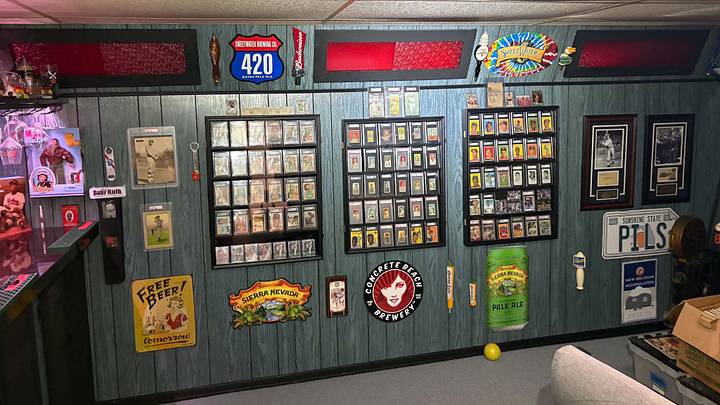
Collector Greg built what he calls a “personal museum” around his collection of rare cards and unopened packs. He worked with a fellow collector who is also a master carpenter to design and build the displays, which Greg called “the best investment I ever made in sports cards.”
Greg’s room shows why card displays have become such an important part of the modern hobby. A collection like this is not just being stored, protected, and tracked by on a spreadsheet. It is being experienced. For collectors who spend years chasing the cards that matter to them, seeing the PC pieces every day is the entire point.
 Add us as a preferred source on Google
David is a collector based in Georgia and a lifelong fan of the New York Yankees, New York Giants, and New York Knicks. He is an avid sports card collector with a strong passion for vintage baseball cards and vintage on-card autographs. David enjoys obtaining autographs through the mail and loves connecting with other knowledgeable collectors to discuss the history and evolution of the hobby. He also previously wrote about the New York Giants for GMENHQ.com