%22%3E%0A%3Cpath%20d%3D%22M6.36075%200.539795H11.3602L17.7209%2015.7493H12.2403L11.4423%2013.719H6.16125L5.38669%2015.7493H0L6.36075%200.539795ZM10.1983%2010.1396L8.81352%206.47806L7.4287%2010.1396H10.1866H10.1983Z%22%20fill%3D%22white%22%2F%3E%0A%3Cpath%20d%3D%22M18.3428%200H23.2366V15.7493H18.3428V0Z%22%20fill%3D%22white%22%2F%3E%0A%3Cpath%20d%3D%22M24.3867%2012.4046V12.3576C24.3867%2010.0105%2026.1353%208.69607%2028.8698%208.69607C29.8673%208.69607%2031.1347%208.90731%2031.6511%209.13029V8.93078C31.6511%207.8511%2030.9822%207.22911%2029.4683%207.22911C28.2595%207.22911%2027.2502%207.48729%2026.2175%207.89804L25.349%204.64725C26.7104%204.13088%2028.2595%203.77881%2030.3132%203.77881C32.7073%203.77881%2034.2564%204.27171%2035.3009%205.30445C36.1811%206.18463%2036.5332%207.33473%2036.5332%209.03641V15.7492H31.6394V14.5639C30.8179%2015.4441%2029.7147%2016.0309%2028.2478%2016.0309C25.9828%2016.0309%2024.3867%2014.74%2024.3867%2012.4046ZM31.6981%2011.3953V10.9024C31.4164%2010.7968%2030.9822%2010.7146%2030.5714%2010.7146C29.5974%2010.7146%2029.0575%2011.3014%2029.0575%2012.029V12.076C29.0575%2012.7684%2029.5504%2013.2143%2030.1842%2013.2143C31.0526%2013.2143%2031.6981%2012.5219%2031.6981%2011.407V11.3953Z%22%20fill%3D%22white%22%2F%3E%0A%3Cpath%20d%3D%22M42.8948%2014.4114V15.7493H38.001V0H42.8948V5.41016C43.6928%204.55345%2044.5964%203.68501%2046.392%203.68501C49.2438%203.68501%2051.4618%206.16124%2051.4618%209.76411V9.81105C51.4618%2013.543%2049.2203%2016.0192%2046.439%2016.0192C44.6434%2016.0192%2043.6576%2015.2447%2042.9065%2014.3997L42.8948%2014.4114ZM46.7089%209.88146V9.83452C46.7089%208.64921%2045.8639%207.72209%2044.749%207.72209C43.6341%207.72209%2042.7891%208.64921%2042.7891%209.83452V9.88146C42.7891%2011.0433%2043.6341%2011.9939%2044.749%2011.9939C45.8639%2011.9939%2046.7089%2011.0668%2046.7089%209.88146Z%22%20fill%3D%22white%22%2F%3E%0A%3Cpath%20d%3D%22M52.2119%2012.4046V12.3576C52.2119%2010.0105%2053.9605%208.69607%2056.695%208.69607C57.6925%208.69607%2058.9599%208.90731%2059.4763%209.13029V8.93078C59.4763%207.8511%2058.8074%207.22911%2057.2935%207.22911C56.0847%207.22911%2055.0754%207.48729%2054.0427%207.89804L53.1742%204.64725C54.5356%204.13088%2056.0847%203.77881%2058.1384%203.77881C60.5325%203.77881%2062.0816%204.27171%2063.1261%205.30445C64.0063%206.18463%2064.3584%207.33473%2064.3584%209.03641V15.7492H59.4646V14.5639C58.6431%2015.4441%2057.5399%2016.0309%2056.073%2016.0309C53.808%2016.0309%2052.2119%2014.74%2052.2119%2012.4046ZM59.5233%2011.3953V10.9024C59.2416%2010.7968%2058.8074%2010.7146%2058.3966%2010.7146C57.4226%2010.7146%2056.8827%2011.3014%2056.8827%2012.029V12.076C56.8827%2012.7684%2057.3756%2013.2143%2058.0094%2013.2143C58.8778%2013.2143%2059.5233%2012.5219%2059.5233%2011.407V11.3953Z%22%20fill%3D%22white%22%2F%3E%0A%3Cpath%20d%3D%22M65.8145%203.97819H70.7082V5.55078C71.4593%204.57671%2072.6446%203.69653%2074.2642%203.69653C75.8837%203.69653%2077.0925%204.38894%2077.7379%205.63293C78.7355%204.5063%2079.9208%203.69653%2081.7281%203.69653C84.2512%203.69653%2085.8004%205.33953%2085.8004%207.9918V15.7608H80.9066V9.52918C80.9066%208.54338%2080.3198%207.98007%2079.6156%207.98007C78.9115%207.98007%2078.2543%208.54338%2078.2543%209.52918V15.7608H73.3605V9.52918C73.3605%208.54338%2072.7737%207.98007%2072.0696%207.98007C71.3654%207.98007%2070.7082%208.54338%2070.7082%209.52918V15.7608H65.8145V3.98993V3.97819Z%22%20fill%3D%22white%22%2F%3E%0A%3Cpath%20d%3D%22M86.8213%2012.4046V12.3576C86.8213%2010.0105%2088.5699%208.69607%2091.3043%208.69607C92.3019%208.69607%2093.5693%208.90731%2094.0857%209.13029V8.93078C94.0857%207.8511%2093.4168%207.22911%2091.9029%207.22911C90.6941%207.22911%2089.6848%207.48729%2088.6521%207.89804L87.7836%204.64725C89.145%204.13088%2090.6941%203.77881%2092.7478%203.77881C95.1419%203.77881%2096.691%204.27171%2097.7355%205.30445C98.6157%206.18463%2098.9677%207.33473%2098.9677%209.03641V15.7492H94.074V14.5639C93.2525%2015.4441%2092.1493%2016.0309%2090.6823%2016.0309C88.4173%2016.0309%2086.8213%2014.74%2086.8213%2012.4046ZM94.1326%2011.3953V10.9024C93.851%2010.7968%2093.4168%2010.7146%2093.006%2010.7146C92.0319%2010.7146%2091.4921%2011.3014%2091.4921%2012.029V12.076C91.4921%2012.7684%2091.985%2013.2143%2092.6187%2013.2143C93.4872%2013.2143%2094.1326%2012.5219%2094.1326%2011.407V11.3953Z%22%20fill%3D%22white%22%2F%3E%0A%3Cpath%20d%3D%22M0%2028.1841V28.1371C0%2023.6306%203.52072%2020.2625%208.02723%2020.2625C11.3484%2020.2625%2013.59%2021.882%2014.8574%2024.1822L10.6912%2026.6232C10.1279%2025.5435%209.32988%2024.7924%207.95681%2024.7924C6.25513%2024.7924%205.12851%2026.2829%205.12851%2028.0902V28.1371C5.12851%2030.097%206.29034%2031.4818%207.95681%2031.4818C9.37683%2031.4818%2010.1749%2030.7072%2010.8086%2029.5806L14.9748%2031.9277C13.7073%2034.1693%2011.5949%2036%207.83945%2036C3.66154%2036%200.0117382%2032.8549%200.0117382%2028.1723L0%2028.1841Z%22%20fill%3D%22white%22%2F%3E%0A%3Cpath%20d%3D%22M15.8906%2023.9238H20.7844V26.2944C21.4533%2024.6983%2022.533%2023.6656%2024.4694%2023.7477V28.9466H23.9531C21.8876%2028.9466%2020.7844%2030.085%2020.7844%2032.7021V35.6947H15.8906V23.9238Z%22%20fill%3D%22white%22%2F%3E%0A%3Cpath%20d%3D%22M25.3604%2019.9456H30.4302V23.0673H25.3604V19.9456ZM25.4425%2023.924H30.3363V35.6949H25.4425V23.924Z%22%20fill%3D%22white%22%2F%3E%0A%3Cpath%20d%3D%22M31.9443%2023.9237H36.8381V25.4963C37.5892%2024.5223%2038.7745%2023.6421%2040.394%2023.6421C42.0136%2023.6421%2043.2224%2024.3345%2043.8678%2025.5785C44.8654%2024.4519%2046.0506%2023.6421%2047.8579%2023.6421C50.3811%2023.6421%2051.9302%2025.2851%2051.9302%2027.9374V35.7064H47.0365V29.4747C47.0365%2028.4889%2046.4497%2027.9256%2045.7455%2027.9256C45.0414%2027.9256%2044.3842%2028.4889%2044.3842%2029.4747V35.7064H39.4904V29.4747C39.4904%2028.4889%2038.9036%2027.9256%2038.1995%2027.9256C37.4953%2027.9256%2036.8381%2028.4889%2036.8381%2029.4747V35.7064H31.9443V23.9355V23.9237Z%22%20fill%3D%22white%22%2F%3E%0A%3Cpath%20d%3D%22M52.5528%2034.2749L54.2075%2031.4935C55.6275%2032.3737%2057.2236%2032.8079%2058.5614%2032.8079C59.0309%2032.8079%2059.2773%2032.7023%2059.2773%2032.4207V32.3737C59.2773%2032.139%2059.0661%2031.9864%2057.869%2031.6813C54.8882%2030.9537%2053.0574%2030.1557%2053.0574%2027.7146V27.6677C53.0574%2025.0741%2055.1229%2023.6306%2058.1859%2023.6306C60.1223%2023.6306%2062.0469%2024.1235%2063.467%2024.992L61.9179%2027.9024C60.6621%2027.21%2059.16%2026.7993%2058.1624%2026.7993C57.693%2026.7993%2057.47%2026.9283%2057.47%2027.1631V27.21C57.47%2027.4447%2057.7282%2027.5973%2058.9135%2027.9024C61.8944%2028.63%2063.6782%2029.4515%2063.6782%2031.8691V31.916C63.6782%2034.4861%2061.7536%2035.9648%2058.5732%2035.9648C56.2847%2035.9648%2054.2192%2035.3781%2052.5293%2034.2632L52.5528%2034.2749Z%22%20fill%3D%22white%22%2F%3E%0A%3Cpath%20d%3D%22M64.4414%2029.8505V29.8036C64.4414%2026.4824%2067.1993%2023.6306%2071.0838%2023.6306C74.9683%2023.6306%2077.6793%2026.4354%2077.6793%2029.7567V29.8036C77.6793%2033.1248%2074.9214%2035.9766%2071.0369%2035.9766C67.1523%2035.9766%2064.4414%2033.1717%2064.4414%2029.8505ZM72.985%2029.8505V29.8036C72.985%2028.6418%2072.1283%2027.7146%2071.0486%2027.7146C69.9689%2027.7146%2069.1474%2028.6418%2069.1474%2029.7684V29.8153C69.1474%2030.9772%2070.0159%2031.9043%2071.0838%2031.9043C72.1518%2031.9043%2072.985%2030.9772%2072.985%2029.8505Z%22%20fill%3D%22white%22%2F%3E%0A%3Cpath%20d%3D%22M78.875%2023.9237H83.7688V25.5667C84.5199%2024.5927%2085.7052%2023.6421%2087.3716%2023.6421C89.8479%2023.6421%2091.4087%2025.2851%2091.4087%2027.9374V35.7064H86.5149V29.5217C86.5149%2028.5124%2085.9047%2027.9256%2085.1771%2027.9256C84.4495%2027.9256%2083.7805%2028.5124%2083.7805%2029.5217V35.7064H78.8867V23.9355L78.875%2023.9237Z%22%20fill%3D%22white%22%2F%3E%0A%3Cpath%20d%3D%22M102.417%2024.8629H97.9688V20.5911H111.899V24.8629H107.451V35.6832H102.405V24.8629H102.417Z%22%20fill%3D%22white%22%2F%3E%0A%3Cpath%20d%3D%22M112.968%2019.9456H118.038V23.0673H112.968V19.9456ZM113.05%2023.924H117.944V35.6949H113.05V23.924Z%22%20fill%3D%22white%22%2F%3E%0A%3Cpath%20d%3D%22M119.199%2029.8857V29.8388C119.199%2026.1068%20121.441%2023.6306%20124.222%2023.6306C126.018%2023.6306%20127.003%2024.4051%20127.755%2025.2501V19.9456H132.648V35.6949H127.755V34.2514C126.957%2035.1081%20126.053%2035.9765%20124.257%2035.9765C121.406%2035.9765%20119.188%2033.5003%20119.188%2029.8974L119.199%2029.8857ZM127.872%2029.827V29.7801C127.872%2028.6182%20127.027%2027.6676%20125.912%2027.6676C124.797%2027.6676%20123.952%2028.5948%20123.952%2029.7801V29.827C123.952%2031.0123%20124.797%2031.9394%20125.912%2031.9394C127.027%2031.9394%20127.872%2031.0123%20127.872%2029.827Z%22%20fill%3D%22white%22%2F%3E%0A%3Cpath%20d%3D%22M133.846%2029.8737V29.8268C133.846%2026.3061%20136.369%2023.6421%20139.901%2023.6421C144.091%2023.6421%20146.027%2026.5525%20146.027%2030.1319C146.027%2030.3901%20146.027%2030.6952%20146.004%2030.9534H138.434C138.775%2031.9862%20139.596%2032.526%20140.652%2032.526C141.533%2032.526%20142.272%2032.1153%20143.047%2031.3172L145.675%2033.4062C144.513%2034.9201%20142.847%2035.9763%20140.3%2035.9763C136.439%2035.9763%20133.834%2033.5353%20133.834%2029.8737H133.846ZM141.568%2028.7941C141.462%2027.6674%20140.793%2027.022%20139.925%2027.022C139.103%2027.022%20138.528%2027.7144%20138.376%2028.7941H141.568Z%22%20fill%3D%22white%22%2F%3E%0A%3Cpath%20fill-rule%3D%22evenodd%22%20clip-rule%3D%22evenodd%22%20d%3D%22M155.368%204.36764C161.191%20-1.45588%20170.632%20-1.45588%20176.456%204.36764C182.279%2010.1912%20182.279%2019.6324%20176.456%2025.4559L165.912%2036L155.368%2025.4559C149.544%2019.6324%20149.544%2010.1912%20155.368%204.36764ZM158.009%207.55761C157.948%207.86849%20157.916%208.39718%20157.916%209.14566V10.4189C157.916%2011.1832%20157.948%2011.7198%20158.013%2012.0267C158.078%2012.3317%20158.278%2012.6168%20158.617%2012.8762C158.956%2013.1376%20159.403%2013.3316%20159.958%2013.4623C160.512%2013.593%20161.1%2013.6584%20161.837%2013.6584C162.573%2013.6584%20163.217%2013.591%20163.769%2013.4524C164.322%2013.3158%20164.761%2013.1178%20165.086%2012.8604C165.411%2012.6029%20165.605%2012.3178%20165.666%2012.0069C165.728%2011.6961%20165.759%2011.1674%20165.759%2010.4189V9.14566C165.759%208.38134%20165.728%207.84473%20165.662%207.53781C165.597%207.23287%20165.397%206.94971%20165.058%206.68834C164.72%206.42696%20164.272%206.23291%20163.718%206.10223C163.163%205.97154%20162.536%205.90619%20161.839%205.90619C161.102%205.90619%20160.459%205.97352%20159.906%206.11213C159.352%206.24875%20158.914%206.44677%20158.589%206.70418C158.265%206.9616%20158.071%207.24673%20158.009%207.55761ZM163.276%2024.8638C166.876%2024.8638%20168.557%2024.2064%20168.557%2021.862V21.858V21.3155C168.557%2019.6581%20167.516%2018.971%20164.252%2018.3136C163.278%2018.1136%20162.908%2017.9136%20162.908%2017.3136V16.9414C162.908%2016.6543%20163.177%2016.5117%20163.413%2016.5117C163.749%2016.5117%20163.918%2016.7137%20163.918%2016.9414V18.1136H168.391V17.3988C168.391%2015.4563%20167.347%2014.4266%20163.177%2014.4266C160.15%2014.4266%20157.896%2015.3414%20157.896%2017.3711V17.7433C157.896%2019.5155%20158.805%2020.3155%20162.201%2021.0303C162.28%2021.0472%20162.355%2021.063%20162.427%2021.0781C163.329%2021.2674%20163.647%2021.3341%20163.647%2021.9174V22.2897C163.647%2022.6619%20163.546%2022.8045%20163.142%2022.8045C162.67%2022.8045%20162.637%2022.5471%20162.637%2022.262V21.2897H157.894V21.7471C157.894%2024.149%20159.476%2024.8638%20163.276%2024.8638ZM169.424%2024.5569H173.925V14.7355H169.424V24.5569ZM170.955%2013.5019H173.925V6.06064H171.092V9.411L169.193%206.06064H166.359V13.5019H169.193V10.1199L170.955%2013.5019ZM162.269%2012.152C162.204%2012.2688%20162.055%2012.3262%20161.825%2012.3262L161.827%2012.3282C161.604%2012.3282%20161.459%2012.2767%20161.398%2012.1758C161.336%2012.0748%20161.305%2011.8074%20161.305%2011.3758V7.90068C161.305%207.51852%20161.352%207.28684%20161.445%207.20962C161.538%207.13239%20161.675%207.09279%20161.851%207.09279C162.059%207.09279%20162.198%207.14031%20162.265%207.23734C162.332%207.33239%20162.366%207.55416%20162.366%207.90068V11.3203C162.366%2011.7579%20162.334%2012.0352%20162.269%2012.152Z%22%20fill%3D%22white%22%2F%3E%0A%3C%2Fg%3E%0A%3Cdefs%3E%0A%3CclipPath%20id%3D%22clip0_15206_214955%22%3E%0A%3Crect%20width%3D%22181%22%20height%3D%2236.0001%22%20fill%3D%22white%22%2F%3E%0A%3C%2FclipPath%3E%0A%3C%2Fdefs%3E%0A%3C%2Fsvg%3E%0A)
Everything Kalen DeBoer, Curt Cignetti Said in Final Press Conference Before Rose Bowl
In this story:
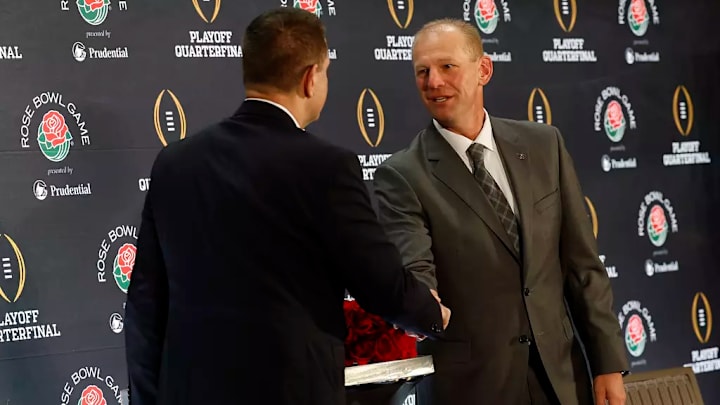
LOS ANGELES–– Alabama head coach Kalen DeBoer and Indiana head coach Curt Cignetti spoke to the media one final time Wednesday morning from the Sheraton Grand in Los Angeles before the two teams meet in the Rose Bowl on New Year's Day.
Here's everything they had to say:
Full transcript
transcript courtesy of ASAP Sports
THE MODERATOR: Good morning, everyone, and welcome to the head coaches press conference for the 2026 College Football Playoff quarterfinal as presented by the Prudential.
CURT CIGNETTI: Good to be here. A lot to do today from a preparation standpoint. The last two days have been fairly disruptive, with the travel day and then a first practice on site. So, as the leader, the head coach, I feel there's a lot of loose ends we've got to tie together today.
I've got a lot of respect for Alabama, obviously, Coach DeBoer. Similar paths in our coaching careers, and it shows up on tape. He's a great football coach, and Alabama's a great football team with a lot of good football players. It's going to be a tremendous challenge. We'll have to play extremely well, and looking forward to the game.
KALEN DEBOER: First of all, just want to congratulate Coach Cignetti and Indiana on another great season. These last two years and what they've done is so impressive. And again, just like Coach said, when you're watching film, you can see why the success is happening -- well-coached, disciplined and obviously a lot of great players making great plays.
Looking forward to the challenge, great opportunity. Big day of prep for us as well. Just continue to try to use the schedule that we've had in place, adapt it to the logistics and the things that go on with the Rose Bowl.
But an honor to be here. I'm proud of our football team and what we've done to get to this point and really appreciate their efforts. And we can't wait for tomorrow.
Q. Riley Nowakowski told a story yesterday about the summer when you go through workouts, and then Sarratt would go, no, guys, we're doing one more. And then it became Sarratt and then Cooper and then the receivers. And it kind of grew. He said Fernando got into it. What did you think when you heard about that?
And what does the mentality say about the approach of your players?
CURT CIGNETTI: That's the first I've heard of it, and I think that's reflective of guys wanting to pay the price to be the best they can be and pushing themselves, understanding it takes a little bit more to be the best. There's good and there's great, and what does it take to be great? It takes a special discipline, work ethic and focus. And those are guys trying to find the edge and improve every single day.
Q. Both of you came up through the smaller-school ranks as head coaches. What did you learn on those experiences and how do you apply that now to both the success that you're enjoying in your current roles, but also in how you build a team and build a cohesiveness with the players and staff?
KALEN DEBOER: I think, first of all, you have an appreciation for the resources and the things you have when you get to these levels of college football and these experiences.
But I think when you're putting it together and you're so hands-on and wearing all the different hats that come along with being a small-college football coach, not even just a head coach, it really forces you to have to think outside the box, be creative, and that might be schematically, that might be how you set up your travel with limited expenses and things like that. So, there's a lot, I think, that forces you to think through.
But, again, it goes back to I have an appreciation for every person in our program because I know the jobs that they're all doing, and there's more to it than just a title. They're working behind the scenes. Now it just comes down to managing the volume of the staff that you have and making sure that everyone is aligned and heading in the same direction.
But I think the small-college opportunity, not near as many people watching. There's a lot of mistakes that I made at the small-college level that you learn from and that you continue to apply as you go through.
Again, I've been fortunate to have had four head coaches I coached for after being a head coach myself that allowed me to take a little bit of bits and pieces of what they did and add it to what I thought could continue to help me as I became a head coach again.
CURT CIGNETTI: We're both small-college head coaches. Our routes and career paths were a little different. There's about five or six of us out there nationally that I followed for
a while. In my particular situation, I had 28 years as an FBS assistant. I'm 23 years old, I'm coaching at Rice, which back then was in the Southwest Conference. We played SMU before they got the death penalty. You're playing Texas, A&M, those people, every week.
When I went to D-II, I came from Alabama, obviously. So for me, it was a chance to be the leader, and like Coach said, get the mistakes out of the way and improve your craft every year.
But having never been at that level, also, it was a culture shock, when you're dressing in the shower up at Clarion for game day and many other things -- playing in the playoffs and the university's shutdown and you're taking the garbage out before the staff meeting or waxing the staff table, or maybe the university's changing their Internet system and you don't have access to game tape until Tuesday of a Wednesday game.
But it was a valuable experience, no question about it. And it was also -- my parents were living there, my wife's parents were there, my wife's mother.
But every move that I made, after I left Alabama, prepared me for this moment and also prepared me for the changes that have taken place in college football since I was an assistant coach, that's where the recruiting coordinator experience came into play.
Q. You talk often about being so process driven and such, and I know we talked the day after the Big Ten championship game, you had a plan sort of already in place for how 25 days would play out until tomorrow. How good do you feel about how that process went for these past 24 days? And if it was anything you would have changed, what would that might have been?
CURT CIGNETTI: Well, so Monday was our travel day, which was a Wednesday practice. So as soon as we found out who our opponent was, after Alabama and Oklahoma played, the next day was a Sunday. So, in my mind, every day then was Sunday, Monday, Tuesday, in terms of our routine. So our travel day really was a Wednesday.
Up until that day, I really liked where we were. I didn't think we had a great practice the travel day because, you know, we had to move everything up. And the players, on a travel day, they're used to having a walk-through. And then we got here and -- all the bowls; I'm going to call this a bowl, since we changed locations early -- we've never had a great practice first day on site, ever. And it wasn't a horrible practice, but it didn't meet the standard.
So that's why I feel the sense of urgency, like, to get it right today, to get everybody thinking the way we want them to think.
Q. Curt, talking to your coaches yesterday about what it's like to evaluate players with you, I'm wondering, when did your philosophy on what mattered in personnel kind of come to you? And how validating is it to see that approach working as well as it has for your program?
CURT CIGNETTI: I think you always learn from your mistakes, or you better or you're not going to be around. And when I first got the job as a recruiting coordinator and a coach for Johnny Majors, second time around at Pitt, we probably took too many chances on potential.
But we were in a position where we didn't have much either. We didn't have resources. We didn't have facilities.
Those things mattered. Back then, we didn't have a lot to sell. Those were the kind of guys we got. And a lot of them didn't pan out. And we had a lot of problems.
At NC State, we were in a little different situation. And then at Alabama -- I think that part of it, with Coach Saban -- the ankle, knee, hip flexibility, position-specific criteria, toughness at all positions, what were the fatal flaws -- I think that helped me a lot, too. And then you just get better at it the more you evaluate.
And when you become the head coach like a D-II, I watched every guy. I kind of did the board. Christmas holiday, everything shut down, coaches are off, I'm in there watching all the guys, right, ranking them. Just repetition is the mother of learning, and you get better and better at it.
Once you become kind of the CEO and your stamp is on it, you want to be invested on who you bring through the door, coaches and players. You want to put the final stamp on them.
Q. Curt, you mentioned some of the distractions the team went through leading up to this game. What are some tweaks you could envision that would help limit those in the future and kind of as this playoff format evolves?
CURT CIGNETTI: I think it changes next year. I don't know for certain. I've been told it does -- the contract, College Football Playoff.
Let's face it, this is a playoff game. It's a football game, right. And I think both teams would like to be able to kind of go through their routine and process like they do for every football game and not have this disruption.
But it is what it is and we made the best of it. And we both had to go through it. I think next year, if I'm not mistaken, the contract reads a little different.
Q. Coach DeBoer, Coach Cignetti was talking about practice yesterday. What was your assessment about how the guys did in that first practice kind of after all the travel?
KALEN DEBOER: I thought it was good energy, that's what I really look for. There was a stress in communication and all that. I thought they came with the right intention. Doesn't mean it was perfectly crisp. That's why you practice and just always trying to get better.
So we continue to refine the game plan and pay attention to the details. I had guys in this morning already asking about certain things. They're just trying to make sure they're completely on the same page with what we're trying to do. So I have an appreciation for our players and the intentions they have.
So we've got to take the next step today. You know, we talk about the hours leading up to kickoff, and yesterday would have been about 48 hours out. And we knew how important those 48 hours, whether it's preparation on the football field or the nutrition, the sleep and all of that. So just all these guys doing the best they can to make sure that they're ready to go tomorrow.
Q. Coach Cignetti, you've mentioned many, many times that you look for hip, ankle and knee mobility in players. I'm curious why that's so important to you. Sounds like you got that maybe from Coach Saban. Why was that something that you decided to carry on from your time at Alabama?
CURT CIGNETTI: It's a start-stop game. You've got to have those for change of direction, but you also need those to create explosive power. So it's a game of speed, quickness and explosive power. And you need those things to generate that.
Q. Coach DeBoer, you talked before Oklahoma that you all really kind of nailed down a system y'all liked for road games leading up to a game that works best for y'all. How is that being affected this week with kind of a different schedule?
KALEN DEBOER: It's certainly different because you would have traveled normally today. But you just adjust. Like Coach said, you just adjust to what it is and make the most of it.
Q. You mentioned how, with the playoff system, there is an end goal past this game. But with both of you leading teams that have legacies in this game, personally, how does it feel to be part of the Rose Bowl?
CURT CIGNETTI: The Rose Bowl has a lot of tradition. I can remember as a little kid watching Sam "Bam" Cunningham jump over the goal line back in the early '70s, I think it was, for USC.
But this is a playoff game. We're playing at the Rose Bowl. We played UCLA last year at the Rose Bowl. And I
respect the tradition of the Rose Bowl. Been a lot of great players, coaches playing in it. But we're getting ready to play a playoff game.
KALEN DEBOER: Yeah, I think that's a lot of how our guys are looking at it. You know, this is the next round of the playoffs. And you know we were in a win-or-go-home mindset a few weeks ago. This is where this is at.
You certainly do appreciate what the Rose Bowl game has been about over the years and watching it over, when I was a kid, high school, I can remember in college watching it as well, and just envisioning what it would be like to play in that game. And here we are.
But for us, it is, I think, probably the playoff piece is above and beyond and added to, I guess, the whole Rose Bowl vibe and Rose Bowl feel.
So, again, we've got to play our best football. There isn't another day.
Q. Obviously as head coaches you're great teachers. I'd be curious what you both have learned from your respective teams this year.
KALEN DEBOER: I've learned that -- it's something I've asked of our guys is that they always think about that they have more in them. And it went back to, really, the second week and just different things, quotes or whatever it was, and just really a mindset that you've got more in you; you can practice and bring more. I always relate that to me, too. I've got more in me.
I think our team really took that on, whether it's the effort that they gave in practice, because nowadays you can track that. You can track it with GPSes and such. And us seeing that we've got more in us. We're stronger now, physically, than we were at any other time during the year. We practice faster as a team than we did at any time of the year.
So you've got more in you when it comes to note taking. You've got more in you when it comes to just the attention to detail.
I guess what -- I learned that from our team or they learned about who we can be and appreciate who we can be. That's what I love about the journey we've been on as a football team.
There's been some highs and lows. We've got some games where we came up short. And just really getting back to the basics that we've got more in us. And what we control moving forward is our attitude, and that's helped us get over the hurdles, get over the humps and continue on to get to the point where we're at today.
CURT CIGNETTI: What I learned about this team is that they have a lot of character, a lot of heart and they're extremely close.
Q. Curt, with Mike Shanahan, what was about it, what attributes did he have that made you want to hire him in the first place. And how has he evolved as an offensive coordinator?
CURT CIGNETTI: I think Mike was with me only my last year at IUP, which would have been '16. He was a graduate assistant at Pitt the year before, maybe two years. He was a good player at Pitt.
And I needed a receiver guy, and it was technically a part-time position. So it probably only paid, like, $10,000. It's not like there's a lot of candidates. I think the other candidate was from Johns Hopkins.
I knew Mike. He's a Western PA guy. He came in for the interview and he was nervous. But a lot of the other coaches had name familiarity. His father had played basketball at IUP. A lot of people thought highly of him in the Western PA area. So we hired Mike.
He did a good job, did a really good job. I was working closely with the offense as well that year. When Elon called and I decided to take the job, he was the first guy I took, and Haines was the second call. Mike just progressed every single year.
When I went to Elon, I hired a coordinator, Drew Folmar. And when I went to JMU I hired Shane Montgomery. And year three, I made a change. Mike wanted to be the coordinator. He had been with me, by that time, maybe six years.
Normally I had gone outside and hired a quarterback guy to be my coordinator. That was my intention when the job was open. And he came to me and he had a really good friend, Tino Sunseri, who was Sark's right-hand man at Alabama. I spent the whole year, I think that was the COVID year, in the fall watching Alabama's offense and liked what they were doing throwing the ball, and felt like we needed some new ideas.
When that came together, that allowed me to hire Mike at that time as the coordinator, because I'm still heavily involved offensively. And we had a good quarterback guy. We had some new ideas, and Mike could put it all together.
Mike's just gotten better every single year, where he's very capable of going and taking and running with it at any level, anywhere. And I feel very fortunate to have him.
Q. You've stacked one success upon another year after year after year. And then you went into great detail of what you've had to do the past three and a half weeks. Is that just the nature of the beast, given this profession nowadays, you can literally never stop and smell the roses?
CURT CIGNETTI: You get a few minutes, maybe, after the game in the coaches room or when you go home for home games and then you get the summer. You get about three and a half weeks in the summer.
I take a little time. Take about a week after the old traditional signing date in February. But it's a grind. And you've got to love the process. And that includes being organized and detailed.
For me, I'm a football guy. And I'm thankful that my athletic director, Scott Dolson, structures it so I can focus on football and not all the other stuff. I'm also thankful that Pam Whitten, our president, and Scott Dolson provide the funds which you need to be successful in the critical areas of program development.
I like football, and football is all about recruiting, development and retention. But I like the Xs and Os part of it, the strategy, the game-day strategy, and putting a team together every year. Those are the things I like.
Q. Curt, given the long buildup to this game, this is maybe the biggest test you've faced as far as your approach to fighting human nature, blocking out the noise and keeping everybody locked in. Just how have you approached that challenge the last three weeks or so? And how have your guys responded to the messaging?
CURT CIGNETTI: You mean the biggest challenge since the last biggest challenge, which was the biggest challenge since the last biggest challenge? All it is is this challenge (laughter).
So we had quite a bit of time before we knew who our opponent was after our last game, which was about two weeks, two and a half weeks. So up until that point, we treated that like an off week. It was about two weeks.
So we got a couple of practices in, rest, recovery, a lot of weight room work, that kind of thing. We didn't spend a lot of time on Alabama or Oklahoma. I didn't want to. We made that mistake last year.
And player retention was huge, coaches retention, portal evaluation. Once we found out who the opponent was, the next day was Sunday, the next day was Monday, and leading up until today.
Q. This time of year, a lot of football has been played, but there's still a lot to go to reach your ultimate goal. How would you put to words the grind that takes place on your team, your staff members, that we just don't see as media members? What would you describe that as and put that to words?
CURT CIGNETTI: One thing I've always tried to do is manage the grind a little bit and be efficient in everything we do. I'm a short-practice guy. I want to keep the players fresh, keep them healthy.
I'm the same way with coaches. I'm very cognizant of their family time, their free time. I think everybody needs time to kind of get away and recalibrate.
So this business, you've got to love it. My dad told me at a very young age, only go into it if you can't live without it. And I think that was good advice. But I wouldn't trade it for anything. I couldn't imagine doing anything else. I think my assistant coaches would say the same thing. But there is a lot that goes into it.
KALEN DEBOER: I mean, Christmas was better because we were still playing, right? And it comes on you. I did a poor job of doing my Christmas shopping for my family. I can tell you that. But I wouldn't have it any other way.
This is what you work all year for. This is what you started in January, for us January 13th, 14th. And that date, those dates, you know, these were the moments that we were kind of setting our sights on and why we were doing the work.
So now that it's here and that we're in it, we have to remember that and not get caught up in the word "grind." And love it, make it positive, because that's what it is.
We have, again, a great challenge, but a great opportunity, something that I know we better be excited for. I know we are. And looking forward to.
Q. Kalen, one of the difficult things in sports is replacing a legend, and that's what you had to do at Alabama. He has this aura over Tuscaloosa still and he's on national TV every week. Could you talk about what your conversations have been like with Coach Saban and your time with him, and what you've gained or culled from that to keep going forward?
KALEN DEBOER: I think the biggest thing is I have an appreciation for Coach Saban, and it was very easy for me to understand what his take was going to be on it or how he wanted this to continue on. Just think about it; he put all this time into this program to make it what it is. And to me the legacy continues when the program continues to grow and improve and be better, even when you're done.
I think that's the way he's always been. When he's there, whenever you need him, I know he has his way with the media and how he's got to handle things, you know, with different teams and such. But I know that he's still rooting for the Crimson Tide.
There's a lot of players on our team that he still recruited and brought in. And he cares about them and just wants them to be successful and realize their dreams and the goals they had when they first committed to coming to Alabama.
Just trying to carry on the legacy of not just Coach Saban but all the great coaches, all the great players that came here to make this place what it is.
We play for that. We play for the program to make it better for those that come after us, too.
Q. Kalen, feels like your guys are embracing a little bit of an underdog role this week. Ty said nobody expected you guys to be here. I'm curious, what do you want your team's mindset to be going up against the No. 1 team in the country?
KALEN DEBOER: Coach and Indiana certainly deserve where they're ranked. There's a 0 at the end of their record right now. So no one's beat them.
For us, I think, we've kind of had this edge about us because of the ups and downs that I referred to earlier of how the season has gone. When we have an edge to us, it seems like -- that edge can come in a lot of different ways, but our guys have done a good job having a confidence, but also feeding off the people that maybe doubt what we're capable of.
So in the end, it still goes back to what our day-to-day attitude is, what our effort is, what we're trying to do in our process of getting to being our best on game day. I think the guys certainly have embraced and fed into anything they see or hear. They kind of add and throw it on the text thread and things like that. You want to use it to fuel the fire.
In the end, it's got to be internal motivation, really, that gets you to the point where you are competing day in and day out and trying to be your best.
Q. With the coming rain tomorrow, what is your plan as far as ball control and all the elements that come with the wet weather?
KALEN DEBOER: I think you just gotta see what it is in the moment. I know it could be heavy at times, I don't know, it could be light. You just have to adjust.
We haven't played -- for us, we haven't played a lot in those elements this season. You try to prepare and practice with a wet ball and things like that, whether it's snapping the football, catching the football, throwing it, whatever it is. But in the end, we've just got to adapt. We talk about those things on the staff, whether it's offense or defense, it kind of affects how you go about.
But obviously ball security and turnovers are something that, I think, everyone would acknowledge would be critical when the factors could be rain like it looks to be. So you have just got to adapt, and we have been part of a lot of rain and games where there's bad weather. Just do our best when that time comes to kind of help our guys get through it and be successful.
CURT CIGNETTI: Like Coach said, adjust, adapt, improvise. If it's a deluge, that's one thing. I don't expect that tomorrow, and I don't expect it to be a real critical factor in the game, and I don't see it changing our game plan very much.
Read more on BamaCentral:
 Add us as a preferred source on Google
Katie Windham is the assistant editor for BamaCentral, primarily covering football, basketball, gymnastics and softball. She is a two-time graduate of the University of Alabama and has covered a variety of Crimson Tide athletics since 2019 for outlets like The Tuscaloosa News, The Crimson White and the Associated Press before joining BamaCentral full time in 2021. Windham has covered College Football Playoff games, the Women's College World Series, NCAA March Madness, SEC Tournaments and championships in multiple sports.
Follow katiewindham_