
In Defense of Ryan Grubb
In this story:
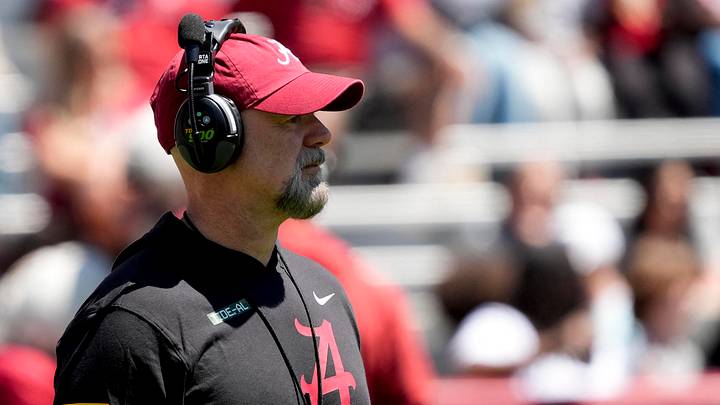
Ryan Grubb is public enemy No. 1.
Why wouldn't he be? Alabama's offense was dreadful in the 26-10 loss to Tennessee. The team produced just 201 yards of offense, failed to cross midfield in nine of its 11 drives that started in its own territory, and scored its only touchdown on a drive that started in the red zone.
There's an easy "win" here as a writer and analyst in this week's film breakdown, which would be to cherry-pick some of the offense's worst moments, highlight a trend or two that's extended across the season, and build analysis around a thesis that Grubb is not the right person for the job. Much of the fanbase has already come to that conclusion, and it would simply be adding fuel to the fire.
That's not what this article is going to do. Because after rewatching Saturday's game, I have come to the conclusion that to pin everything on Grubb would be lazy. The issues run far deeper. Today, we are going to look at some of Grubb's decision-making, but we are also going to dive into the poor execution that doomed the Crimson Tide.
What Grubb Has To Answer For
As stated, this article functions as a mechanism by which to demonstrate that the issues from a game or season cannot be entirely pinned on Grubb. It is by no means arguing that he is perfect. There's plenty that Grubb has to answer for, and he will answer for all of it in Monday's press conference.
The first thing I'll be asking him about is why he insists on continuing to run these jet sweeps to Lotzeir Brooks. It's bizarre. Tennessee recognizes this right away; it was never going anywhere, and it hasn't all year. These plays may have worked last year with Germie Bernard, but it's a new season.
This unwillingness to abandon plays and formations that have stopped working is a clear, identifiable flaw in Grubb's playcalling. It appears we're heading down the same path with the I-formation, which was successful in Starkville two weeks ago (four runs, 25 yards, two touchdowns), but has bottomed out as Georgia and Tennessee recognized that it signified a run. Will Grubb be willing to abandon it, or at least start throwing out of it more often moving forward?
At the end of the day, this kind of offensive performance is unacceptable. Ten points with this quarterback is unacceptable. Forty-seven total rushing yards is unacceptable. The product that was put on the field was bad, and the playcalling was questionable. It has been all season. Where were the screens? Why don't we see more wide zone runs? Why weren't Cederian Morgan and Noah Rogers on the field?
Grubb knows a whole lot more about football than me, and he knows a whole lot more about offense than you, the reader. Let's see how he responds to these questions — how he justifies Alabama's offensive strategy and personnel, and how the offense develops from here.
WR Struggles
To reiterate, the rest of this piece is not attempting to make excuses for Grubb. But Alabama's offensive execution was the worst it has been all year, bar none. First, a misscommunication between Keelon Russell and Brooks on Russell's first-quarter interception.
I'm not sure why Brooks stops running. This set Tennessee up in field-goal range, where the Alabama defense would be able to hold the Volunteers to three.
Rico Scott had 54 receiving yards in Saturday's game, the second most of his career, but he also saw two balls hit his hands and fall incomplete.
This is an excellent defensive play to close the gap and lay a good hit on the junior, but it's a ball he has to come down with, especially on third down. This next one is just a textbook drop.
This was the first play of the second half, and set the tone for the atrocious final two quarters of offense that would follow.
What's a First-Down Marker?
Continuing with the pass-catchers, Alabama had three third-downs that should have been converted (the Scott drop above notwithstanding). First, Derek Meadows, who was making his first career start in place of the injured Ryan Coleman-Williams, runs a stick route short of the chains and is tackled to bring up fourth down.
Kaleb Edwards had his worst game of the season. I'd really liked what he's done in the pass game up until this game, but he absolutely has to stay on his feet and reach the marker on this play.
And here's another from Edwards, who decides to possession catch this ball instead of trying to turn and move the chains.
I'm not sure why Edwards does this. His hands have been reliable, and there's no reason to doubt them. He's big and athletic enough to make this play and use his momentum to get Alabama a fresh set of downs.
Let's take a look at why these last two plays held an even greater significance in this game.
What Else Can Grubb Do Here?
This is the play immediately following the first Edwards reception. Fourth-and-one, Daniel Hill in the backfield, Alabama lined up in a heavy set. This is exactly what we want to see. When the Crimson Tide has needed the yardage, this has been a near-guarantee.
Until Saturday.
Michael Carroll steps on Russell's foot, he's thrown off, the ball doesn't get to Hill cleanly, and he fumbles. Instead of having a first down in the red zone, primed to take a 14-12 lead heading into halftime, Tennessee takes over.
No worries, Conor Talty drains a field goal, the defense makes a third-quarter stop, and now Alabama is just outside field-goal range with another fourth-and-one. Hill is again in the backfield with another heavy set, this time with Josh Ford and Edwards in.
Not today.
Edwards makes the wrong block. Instead of taking the inside man and giving Hill the opportunity to beat the edge, he allows Jeremiah Telander a direct path to the stop.
Alabama should've had a third crack at a fourth-and-one later in the quarter, but a Jayvin James false start forced a punt.
These are plays Alabama has converted all year. The usage of these heavy sets and 13 personnel has been my favorite thing Grubb has done with this roster, and I find no fault in his attempt at continuing that success. The offense needs to convert these, and can't shoot itself in the foot with operational errors.
Better Luck Next Year
Finally, there's the apparent reality that the Crimson Tide is not ready to face this kind of defensive front. Tennessee is nationally elite — Jim Knowles' unit leads the SEC in sacks, and Xavier Gilliam (see below) may be the best defensive lineman in the country.
One clear deficiency on the offense is pass protection from the running backs. Daniel Hill has been good, freshmen EJ Crowell and Trae'Shawn Brown have not. This play from Crowell sums it up, as he commits a blindside block to try and protect Russell.
The violence is appreciated. We can see the effort Crowell makes, which has not always been evident in pass pro through six games. We can also recognize that it takes a lot of development to become a competent blocker, and that he (and Brown) will be better next season. That doesn't help much right now.
Onto Gilliam, who lived up to all of the hype around him in this game. Maybe things could have been different had Racin Delgatty been able to play, but he had his way with center Mal Waldrep and the interior offensive line.
He gets the perfect jump on the play and immediately wrecks things inside. Marshall Pritchett loses on the edge, and second-and-two becomes third-and-three (this was two plays before the Hill fumble highlighted earlier).
Alabama's offensive line had a rough day. Jackson Lloyd had impressed through six games, notably in his performance against South Carolina's Dylan Stewart, but got dominated in Knoxville. Watch Tyree Weathersby blow by him to sack Russell late in the second quarter.
Now, Russell is playing further back than normal here, and the sack is partly on him. You still can see how effectively the Tennessee rush was able to move on Lloyd compared to usual. Here's some more footage of Alabama's offensive line getting killed in the first quarter, to really drive the point home.
In Conclusion
None of this absolves Grubb, and it isn’t meant to. Most of what you saw above started with players losing their one-on-one matchups or failing to execute. No play call fixes that on its own, but a coordinator is ultimately judged by what his players can and can't do on the field. Grubb had the opportunity to turn to the quick game, utilize screens, and run fewer long-developing plays. Right or wrong, he didn't take it.
Grubb's future in Tuscaloosa is very much in question. His contract expires at the end of the season, and as things currently stand, I do not think it will be renewed. But DeBoer is not taking playcalling duties from him anytime soon, so, like it or not, this season belongs to Grubb.
Let's see what he does with it.
Sign up to our free newsletter and follow us on Twitter/X, Facebook, YouTube, Instagram, TikTok for the latest Alabama news.
 Add us as a preferred source on Google

Theodore Fernandez is BamaCentral’s baseball beat reporter and a co-host of The Joe Gaither Show. He also works as a weekend sports anchor at WVUA 23 News in Tuscaloosa and serves as one of the station’s lead high school sports reporters. Fernandez is a news media student at The University of Alabama and is pursuing a master’s degree in sports management.