
Statistical Matchups That Give No. 9 BYU an Edge Against No. 3 Utah
In this story:
On Saturday morning, no. 9 BYU will take on no. 3 Utah in the most important Holy War in the decorated history of the rivalry. The Utes are undefeated and highly ranked for a reason - they have been efficient and explosive on both sides of the ball. BYU is an underdog going into this game. On paper, there are very few weaknesses that BYU can exploit.
However, the Utes aren't flawless. There are a few key matchups that favor BYU going into this game. In this article, we're highlighting the advanced statistical matchups that give BYU an edge against Utah.
1. Bear Bachmeier should have time to operate from a clean pocket
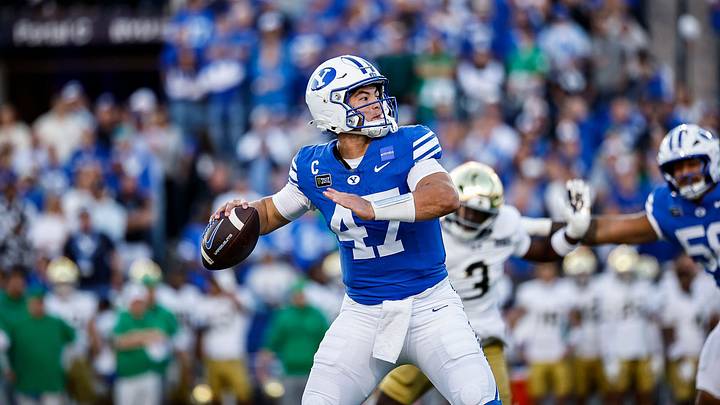
The chief strength of this BYU team has been the offensive line and preventing opponent pressure. In games against Power Four teams, BYU has allowed pressure on 24% of dropbacks, good enough for 6th nationally. When BYU took on the best pass rush in the country in Notre Dame, Bachmeier was pressured on just 19% of dropbacks. For context, Notre Dame was generating pressure on 46% of dropbacks going into that game.
Bachmeier had more success against Notre Dame than any other quarterback this season because he had time to throw from a clean pocket. Bachmeier should have time to operate from a clean pocket against Utah as well.
The Utes have struggled to consistently pressure the quarterback this season. Utah is ranked 62nd out of 68 P4 teams in pressure rate (P4 vs P4 games only), generating pressure on 26% of dropbacks. One caveat: this data excludes the Utah-Cincinnati game since there was a bug in the data from that game. Using a secondary source (PFF), Utah generated pressure on 31% of dropbacks in that game, so if we add that game into the mix, Utah's pressure rate would increase slightly to 27%.

After we add back the Cincinnati game, the Utes still have the worst pressure rate among the P4 teams BYU has faced this season. They are just behind two teams BYU has already faced this season: Iowa State (58th) and ASU (50th). In those two games, Bear Bachmeier was pressured on 9% and 21% of dropbacks, respectively. It's not surprising that Bachmeier's best outing came against Iowa State when he was only pressured 9% of the time. Bachmeier had a season high 329 passing yards in that game.
The data suggests Bachmeier will only be pressured on 1 out of every 5 dropbacks in this game, and Devon Dampier will probably face pressure on one out of every 3 dropbacks - BYU generates pressure on 31% of dropbacks and Utah allows pressure on 34% of dropbacks. BYU should have an advantage in net pressure rate on Saturday. The Utes will probably try to blitz Bachmeier to offset their pass rushing deficiency, and that could open them up to explosive plays. More on that in a moment.
2. Utah will give up yards, and BYU is good at capitalizing on scoring chances
In terms of points allowed per drive, Utah is the best defense BYU will have faced this season. The Utes are ranked 10th nationally in points allowed per drive. However, Utah is susceptible to explosive plays, primarily through the air.

Excluding garbage time, Utah ranks 60th nationally in yards allowed per play against FBS opponents. BYU's offense ranks 28th in yards gained per play. We already talked about the clean pockets we expect Bachmeier to throw from, and that could open up downfield opportunities for Bachmeier in the passing game. Utah ranks 72nd nationally in explosive pass rate allowed.
BYU, meanwhile, has one of the best deep threats in college football at wide receiver. True freshman Legend Glasker is tied with Malachi Toney and Jeremiah Smith - widely regarded as the two best wide receivers in college football - in receiving yards per route run. He leads FBS wide receivers in receptions of 50 yards or more.
There's a three-way tie for the most efficient WR in football.
— Underdog CFB (@UnderdogCFB) November 3, 2026
Malachi Toney
Jeremiah Smith
BYU freshman Legend Glasker
All at 4.30 yards per route run. pic.twitter.com/jw8JWWAjYy
The only problem? Glasker is only on the field about half the time. That could change against Utah. BYU plays a lot of 12 personnel (one running back, two tight ends) with Walker Lyons and Roger Saleapaga. Saleapaga suffered an injury against Arizona State and is doubtful for this game. As a result, we expect BYU to play a lot more three wide receiver sets, meaning Glasker will be on the field more often than not.
Where Utah's defense has been elite is in the red zone. The Utes allow touchdowns on just 40% of red zone trips, good enough for 7th nationally. This game will probably come down to red zone execution. BYU's offense has the chance to counter Utah's defense in the red zone as the Cougars are ranked 9th nationally in red zone touchdown rate, scoring touchdowns on 80% of red zone possessions.
Before LJ Martin suffered an injury against TCU, BYU's offense had a perfect 100% touchdown rate in the red zone in non-garbage time. That's relavant since Pete Thamel reported that Martin is "trending toward playing Saturday and having some impact on the game."
If Martin is on a pitch count, it would be wise to save him for the red zone when possible.
Utah has allowed at least 365 yards in it last three games aginst Colorado, Houston, and Cincinnati, and they allowed 406 yards per game on average. Houston had four chances inside the Utah 30 that didn't result in touchdowns. In fact, Houston scored only 3 points from those four drives. Cincinnati had three of those stalled drives deep in Utah territory that ended in 6 points.
If BYU capitalizes on scoring opportunities like it has all season, the Cougars can leave Rice Eccles with an upset win.
3. Utah hasn't faced a defense like BYU's defense
Utah's offense has been a juggernaut. We're not here to tell you they're not good because they are. Utah ranks 5th in points per drive, 3rd in yards per play, 1st in success rate, and 7th in explosive play rate. If BYU isn't assignment sound and doesn't tackle well in space, it will be a long game for Kelly Poppinga's unit. On paper, Utah has the advantage in this matchup.
However, Utah has not faced a defense as good as BYU and, frankly, it's not even close. Utah has not faced a Power Four defense better than 58th in points per drive (Houston). BYU is 23rd in points allowed per drive.
Utah hasn't faced a Power Four defense that ranks better than 61st in yards allowed per play. BYU is 12th nationally in that same metric. In terms of points per drive allowed, yards per play allowed, success rate allowed, and explosive play rate allowed, BYU is the best defense Utah will have faced by a wide margin.

As part of our weekly data run this week, we made a new metric to evaluate the strength of a teams' schedule with a focus on one side of the ball. These metrics show how good the defenses (or offenses) a team has already faced have been on average, ranked nationally, so you can see whether a team has been tested on that side of the ball.
On average, the defenses Utah has faced rank 122nd in yards per play allowed, 114th in success rate allowed, and 90th in points allowed per drive. Said differently, Utah has faced one of the worst compilations of defenses in college football. To get one level deeper, Utah has faced some bad run defenses. Combined, their opponents rank 117th in rush rate allowed and 118th in explosive rush rate allowed. In contrast, the defenses BYU has faced rank 45th in rush success rate allowed and 15th in explosive rush rate allowed, on average.
The way we see it, the BYU defense will try to keep the Utah offense in the 20-24 points range. If they keep Utah at or below 24, we believe BYU will have the offensive firepower to win the game. The data suggests BYU has a strong chance to hold them to that number, assuming BYU doesn't hand Utah short fields with turnovers. The Utes scored 21 points against Houston and 24 points against Colorado. On paper, the BYU defense is a much better unit than either of those two defenses. Kelly Poppinga's defense won't stop the Utah offense, but they have a great chance to limit them.
Sign up to our free newsletter and follow us on X and Facebook for the latest news.
 Add us as a preferred source on Google

Casey Lundquist is the publisher and lead editor of BYU On SI. He has covered BYU athletics since 2020. During that time, he has published over 3,500 stories that have reached millions of readers.
Follow casey_lundquist