
5 Stats That Defined Indiana Basketball's Win Over Kentucky
In this story:
Indiana (6-0) mostly cruised to yet another high-major non-conference victory on Friday night. This time it was Kentucky – which, save for a late run in the first half, was never really in this one. Here are five stats that determined the Hoosiers’ sixth straight win to open this 2026-27 season:
5 key stats that explain Indiana's dominant win over Kentucky

The bench scoring disparity in Indiana’s favor: 29
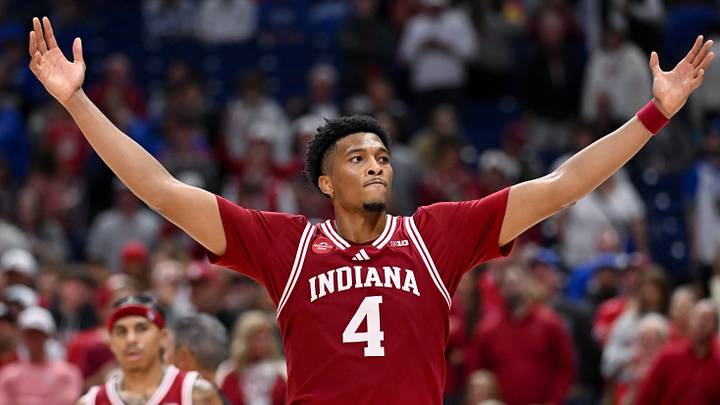
Every Hoosier that came off the bench scored at least four points on Friday night. Kentucky, meanwhile, saw its entire bench combine for four points. Indiana’s reserves were led by Bryce Lindsay, who wound up playing 31 minutes and scoring a team-high 20 points despite struggling from the field (5-for-15).
The crowd was HYPED after this dagger from Bryce Lindsay.
— CBS Sports College Basketball 🏀 (@CBSSportsCBB) November 21, 2026
Also gave him a team-leading 20 points on the night 🔥 @IndianaMBB pic.twitter.com/YT1Ggs5Y3F
The 2026-27 Hoosiers just have more depth than most teams (and certainly more than the Wildcats on Friday). So, aside from the scoring, that allows them to pick and choose lineups that favor them in specific matchups – which is exactly what happened vs. Kentucky. Starting big Samet Yigitoglu played just 17 minutes, Indiana went small and it used Kentucky’s size against it.
The Hoosiers’ offensive rebounding advantage: eight

Somehow, despite the Wildcats boasting an otherworldly size advantage – especially with Yigitoglu barely playing – the Hoosiers dominated the glass. The overall advantage was plus-eight, which matched the difference on the offensive boards.
Indiana was the more physical team. Plain and simple. The Hoosiers brought the fight to the Wildcats, and Mark Pope’s squad folded. It’s often a cliche to say “they wanted it more”. But that was the reality on Friday night. Indiana outhustled and outmuscled Kentucky all night long. And the difference on the scoreboard: nine more second-chance points.
Kentucky’s field-goal percentage: 54.1
There were enough notable disparities – points off turnovers, second-chance points, free-throw margin (more on that shortly) – working against Kentucky, that it’s a borderline shock that the Wildcats only lost by 14. That is, until you see their efficiency.
When Kentucky actually got a field goal off, it was very efficient. 54.1 percent from the field and 38.9 percent from deep, to be exact. As expected, the Hoosiers’ two-point defense remains a key weakness.
Every Wildcat in the starting lineup shot 50 percent or better from inside the arc. As a team, they shot 60.5 percent on two-pointers. Admittedly, some of those were tough midrange pull-ups. But a lot of them were at-the-rim twos, as well.
The free throws margin in Indiana’s favor: 25

This was, without a doubt, the biggest swing in the game. Indiana shot 28-for-31 – how about that efficiency? – from the free-throw line, while Kentucky went just 3-for-7. The Hoosiers are top-75 in the nation in both free-throw rate on offense (No. 25) and free-throw rate allowed (No. 62).
Essentially, they keep teams off the line, yet live there themselves. And if Indiana can continue that trend while also hitting freebies near this clip, the Hoosiers are going to win themselves a lot of games at the charity stripe. (Related note: they shouldn’t expect to draw that many whistles on threes, though.)
Indiana’s two-point efficiency: 40.6 percent
OK, without Yigitoglu playing big minutes, the Hoosiers suddenly become relatively small. Markus Burton is undersized. The trio of Bryce Lindsay, Darren Harris and Jaeden Mustaf isn’t gigantic. And if Aiden Sherrell is going to live on the perimeter, Indiana isn’t going to find a lot of easy ones inside (hence the 40.6 percent on two-pointers vs. Kentucky).
On Friday in particular, Mustaf was a bit out of control on offense and couldn’t get much going (0-for-4 on twos). Burton, for his part, was pretty sound, navigating through the teeth of the defense and getting to his midrange jumper or finishing at the cup.
Sherrell, though, didn’t have a perfect night. His three-point shooting was superb (4-for-6). But Sherrell is a physical, athletic and skilled 7-footer. In no world should he ever shoot 1-for-7 on two-pointers. He must strike a better balance between striping it from deep and making an impact inside.
 Add us as a preferred source on Google

Primarily covers Illinois football and basketball, and Indiana basketball, with an emphasis on analysis, features, and recruiting. Langendorf, a third-generation University of Illinois alum, has been watching Illini basketball and football for as long as he can remember. An advertising student and journalism devotee, he has been writing for On SI since October 2024.
Follow jglangendorf