%20%20--%3E%0A%3Csvg%20version%3D%221.1%22%20id%3D%22Layer_1%22%20xmlns%3D%22http%3A%2F%2Fwww.w3.org%2F2000%2Fsvg%22%20xmlns%3Axlink%3D%22http%3A%2F%2Fwww.w3.org%2F1999%2Fxlink%22%20x%3D%220px%22%20y%3D%220px%22%0A%09%20width%3D%2239px%22%20height%3D%2240px%22%20viewBox%3D%220%200%2039%2040%22%20enable-background%3D%22new%200%200%2039%2040%22%20xml%3Aspace%3D%22preserve%22%3E%0A%3Cpath%20fill%3D%22%23FFFFFF%22%20d%3D%22M38.5%2C7H28.2v26h10.3V7z%22%2F%3E%0A%3Cpath%20fill-rule%3D%22evenodd%22%20clip-rule%3D%22evenodd%22%20fill%3D%22%23FFFFFF%22%20d%3D%22M26.1%2C25.5c0%2C5.8-4.1%2C7.5-12.9%2C7.5C3.9%2C33%2C0%2C31.2%2C0%2C25.2v-1.1h11.6%0A%09v2.4c0%2C0.7%2C0.1%2C1.4%2C1.2%2C1.4c1%2C0%2C1.2-0.4%2C1.2-1.3v-0.9c0-1.6-0.9-1.6-3.5-2.2C2.2%2C21.7%2C0%2C19.7%2C0%2C15.3v-0.9C0%2C9.3%2C5.5%2C7%2C12.9%2C7%0A%09c10.2%2C0%2C12.8%2C2.6%2C12.8%2C7.4v1.8h-11v-2.9c0-0.6-0.4-1.1-1.2-1.1c-0.6%2C0-1.2%2C0.4-1.2%2C1.1v0.9c0%2C1.5%2C0.9%2C2%2C3.3%2C2.5%0A%09c8%2C1.6%2C10.5%2C3.3%2C10.5%2C7.5V25.5z%22%2F%3E%0A%3C%2Fsvg%3E%0A)
Pricey Tickets, Empty Seats: Why College Hoops Keeps Pushing Neutral Site Games While Fan Interest Lags
In this story:
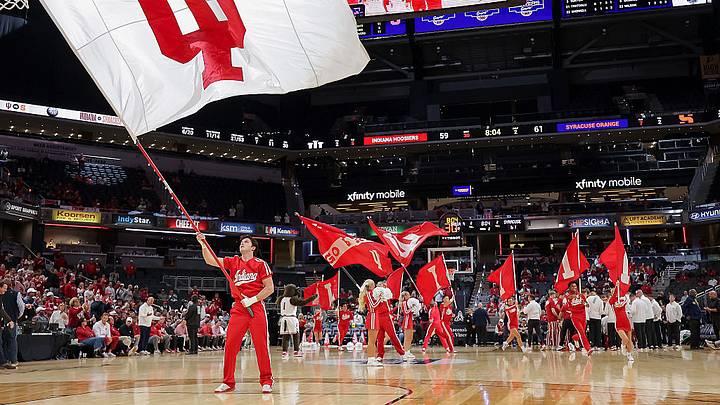
The highest-profile game of the second Monday of the college basketball season was a showdown between Indiana and Syracuse. It was a rematch of two memorable NCAA tournament games: the 1987 national title game (won by the Hoosiers) and a 2013 Sweet 16 matchup (the Orange upset a top-seeded IU team).
And yet the storyline that came out of it wasn’t about either program looking to re-emerge as a national power. Instead, it was about empty seats (and lots of them) at Gainbridge Fieldhouse in Indianapolis. Announced attendance was 5,047; having been there, even that number felt generous. There weren’t just empty rows, there were nearly empty sections.
Crowd inside Gainbridge Fieldhouse at tipoff for Syracuse vs. Indiana.
— Zach Horwitz (@HorwitzZach) November 9, 2026
Maybe they were a bit greedy with $100+ upper deck tickets… Or the idea that fans and students alike appreciate these power conference games played on campus. #iubb pic.twitter.com/cR5BRdyb8B
Unfortunately, that game is hardly an outlier. Take Sunday, when two of the biggest games were Marquette vs. Missouri at the United Center in Chicago and Baylor vs. Texas at the Frost Bank Center in San Antonio. Both games’ published attendance was just over 6,000.
These near-daily empty arena shots have sparked plenty of reaction. Why are these high-profile matchups being played in stale NBA arenas if no one is there to watch? And why are the ticket prices so expensive when demand clearly isn’t there? Is this the sign of a crumbling sport, or simply an oversaturated market?
To get answers to those questions, Sports Illustrated sat down with two well-respected veterans in the college basketball scheduling world to get a better understanding of the economics of these neutral site games. Mark Starsiak is a senior VP at Intersport, which ran the Baylor vs. Texas game and operates many of the highest-profile events of the nonconference season. Rick Giles is the founder and president of Gazelle Group, which ran the Marquette vs. Missouri game and has long been a staple in the multi-team event/neutral site game world.
Here’s how they explain the state of the industry and what comes next:
How game contracts are structured
Event operators contract with the two schools to play the game and, in most cases, give them a financial guarantee as incentive to participate. The operators then look to recoup the money spent on the guarantee (and other costs, such as renting the arena and staffing the game) through two main buckets: ticket sales and sponsorships. Tickets are usually responsible for a larger portion of the revenue generated from the game than sponsorships, but title sponsorships for significant nonconference games often top six figures.
To refute a popular misconception, the third party doesn’t own the TV rights to the game to sell to a network in the majority of cases. The multi-million dollar TV deals that the power conferences have struck with networks give the networks rights to all games played by teams in the league’s footprint. And with some conferences growing increasingly national, those footprints in some cases stretch much of the country. A game like Indiana playing in Indianapolis would be owned by the Big Ten and its rightsholders, not put on the open market.
The one area where TV does come into play is with sponsorships. Partially as an incentive to the event operators to bring together high-level games, networks will sometimes allow the operator to purchase advertising inventory that can be sold as part of larger sponsorship packages for the event. That can drive up the value of those game title sponsorships.
But these are not made-for-TV events. The economies of these early-season games rely on fans buying tickets.
“We start with ticket sales, right?” Giles says. “I start with, these two teams in this location on this date, does it make sense? And then we get to the media and the sponsorships.”
How NIL and revenue sharing has changed the game
Playing neutral site games has become an increasingly popular avenue for teams to use to generate above-the-cap NIL for their rosters in the revenue sharing era. Instead of the guarantee for playing the game going to the athletic department, schools can instead negotiate that the money for the game go to an NIL collective or have the event company engage with their players directly for NIL deals to promote the game.
And with many (if not most) basketball rosters at the power conference level funding at least half of their overall roster spend with above-the-cap NIL, there’s huge demand for ways to eat into those extra costs. That’s why the quantity of these games has grown in recent years. Indiana played two preseason games on neutral courts (North Carolina in Indianapolis, Western Kentucky in Evansville) and three more during nonconference play (Syracuse and Kentucky in Indianapolis, Arkansas in New York City). The Orange played that game against the Hoosiers, go to Boston to play Providence in December and will play a February nonconference game against Rutgers at Barclays Center in Brooklyn. Missouri has five games on neutral courts just in the regular season alone. Go back to the 2021–22 season (when NIL was in its infancy) and Indiana played just one neutral game, Mizzou played two, while Syracuse played one in addition to playing in the Battle 4 Atlantis tournament.
But schools aren’t just looking to up the number of these games they’re playing. They’re also increasingly demanding far higher guarantees from event operators in order to agree to play the games. Starsiak said that compared to before NIL, many schools’ requests to play in a one-off neutral game have increased by “four to five times.” Schools that used to sign up to play a game like this for a small guarantee (say, $50–75,000) or even free in some cases are now asking for $200–300,000. Blue bloods’ asks can go higher than that.
“The market has moved in a way that, for the most valuable teams, the pricing has accelerated,” Giles says.
Also driving the big financial asks from schools has been the disruption to the ecosystem caused by the controversial Players Era early-season tournaments, which have expanded to 24 teams for 2026–27. The event came onto the scene promising million-dollar payouts for schools. While the economics have changed slightly (some teams make more than others, and similar to bowl games, schools have a ticketing minimum they have to buy), it’s still paying out figures to schools that others in the space claim they can’t match.
“The math for Players Era doesn't work,” Giles says. “There's no way that you can justify paying all those teams all that money based upon their attendance. So they're getting this outside funding, like LIV [Golf], and at some point somebody might realize the math doesn't work and pull the funding, and so then that adjusts and Players Era goes away like LIV went away.”
More expensive guarantees = more expensive tickets
Event operators have responded to the explosive increase in demands from teams by passing down costs to the consumers. Fans reported seeing second-deck tickets listed for the Indiana/Syracuse game for over $100; even the day of the game when it was obvious the arena would be empty, tickets were on sale in the $70–80 range. Seeing prices for these one-off neutral games that are well higher than the get-in price for the NBA teams that use these arenas normally has become common.
“There are no new revenue streams to unlock,” Starsiak says. “When the number goes up four to five times, it has to be passed through the consumer, similar to any other business, right?”
And there’s no shortage of headwinds that make it hard to drive the masses to pay those premium prices. At the top of the list are larger economic realities: Affordability concerns are at the center of just about every political conversation right now, and college sports aren’t immune to that. Demanding premium prices for November college basketball games is a tough pill for many to swallow. Empty stadium pictures from on-campus basketball and football games are increasingly common; neutral site games aren’t the only ones feeling the hurt.
There’s also the reality that college basketball is competing in November with an ultra-crowded sports calendar for eyeballs and attention. How many Indiana fans elected to save their money on IU vs. Syracuse to gear up for a potential Big Ten football championship game appearance a few weeks later? Texas and Baylor’s neutral site game in San Antonio Sunday was going on at the same time as the Cowboys playing the 49ers. There’s plenty of Marquette/Packers fan overlap; how many fans chose to watch a divisional rivalry against the Vikings at home and double-box in the Golden Eagles on Sunday?

What does the future look like?
The challenge of competing with football is one of the reasons that event companies are increasingly looking later in the season for potential showcase nonconference games as a break from conference play. Giles called the late February Duke vs. Michigan clash his company ran “one of the most successful neutral site games in years and years.” That game was ESPN’s most-viewed college game since 2019 and drew more than 20,000 fans in Washington, D.C. More of those games are coming this year, among them Illinois vs. North Carolina in Nashville, Louisville vs. Baylor in Indianapolis and Duke vs. Gonzaga in Detroit.
“We're trying to do more February games,” Giles says. “If we can't do February, we ask about January. January [goes] to December, and then November’s our last preference.”
But Starsiak notes there are limitations there, too; it’s hard to fit those games into the crowded conference calendar, and some schools don’t want to strip focus away from conference title races for a late-season nonconference game. And there’s basically no possibility of a team playing more than one of those games in one year without wholesale changes to the conference schedules that all high-major leagues use.
“It’s never going to be overly prevalent, I don’t think,” Starsiak says. “I think it still follows the November and December timeline. The good teams and the good programs are more valuable in January and February than they are in November and December, but you have to fight other battles.”

The financial model could also change. Both Giles and Starsiak brought up contracts that include less guaranteed money for the schools and more revenue sharing based on ticket sales, which decreases risk for the event company and increases the incentive for schools to work hard promoting the event with them. The design of each individual event has also changed; Giles said Gazelle does fewer doubleheaders (it's harder to sell enough tickets at the price point necessary) and fewer events with back-to-back days of games when fans might’ve chosen one or the other to attend.
The demand will continue from schools, particularly as the price to put a competitive roster on the floor has increased. But if they can’t drive ticket sales, those opportunities could soon evaporate.
“Some schools are certainly justified in their ask and they’re spot on from a marketplace value perspective,” Starsiak says. “But some coaches are left to fend for themselves to try and find dollars in the new day and age. They just think that because other teams and other brands and places get that, why can’t we get it too? There’s becoming a pecking order in the industry from a tangible value perspective.”
PODCAST: Listen to Sports Illustrated’s college sports podcast, Others Receiving Votes, hosted by Pat Forde, on Apple and Spotify. Watch the show on SI’s college YouTube channel or on SI TV.
 Add us as a preferred source on Google

Kevin Sweeney is a staff writer at Sports Illustrated covering college basketball and the NBA draft. He joined the SI staff in July 2021 and also serves host and analyst for The Field of 68. Sweeney is a Naismith Trophy voter and ia member of the U.S. Basketball Writers Association. He is a graduate of Northwestern University’s Medill School of Journalism.
Follow CBB_Central