%22%3E%0A%3Cpath%20d%3D%22M0%209.69043H5.34889V25.7008H0V9.69043Z%22%20fill%3D%22white%22%2F%3E%0A%3Cpath%20d%3D%22M7.18359%2013.2135H12.3781V14.948C13.1773%2013.9218%2014.4396%2012.9138%2016.2013%2012.9138C18.8349%2012.9138%2020.4786%2014.6483%2020.4786%2017.4636V25.7003H15.2841V19.1345C15.2841%2018.0629%2014.6393%2017.4454%2013.8674%2017.4454C13.0955%2017.4454%2012.3781%2018.0629%2012.3781%2019.1345V25.7003H7.18359V13.2135Z%22%20fill%3D%22white%22%2F%3E%0A%3Cpath%20d%3D%22M21.6587%2019.5434V19.498C21.6587%2015.5385%2024.038%2012.914%2026.9894%2012.914C28.8874%2012.914%2029.9408%2013.7404%2030.74%2014.6304V9H35.9345V25.7005H30.74V24.1658C29.8954%2025.083%2028.9328%2025.9911%2027.0348%2025.9911C24.0108%2025.9911%2021.6587%2023.3576%2021.6587%2019.5434ZM30.8581%2019.4798V19.4344C30.8581%2018.1994%2029.9681%2017.1913%2028.7784%2017.1913C27.5888%2017.1913%2026.6988%2018.1721%2026.6988%2019.4344V19.4798C26.6988%2020.7421%2027.5888%2021.7229%2028.7784%2021.7229C29.9681%2021.7229%2030.8581%2020.7421%2030.8581%2019.4798Z%22%20fill%3D%22white%22%2F%3E%0A%3Cpath%20d%3D%22M37.5337%209H42.9098V12.3147H37.5337V9ZM37.6245%2013.2137H42.819V25.7005H37.6245V13.2137Z%22%20fill%3D%22white%22%2F%3E%0A%3Cpath%20d%3D%22M44.0259%2022.1496V22.1042C44.0259%2019.6159%2045.8785%2018.2174%2048.7845%2018.2174C49.8379%2018.2174%2051.182%2018.4444%2051.7359%2018.6714V18.4626C51.7359%2017.3183%2051.0276%2016.6554%2049.4293%2016.6554C48.1488%2016.6554%2047.0772%2016.9278%2045.9784%2017.3637L45.0611%2013.9128C46.5051%2013.3679%2048.1488%2012.9956%2050.3192%2012.9956C52.862%2012.9956%2054.5057%2013.5223%2055.6046%2014.6212C56.5399%2015.5565%2056.9123%2016.7734%2056.9123%2018.5806V25.6913H51.7178V24.429C50.8459%2025.3644%2049.6835%2025.9819%2048.1306%2025.9819C45.7332%2025.9819%2044.035%2024.6106%2044.035%2022.1405L44.0259%2022.1496ZM51.7813%2021.078V20.5513C51.4816%2020.4332%2051.0276%2020.3424%2050.5917%2020.3424C49.5655%2020.3424%2048.9934%2020.9599%2048.9934%2021.7409V21.7863C48.9934%2022.5219%2049.5201%2023.0032%2050.183%2023.0032C51.1002%2023.0032%2051.7813%2022.2676%2051.7813%2021.078Z%22%20fill%3D%22white%22%2F%3E%0A%3Cpath%20d%3D%22M58.4653%2013.2135H63.6598V14.948C64.459%2013.9218%2065.7213%2012.9138%2067.4831%2012.9138C70.1167%2012.9138%2071.7604%2014.6483%2071.7604%2017.4636V25.7003H66.5659V19.1345C66.5659%2018.0629%2065.9211%2017.4454%2065.1492%2017.4454C64.3773%2017.4454%2063.6598%2018.0629%2063.6598%2019.1345V25.7003H58.4653V13.2135Z%22%20fill%3D%22white%22%2F%3E%0A%3Cpath%20d%3D%22M72.832%2022.1496V22.1042C72.832%2019.6159%2074.6846%2018.2174%2077.5906%2018.2174C78.6441%2018.2174%2079.9881%2018.4444%2080.5421%2018.6714V18.4626C80.5421%2017.3183%2079.8337%2016.6554%2078.2354%2016.6554C76.9549%2016.6554%2075.8834%2016.9278%2074.7845%2017.3637L73.8673%2013.9128C75.3112%2013.3679%2076.9549%2012.9956%2079.1254%2012.9956C81.6681%2012.9956%2083.3119%2013.5223%2084.4107%2014.6212C85.3461%2015.5565%2085.7184%2016.7734%2085.7184%2018.5806V25.6913H80.5239V24.429C79.6521%2025.3644%2078.4897%2025.9819%2076.9368%2025.9819C74.5393%2025.9819%2072.8411%2024.6106%2072.8411%2022.1405L72.832%2022.1496ZM80.5784%2021.078V20.5513C80.2787%2020.4332%2079.8246%2020.3424%2079.3887%2020.3424C78.3626%2020.3424%2077.7904%2020.9599%2077.7904%2021.7409V21.7863C77.7904%2022.5219%2078.3171%2023.0032%2078.9801%2023.0032C79.8973%2023.0032%2080.5784%2022.2676%2080.5784%2021.078Z%22%20fill%3D%22white%22%2F%3E%0A%3Cpath%20d%3D%22M93.3018%209.69043H98.6506V15.339H103.545V9.69043H108.894V25.7008H103.545V19.9614H98.6506V25.7008H93.3018V9.69043Z%22%20fill%3D%22white%22%2F%3E%0A%3Cpath%20d%3D%22M110.292%2019.4978V19.4524C110.292%2015.9288%20113.217%2012.9138%20117.34%2012.9138C121.462%2012.9138%20124.341%2015.8834%20124.341%2019.407V19.4524C124.341%2022.9759%20121.417%2025.9909%20117.294%2025.9909C113.171%2025.9909%20110.292%2023.0213%20110.292%2019.4978ZM119.356%2019.4978V19.4524C119.356%2018.2173%20118.438%2017.2365%20117.294%2017.2365C116.15%2017.2365%20115.278%2018.2173%20115.278%2019.407V19.4524C115.278%2020.6874%20116.195%2021.6682%20117.34%2021.6682C118.484%2021.6682%20119.356%2020.6874%20119.356%2019.4978Z%22%20fill%3D%22white%22%2F%3E%0A%3Cpath%20d%3D%22M125.204%2019.4978V19.4524C125.204%2015.9288%20128.128%2012.9138%20132.251%2012.9138C136.374%2012.9138%20139.252%2015.8834%20139.252%2019.407V19.4524C139.252%2022.9759%20136.328%2025.9909%20132.205%2025.9909C128.082%2025.9909%20125.204%2023.0213%20125.204%2019.4978ZM134.267%2019.4978V19.4524C134.267%2018.2173%20133.35%2017.2365%20132.205%2017.2365C131.061%2017.2365%20130.189%2018.2173%20130.189%2019.407V19.4524C130.189%2020.6874%20131.106%2021.6682%20132.251%2021.6682C133.395%2021.6682%20134.267%2020.6874%20134.267%2019.4978Z%22%20fill%3D%22white%22%2F%3E%0A%3Cpath%20d%3D%22M139.507%2024.1837L141.269%2021.2323C142.776%2022.1677%20144.474%2022.6308%20145.891%2022.6308C146.39%2022.6308%20146.645%2022.5128%20146.645%2022.2222V22.1768C146.645%2021.9225%20146.418%2021.7681%20145.155%2021.4412C141.995%2020.6602%20140.052%2019.8156%20140.052%2017.2365V17.1911C140.052%2014.4486%20142.249%2012.9138%20145.491%2012.9138C147.553%2012.9138%20149.587%2013.4405%20151.095%2014.3577L149.451%2017.4454C148.125%2016.7098%20146.527%2016.283%20145.473%2016.283C144.974%2016.283%20144.738%2016.4192%20144.738%2016.6735V16.7189C144.738%2016.9732%20145.01%2017.1275%20146.272%2017.4545C149.433%2018.2355%20151.331%2019.0982%20151.331%2021.6591V21.7045C151.331%2024.4289%20149.296%2026%20145.909%2026C143.484%2026%20141.287%2025.3825%20139.507%2024.1928V24.1837Z%22%20fill%3D%22white%22%2F%3E%0A%3Cpath%20d%3D%22M152.448%209H157.824V12.3147H152.448V9ZM152.539%2013.2137H157.733V25.7005H152.539V13.2137Z%22%20fill%3D%22white%22%2F%3E%0A%3Cpath%20d%3D%22M159.041%2019.525V19.4796C159.041%2015.7563%20161.72%2012.9138%20165.471%2012.9138C169.902%2012.9138%20171.964%2016.0015%20171.964%2019.7975C171.964%2020.0699%20171.964%2020.3968%20171.946%2020.6693H163.918C164.281%2021.7681%20165.153%2022.3402%20166.27%2022.3402C167.205%2022.3402%20167.986%2021.9043%20168.813%2021.0598L171.6%2023.2756C170.365%2024.8739%20168.604%2026%20165.906%2026C161.811%2026%20159.041%2023.4118%20159.041%2019.525ZM167.223%2018.3808C167.105%2017.1911%20166.397%2016.5009%20165.489%2016.5009C164.581%2016.5009%20163.999%2017.2365%20163.845%2018.3808H167.232H167.223Z%22%20fill%3D%22white%22%2F%3E%0A%3Cpath%20d%3D%22M173.198%2013.2137H178.393V15.7292C179.101%2014.0401%20180.245%2012.9413%20182.307%2013.0321V18.5444H181.762C179.564%2018.5444%20178.402%2019.7523%20178.402%2022.5221V25.7005H173.207V13.2137H173.198Z%22%20fill%3D%22white%22%2F%3E%0A%3Cpath%20d%3D%22M182.389%2024.1837L184.151%2021.2323C185.658%2022.1677%20187.357%2022.6308%20188.773%2022.6308C189.273%2022.6308%20189.527%2022.5128%20189.527%2022.2222V22.1768C189.527%2021.9225%20189.3%2021.7681%20188.038%2021.4412C184.877%2020.6602%20182.934%2019.8156%20182.934%2017.2365V17.1911C182.934%2014.4486%20185.132%2012.9138%20188.374%2012.9138C190.435%2012.9138%20192.469%2013.4405%20193.977%2014.3577L192.333%2017.4454C191.007%2016.7098%20189.409%2016.283%20188.356%2016.283C187.856%2016.283%20187.62%2016.4192%20187.62%2016.6735V16.7189C187.62%2016.9732%20187.892%2017.1275%20189.155%2017.4545C192.315%2018.2355%20194.213%2019.0982%20194.213%2021.6591V21.7045C194.213%2024.4289%20192.179%2026%20188.791%2026C186.367%2026%20184.169%2025.3825%20182.389%2024.1928V24.1837Z%22%20fill%3D%22white%22%2F%3E%0A%3Cpath%20fill-rule%3D%22evenodd%22%20clip-rule%3D%22evenodd%22%20d%3D%22M203.99%204.36764C209.813%20-1.45588%20219.254%20-1.45588%20225.078%204.36764C230.901%2010.1912%20230.901%2019.6324%20225.078%2025.4559L214.534%2036L203.99%2025.4559C198.166%2019.6324%20198.166%2010.1912%20203.99%204.36764ZM206.631%207.55761C206.57%207.86849%20206.538%208.39718%20206.538%209.14566V10.4189C206.538%2011.1832%20206.57%2011.7198%20206.635%2012.0267C206.7%2012.3317%20206.9%2012.6168%20207.239%2012.8762C207.578%2013.1376%20208.025%2013.3316%20208.58%2013.4623C209.134%2013.593%20209.722%2013.6584%20210.459%2013.6584C211.195%2013.6584%20211.839%2013.591%20212.391%2013.4524C212.944%2013.3158%20213.383%2013.1178%20213.708%2012.8604C214.033%2012.6029%20214.227%2012.3178%20214.288%2012.0069C214.35%2011.6961%20214.381%2011.1674%20214.381%2010.4189V9.14566C214.381%208.38134%20214.35%207.84473%20214.284%207.53781C214.219%207.23287%20214.019%206.94971%20213.68%206.68834C213.342%206.42696%20212.894%206.23291%20212.34%206.10223C211.785%205.97154%20211.158%205.90619%20210.461%205.90619C209.724%205.90619%20209.081%205.97352%20208.528%206.11213C207.974%206.24875%20207.536%206.44677%20207.211%206.70418C206.887%206.9616%20206.693%207.24673%20206.631%207.55761ZM211.898%2024.8638C215.498%2024.8638%20217.179%2024.2064%20217.179%2021.862V21.858V21.3155C217.179%2019.6581%20216.138%2018.971%20212.874%2018.3136C211.9%2018.1136%20211.53%2017.9136%20211.53%2017.3136V16.9414C211.53%2016.6543%20211.799%2016.5117%20212.035%2016.5117C212.372%2016.5117%20212.54%2016.7137%20212.54%2016.9414V18.1136H217.013V17.3988C217.013%2015.4563%20215.969%2014.4266%20211.799%2014.4266C208.772%2014.4266%20206.518%2015.3414%20206.518%2017.3711V17.7433C206.518%2019.5155%20207.427%2020.3155%20210.823%2021.0303C210.902%2021.0472%20210.978%2021.063%20211.049%2021.0781C211.951%2021.2674%20212.269%2021.3341%20212.269%2021.9174V22.2897C212.269%2022.6619%20212.168%2022.8045%20211.764%2022.8045C211.292%2022.8045%20211.259%2022.5471%20211.259%2022.262V21.2897H206.516V21.7471C206.516%2024.149%20208.098%2024.8638%20211.898%2024.8638ZM218.047%2024.5569H222.547V14.7355H218.047V24.5569ZM219.577%2013.5019H222.547V6.06064H219.714V9.411L217.815%206.06064H214.981V13.5019H217.815V10.1199L219.577%2013.5019ZM210.891%2012.152C210.826%2012.2688%20210.677%2012.3262%20210.447%2012.3262L210.449%2012.3282C210.226%2012.3282%20210.081%2012.2767%20210.02%2012.1758C209.958%2012.0748%20209.927%2011.8074%20209.927%2011.3758V7.90068C209.927%207.51852%20209.974%207.28684%20210.067%207.20962C210.16%207.13239%20210.297%207.09279%20210.473%207.09279C210.681%207.09279%20210.82%207.14031%20210.887%207.23734C210.954%207.33239%20210.988%207.55416%20210.988%207.90068V11.3203C210.988%2011.7579%20210.956%2012.0352%20210.891%2012.152Z%22%20fill%3D%22white%22%2F%3E%0A%3C%2Fg%3E%0A%3Cdefs%3E%0A%3CclipPath%20id%3D%22clip0_15185_22842%22%3E%0A%3Crect%20width%3D%22230%22%20height%3D%2236%22%20fill%3D%22white%22%2F%3E%0A%3C%2FclipPath%3E%0A%3C%2Fdefs%3E%0A%3C%2Fsvg%3E%0A)
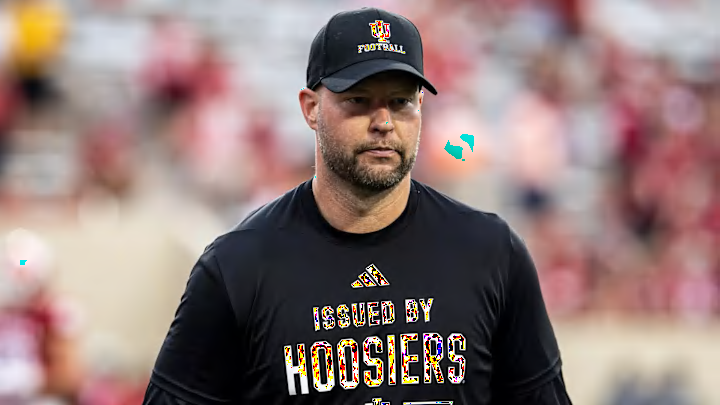
Bryant Haines Spent 2 Years on Welfare. Now, He's Indiana Football's 'Mastermind'
In this story:
LOS ANGELES — Those moments, Bryant Haines says, were perhaps the lowest in his life.
Haines had already been on food stamps for two years, surviving primarily by way of government assistance. He didn’t have the time to build a family or find a girlfriend, let alone the money to afford either.
Nothing hurt more than the times — plural — he had to ask his parents for money as he finished his second year as an assistant coach at Indiana University of Pennsylvania in 2015.
“That was a low point for me,” Haines told Indiana Hoosiers On SI. “And to me, that's when I really had to feel like that was a decision time. Like, you have to ask your parents for money — maybe you should stop what you're doing, you're not good at it.”
Haines’ confidence took a hit, and he admitted he almost left the coaching industry a couple times because he “couldn’t survive” and didn’t want to live on welfare. But he never doubted whether he was good enough to make a living as a coach. He knew his time would eventually come.
So, he kept pushing, even though offseasons forced him to reconsider whether his dream was worth chasing.
“There was times, like, I could go work for one of my buddies and make money,” Haines said. “But I was passionate about football. It's what I love, so I stuck it out.”
Haines followed his heart. Now, he’s among college football’s best — and highest-paid — assistant coaches as the linchpin to No. 1 Indiana’s top-ranked defense behind a blend of physicality, aggression and fight that doesn’t merely comprise Haines’ system, but embodies his principles and his past.
'He was a football junkie': Haines had professional aspirations
Bryant’s brother, Tyler, still remembers the obstacles they navigated in their yard. There was a swing set here, a porch there. The Haines brothers often played against each other. They’d do one-on-ones in the snow, where Bryant kicked off to Tyler and attempted to make the tackle. Then, they’d switch. Over, and over, and over again.
Bryant and Tyler were football-crazed kids in a football-crazed town.
Piqua, Ohio, sits on the state’s west side, just north of Dayton and aligned next to the Great Miami River. It settled as a German Catholic town after the revolutionary war and is home to one of high school football’s oldest rivalries, Troy vs. Piqua.
Carrying a population of 20,000, Piqua is lauded as a blue-collar city, one marked by toughness and grit — and a whole lot of football.
“It's something where the community does embrace football and kind of wears it on its sleeve,” Tyler said. “If football beats the rivals, it's a good year and everybody's smiling. It makes their week or breaks their week based on what the football team does.”
Bryant and Tyler’s dad, Randy, played basketball at Eastern Kentucky University before becoming an Air Force sergeant. Randy, who worked the first shift at a local Honda, taught his sons the value of hard work.
He was a “lunch pale guy,” Tyler said, who woke up each day to support their family. Randy passed away in 2020. Their mom, Michele, was a nurse who proved the value of genuine love and care.
Ball State defensive coordinator Mark Smith discovered Bryant in 2003, when he was a senior at Piqua High School. Smith met Bryant and his parents in their home in Piqua and came away impressed with the quality of the family and Bryant’s love for football.
Bryant’s tape impressed, too. He was a rangy 6-foot-5 safety and receiver who scored eight touchdowns, made 95 tackles and recorded four interceptions as a high school senior. Bryant committed to Ball State, which converted him to linebacker.
After redshirting as a freshman, he started 43 of his 45 appearances to close a decorated career. He was a high-effort linebacker who played with his hair on fire, Tyler said. Bryant still shows clips of his film to Indiana’s linebackers.
“When he coaches, he talks about a lot of what he used to do, what he used to see and how it helped him,” sophomore linebacker Rolijah Hardy said. “So, he’s used that a lot to help us.”
Teach-tape aside, Bryant left a legacy in Muncie, Ind., with his work ethic and habits — and an infatuation with football that inspired confidence he had a future in coaching.
“He was a football junkie,” Smith said. “He was always trying to learn more football. He was going to watch film. Some guys, maybe they'll watch the minimum they have to watch. Bryant was a guy that was always trying to absorb more.
“As a coach, you loved him being in your room because you knew he was all about football.”

Bryant is success-driven and struggles accepting failure, Smith said. When he made a mistake during practice, he wouldn’t make it again. He took it upon himself to learn the ins and outs of Ball State’s defense and grasp the responsibilities of each player, not just his own.
It was there, in the quiet Muncie shadows, where Haines learned how each level of the defense works in unison.
“He understood what was going on, not just in his little world at (weakside) linebacker,” Smith said. “He understood what was going on in front of him. He understood what was going on behind him with the coverages.
“That's one of the reasons he's having great success as a defensive coordinator, just because he understands the whole package of what goes on defensively.”
But being a successful defensive coordinator wasn’t Bryant’s first dream. He had NFL aspirations and intended on playing as long as he could before injuries at Ball State abruptly ended that plan.
“He was like, ‘Okay, well, now what am I going to do?’” Tyler said.
'Attack first and react second': Haines gets his foot in the door
Bryant saw Tyler, who played at then-Division III school Defiance College before entering the coaching ranks in 2007, enjoying his job on the sidelines and began to view coaching as a plausible avenue.
Then, Shannon Griffith called.
Griffith, the head coach at Manchester University in North Manchester, Ind., learned of Bryant through Ball State coach Brady Hoke. Griffith played at Ball State from 1987-90 and coached there from 1994-2002, and he had ties to Hoke and Smith.
When Hoke learned Manchester had an opening on its staff, he called Griffith, pitching Haines as a “great leader” who checked all the boxes. They set up an interview and bonded over their shared Ball State histories.
Griffith hired Haines for his first coaching job in 2009 — a glorified grad assistant spot to coach defensive linemen that paid up to $14,000 but came with room and board.
“The biggest thing that stood out to me about Bryant, outside of the X's and O's and the knowledge he had, was he had a captivating personality that people wanted to be around him,” Griffith said. “I'm not saying he's some over the top guy, waving a band around and saying, ‘Look at me, look at me.’ You're going to get straight answers.”
If Griffith wanted to call a player into his office, Haines knew exactly what class they were in and when his next break was scheduled. Anything Griffith needed, Haines would drop what he was doing and go do it. He thrived at being where his feet were.
Haines interjected his thoughts during game-plan meetings. His philosophy then mirrors what it remains now. Defense, Griffith says, is usually a read-and-react operation. Haines, even at Division III Manchester, preached the need to attack.
“He was always, always, always under the mindset, if you could attack first and react second, you're going to be better because you always put the offense on their heels,” Griffith said. “And that's kind of where his philosophy grew.”
Griffith knew Haines specialized in linebackers, but he also knew if Haines wanted to advance in the industry, he needed to expand his horizons. So, Griffith took Haines out of his comfort zone and put him with defensive linemen.
Manchester went 4–4, finishing with the second best defense in the Heartland Collegiate Athletic Conference and ranking third in the league in sacks. Griffith said Haines was a “big part” in the Spartans’ success.
“How he handled them on the field and off the field made those kids want to play hard for him,” Griffith said. “He was able to get every ounce of their ability out because of the way he was, how he coached, how he communicated. He was very good at all those things.”
Manchester’s players — and their parents — took a liking to Haines. Griffith had year-end meetings with every player and never heard a bad word about the 24-year-old Haines.
“He had the ability to talk to kids, relate well with them, and we got some guys at Manchester that probably would have never come other than they really had a great relationship with Bryant, as did the mom and dads,” Griffith said. “Always got several compliments from them, especially moms and dads, about how well he represented the institution or myself.
“That's hard to come by in some of the days and times of football coaches — he was a guy that was going to represent the institution, the program, in a first class manner.”
Griffith knew he wouldn’t have Haines for long. Soon, his intuition proved true. Tyler called. Eventually, so did Indiana, Ohio State and Curt Cignetti.
The road to IUP — and a brief walk in the park in Bloomington
Tyler had just been promoted to Adrian College’s offensive coordinator when he pitched the team’s head coach, Jim Deere, on hiring another Haines to the staff. Adrian, a Division III program in southern Michigan, marked a step above Manchester due to its longer track record of success.
The Bulldogs had vacancies at defensive line and strength and conditioning coach. Tyler connected Bryant with Deere, and after an interview, Deere hired Bryant to fill both roles. Bryant also recruited for two years.
Adrian’s defensive line immediately played harder and produced more. The Bulldogs’ recruiting success skyrocketed. They were bigger, stronger and faster. Everything Bryant touched, Tyler said, immediately improved.
“He did all three really, really well,” Tyler said. “And you could tell this is what he was meant to do.”
Bryant not only found his calling at Adrian, but he made the connections that shaped his future. Adrian’s offensive line coach, Chris Bache, played linebacker at Indiana University of Pennsylvania and knew Cignetti.
When Cignetti left Alabama and took over IUP in 2011, Adrian running backs coach Jim Chapin joined Cignetti’s staff. With help from Chapin and Bache, Cignetti hired Tyler as IUP’s offensive coordinator in 2013.
Bryant didn’t make the initial migration. After two years at Adrian, he learned of an open graduate assistant job at Indiana in the spring of 2012. He reached out to Griffith, whose son, Isaac, was committed to play receiver for the Hoosiers.
Griffith knew Indiana coach Kevin Wilson and co-defensive coordinator Doug Mallory, and Wilson called Griffith to ask for his input on hiring Haines as a graduate assistant.
“It's a no-doubter,” Griffith told Wilson. “You need to hire the kid, because he's going to give you everything you want and then some.”
Haines had another connection through Indiana co-offensive coordinator Kevin Johns, who also hails from Piqua. Wilson reached out to Piqua coach Bill Nees, who endorsed Haines as a “great kid and hard worker.” Between Griffith, Johns and Nees, Haines had enough allies to secure his ticket to Bloomington.
Then a 26-year-old, Haines was one of seven coaches — five full-time staff members, two graduate assistants — on Indiana’s defense.
He worked primarily with linebackers and also evaluated recruits. Wilson didn’t make his graduate assistants do trivial tasks such as running errands or picking up kids from school, and by rule, they had to attend class and faced pay restrictions.
Wilson spent much of his meeting time with Indiana’s offense and, subsequently, wasn’t around Haines enough to confidently predict his coaching future. But Wilson knew Haines had the necessary traits with his character and work ethic.
“He looked like a good young coach,” Wilson said. “At the time, he was just a young guy coming from a football school, football background, wanting to get in. He had the right mindset, had the right work habits, had the right energy. I mean, (he) did a great job.”
Indiana’s players agreed.
“My son at that time always raved about Bryant and how much the guys on the team respected him, liked him, on a lot of different fronts,” Griffith said.
Wilson compared being a graduate assistant to a walk-on. The walk-ons who make the team do so because of work ethic, great desire and intelligence. Some graduate assistants in Haines’ position — former players searching for a new career path — don’t last because they don’t love it.
Haines didn’t just love it. He lived it. Twice.
He took another graduate assistant job at Ohio State in 2013, working under then-coach Urban Meyer and co-defensive coordinator Luke Fickell.
But after his year at Ohio State, Haines didn’t have anything lined up. For the second time in his coaching career, Tyler, freshly removed from his first season as Indiana University of Pennsylvania’s offensive coordinator, put in a good word. A few days later, Bryant met Cignetti.
Cig-sess story
Tyler and Bryant arrived together in Cignetti’s living room in the spring of 2014 for the job interview that ultimately changed Bryant’s life. Bryant and Cignetti went to the living room and, after one typical interview question, spent an hour and 25 minutes talking about football.
It was a meeting, Tyler says, between two individuals who are “football guys through and through.” Naturally, the interview went well.
“There was no doubt leaving the house, whether it was verbal or body language, that Curt thought it was right and Bryant thought it was right,” Tyler said, “and we were going to win some football games.”
There was also little doubt Bryant’s early-career, money-less grind would continue.
Bryant’s job — part-time by law, full-time by hours and responsibilities — as IUP’s defensive line and strength and conditioning coach paid approximately $8,000.
He lived down the street from Tyler, in a reduced-priced house Cignetti provided for all the young coaches who weren’t making more than $700 per month. The house no longer exists — the roof over the bathroom caved right after Haines moved out.
Money was short, life was tight. In addition to food stamps, Bryant found meals through the cafeteria and with help from Tyler. Every Thursday, Tyler welcomed Bryant — and Chapin — to his house for family night. The menu was, if anything, consistent.
“I think we had maybe one, maybe if it was a really good week, two Domino's pizzas sitting there watching TV,” Tyler said. “I know it was a struggle.”
Though he was penny-pinching and living on welfare, Bryant’s work and commitment never wavered.
“I thought he did a great job with the defensive line,” Cignetti said. “At that point, I always kind of viewed him as a D-line guy. But he always expressed he wanted to be more of a linebacker guy. I always thought he would be coordinator material.”
Haines left Cignetti after the 2015 season, venturing to the University of California, Davis, and becoming the Aggies’ linebackers coach. UC Davis not only marked Haines’ first Division I job, but it also gave him a substantial pay raise.
Cignetti initially offered Haines a promotion to $10,500, but it wasn’t enough. The Aggies offered $20,000.
“That would be my third year on welfare,” Haines said. “UC Davis paid me money.”
But Haines’ stint at UC Davis lasted only one season. For the first, and only, time in his coaching career, he experienced a losing season — and along with the rest of the Aggies’ staff, he was fired at the end of the year.
Haines was a 31-year-old free agent, his coaching career firmly at a crossroads. Self-doubt crept in. His car broke down. Yet he was unfazed. After all, Haines knew his worst case scenario. He’d already lived it.
“I can't say I was super scared, because I had already been broke on welfare, so it felt like maybe I would just have to return to that,” Haines said. “Maybe a moment there where I'm like, ‘Man, again, maybe I'm not going to be able to do this.’”
Less than one week after being released by UC Davis, Haines received a call from Cignetti, who wanted to hire him as the linebackers coach at Elon University.
“I didn't have a whole lot of time to languish in my misery,” Haines said. “And then, get the car up and running, and head out east.”
He hasn’t hit the brake pedal since.
Haines served as Elon defensive coordinator Tony Trisciani's right-hand man, Cignetti said, and “did a tremendous job.” Cignetti left Elon for James Madison University after the 2018 season, and he brought Haines with him. Trisciani stayed and became Elon’s head coach.
Needing to replace Trisciani, Cignetti opted against promoting Haines and looked external. He wanted to hire Corey Hetherman, then at the University of Maine, to be James Madison’s defensive coordinator.
Cignetti’s plans hit a brief snag. About 20 minutes before Hetherman arrived for his interview, Haines walked into Cignetti’s office, proclaiming Trisciani offered him the defensive coordinator job at Elon.
“What do you want to do?” Cignetti asked.
“I want to stay with you,” Haines responded.
“Okay, well, look, I'll talk to Corey, see about you being a co-coordinator. But understand that Corey's the coordinator,” Cignetti answered.
Hetherman approved it, and he served as the Dukes’ defensive coordinator for three seasons before leaving for Rutgers after 2021. Then, Cignetti removed the “co” tag from Haines’ job description — he was the full-time defensive coordinator.
At 35 years old, Haines, after two stints at Division III schools, a pair of graduate assistant gigs, two years of an $8,000 salary, one firing and five years biding his time as a position coach, led a Division I defense.
“And he just did a tremendous job,” Cignetti said.
When Cignetti left James Madison for Indiana in November of 2023, he had no reservations about keeping Haines as the orchestrator of his defense.
“Every year, the package continues to build, the production numbers are great,” Cignetti said. “He's a super key guy in the organization.”
Cignetti proudly rattled off the accomplishments of Haines’ unit. Always top three in the country in run defense. Normally top 10 in tackles for loss and sacks. Often among the best in total yards allowed.
It’s enough for Haines to earn perhaps the greatest compliment, or title, one can receive from Cignetti.
“He's a football guy,” Cignetti said. “So, the X and O part of it is his strength, but he's a great teacher. He's a great teacher for the linebackers, very detailed. And I can't say enough good things about Bryant Haines.”
How MMA, jiu-jitsu leads to IU “running good plays and kicking ass”
Haines considers himself a creative person. He doesn’t paint or draw or make music. But he’s an artist, and the football field is his canvas.
“Football always came very, very easily to me,” Haines said. “I could just see it in ways that I don't think other people could view it. So, it's my only artistic gift, I suppose.”
Haines also considers himself aggressive. Growing up, he participated in karate. He remains a big fan of mixed martial arts and jiu-jitsu, which he notes is the most physical chess game human beings can execute.
Haines is still a fighter today. He plays full-combat chess matches each time he steps foot on the sideline.
“I think I'm a creative person and I'm an aggressive person, and those make for the best fighters,” Haines said. “That's why Jon ‘Bones’ Jones is my favorite fighter. He's the most creative. He's also the most violent fighter I've ever watched.”
Deception is one of jiu-jitsu’s core principles. Don't be where your opponent expects you. Attack when your opponent doesn’t want you to attack. Haines’ defense, by and large, is 11 different fighters morphed into one collective unit.
“There's this cat and mouse game that's big in MMA and jujitsu and one-on-one combat that you can put on a field and it's 11 guys doing that,” said Tyler, now the head coach at Catawba. “They're never where you think they are. It's all about the super aggressive attack, relentless, physical.
“It's chess with people, but all the chess pieces are moving forward.”
Indiana gives opposing offenses 60 minutes of controlled chaos. The Hoosiers’ defense is constantly moving, angling, disguising and attacking. Quarterbacks rarely know who’s coming, or where they’re coming from.
The system, Hardy admits, looks “really hard,” and he said defenders have to be smart to play under Haines. But the Hoosiers play fast and free, because they have perhaps Indiana University’s best professor as their defensive coordinator.
“I think if I'm good at anything in the coaching world, it's that I'm a teacher,” Haines said. “I'm just a teacher. I communicate somewhat effectively to my room. I try to say the most impactful things that I can say, whether I'm teaching a scheme or designing a blitz.
“Say the least amount of words with the largest amount of impact.”

Indiana senior linebacker Aiden Fisher said Haines doesn’t just tell players what to do, but he explains how — and why — they're doing it. Haines’ teaching principles boil down to an oft-used expression: Do your 1/11th.
“I like to break it down to the smallest microcosm of what a football play is: It's 11 guys that have independent job descriptions,” Haines said. “Just complete your job description within the framework of the call.
“When you look at it as a grand thing, it's a lot of moving parts. It's really 11 one-person jobs. And if you can do your 1/11th, then what you end up with is a nice, tight scheme.”
Indiana safeties coach Ola Adams spit-balled earlier this season on the Inside IU Football radio show that nobody in the Hoosiers’ defensive staff room is over 40 years old. The group, collectively, is young, creative, unafraid to try new things and not stuck in its ways. Adams said they want to be innovative, to invent things never done or thought of before.
Haines’ mind often wanders to ways he can use different pieces on his chessboard. Perhaps, he thinks, he’ll align Fisher over the center, or maybe he’ll move senior edge rusher Mikail Kamara to a different spot, or kick his three-technique defensive tackle to the perimeter.
“Coach Haines is probably the best D-coordinator I've ever been around,” redshirt junior linebacker Isaiah Jones said. “He comes up with some defensive schemes that you wouldn't even be able to draw up in your dreams.”
When he leaves the office, Haines admits his mind often stays on football. Indiana tailors its game plans to each opponent and often repackages its system, staying one step, or week, ahead of the next team on its schedule.
The Hoosiers’ gameplan is never vanilla, Jones said. There are different wrinkles, different schemes, installed each week, all with the intention of exploiting weaknesses within the opposing offense.
And all straight from the football-obsessed — or, as cornerback D’Angelo Ponds said, “evil” — brain cells resting within Haines’ ever-racing mind.
“We call him the mastermind,” Indiana cornerbacks coach Rod Ojong said on the Inside IU Football radio show. “I don't know where he comes up with all these blitzes and coverages and all that, but he's really good at what he does.”
Nine years removed from the last time he coached Indiana, Kevin Wilson, who gave Haines his first taste of Bloomington and is now an analyst at Oklahoma, turned on the Hoosiers’ game tape earlier this season with a simple question: “What the hell are they doing?”
Wilson saw good players who’ve been developed and great coaches who’ve explained the scheme so thoroughly that no tackles are missed, no gaps are open and few coverages are busted.
“Bryant’s got his area, and he's mastering that area about as good as anyone in the country,” Wilson said. “They're just running good plays and kicking ass.”
From food stamps to the Rose Bowl
Tucked away in the bowels of Lucas Oil Stadium, away from the confetti-filled field, away from the overjoyed players, away from the party that never seemed possible, Haines widened his arms and hugged Indiana University President Pamela Whitten.
Six days later, Whitten helped give Haines, who was named the AFCA Assistant Coach of the Year, a three-year contract extension worth roughly $3 million annually, putting him amongst the highest-compensated assistants in the country.
But Haines wasn’t worried about that. He was focused on the present. Sporting his newly minted Big Ten Champions hat, Haines walked through Lucas Oil Stadium’s north tunnel to revel in the celebration he’d been so instrumental in creating — and bring his newest guest along for the ride.
On the field, the 40-year-old Haines carried his five-month-old daughter, Grace. Now, he not only has money and job security, but a family, too.
Haines is set to lead No. 1 Indiana’s highly ranked defense into a Rose Bowl bout with No. 9 Alabama at 4 p.m. ET Thursday in Pasadena. Haines’ defense is much like the parade floats that will roam through Pasadena on New Year’s Day — it’s a bunch of pieces, or materials, culminating into one celebrated unit, always moving forward.
Haines prides himself on being where others least expect him. Perhaps nothing better summarizes that than this moment — clad in Rose Bowl-branded, team-issued apparel as the defensive coordinator for the top-ranked team in the nation.
It’s a far cry from food stamps, from government-assisted living, from a house that no longer exists. But unlike the roof above Haines’ bathroom at IUP, he never caved. All he’s ever known is hard work and football.
Now, Haines lives the life he always dreamed — a life once so unattainable, so improbable, but in Haines’ eyes, always worth fighting for.
 Add us as a preferred source on Google
Daniel Flick is a senior in the Indiana University Media School and previously covered IU football and men's basketball for the Indiana Daily Student. Daniel also contributes NFL Draft articles for Sports Illustrated, and before joining Indiana Hoosiers ON SI, he spent three years writing about the Atlanta Falcons and traveling around the NFL landscape for On SI. Daniel will cover Indiana sports once more for the 2025-26 season.