
Why Lack of Offensive Explosiveness Is MSU's Biggest Problem
In this story:
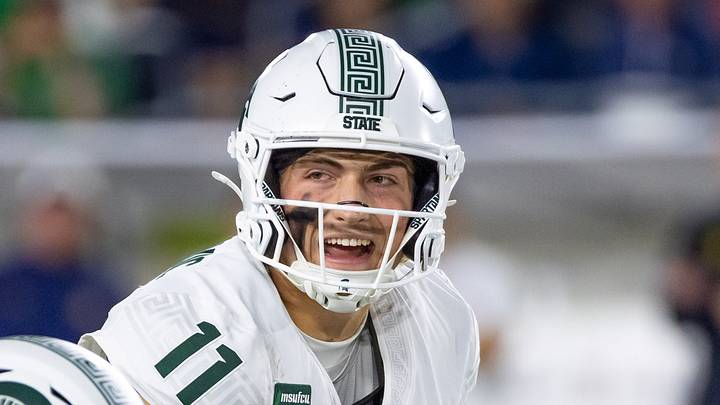
EAST LANSING -- Michigan State's offense ran 79 offensive plays on Saturday against Wisconsin. The longest play not aided by a Badger penalty went just 13 yards.
It's pretty clear right now that MSU's offense is bad -- scratch that -- really bad. The Spartans are averaging just 305.6 yards per game. That number isn't just last in the Big Ten, but it's last among all teams in the Power Four conferences. Michigan State has scored just two touchdowns and 26 total points in its three games against P4 competition.

A pretty clear reason for that has been MSU's inability to generate chunk plays. The Spartans have had 52 plays this season go for 10 yards or more, according to CFBStats.com, which is the fourth-fewest number among Power Four teams. Just 11 of those plays have gone for 20 yards or more; that's the fewest in the P4, period.

Michigan State's offense actually has a 44.2% success rate, which is a respectable 58th in the country, according to GameOnPaper.com. The problem is that a four-yard gain on first down is weighted the same as a big pass downfield, sort of like how a single impacts batting average the same way as a home run in baseball.
MSU's successful plays are almost entirely singles. They also strike out too much, having allowed the eighth-most tackles for loss in the Power Four. There are hardly any doubles or triples, let alone home runs. You need some extra-base knocks here and there to win, and the Spartans aren't getting close to enough right now.
Fitzgerald's Thoughts on Offensive Struggles

"You've got to be able to catch and run, and we've had a lot of catch and fall down," Pat Fitzgerald said Monday when asked about the lack of offensive explosiveness. "So we've got to help out the quarterback with that. We've got to help them schematically also."
"And then we've got to pick and choose our shots. There's more that we've tried to make, and it's also been some of our more catastrophic negatives, if that makes sense: either an interception or a sack. We've got to execute it, so that's on us as coaches to look at the fundamentaland the technique, which we are working on diligently."

One play Fitzgerald also cited was the lost fumble that starting quarterback Alessio Milivojevic had against Nebraska. Wide receiver Rodney Bullard Jr. was wide open on a crossing route, and a well-placed pass from Milivojevic would have created an explosive play. Milivojevic never threw the ball, though, and he lost the ball while being taken down. Fitzgerald thinks the opportunities have been there, and in some areas he's right.
"Just don't stop what we're doing; just stay the course," he also said. "Like I've said a couple of times, it's not fun, but there's no other way to do it. You've just got to stay the course."
Further Look at the Offense

Sometimes, though, it just comes down to players executing. The fumble against Nebraska is a bit of a microcosm of that. Offensive coordinator Nick Sheridan dialed up a pretty great play call, going play-action against a heavy box while the Cornhuskers were in man, and the throw just wasn't made.
On those dialed-up shots, three things have to go right: the offensive line needs to provide a good enough pocket, a receiver has to get open, and then Milivojevic has to make that throw. A frustrating number of Michigan State's attempted deep passes have had two of those things go right.

Sometimes, there have been open receivers downfield, but Milivojevic has had to worry about avoiding or taking the sack because the protection hasn't been good enough. Other times, as in the Bullard play above, Milivojevic has just missed it. Then there are times when the time is there, but nobody gets open. It's only truly connected twice: Charles Taplin's touchdown vs. EMU, and then Bullard's long catch at Notre Dame.
Sheridan has actually done a fine job this season, as far as play-calling goes. The percentage of plays in his playbook that he can truly call is just pretty limited by the personnel he has to work with. It's certainly not the same guys he got to utilize at Alabama two seasons ago.

This offense simply lacks a serious playmaker, especially with top running back Cam Edwards out for the year. None of Michigan State's remaining running backs feel like big home-run threats, and absolutely none of the Spartans' receivers feel like players opposing secondaries should fear over the top or when it's time to battle for a 50/50 ball.
MSU's wide receiver room feels like one that needs a big makeover this offseason. Losing a player like Nick Marsh this offseason was tough, but Michigan State didn't even come close to replacing him in any form.
 Add us as a preferred source on Google
A 2025 graduate from Michigan State University, Cotsonika brings a wealth of experience covering the Spartans from Rivals and On3 to his role as Michigan State Spartans Beat Writer on SI. At Michigan State, he was also a member of the world-renowned Spartan marching band for two seasons.
Follow jacobcotsonika