%22%3E%0A%3Cpath%20d%3D%22M0%200.683105H4.9762L10.6354%207.70833V0.683105H15.9043V16.5874H11.1843L5.28112%209.2451V16.5874H0.0121963V0.683105H0Z%22%20fill%3D%22white%22%2F%3E%0A%3Cpath%20d%3D%22M17.2964%2010.4526V10.4038C17.2964%206.69607%2019.9552%203.87866%2023.6752%203.87866C28.0781%203.87866%2030.1272%206.94%2030.1272%2010.7209C30.1272%2010.9893%2030.1272%2011.3064%2030.1028%2011.5869H22.1262C22.4921%2012.6724%2023.3581%2013.2456%2024.468%2013.2456C25.3949%2013.2456%2026.1755%2012.8188%2026.9927%2011.9772L29.7613%2014.1848C28.5294%2015.7703%2026.7853%2016.8924%2024.1021%2016.8924C20.0406%2016.8924%2017.2842%2014.3189%2017.2842%2010.4648L17.2964%2010.4526ZM25.4315%209.31833C25.3217%208.13527%2024.6143%207.45226%2023.6996%207.45226C22.7848%207.45226%2022.2238%208.18405%2022.0652%209.31833H25.4315Z%22%20fill%3D%22white%22%2F%3E%0A%3Cpath%20d%3D%22M36.5166%2015.1847V16.5873H31.3574V0H36.5166V5.708C37.3581%204.79325%2038.3095%203.89071%2040.1999%203.89071C43.2003%203.89071%2045.542%206.50078%2045.542%2010.2939V10.3427C45.542%2014.27%2043.1759%2016.8923%2040.2487%2016.8923C38.3583%2016.8923%2037.3215%2016.0751%2036.5166%2015.1847ZM40.5414%2010.4037V10.3549C40.5414%209.11084%2039.6511%208.13512%2038.468%208.13512C37.285%208.13512%2036.3946%209.11084%2036.3946%2010.3549V10.4037C36.3946%2011.6355%2037.285%2012.6357%2038.468%2012.6357C39.6511%2012.6357%2040.5414%2011.6599%2040.5414%2010.4037Z%22%20fill%3D%22white%22%2F%3E%0A%3Cpath%20d%3D%22M46.8086%204.1835H51.9677V6.68379C52.6751%205.00067%2053.8094%203.91517%2055.8585%204.00055V9.47681H55.3096C53.1264%209.47681%2051.9677%2010.6843%2051.9677%2013.4285V16.5874H46.8086V4.1835Z%22%20fill%3D%22white%22%2F%3E%0A%3Cpath%20d%3D%22M55.789%2013.0623V13.0135C55.789%2010.5376%2057.6307%209.14717%2060.5091%209.14717C61.558%209.14717%2062.8996%209.3789%2063.4363%209.59844V9.3911C63.4363%208.25682%2062.7289%207.5982%2061.1433%207.5982C59.8749%207.5982%2058.8016%207.86653%2057.7161%208.3056L56.8014%204.87837C58.2284%204.32952%2059.8749%203.96362%2062.0215%203.96362C64.5462%203.96362%2066.1805%204.48808%2067.266%205.57357C68.193%206.50051%2068.5589%207.70797%2068.5589%209.50087V16.5627H63.3997V15.3064C62.5337%2016.2334%2061.3751%2016.8554%2059.8261%2016.8554C57.4356%2016.8554%2055.7646%2015.4894%2055.7646%2013.0379L55.789%2013.0623ZM63.4973%2012.0012V11.4767C63.2046%2011.3669%2062.7533%2011.2694%2062.3142%2011.2694C61.2897%2011.2694%2060.7287%2011.8792%2060.7287%2012.6598V12.7086C60.7287%2013.4404%2061.2531%2013.916%2061.9117%2013.916C62.8265%2013.916%2063.4973%2013.1842%2063.4973%2012.0134V12.0012Z%22%20fill%3D%22white%22%2F%3E%0A%3Cpath%20d%3D%22M69.2422%2015.0876L70.9863%2012.1604C72.4865%2013.0873%2074.1696%2013.5508%2075.5722%2013.5508C76.0723%2013.5508%2076.3162%2013.441%2076.3162%2013.1483V13.0995C76.3162%2012.8556%2076.0844%2012.697%2074.8404%2012.3677C71.7059%2011.5993%2069.7788%2010.7578%2069.7788%208.18431V8.13552C69.7788%205.40349%2071.962%203.89111%2075.1819%203.89111C77.2309%203.89111%2079.2434%204.41556%2080.7435%205.31811L79.1092%208.39165C77.792%207.65985%2076.2064%207.23297%2075.1575%207.23297C74.6574%207.23297%2074.4257%207.36714%2074.4257%207.62326V7.67205C74.4257%207.91598%2074.694%208.07454%2075.9503%208.40384C79.0848%209.17223%2080.9753%2010.0382%2080.9753%2012.5873V12.6361C80.9753%2015.3437%2078.9506%2016.9049%2075.5844%2016.9049C73.1817%2016.9049%2070.9985%2016.295%2069.2178%2015.112L69.2422%2015.0876Z%22%20fill%3D%22white%22%2F%3E%0A%3Cpath%20d%3D%22M82.144%200H87.3032V8.00095L89.962%204.18343H95.5725L91.6818%209.23281L95.6334%2016.5995H90.1084L88.3155%2013.1967L87.291%2014.5139V16.5995H82.1318V0.0121969L82.144%200Z%22%20fill%3D%22white%22%2F%3E%0A%3Cpath%20d%3D%22M95.4873%2013.0623V13.0135C95.4873%2010.5376%2097.329%209.14717%20100.207%209.14717C101.256%209.14717%20102.598%209.3789%20103.135%209.59844V9.3911C103.135%208.25682%20102.427%207.5982%20100.842%207.5982C99.5731%207.5982%2098.4998%207.86653%2097.4143%208.3056L96.4996%204.87837C97.9266%204.32952%2099.5731%203.96362%20101.72%203.96362C104.244%203.96362%20105.879%204.48808%20106.964%205.57357C107.891%206.50051%20108.257%207.70797%20108.257%209.50087V16.5627H103.098V15.3064C102.232%2016.2334%20101.073%2016.8554%2099.5244%2016.8554C97.1338%2016.8554%2095.4629%2015.4894%2095.4629%2013.0379L95.4873%2013.0623ZM103.196%2012.0012V11.4767C102.903%2011.3669%20102.452%2011.2694%20102.012%2011.2694C100.988%2011.2694%20100.427%2011.8792%20100.427%2012.6598V12.7086C100.427%2013.4404%20100.951%2013.916%20101.61%2013.916C102.525%2013.916%20103.196%2013.1842%20103.196%2012.0134V12.0012Z%22%20fill%3D%22white%22%2F%3E%0A%3Cpath%20d%3D%22M0.0121992%2027.7428V27.6941C0.0121992%2022.9496%203.71996%2019.4004%208.46443%2019.4004C11.9648%2019.4004%2014.331%2021.1079%2015.6726%2023.535L11.2818%2026.1085C10.6964%2024.9742%209.85483%2024.1814%208.39124%2024.1814C6.59834%2024.1814%205.41528%2025.7548%205.41528%2027.6575V27.7063C5.41528%2029.7797%206.64713%2031.2311%208.39124%2031.2311C9.89142%2031.2311%2010.733%2030.4139%2011.3916%2029.2308L15.7702%2031.7067C14.4285%2034.0729%2012.2088%2035.9999%208.24489%2035.9999C3.84192%2035.9999%200%2032.6825%200%2027.755L0.0121992%2027.7428Z%22%20fill%3D%22white%22%2F%3E%0A%3Cpath%20d%3D%22M16.1475%2029.4871V29.4383C16.1475%2025.9379%2019.0503%2022.9375%2023.1483%2022.9375C27.2464%2022.9375%2030.1003%2025.8891%2030.1003%2029.3895V29.4383C30.1003%2032.9387%2027.1976%2035.939%2023.0995%2035.939C19.0015%2035.939%2016.1475%2032.9875%2016.1475%2029.4871ZM25.1363%2029.4871V29.4383C25.1363%2028.2064%2024.2216%2027.2307%2023.0873%2027.2307C21.953%2027.2307%2021.0871%2028.2064%2021.0871%2029.3895V29.4383C21.0871%2030.6701%2021.9896%2031.6459%2023.1361%2031.6459C24.2826%2031.6459%2025.1363%2030.6701%2025.1363%2029.4871Z%22%20fill%3D%22white%22%2F%3E%0A%3Cpath%20d%3D%22M31.3447%2023.2421H36.5039V25.7424C37.2113%2024.0593%2038.3456%2022.9738%2040.3946%2023.0591V28.5354H39.8457C37.6626%2028.5354%2036.5039%2029.7429%2036.5039%2032.4871V35.646H31.3447V23.2421Z%22%20fill%3D%22white%22%2F%3E%0A%3Cpath%20d%3D%22M41.3584%2023.2424H46.5175V24.9743C47.3103%2023.9498%2048.5666%2022.9497%2050.3107%2022.9497C52.9207%2022.9497%2054.5551%2024.6816%2054.5551%2027.4746V35.6585H49.3959V29.1334C49.3959%2028.0723%2048.7617%2027.4502%2047.9933%2027.4502C47.225%2027.4502%2046.5175%2028.0601%2046.5175%2029.1334V35.6585H41.3584V23.2546V23.2424Z%22%20fill%3D%22white%22%2F%3E%0A%3Cpath%20d%3D%22M56.1177%2019.0586H61.2768V24.9008C62.0696%2023.8762%2063.3258%2022.9493%2065.07%2022.9493C67.68%2022.9493%2069.3144%2024.6812%2069.3144%2027.4742V35.6581H64.1552V29.133C64.1552%2028.0719%2063.521%2027.4498%2062.7404%2027.4498C61.9598%2027.4498%2061.2646%2028.0597%2061.2646%2029.133V35.6581H56.1055V19.0708L56.1177%2019.0586Z%22%20fill%3D%22white%22%2F%3E%0A%3Cpath%20d%3D%22M70.7656%2031.4256V23.2417H75.9248V29.7669C75.9248%2030.8402%2076.559%2031.45%2077.3396%2031.45C78.1202%2031.45%2078.8154%2030.8402%2078.8154%2029.7669V23.2417H83.9745V35.6456H78.8154V33.9869C78.0226%2035.0114%2076.7663%2035.9383%2075.0222%2035.9383C72.4122%2035.9383%2070.7778%2034.2064%2070.7778%2031.4134L70.7656%2031.4256Z%22%20fill%3D%22white%22%2F%3E%0A%3Cpath%20d%3D%22M84.7178%2034.1462L86.4619%2031.219C87.9621%2032.1459%2089.6452%2032.6094%2091.0478%2032.6094C91.5478%2032.6094%2091.804%2032.4996%2091.804%2032.2069V32.1581C91.804%2031.9142%2091.5722%2031.7556%2090.3282%2031.4263C87.1937%2030.6579%2085.2666%2029.8164%2085.2666%2027.2429V27.1941C85.2666%2024.4621%2087.4498%2022.9497%2090.6697%2022.9497C92.7187%2022.9497%2094.7311%2023.4742%2096.2313%2024.3767L94.597%2027.4502C93.2798%2026.7184%2091.6942%2026.2916%2090.6453%2026.2916C90.1453%2026.2916%2089.9135%2026.4257%2089.9135%2026.6819V26.7306C89.9135%2026.9746%2090.1818%2027.1331%2091.4381%2027.4624C94.5726%2028.2308%2096.4631%2029.0968%2096.4631%2031.6459V31.6947C96.4631%2034.4023%2094.4384%2035.9635%2091.0844%2035.9635C88.6816%2035.9635%2086.4985%2035.3536%2084.7178%2034.1706V34.1462Z%22%20fill%3D%22white%22%2F%3E%0A%3Cpath%20d%3D%22M97.6225%2019.0586H102.782V27.0595L105.441%2023.242H111.051L107.16%2028.2914L111.112%2035.6581H105.587L103.794%2032.2553L102.769%2033.5725V35.6581H97.6104V19.0708L97.6225%2019.0586Z%22%20fill%3D%22white%22%2F%3E%0A%3Cpath%20d%3D%22M110.493%2029.5115V29.4627C110.493%2025.7549%20113.152%2022.9375%20116.871%2022.9375C121.274%2022.9375%20123.323%2025.9988%20123.323%2029.7798C123.323%2030.0481%20123.323%2030.3652%20123.299%2030.6457H115.323C115.688%2031.7312%20116.554%2032.3045%20117.664%2032.3045C118.591%2032.3045%20119.372%2031.8776%20120.189%2031.036L122.958%2033.2436C121.726%2034.8292%20119.982%2035.9512%20117.298%2035.9512C113.237%2035.9512%20110.48%2033.3778%20110.48%2029.5236L110.493%2029.5115ZM118.628%2028.3772C118.518%2027.1941%20117.811%2026.5111%20116.896%2026.5111C116.03%2026.5111%20115.42%2027.2429%20115.262%2028.3772H118.628Z%22%20fill%3D%22white%22%2F%3E%0A%3Cpath%20d%3D%22M124.553%2023.2421H129.712V25.7424C130.419%2024.0593%20131.554%2022.9738%20133.603%2023.0591V28.5354H133.054C130.871%2028.5354%20129.712%2029.7429%20129.712%2032.4871V35.646H124.553V23.2421Z%22%20fill%3D%22white%22%2F%3E%0A%3Cpath%20d%3D%22M133.689%2034.1462L135.434%2031.219C136.934%2032.1459%20138.617%2032.6094%20140.019%2032.6094C140.52%2032.6094%20140.776%2032.4996%20140.776%2032.2069V32.1581C140.776%2031.9142%20140.544%2031.7556%20139.3%2031.4263C136.165%2030.6579%20134.238%2029.8164%20134.238%2027.2429V27.1941C134.238%2024.4621%20136.421%2022.9497%20139.641%2022.9497C141.69%2022.9497%20143.703%2023.4742%20145.203%2024.3767L143.569%2027.4502C142.251%2026.7184%20140.666%2026.2916%20139.617%2026.2916C139.117%2026.2916%20138.885%2026.4257%20138.885%2026.6819V26.7306C138.885%2026.9746%20139.154%2027.1331%20140.41%2027.4624C143.544%2028.2308%20145.435%2029.0968%20145.435%2031.6459V31.6947C145.435%2034.4023%20143.41%2035.9635%20140.056%2035.9635C137.653%2035.9635%20135.47%2035.3536%20133.689%2034.1706V34.1462Z%22%20fill%3D%22white%22%2F%3E%0A%3Cpath%20fill-rule%3D%22evenodd%22%20clip-rule%3D%22evenodd%22%20d%3D%22M155.368%204.36764C161.191%20-1.45588%20170.632%20-1.45588%20176.456%204.36764C182.279%2010.1912%20182.279%2019.6324%20176.456%2025.4559L165.912%2036L155.368%2025.4559C149.544%2019.6324%20149.544%2010.1912%20155.368%204.36764ZM158.009%207.55761C157.948%207.86849%20157.916%208.39718%20157.916%209.14566V10.4189C157.916%2011.1832%20157.948%2011.7198%20158.013%2012.0267C158.078%2012.3317%20158.278%2012.6168%20158.617%2012.8762C158.956%2013.1376%20159.403%2013.3316%20159.958%2013.4623C160.512%2013.593%20161.1%2013.6584%20161.837%2013.6584C162.573%2013.6584%20163.217%2013.591%20163.769%2013.4524C164.322%2013.3158%20164.761%2013.1178%20165.086%2012.8604C165.411%2012.6029%20165.605%2012.3178%20165.666%2012.0069C165.728%2011.6961%20165.759%2011.1674%20165.759%2010.4189V9.14566C165.759%208.38134%20165.728%207.84473%20165.662%207.53781C165.597%207.23287%20165.397%206.94971%20165.058%206.68834C164.72%206.42696%20164.272%206.23291%20163.718%206.10223C163.163%205.97154%20162.536%205.90619%20161.839%205.90619C161.102%205.90619%20160.459%205.97352%20159.906%206.11213C159.352%206.24875%20158.914%206.44677%20158.589%206.70418C158.265%206.9616%20158.071%207.24673%20158.009%207.55761ZM163.276%2024.8638C166.876%2024.8638%20168.557%2024.2064%20168.557%2021.862V21.858V21.3155C168.557%2019.6581%20167.516%2018.971%20164.252%2018.3136C163.278%2018.1136%20162.908%2017.9136%20162.908%2017.3136V16.9414C162.908%2016.6543%20163.177%2016.5117%20163.413%2016.5117C163.749%2016.5117%20163.918%2016.7137%20163.918%2016.9414V18.1136H168.391V17.3988C168.391%2015.4563%20167.347%2014.4266%20163.177%2014.4266C160.15%2014.4266%20157.896%2015.3414%20157.896%2017.3711V17.7433C157.896%2019.5155%20158.805%2020.3155%20162.201%2021.0303C162.28%2021.0472%20162.355%2021.063%20162.427%2021.0781C163.329%2021.2674%20163.647%2021.3341%20163.647%2021.9174V22.2897C163.647%2022.6619%20163.546%2022.8045%20163.142%2022.8045C162.67%2022.8045%20162.637%2022.5471%20162.637%2022.262V21.2897H157.894V21.7471C157.894%2024.149%20159.476%2024.8638%20163.276%2024.8638ZM169.424%2024.5569H173.925V14.7355H169.424V24.5569ZM170.955%2013.5019H173.925V6.06064H171.092V9.411L169.193%206.06064H166.359V13.5019H169.193V10.1199L170.955%2013.5019ZM162.269%2012.152C162.204%2012.2688%20162.055%2012.3262%20161.825%2012.3262L161.827%2012.3282C161.604%2012.3282%20161.459%2012.2767%20161.398%2012.1758C161.336%2012.0748%20161.305%2011.8074%20161.305%2011.3758V7.90068C161.305%207.51852%20161.352%207.28684%20161.445%207.20962C161.538%207.13239%20161.675%207.09279%20161.851%207.09279C162.059%207.09279%20162.198%207.14031%20162.265%207.23734C162.332%207.33239%20162.366%207.55416%20162.366%207.90068V11.3203C162.366%2011.7579%20162.334%2012.0352%20162.269%2012.152Z%22%20fill%3D%22white%22%2F%3E%0A%3C%2Fg%3E%0A%3Cdefs%3E%0A%3CclipPath%20id%3D%22clip0_15191_23649%22%3E%0A%3Crect%20width%3D%22181%22%20height%3D%2236%22%20fill%3D%22white%22%2F%3E%0A%3C%2FclipPath%3E%0A%3C%2Fdefs%3E%0A%3C%2Fsvg%3E%0A)
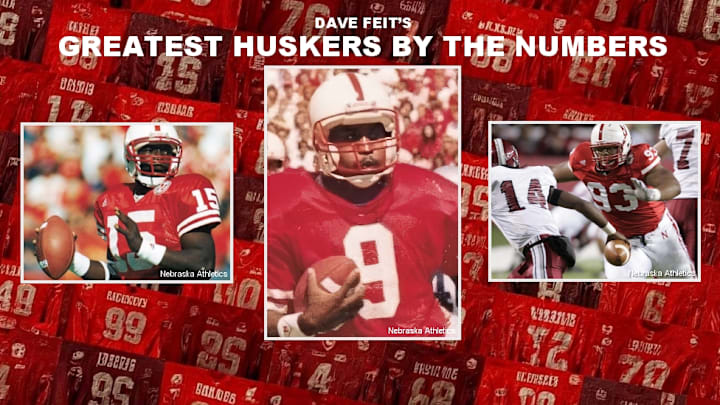
Dave Feit's Greatest Huskers by the Numbers: 9 - Steve Taylor
In this story:
Dave Feit is counting down the days until the start of the 2025 season by naming the best Husker to wear each uniform number, as well as one of his personal favorites at that number. For more information about the series, click here. To see more entries, click here.
Greatest Husker to wear 9: Steve Taylor, Quarterback, 1985-1988
Honorable Mention: Russell Gary
Also worn by: Ajay Allen, Jason Ankrah, Joe Broekemeier, Tyson Broekemeier, Sam Burtch, Monte Christo, Curtis Cotton, Fait Elkins, Earl Everett, David Horne, Sam Keller, Mark LeFlore, DaiShon Neal, Kanawai Noa, Ty Robinson, Wilson Thomas, Tony Veland, Bryan Wilson
Dave's Fave: Monte Christo, Quarterback, 1995-1998
We've talked about many of things that helped Nebraska football become a dominating force for over 40 years. So far, each of these edges and advantages were things that Nebraska actively controlled (recruiting, strength training, the walk-on program, offensive system, etc.)
Today, we will discuss something that was vital to Nebraska's success, even though the Huskers had no control over it.
Television
Before the start of the 1952 season, the NCAA - in an attempt to protect in-stadium attendance - limited TV exposure to one nationally televised game per week. Broadcast rights were controlled by the NCAA, not the individual schools or their conferences. Nebraska's first-ever nationally televised game was in 1953 (the Huskers lost to Oregon 20-12). By 1955, TV coverage was expanded to eight national games and regional broadcasts during five specific weeks of the season.
Until the early 1980s, teams were not allowed more than six national appearances every two years (excluding bowl games, which were outside of the NCAA's purview). The NCAA decided which games would be nationally or regionally broadcast.

Being on television was such a big deal that teams would regularly have a blurb in their preseason media guides touting their TV appearances over the previous decades. Nebraska's TV Log in 1982 was about to spill over to a second page.
In 1977, the College Football Association was formed. The CFA comprised 63 schools from the major conferences and independents - with the notable exceptions of the Big Ten and Pacific 8. In 1981, the CFA brokered a TV deal that would generate more money for member schools and increase exposure.
The NCAA believed it still owned the TV rights and threatened sanctions against any school that participated in the new CFA deal. The universities of Oklahoma and Georgia sued the NCAA, alleging restraint of trade and price fixing. In June of 1984, the U.S. Supreme Court ruled that the NCAA was in violation of the Sherman Antitrust Act. As a result, schools and conferences could sell their rights independent of the NCAA.
The fallout from the Supreme Court ruling was staggering, with ripples being felt to this day.

In 1983, there were 89 college football games on television. In 1984, the number was over 200. A fledgling cable channel, the "Entertainment and Sports Programming Network," was looking for content other than strongest-man competitions, and they found it. Prior to the SCOTUS ruling, they only aired tape delayed games and a few bowl games. On the first college football Saturday of 1984, ESPN aired two games.
The dominos started falling fast. Notre Dame signed an exclusive deal with NBC. In the early 1990s, the Southeastern Conference wanted to break away from the CFA and strike its own TV deal. To make itself more attractive, the SEC convinced South Carolina to give up its independent status, and poached Arkansas from the Southwest Conference. Penn State joined the Big Ten. With the SWC teetering, four of the conference's top schools joined forces with the Big Eight to form the Big 12.
The wheels of conference realignment haven't stopped spinning since. In 1984 there were 21 independent teams. In 2024, there were three. As conferences started to negotiate their own TV contracts, they realized that having more members would usually result in more money, especially if those additional members were 1) a nationally known brand, and/or 2) from a region with many TV viewers or cable subscribers. Eight conferences now have 12 or more members, and several longtime conferences are now gone or stripped bare.
Today, a college football Saturday usually has multiple games on multiple networks airing from before noon until well after midnight. In addition, there are often games on Tuesdays, Wednesdays, Thursdays, and Fridays.
Bowl games were once about attracting tourists to warmer destinations during the winter months, as well as creating attractive matchups between teams from different conferences. Most of those games were played on Jan. 1, a glorious daylong football binge. Today, there are more than 35 bowls that are played from mid-December into early January, often in front of half-empty stadiums. These games don't exist because we need to determine if the sixth-best team from the MAC is better than the fifth-best team from the Mountain West. That majority of bowls - especially the 17 owned by ESPN - exist because live content draws enough viewers to make them profitable.

Money from TV contracts has funded new facilities and spiraling salaries (and buyouts) for coaches and staffs. The increased riches in the sport have undoubtably played a role in student athletes demanding a slice of the pie via name, image and likeness deals and revenue sharing. The networks, which must pay out these ballooning contracts, have added more - and longer - TV timeouts, extending the time needed to play a 60-minute game.
The NCAA's monopoly on TV rights was bad, even if it was a good thing for Nebraska. Between 1962 and 1983, Nebraska appeared on network television 57 times - an average of 2.6 times per season. That doesn't sound like much now, but the Huskers got a lot of national exposure from it. Being on TV in those days obviously had its advantages. It's much easier to coax a kid from Texas, Michigan or Florida to come to Nebraska if Mom and Dad know they'll be able to watch him on TV a few times a year. Players liked knowing they would be on TV.
An estimated 55 million people watched the 1971 "Game of the Century" between Oklahoma and Nebraska. Yes, it was an epic 1-vs.-2 battle that was somehow better than the pregame hype. But it was also the only game on TV.
I.M. Hipp was one of the 55 million viewers. After the game, he couldn't stop thinking about Nebraska. After graduation from high school, he borrowed money from his girlfriend, drove up from South Carolina and walked on to the team. He became Nebraska's all-time leading rusher (until Mike Rozier arrived).
Steve Taylor - a national top 100 prospect from Fresno - became a fan of Husker quarterback Turner Gill after watching him on TV. Taylor saw Gill - a dual-threat black quarterback - being successful, and realized Nebraska would give him an opportunity to do the same.
Throughout the countdown, we’ve talked about players who were ahead of their time. Guys who could be lifted out of their era and land successfully in today’s game. Steve Taylor is one of those guys. I’d love to see what somebody with his skill set would look like in one of today’s spread offenses.

Taylor had great speed and elusive moves as a runner (over 2,000 career rush yards and a (then) single-game record 157 QB rush yards against Utah State in 1987). He also finished as the (then) fifth-leading passer in school history. He threw a school-record five TDs against No. 3 UCLA in 1987 and four more against Missouri a few games later. Remember, this was out of Tom Osborne's 1980s power option offense, which was not exactly a prolific passing scheme.
Taylor came off the bench - as a true freshman - in the 1986 Fiesta Bowl against Michigan. Although his fourth-quarter comeback attempt fell just short, that performance helped him earn the starting job in 1986. Every season, his production got better and better. Taylor earned All-America honors as a junior in 1987. In his senior season, Taylor improved in almost every statistical category and repeated as an All-Big Eight selection. Taylor also played at least 20 games on TV, easily making him the most televised Husker quarterback to that point.
Television exposure has been both good and bad for Nebraska and its fans.
It is the reason Nebraska is a member of the Big Ten Conference, why most Husker sports have excellent facilities, and why Husker fans around the globe have been able to watch each and every game since October 2007.*

*As of the start of the 2025 season, the last 220 Nebraska games have been televised in some capacity - network TV, national cable, regional broadcasts (over the air or cable), pay-per-view, streaming, or via tape delay. The last Nebraska game not to be televised was a home game against Iowa State in 2007. Not coincidentally, that is the one of the last Husker home games to kick off at 1:00 or 1:30 Central time - the regular kickoff time going back to (at least) the 1950s.
If and/or when the celebrated Memorial Stadium sellout streak ends, television - specifically the gigantic, ultra-high-definition sets that can be purchase for a few hundred dollars - will get a big chunk of the blame. Many of today's fans greatly prefer watching on TV to attending in person… just as the NCAA feared would happen back in the 1950s.
* * *
On Saturday, Sept. 17, 1994, fans entering Memorial Stadium for the home opener against UCLA could not believe their eyes.
The familiar Husker scoreboard - with First Federal Lincoln bank branding - was still perched about the north end zone. A fixture since 1977, it used light bulbs to form words and simple graphics. As a kid, I always loved the electronic squirrels that would say "NUTS!" after a big play was called back.
But on this day, fans were captivated by the two new two video replay boards - one in the northwest corner and one in the southeast. The screens were the first for any college team playing in a non-NFL stadium.
The in-stadium screens would be used for showing replays of the previous play, highlights, and yes, commercials during timeouts. The new system had a catchy name: Husker Vision.
For as long as anybody could remember, the band would finish its pregame show and march to form a tunnel for the team to run through onto the field. Late-arriving fans would attempt to clap along with "Hail Varsity" as they walked to their seats, knowing they had a couple of minutes until kickoff.
But Nebraska football changed on that September Saturday.

A few minutes before kickoff, the screens went black. A deep chord rumbled through the speakers. Two pulses of white light flashed on the screens as "Sirius" by the Alan Parsons Project started to play. At the time, that song was synonymous with the Michael Jordan-led Chicago Bulls. The screens then showed the doors of the Nebraska locker room opening. Head coach Tom Osborne led his team on the winding path from their south stadium locker room to the gate in the southwest corner where they entered the field.
That was it. To my knowledge, the only online video of it is from right after the players took the field. KFAB's Gary Sadlemyer gushes about how special it was.
No cinematic videos. No animated Sower raising the roof, helmets exploding, or players jumping out of an airplane. Just the team walking through a few dozen fans who lined the path.
But from those humble beginnings one of Nebraska's most beloved traditions arose: The Tunnel Walk.
In 1995, computer animations - cutting edge for the time* - were added to the Tunnel Walk. I'll never forget the roar of approval from the crowd the first time the Sears Trophy burst through Memorial Stadium's virtual turf.
*One of my college classmates, Maury McCoy, created a lot of the original Husker Vision graphics and Tunnel Walk videos while still in school. For those who attended Nebraska games in the mid to late 1990s, his old demo reel on YouTube is an avalanche of memories. Like many graphics creators, he hid some Easter eggs in his work. He told me that his name appears on the scoreboard in 1996 Tunnel Walk, and that he made the score 18-0 in memory of Brook Berringer.
Over the years, the Tunnel Walk intros would get bigger and more creative. Sears Trophies flying over the stadium like rockets. The west stadium expansion rising from the ground. The Sower atop the state capitol striking a Heisman pose and rifling a pass into the opposing team's helmet. Combines spelling out "THIS IS NEBRASKA" in a field of corn. A secret lair under the stadium with all of the trophies. Not so subtly drilling "Husker Nation" into our brains through repeated repetition. Bill Callahan's "Blueprint for Championships." Keith Jackson correctly stating that "This is college football." And on and on.
But Husker Vision was more than just a pregame hype video. Every snap was replayed, giving fans the ability to marvel over a big run, see a key block unfold, or watch the linebackers pursue the backs. Rule changes that allow a previous play under video review to be replayed multiple times have been a godsend.
Over the years, Husker Vision has had many fun recurring segments and features.
- "Football Physics," where a UNL professor of physics (Dr. Tim Gay) explained the physics principles behind football plays.
- "Hits of the Game," a fourth-quarter compilation of - you guessed it - the biggest hits of the game. This was in the days before targeting penalties and CTE were in a football fan's vocabulary.
- Bottles of Pepsi products racing around the state, with each side of the stadium being represented by a different bottle of pop.
- A "shell game" style game (with graphics based on the corporate sponsor). My buddy Tony and I would wager on if the Husker logo would be under the left, middle, or right pizza.
- Individual player graphics. When backup quarterback Matt Turman would make a play, they would show an image of Turman as Arnold Schwarzenegger's character from the "Terminator" films.
One of my favorite player graphics was for backup quarterback Monte Christo. As you might expect, it had him as the title character from the literary classic "The Count of Monte Christo" by Alexandre Dumas.
That made sense, because, as you might expect, Nebraska's Monte Christo was named after the classic novel. His grandmother talked his parents into it. As Christo later told Husker247, he found a lot of parallels between the book and his Nebraska career:

"It is a very complex book with a lot of different characters and storylines," Christo said. "Looking back on my career at Nebraska there's certainly some similarities, because it involves a guy who faced a lot of adversities and with things stacked against him, was able to overcome some tough times and in the end everything worked out well for him.
"That was kind of the way it was for me in terms of the injury bug. Every time I got a chance to move up the depth chart and make an advancement I would always get hurt, but I just kept plugging away and things worked out okay."
In 1998, Scott Frost graduated, and the quarterback job was wide open. The battle between Eric Crouch and Bobby Newcombe got the headlines, but Christo was in the mix too. When Crouch was hurt at Cal, Christo played the entire second half, helping to put the Bears away.
Later, against No. 18 Missouri, Christo came off the bench for an injured Newcombe and rallied the Huskers to a 20-13 victory. Christo rushed for two second-half touchdowns. That performance was good enough to earn Christo his first career start - against a Texas team led by Major Applewhite and Ricky Williams. Christo struggled and was pulled for Crouch. Nebraska's 47-game home winning streak - which dated back to 1991 - was snapped. It was the first loss of the Husker Vision era.
Since its beginning in 1994, Husker Vision has continually grown and expanded. In 2006, a massive screen - nearly 118 feet by 34 feet - was placed on top of the new Tom and Nancy Osborne Athletic Complex in the north stadium. In 2009, screens are added to the southwest and northeast corners, along with electronic ribbon boards. Husker Vision regularly upgrades to larger screens with better resolution, and they continue to get better at making the in-stadium experience enjoyable for fans.
Husker Vision now operates video screens in six different venues for over a dozen different sports. Their technical advances are impressive… even if a part of me would love to see the old "Count of Monte Christo" animation again.
More from Nebraska on SI
Stay up to date on all things Huskers by bookmarking Nebraska Cornhuskers On SI, subscribing to HuskerMax on YouTube, and visiting HuskerMax.com daily.
 Add us as a preferred source on Google
Dave Feit began writing for HuskerMax in 2011. Follow him on Twitter (@feitcanwrite) or Facebook (www.facebook.com/FeitCanWrite)