
Matt Rhule Knows What He Wants Nebraska's Offense to Be. Why Hasn't He Found It?
In this story:
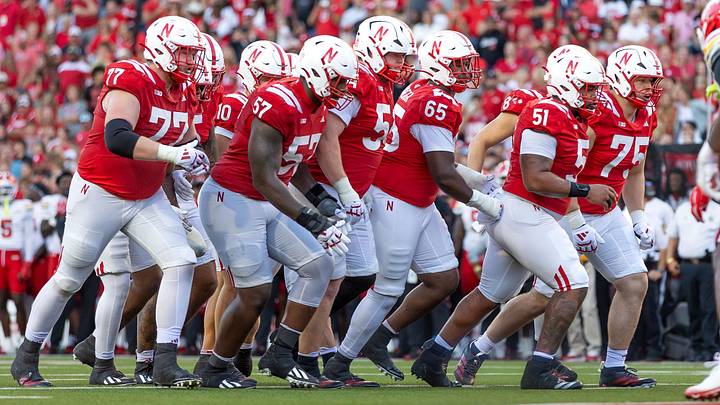
Nebraska became bowl eligible Saturday with a 31-0 drubbing of Rutgers, its first conference shutout in 23 years. The last time the Cornhuskers achieved that was Oct. 25, 2003, when Bo Pelini’s Blackshirts blanked Iowa State 28-0.
The offense looked better, too, after a four-game losing streak that derailed what had once looked like a promising season.
But let’s be honest. Nebraska proved it can still beat inferior opponents. Rutgers entered the game ranked 125th nationally in scoring defense and 121st in both total and rushing defense. The Scarlet Knights were the ultimate get-right opponent. That team would struggle to compete in the Mountain West.
That doesn’t change the biggest question facing head coach Matt Rhule.
Why has it been so difficult for him to build the offense he’s spent nearly four years telling us he wants?
Explaining vs. Executing
Go back to Nov. 28, 2022, when Rhule was introduced as Nebraska’s head coach. He described a physical, balanced team that could control the line of scrimmage, run the football and win games in the elements. “We are not going to be like new spread teams,” he said. “We will be balanced.”
Fast-forward to Nov. 9, 2026. Two days after firing Dana Holgorsen, Rhule again described an offense that can run the ball, control the line of scrimmage, avoid costly mistakes and produce explosive plays. He wanted a unit that’s disciplined, detailed and dependable in critical situations.
Sound familiar?
The frustrating part isn’t that Rhule doesn’t understand what kind of offense he wants. He’s been remarkably consistent in explaining it. The frustration comes from watching him hire two coordinators with different backgrounds, spend four seasons trying to establish that identity and repeatedly find himself explaining why Nebraska still isn’t executing it.
His first choice was Marcus Satterfield, a longtime assistant of his from Temple and Baylor whose South Carolina offenses hardly screamed physical, imposing running game. In two years in Columbia, Satterfield’s offenses were pitiful. In 2021, the Gamecocks finished 111th nationally in total offense, 104th in scoring, 95th in passing and 93rd in rushing. They were also 103rd in third-down conversions and 116th in turnovers lost.

In 2022, led by future NFL quarterback Spencer Rattler, South Carolina improved to 39th nationally in scoring and 72nd in total offense. But the running game actually got worse. The Gamecocks fell to 106th in rushing, averaging just 118.8 yards per game. They also ranked 126th in turnovers lost. If you dig a little deeper, you see their scoring average actually benefited from five special teams touchdowns and two defensive touchdowns.
In Satterfield's first season at Nebraska, the Huskers finished 121st nationally in scoring, averaging 18 points per game.
By November 2024, Rhule had seen enough and turned the offense over to Dana Holgorsen. I’ll admit I was initially optimistic.
An Odd Fit in Holgorsen
I expected Holgorsen to embrace the run-game and RPO elements fellow Air Raid disciple and former protégé Lincoln Riley had incorporated. The pair had spent 2003-07 together at Texas Tech and shared similar divorces from the strict pass-first mentality of former boss Mike Leach as each branched out further on their own. I even wrote about that anticipation in July 2025.
But there’s a difference between hiring a proven offensive mind and hiring one whose system fits the specific identity you’ve been describing.
Holgorsen built his reputation on explosive passing attacks. Yes, he had some highly productive rushing teams at West Virginia, but his more recent Houston offenses weren’t exactly known for overpowering defenses on the ground. It was a little like opening a steakhouse and hiring a vegan chef.
Rhule apparently saw it differently.
During his Nov. 11, 2024, press conference, he praised Holgorsen’s use of inside zone, counter and power. Rhule had coached against his West Virginia teams and believed those concepts demonstrated their philosophical compatibility.
Maybe Rhule and I watched different tape. What Nebraska put on the field wasn’t the physical, versatile rushing attack he’d been selling.
Keeping the Playbook
Holgorsen initially worked with Satterfield’s playbook because he arrived in the middle of the season. That made sense. But after an entire offseason to install his own system, he elected to retain most of the existing terminology, formations and plays. In March 2025, he called what he’d inherited “a good scheme.”
Think about that for a moment.
Nebraska had demoted Satterfield because the offense wasn’t working. Then it hired an accomplished coordinator with decades of experience running his own systems, only to preserve much of the framework that had failed under his predecessor.
Rhule was part of that decision. During an August 2025 interview with Nebraska Public Media, Holgorsen explained that Rhule had specifically asked whether he wanted to overhaul the offense. If he did, Rhule wanted those changes made early enough for everyone to learn the new system. But Holgorsen believed a complete overhaul would be unfair to Dylan Raiola, the returning players and the assistants who’d spent multiple seasons learning the existing terminology.

So he elected to preserve much of that foundation while incorporating his own concepts.
There were improvements. Nebraska averaged 28.7 points in 2025, and Emmett Johnson rushed for 1,451 yards. But the Huskers still ranked 80th nationally in rushing, with Johnson accounting for an extraordinary 40.7% of the team’s offensive yardage during the regular season. That’s a tremendous individual achievement, but there was still no evidence of a consistently physical rushing identity.


And remember those running concepts Rhule specifically praised when hiring Holgorsen?
According to football analyst Jordan Fox’s charting of Nebraska’s 2025 offense, Duo and inside zone formed the foundation of the running game. Counter accounted for just 10.5% of plays featuring a running element, while power represented only 4.3% and outside zone 6.5%.
Those were precisely the concepts Rhule had pointed to as evidence Holgorsen could deliver his preferred offensive philosophy. Yet they played relatively minor roles in the offense.
New Assistants for the O-Line
So Rhule went looking for more answers.
He replaced offensive line coach Donovan Raiola with Geep Wade and hired Lonnie Teasley as run game coordinator. Wade came from Georgia Tech, where he’d worked with Buster Faulkner in an offense built around a far more varied, movement-oriented rushing attack.
Here’s the irony. Counter and power were among the very concepts Rhule had praised when defending Holgorsen’s fit in 2024. Yet after the 2025 season, Nebraska was bringing in additional coaches to help develop them. And in July 2026, Rhule was still talking about the need to execute counter, outside zone and quarterback runs more consistently.
Wasn’t that part of what he believed Holgorsen could give him in the first place?
It’s not as though the new assistants controlled the offense's direction. Rhule specifically said Holgorsen would remain the decision-maker on installations and play calls.
Then came this season’s 5-0 start, followed by four straight losses and just 54 points. On Nov. 2, Rhule called Holgorsen one of the best offensive minds of their generation. Five days later, he fired him.
At his next press conference, while explaining the need for greater discipline and attention to detail, Rhule insisted, “I don’t think the offense is broken.”
That’s a pretty interesting statement considering the circumstances.
It’s Year 4. Why are we still talking about a lack of discipline and attention to detail on offense?
Different Faces, Same Issues
Nebraska has demoted one coordinator, fired another, replaced its offensive line coach and added a run game coordinator. Rhule is now on his third play-caller. The guy wearing the headset is different, but we keep seeing many of the same issues: lack of identity, lack of discipline and lack of focus.
Continuity matters. Familiar terminology has value, but this isn’t college football from ten years ago.
Consider the roster turnover across the sport. In 2026, FBS programs added an average of approximately 44 players through high school recruiting and the transfer portal. The Big Ten average was virtually identical. That’s the equivalent of roughly 42% of a 105-man roster being replenished in a single offseason.

And we’re not talking about 44 inexperienced freshmen who need two or three years to develop. Many of those newcomers are transfers who’ve already spent years in college programs, learned multiple playbooks and competed against experienced college players. They’re accustomed to adjusting to new coaches, new teammates and different schemes.
There’s a difference between preserving continuity and stubbornly holding on to an offensive approach that hasn’t consistently delivered the results you’re looking for.
I hear from Husker fans who tell me that listening to Rhule on Mondays makes them optimistic, but watching Nebraska on Saturdays leaves them frustrated. As you’d expect, some use more colorful language.
This Thing Needs a Total Overhaul
Glenn Thomas deserves credit for ending the losing streak, but beating Rutgers doesn’t change the fact that he remains a gargantuan long shot to keep the coordinator job. The next hire needs to be more than a different voice calling the same plays. This system, playbook and verbiage need to be nuked and replaced by one with a proven track record.
For better or worse, athletic director Troy Dannen and Matt Rhule’s fates are inextricably linked. Which means Rhule will be given substantial financial means to get the right person. If he’s truly this clear about the type of offense he wants, find a proven coordinator who’s already running it successfully and make him a rich man to come to Lincoln.
That doesn’t guarantee success, of course. Finding a philosophical fit and implementing a productive offense in the Big Ten are two different challenges. But after Satterfield and Holgorsen, Rhule has to do a much better job of evaluating both. Don’t hire another unqualified known commodity like Satterfield, and don’t try and force a square peg into a round hole like you did with Holgorsen.
Husker fans should be excited about the opportunity to reimagine this offense. They also have every reason to be nervous about whether Rhule will finally get this decision right.
He’s spent nearly four years explaining what Nebraska’s offense is supposed to look like. He doesn’t need another four years to explain it.
He needs to hire someone who can deliver it.
Stay up to date on all things Huskers by bookmarking Nebraska Cornhuskers On SI, following us on Twitter/X, and visiting HuskerMax.com daily.
 Add us as a preferred source on Google

Jeremy Pernell has evaluated prospects for the NFL Draft since 1996. In January of 2002, along with Kyle Knutzen, he co-founded the website N2FL.com. The pair ran the site until June of 2014, when they decided to dissolve it to focus on other professional opportunities. A section of the website was dedicated to fantasy football strategies and projections, which was handled by Knutzen. With Jeremy expanding his scope to include college recruiting, the majority of the site focused on talent evaluation. It consisted of scouting reports, prospect interviews and player rankings. It was one of the earliest independent sites of its kind, and Jeremy gained recognition for his ability to identify and project talent. His content has been featured on numerous websites as well as newspapers. With the reputation and popularity of N2FL.com, Jeremy fostered professional relationships with coaches on all levels. In February of 2013, Jeremy officially joined HuskerMax.com as a columnist. He contributes recruiting updates, game reviews and opinion pieces about the Nebraska football program. You can contact him at jgpernell@comcast.net.